This guide explains how to lift extra long pallet loads safely by tuning fork setup, choosing the right attachments, and staying inside the truck’s stability limits. You will see how pallet length, fork insertion, and equipment choice directly affect tip-over risk, damage, and throughput. We focus on simple calculations, practical rules like the 80% fork insertion guideline, and layout choices that make long-pallet handling repeatable and safe for operators and pedestrians.
Fundamentals Of Load Center And Fork Insertion
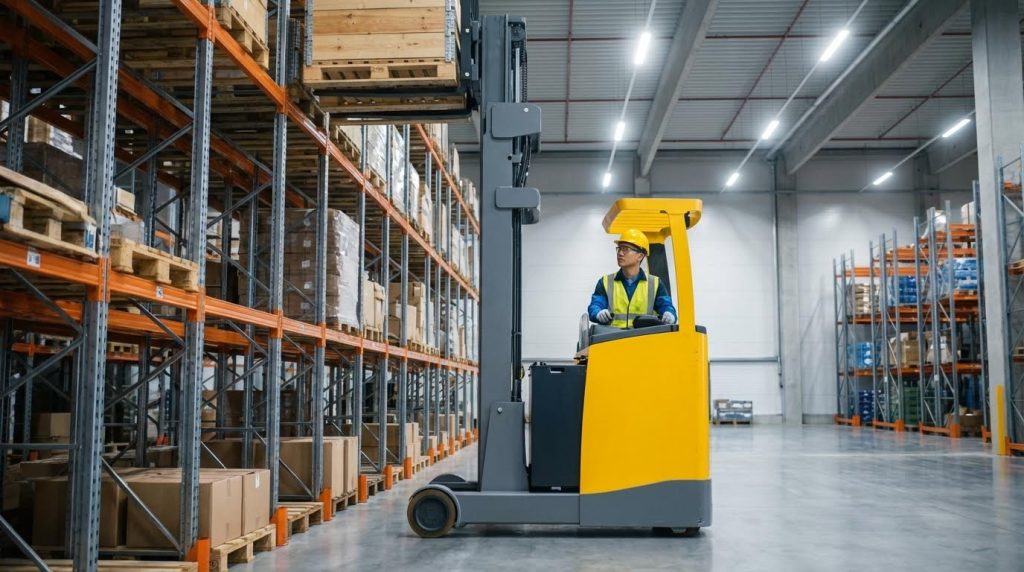
This section explains how pallet length, fork depth, and insertion percentage change the effective load center and stability, which is the core of how to lift extra long pallet loads without derating the truck into an unsafe zone.
How pallet length and fork depth shift load center
The effective load center moves forward as pallet length increases and fork insertion decreases, which rapidly reduces safe lifting capacity and increases tip-over risk for extra-long pallets.
On a forklift, the load center is the horizontal distance from the fork face to the load’s center of gravity. Standard trucks are often rated at a 600 mm (24 in) load center, meaning the center of gravity must stay within that distance from the fork face to maintain the rated capacity. If the effective load center increases to 900 mm (36 in) or 1,200 mm (48 in), the truck’s safe capacity drops sharply and the risk of forward tip-over rises. This relationship is a core stability principle.
For extra-long pallets, forks rarely reach full pallet depth, so engineers must treat pallet length as L and fork insertion as D. For a uniformly distributed load, the nominal pallet center lies at L/2 from the pallet end. If forks enter D from the near end, the distance from the fork face to the load center becomes (L/2 − D), plus any offset from overhang or asymmetry. This formula lets you quantify how far the center of gravity moves forward when you change pallet length or fork depth.
| Parameter | Symbol | Typical Example | Effect On Load Center | Operational Impact |
|---|---|---|---|---|
| Pallet length | L | 2,400 mm long pallet | Nominal center at L/2 = 1,200 mm from pallet end | Longer pallets push center further from fork face if forks are short. |
| Fork insertion depth | D | 1,200 mm fork insertion | Distance from fork face to load center ≈ (L/2 − D) | Shallow insertion increases effective load center and derates capacity. |
| Rated load center of truck | LCrated | 600 mm rating | Truck is designed for CG at ≤600 mm from fork face | Using an effective load center above this requires reducing load mass. |
| Effective load center | LCEFF | 900–1,200 mm for long pallets | Often >LCrated on standard trucks | High tip-over risk unless you downrate or change equipment. |
When working out how to lift extra long pallet loads, you must recalculate the effective load center every time you change pallet length, overhang, or fork length, then compare it to the capacity plate and manufacturer load chart. If the effective load center exceeds the truck’s rated value, the operator must reduce the load mass, extend fork engagement, or choose equipment designed for long loads. This is a mandatory engineering check, not an optional guideline.
- Recalculate LCEFF: Use geometry (L/2 − D plus overhang) – Prevents invisible overload at extended centers.
- Compare to capacity plate: Check against rated load center – Ensures compliance with the truck’s designed stability triangle.
- Control pallet overhang: Keep product as close to the fork face as possible – Minimizes forward CG shift.
- Standardize pallet families: Limit length variants where possible – Reduces calculation errors and training complexity.
How to estimate effective load center on site
Measure pallet length L (mm). Measure fork insertion D (mm) from pallet entry edge to fork face. For a roughly even load, estimate effective load center from fork face as (L/2 − D). If this value is above the rated load center on the data plate, treat the load as derated and either reduce mass or change equipment.
💡 Field Engineer’s Note: In practice, operators often “feel” the truck getting light at the rear but underestimate how quickly capacity falls once the load center moves past the rating. For extra-long pallets, insist on a simple laminated chart at the truck showing allowable load mass versus effective load center to prevent guesswork in busy shifts.
Applying the 80% fork insertion rule to long pallets
The 80% fork insertion rule requires forks to enter at least 80% of pallet depth, which is critical for extra-long pallets to control bending on fork tips and keep the load center within a safe range.
Industry guidance is clear: insert forks to full depth whenever possible, or at least 80% of pallet depth. For example, on a 1,165 mm deep pallet, that means around 900–1,165 mm of fork engagement. This rule exists because insufficient insertion shifts the load center forward and forces fork tips to carry a disproportionate bending moment. On extra-long pallets, ignoring this rule is one of the fastest ways to crack decks and overload forks.
Shallow fork insertion concentrates contact pressure at the leading boards, raising the risk of top deck penetration or splitting. Typical failure modes include fork tips punching through top boards, lower deck boards splitting, and stringers or blocks crushing under eccentric loading. These failures often occur suddenly when traveling or braking, turning a stable-looking load into a dropped or shifted one.
| Pallet Depth (mm) | 80% Minimum Insertion (mm) | Insertion Below 80% | Main Risk Created | Best For / Action |
|---|---|---|---|---|
| 1,200 | ≥960 | 600–800 mm | Forward CG shift, fork tip overload | Use longer forks or fork extensions, or reduce load mass. |
| 2,400 (extra-long) | ≥1,920 | 1,200–1,600 mm | Severe deck bending and high tip-over risk | Specify long forks or dedicated long-load truck; avoid lifting at full mass. |
| 3,000 (very long) | ≥2,400 | ≤1,800 mm | Forks behave like levers under the pallet | Consider multi-directional or side-carry equipment instead of standard forklifts. |
- Define minimum insertion by pallet family: Document required fork depth for each pallet type – Makes “80% rule” enforceable in daily operations.
- Limit overhang beyond fork tips: Target zero overhang for extra-long or high-value loads – Reduces tipping and deck punch-through.
- Train operators to check fork tips: Require a quick visual confirmation before lift – Prevents partial engagement when pallets are skewed or blocked.
- Use extensions only with updated ratings: Recalculate and mark new capacity when adding fork extensions – Prevents hidden overload from longer effective load centers.
Practical checklist before lifting an extra-long pallet
1) Confirm fork length and planned insertion meet or exceed 80% of pallet depth. 2) Check that there is no product or pallet overhang beyond fork tips, especially on heavy ends. 3) Verify that the effective load center (based on insertion depth) does not exceed the truck’s rated load center on the data plate. 4) If any condition fails, either reduce load mass, change approach (e.g., lift from the long side with suitable equipment), or use a truck designed for long loads.
💡 Field Engineer’s Note: In cold stores and rough yards, pallets often sit skewed or racked, so operators “catch” only 50–60% of the depth without noticing. Mandate a rule that if you cannot reach 80% insertion due to obstructions or layout, you do not lift at full mass; you either reposition the pallet or call for equipment with longer forks or a side-carry configuration.
Fork Positioning, Attachments, And Stability Limits
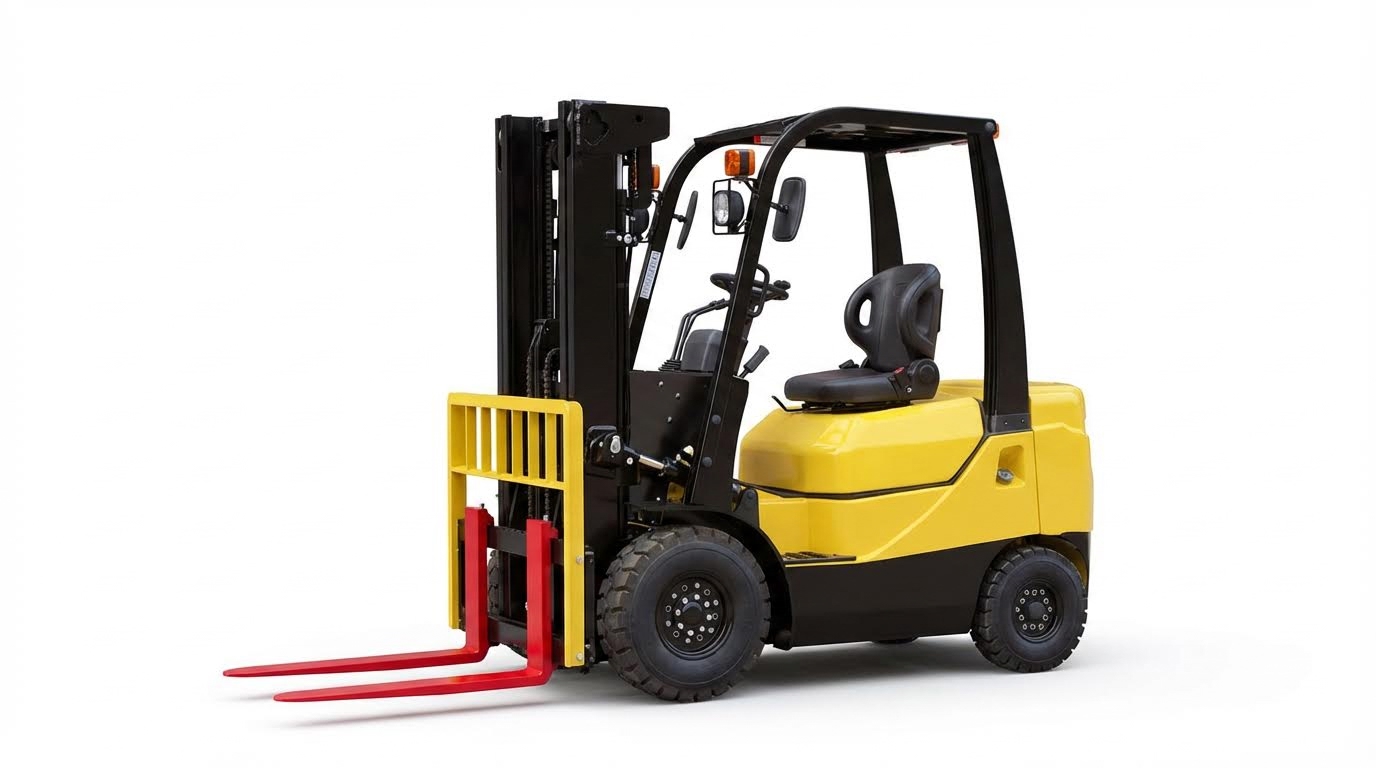
This section explains how to lift extra long pallet loads safely by setting fork spread correctly, choosing the right attachments, and respecting the forklift’s de‑rated capacity and stability triangle.
💡 Field Engineer’s Note: With extra-long pallets, operators often “make it work” by creeping under the near edge with short forks. That habit quietly moves the load center forward 100–300 mm, which is exactly how you turn a stable 2,500 kg truck into a surprise 1,500 kg truck without changing the nameplate. Always treat fork setup and attachments as a capacity change, not just a convenience feature.
Setting fork spread for two-way and four-way pallets
Correct fork spread for two-way and four-way pallets keeps the load’s center of gravity between the forks and directly over structural members, which is critical when deciding how to lift extra long pallet loads safely.
Two-way pallets only accept forks from two opposite sides, so alignment and spread must match the entry openings and stringers. Four-way pallets are more flexible but still require forks to sit under blocks or stringers, not just under deck boards. Misplaced forks on an extra-long pallet amplify deck bending and twist, which can crack boards or drop product.
- Align for entry type: Two-way pallets – approach square to the entry face and align forks with the fork openings – prevents riding up on stringers and impact damage.
- Match structural lines: Four-way pallets – position forks directly under stringers or blocks – reduces deck deflection and torsion on long pallets according to OSHA guidance.
- Maximise safe spread: Widen fork spread as much as the pallet design allows – creates a larger support base for long, heavy loads as recommended in long-load handling practice.
- Center the weight: Keep the pallet’s estimated center of gravity midway between forks – avoids one fork carrying most of the bending moment on extra-long pallets.
- Use marked positions: Mark standard fork positions on the carriage for each pallet family – reduces setup time and alignment errors in repetitive operations per OSHA alignment guidance.
How fork spread affects stability on long pallets
On an extra-long pallet, narrow fork spread concentrates load into a narrow strip, which increases deck bending and can twist the pallet if the product is not perfectly centered. Widening the forks under structural members increases the effective support polygon, which helps keep the combined center of gravity inside the truck’s stability triangle when you tilt back or travel over uneven floors.
Using fork extensions, telescopic forks, and positioners
Fork extensions, telescopic forks, and hydraulic fork positioners let you reach deeper into extra-long pallets and adjust fork spacing, but they all shift the load center and reduce the truck’s rated capacity.
When you decide how to lift extra long pallet loads, the first question is whether your existing fork length and adjustment range can achieve at least 80% insertion without exceeding the rated load center. If not, you consider attachments, but every millimeter of extra reach is a lever that reduces capacity and narrows your stability margin.
| Attachment Type | Typical Length / Function | Key Engineering Effect | Best For… |
|---|---|---|---|
| Fork extensions | Approx. 1,200–1,500 mm (48–60 in) slide over base forks and lock with a pin as described in long-reach attachment catalogs | Increase effective fork length but push load center forward and de-rate capacity; require minimum base fork length (e.g., ≥1,625 mm for 2,000 mm extensions by the same proportion logic as 64 in base for 96 in extension) per long-load safety guidance | Occasional handling of pallets that exceed standard fork length where 80% insertion is otherwise impossible. |
| Telescopic (extendable) forks | Telescoping from about 800 mm to ≥1,200 mm reach or more, with some heavy-duty designs reaching much longer extensions for 5‑ton trucks | Allow variable insertion depth to meet the 80% rule on different pallet lengths, but each extended position has a higher load center and lower capacity. | Frequent handling of mixed pallet depths, double-deep storage, or loading from one side of a trailer or conveyor interface. |
| Hydraulic fork positioners | Hydraulic carriage that adjusts fork spread from the cab and in OSHA load-handling guidance | Optimize fork spacing under stringers or blocks without manual effort; add attachment weight, which reduces net lifting capacity. | High-throughput sites with varying pallet widths where frequent manual fork adjustment would slow operations or invite shortcuts. |
- Respect the 80% rule: Use extensions or telescopic forks to achieve at least 80% of pallet depth in fork insertion – keeps the effective load center closer to the truck rating and reduces tip-over risk per OSHA’s insertion recommendations.
- Check base fork length: Only fit fork extensions when the base forks are long enough to support them – short base forks under long sleeves behave like a hinge and can bend or snap under long pallets as highlighted in long-load examples.
- Control attachment weight: Remember that heavy steel attachments and positioners consume part of the truck’s rated capacity – the more steel on the carriage, the less pallet mass you can safely lift per attachment selection guidance.
- Standardize overhang limits: Define maximum allowed pallet overhang beyond fork tips (ideally zero for extra-long pallets) – prevents tip loading of fork heels and deck punching on long loads as OSHA notes for insertion depth.
Material and maintenance considerations for long-reach attachments
Most long-reach forks and extensions use high-strength steel with reinforced heels and heavy welds to resist bending and warping under long pallets. Many include wear-resistant or anti-rust coatings to survive outdoor or humid environments. Hydraulic components on positioners and telescopic forks require regular checks for leaks and hose damage, as failure under a long, elevated pallet can cause sudden loss of support and dynamic instability.
Re-rating truck capacity and checking stability triangle
Re-rating the forklift’s capacity and checking the stability triangle is mandatory whenever longer forks or extra attachments change the load center, especially when planning how to lift extra long pallet loads safely and repeatedly.
The load center is the horizontal distance from the fork face to the load’s center of gravity; as that distance increases beyond the nameplate rating, the safe lifting capacity drops sharply. Extra-long pallets, partial fork insertion, and long-reach attachments all move the center of gravity forward, which pushes the combined truck‑plus‑load center of gravity toward or beyond the front edge of the stability triangle.
| Factor | Effect on Load Center / Capacity | Operational Impact for Long Pallets |
|---|---|---|
| Longer pallet or less insertion | Effective load center increases beyond the rated value (e.g., from 600 mm to 900–1,200 mm equivalent) when forks do not reach near the pallet center as OSHA explains | Requires reducing pallet mass, increasing fork insertion, or choosing a truck rated for the higher load center before lifting long pallets. |
| Attachment weight (extensions, positioners, telescopic forks) | Reduces the net capacity at a given load center because part of the rating is consumed by attachment mass per attachment selection guidelines | Truck that could lift 2,500 kg at 600 mm may only be safe for a significantly lower pallet mass once a heavy long-reach attachment is installed. |
| Increased load center (e.g., 600 → 900–1,200 mm) | Safe capacity drops steeply as the center of gravity moves away from the mast; OSHA notes large reductions at 900 mm and dramatic losses by 1,200 mm equivalent load centers in its load-handling examples | Even if the pallet mass is unchanged, the same load may now exceed the de-rated capacity and risk forward tip-over when raised or tilted. |
- Understand the stability triangle: The truck’s center of gravity and the load’s center of gravity must stay within the triangle formed by the drive axle and steer wheels – extra-long pallets move this combined point toward the front edge per OSHA’s stability model.
- Recalculate effective load center: Treat pallet length as L and fork insertion as D; for a uniform load, the center is at L/2, so the distance from fork face is (L/2 − D) plus any overhang – this gives the new load center to compare to the data plate as OSHA’s engineering guidance describes.
- Update the capacity plate: When you add long-reach attachments or change forks, have the truck re-rated and fit an updated data plate – operators must see the correct capacity at the new load center as long-load safety examples stress.
- Control mast tilt and lift height: With extra-long pallets at high load centers, limit forward tilt and avoid lifting higher than necessary – both actions move the combined center of gravity closer to the triangle edge per OSHA’s lifting technique guidance.
- Prefer end-on lifting when possible: Lifting long loads from the end keeps the center of gravity aligned with the truck’s longitudinal axis and within the standard load center – side lifting creates lateral instability and can cause sideways tip-over as long-load orientation guidance notes.
Practical checklist before lifting an extra-long pallet
Before lifting, confirm: (1) forks or attachments allow ≥80% insertion into the pallet; (2) fork spread matches pallet stringers or blocks; (3) the recalculated load center is at or below the rating on the current data plate; (4) attachment weight has been included in the re-rating; and (5) travel path and stacking height do not require excessive forward tilt or sharp turns with the load raised. If any of these fail, the correct answer is to change the equipment or handling method, not to “try it once.”
Equipment Choices And Layout For Long Pallet Handling
Equipment choice and layout for long pallets focus on keeping the load center inside the truck’s stability limits while minimizing aisle width and impact at transfer points. This section connects “how to lift extra long pallet” decisions with truck type and facility design.
When to specify multi-directional or side-carry trucks
Multi-directional and side-carry trucks are specified when pallet length starts to dominate your aisle width and turning space, or when you must carry long loads sideways safely and repeatedly.
- Trigger 1 – Aisles too narrow for turning: If a standard counterbalance truck needs >4–4.5 m to turn a 4–6 m pallet, multi-directional travel lets you crab sideways in 2.5–3.0 m aisles – you move the truck around the pallet, not the pallet around the truck.
- Trigger 2 – Frequent long-load handling: Once long pallets or beams are more than an occasional exception, dedicated multi-directional or side-carry trucks reduce damage and near-misses – operators no longer “cheat” with partial fork insertion or unstable side picks.
- Trigger 3 – High capacity with long loads: Multi-directional trucks are available from roughly 1,800 kg up to over 25,000 kg with lift heights above 4 m, allowing safe vertical storage of very long, heavy pallets or packs of product. This keeps storage dense without overloading small counterbalance units. Capacity and application range
- Trigger 4 – Need to carry loads lengthwise along the truck: Side-carry arrangements let the pallet ride along the truck side instead of projecting forward. This shortens the effective load length in the travel direction, cutting aisle width and improving forward visibility. Side-carry behavior
- Trigger 5 – Mixed-traffic safety issues: Long pallets on standard forklifts can swing their tails into walkways when turning. Multi-directional trucks doing crab steering shift this hazard envelope to the pallet ends, so they are a better fit in clearly segregated, well-marked long-load aisles – you can engineer the risk away with fixed routes and exclusion zones. Hazard envelope shift
💡 Field Engineer’s Note: When you move to multi-directional trucks, redesign your pedestrian routes first. Long pallets carried side-on can sweep 1–2 m further than operators expect when they “crab” around columns or rack ends.
How this supports “how to lift extra long pallet” safely
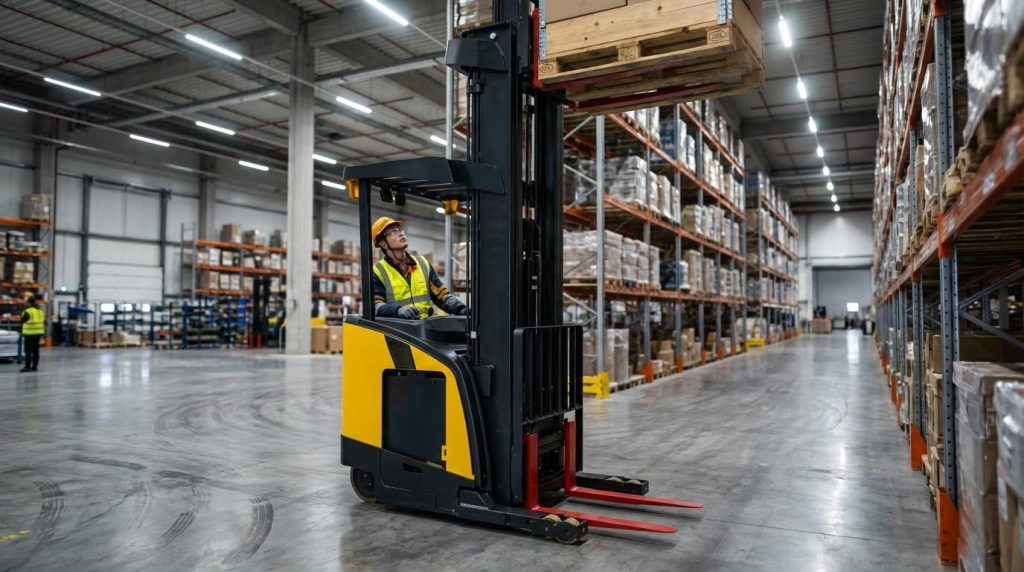
Specifying multi-directional or side-carry trucks lets you pick long pallets from the end, keep forks fully inserted, and then travel sideways. That keeps the effective load center close to the mast while still fitting in narrow aisles.
Interface design with conveyors, racks, and docks
Interface layout for conveyors, racks, and docks must match long-pallet geometry, truck mast geometry, and load center limits so that every transfer happens with squared, fully supported pallets.
- Conveyor width and lengthwise travel: Conveyor width should exceed the widest pallet by about 100–150 mm. For a 1,200 mm wide pallet carried lengthwise, designers often use ~1,350 mm conveyor width – this gives side clearance so long pallets do not rub or jam. Conveyor sizing guidance
- Roller pitch for long pallets: Keep at least three rollers under each pallet runner at all times. That usually means 75–100 mm roller pitch for stringer pallets and up to 100–150 mm for full-bottom pallets – this limits deflection and prevents long pallets from “bridging” and tipping. Roller pitch criteria
- Height matching with trucks and AGVs: Conveyor infeed/outfeed height must match forklift or AGV fork height within about ±10 mm. Tapered entry plates and 3–5 mm vertical gaps prevent wheel impact and pallet hang-ups – critical when a long pallet overhang magnifies small misalignments. Interface geometry
- Apron space for squaring long pallets: Forklift approaches to conveyors, racks, or docks need roughly 1,500–3,000 mm of clear apron so operators can straighten a 3–6 m pallet before set-down – this is where “how to lift extra long pallet” becomes “how to put it down without twisting it.” Wheel stops and painted alignment lines help drivers land pallets parallel to rollers or rack beams. Apron and alignment practices
- Zero pressure accumulation for long pallets: For powered conveyors, zero-pressure accumulation zones should be slightly longer than the longest pallet, typically pallet length plus 200–300 mm. Sensors stop upstream zones before physical contact – this protects flexible or overhanging long loads from buckling. Control strategy
- Side guides and nip-point guarding: Side guides of about 100–150 mm height keep long pallets from drifting off rollers, especially in curves or on declines. At the same time, finger guards of similar height around nip points and emergency stop pull-cords along the conveyor length control entrapment risk – important when operators work close to long, moving pallets. Guarding and safety devices
- Rack bay and beam design: For long pallets stored in racks, bay clear width should exceed pallet length by a modest margin (commonly 75–100 mm each side) while beams or support rails must sit under load-bearing runners. This ensures the pallet’s center of gravity stays between supports and inside the truck’s stability triangle at all lift heights.
- Dock interface and trailer access: Long pallets often force end-loading only. Dock leveler length and rated capacity must match the combined load of pallet plus truck axle loading, and dock bumper projection must still leave enough room to tilt the mast back slightly without striking the trailer – otherwise operators are tempted to travel with the mast forward and the load center pushed out.
💡 Field Engineer’s Note: On long-pallet conveyor infeeds, I always add a short “landing zone” roller section with tighter pitch and side guides. It forgives slightly skewed placements and stops the pallet nose from diving between rollers when the operator is rushed.
Fast layout checklist for long-pallet projects
- Aisles: Confirm turning or crab-steering paths with a scaled truck-and-load template.
- Heights: Match fork, rack, and conveyor heights within ±10 mm at every transfer point.
- Zones: Mark pedestrian exclusion zones around typical long-load swing paths.
- Controls: Use zero-pressure accumulation and soft starts on powered conveyors handling long pallets.
Final Considerations For Extra-Long Pallet Operations
Safe extra-long pallet handling depends on one simple idea. Keep the real load center inside the truck’s rated stability envelope at every step. Geometry, fork setup, and layout all serve that goal. When you extend pallet length or reduce fork insertion, you move the center of gravity forward. Capacity falls fast and tip-over risk rises. The 80% fork insertion rule and correct fork spread are not comfort margins. They are structural limits that protect pallets, forks, and operators.
Attachments and long-reach forks only help if you treat them as a full engineering change. You must re-rate the truck, update the capacity plate, and train operators on the new limits. The same logic applies to layout. Aisle width, rack design, conveyor geometry, and dock interfaces must let trucks approach square, insert forks deep, and set down loads without twist.
The best practice is clear. Standardize pallet families, define insertion and overhang rules, and lock them into procedures, training, and signage. Use multi-directional or side-carry equipment when pallet length starts to drive unsafe workarounds. Above all, make the load-center calculation and stability triangle check a routine step. That is how operations teams turn long-pallet handling from a daily compromise into a controlled, repeatable process with Atomoving equipment.
Frequently Asked Questions
What equipment can be used to lift extra long pallets?
To lift extra long pallets without a forklift, you can use alternatives like low-lift pallet trucks, high-lift trucks, or stationary conveyor systems. These options are designed to handle oversized loads safely and efficiently. For narrow spaces, reach trucks or tugger trains with trailers may also work. Forklift Alternatives Guide.
How can I safely move an extra long pallet manually?
Moving extra long pallets manually requires proper technique and teamwork. Always keep your back straight, carry the load close to your chest, and avoid twisting your body. Ideally, two or more people should handle the task to distribute the weight evenly and prevent injuries. Heavy Lifting Safety Tips.
When should I avoid manual lifting of pallets?
You should avoid manual lifting of pallets if they weigh more than 75-80 pounds or are too long to handle safely. Instead, use mechanical aids like hand trucks, dollies, or pallet jacks. Attempting to lift heavy or oversized pallets alone can lead to serious injuries and should always be avoided. Proper Pallet Lifting Guide.