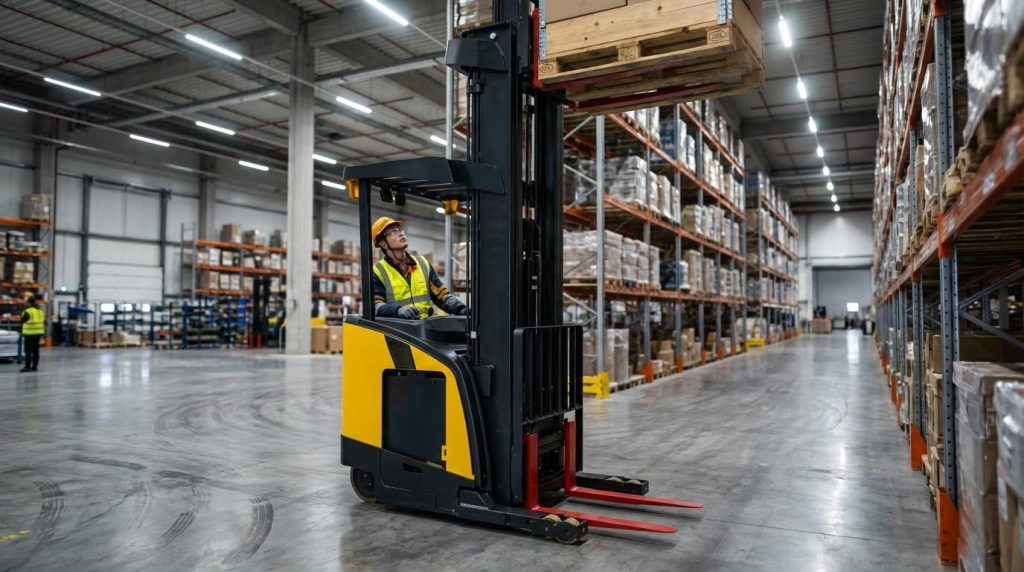
If you are asking “how much does an electric forklift weigh”, the realistic answer ranges from about 3,000 kg to nearly 12,000 kg depending on capacity and battery. This guide explains how truck mass, battery weight, and floor loading interact so you can choose a safe, efficient machine for your building, slab, and mezzanines.
Understanding Electric Forklift Weight And Components
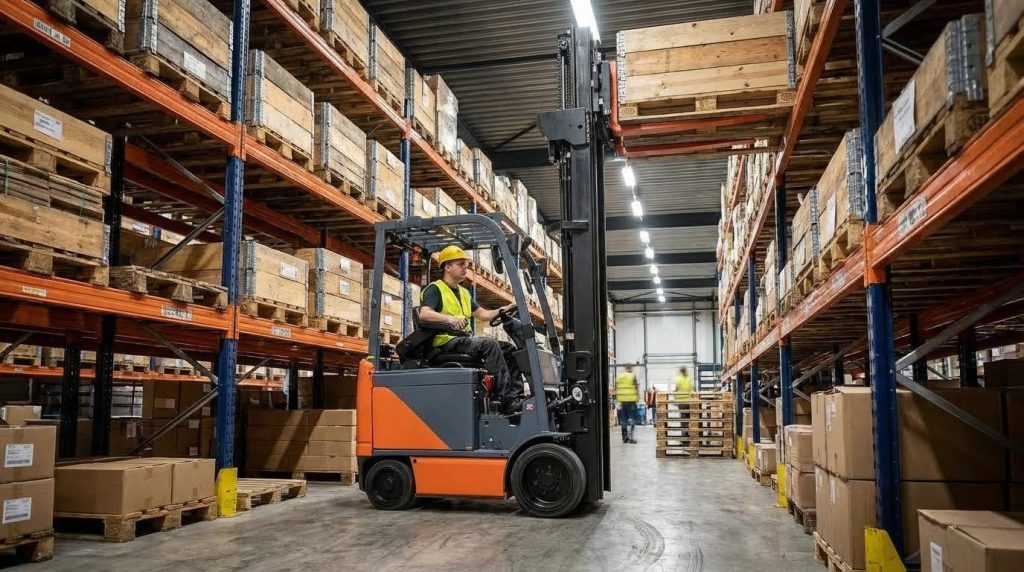
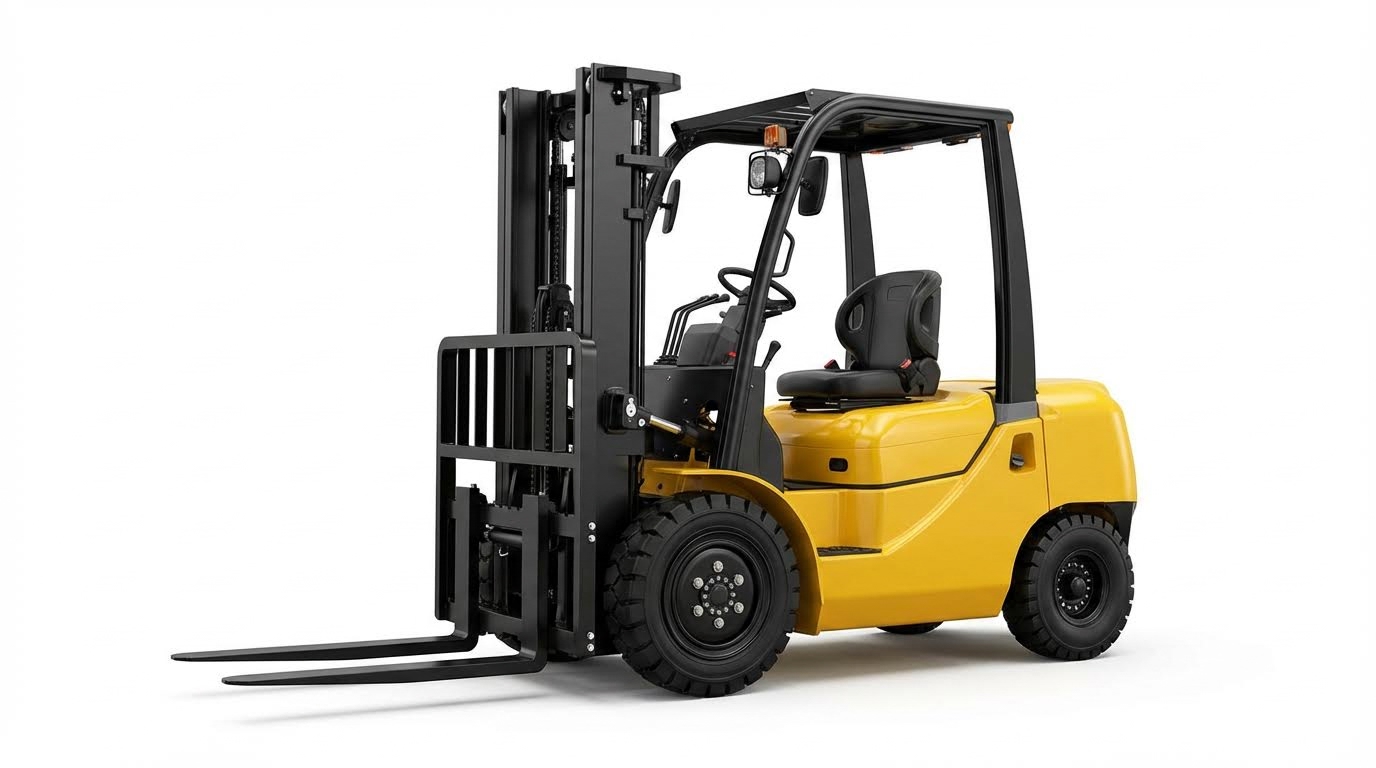
Electric forklift weight is the combined mass of chassis, mast, drive components, counterweight, and battery, and it is usually far higher than the rated lifting capacity. This section explains how much an electric forklift weighs and why each component matters for stability and floor loading.
When people ask “how much does an electric forklift weigh,” they usually mean the service or operating weight printed on the data plate. That value already includes the standard battery and fluids, and it is critical for checking floor capacity, transport limits, and elevator or dock ratings.
Typical weight ranges by capacity class
Electric forklifts generally weigh 1.5–2.5 times their rated lifting capacity because of the heavy battery and counterweight. Understanding these ranges helps you quickly screen whether a truck is compatible with your floor slab, dock, or mezzanine.
| Rated Lift Capacity | Typical Electric Forklift Weight | Example Data / Source | Operational Impact |
|---|---|---|---|
| 1,500–2,000 kg | ≈3,000–3,300 kg | Service weight 2,968–3,311 kg for 1.6–2.0 ton trucks with 48 V battery (48 V class) | Common in tight warehouses; usually acceptable on modern 150 mm–200 mm slabs. |
| 3,000 kg | ≈4,100 kg | 3,000 kg capacity truck weighing 4,110 kg with lithium battery (3 ton example) | Heavier chassis improves stability for 3,000 kg pallet loads at 500 mm load center. |
| 1,500–7,000 kg | ≈3,030–11,905 kg | Electric forklifts in this capacity band weigh 3,030–11,905 kg (range data) | Covers light warehouse units up to heavy industrial trucks for steel, paper, or ports. |
| Compact warehouse (narrow aisle) | ≈1,600–2,500 kg | Light-duty electric forklifts 3,000–6,000 lbs (≈1,360–2,720 kg) (light-duty class) | Suitable for mezzanines or older floors with lower load ratings. |
| Standard 4-wheel warehouse | ≈3,200–5,000 kg | Standard four-wheel models 7,000–11,000 lbs (≈3,175–4,990 kg) (standard class) | Most common choice on ground-floor distribution centers. |
| High-capacity industrial | ≥6,800–9,000+ kg | Heavy-duty models 15,000–20,000 lbs+ (≈6,800–9,070+ kg) (heavy-duty class) | Often unsuitable for suspended slabs; usually restricted to ground-level, thick industrial floors. |
From these ranges, you can see that asking “how much does an electric forklift weigh” has a very capacity‑dependent answer. A 1.6 ton truck might be around 3,000 kg, while a 7 ton electric truck can approach 12,000 kg including battery.
- Rule of thumb: Total truck mass is usually 1.5–2.5 × rated capacity – Quick screening for floor and transport limits.
- Data plate first: Always check the manufacturer’s service/operating weight – That is the value structural engineers use.
- Consider attachments: Side shifts, clamps, or long forks add weight – They increase axle loads and floor pressure.
💡 Field Engineer’s Note: For any truck above about 4,000 kg, I always ask for axle load data at maximum load. Total weight alone is misleading; concentrated front axle loads can overstress 120–150 mm slabs or mezzanine decks even when the “overall” floor rating looks acceptable.
How does this compare to the load you lift?
A 3,000 kg electric forklift weighing about 4,100 kg might lift a 1,200 kg pallet. In that moment, the floor “sees” more than 5,000 kg concentrated mainly under the front axle and front tires, which is why truck weight plus load weight both matter.
How battery chemistry changes total truck weight
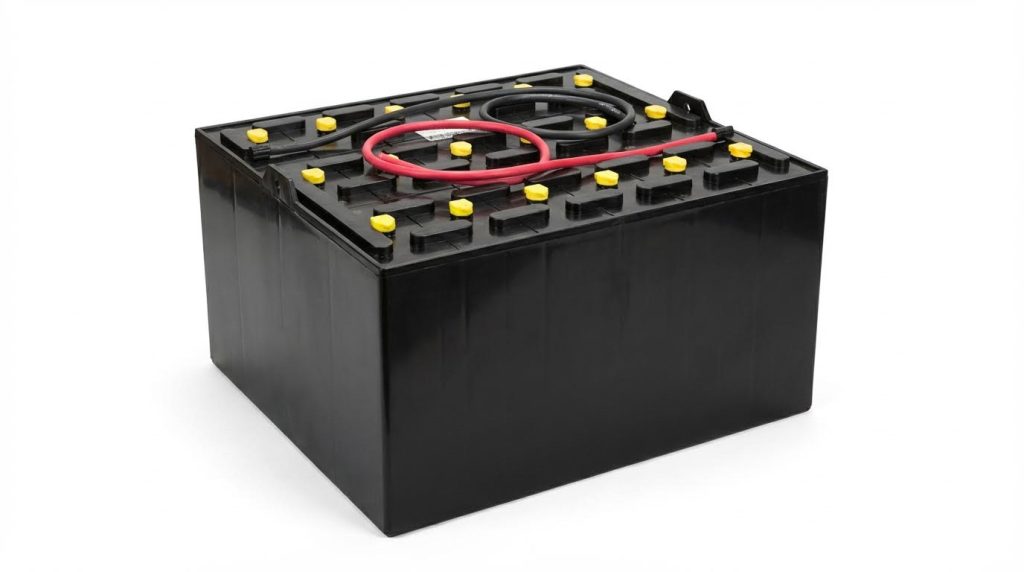
Battery chemistry can change electric forklift weight by several hundred kilograms, which directly affects stability, transport weight, and floor loading. Lead-acid batteries are heavier and act as counterweight, while lithium-ion cuts mass but may require extra steel to maintain capacity.
| Battery Type | Typical Battery Weight | Key Characteristics | Operational Impact on Truck Weight |
|---|---|---|---|
| Lead-acid (48 V, 525–625 Ah) | ≈856 kg | Heavy flooded or sealed cells, classic counterweight role (48 V example) | Adds significant mass; improves rear stability but increases floor loading and transport weight. |
| Lead-acid (48 V, 630–750 Ah) | ≈1,013 kg | Higher capacity, even heavier pack (high-capacity) | Pushes total truck weight up by about 150 kg+ vs smaller pack; may affect trailer and elevator limits. |
| Lithium-ion (various capacities) | ≈154–305 kg | Much lighter pack for similar energy, fast charging (Li-ion range) | Typically 30–50% lighter than lead-acid equivalents (relative weight); reduces total truck mass but may require added counterweight. |
| TPPL (Thin Plate Pure Lead) | Similar or slightly lighter than standard lead-acid | Advanced lead technology, high performance, drop‑in compatible with many trucks (TPPL option) | Weight still contributes to counterbalance; total truck mass close to classic lead-acid configuration. |
In many electric forklifts, the battery is one of the single heaviest components, often running from about 450 kg up to over 1,000 kg depending on voltage and amp‑hour rating. Lead-acid packs in particular can weigh 1,000–4,000 lbs (≈450–1,800 kg) in some classes, and this mass is built into the truck’s stability calculations and center of gravity layout (battery role).
- Lead-acid battery: Heavier, acts as counterweight – Higher truck mass and floor loading, but very stable for heavy pallets.
- Lithium-ion battery: 30–50% lighter than lead-acid – Reduces total weight and energy use per hour, but the truck may need extra steel counterweight.
- Power flexibility: Many trucks accept flooded lead-acid, TPPL, or lithium – Lets you tune weight and runtime to your facility’s floor limits and duty cycle (multi-battery compatibility).
Battery chemistry also changes how you operate the truck. Lithium-ion supports fast, opportunity charging and reaches full charge in under three hours, which reduces the need for massive, heavy packs sized for long shifts and battery change‑outs (Li-ion operation). Lead-acid typically needs longer charge times and regular maintenance, but its extra mass can be an advantage when you need maximum stability with heavy, high loads.
💡 Field Engineer’s Note: When converting a fleet from lead-acid to lithium-ion, I always re-check the truck data sheet for “with Li-ion battery” axle loads. Dropping 300–500 kg out of the battery compartment can shift the stability triangle and slightly reduce residual capacity at high lift heights, even if the nameplate capacity looks unchanged.
Does a lighter lithium-ion truck always mean safer floors?
Not automatically. While total mass drops, lithium trucks often run faster between charges and may operate more hours per day. Higher traffic frequency can fatigue marginal slabs. Always check both axle loads and expected traffic cycles with your structural engineer.
Battery Mass, Axle Loads, and Floor Loading
Battery mass dominates electric forklift weight and directly sets axle loads and floor pressure, so you must size trucks and batteries to stay within slab and mezzanine load limits while maintaining stability.
When people ask how much does an electric forklift weigh, they rarely realise how much of that number is battery and counterweight. A typical 1.6–2.0 ton capacity electric forklift with 48 V battery has a service weight around 2,968–3,311 kg, depending on configuration (service weight data). Across models, operating weight including fluids can reach 4,420 kg (operating weight range).
Battery choice, counterweight sizing, and truck geometry then decide how that weight sits on the front and rear axles, and how it transfers into your slab or mezzanine. The same 3,000 kg capacity truck can impose front axle loads over 7,000 kg when loaded (axle load distribution), which is what your concrete and racking actually feel.
💡 Field Engineer’s Note: Always check axle loads at maximum load and mast tilt, not just total truck weight. Slabs that look fine on paper often crack at dock edges or mezzanine joints because front axle point loads were never checked.
Battery weight, counterweight, and stability
Battery mass and counterweight together create the rear ballast that keeps an electric forklift stable when lifting, tilting, and braking with elevated loads.
The battery is one of the heaviest single components on an electric truck. A 48 V traction battery with 525–625 Ah capacity weighs about 856 kg, while a higher-capacity 48 V, 630–750 Ah battery weighs roughly 1,013 kg (battery weight by capacity). Lead-acid batteries in general can range from about 450–1,800 kg (1,000–4,000 lbs) depending on size, while lithium-ion packs are typically 30–50% lighter for the same energy (battery system contribution).
Counterweight is then sized to complement the battery mass. Higher capacity trucks receive proportionally larger counterweights to keep the combined centre of gravity within the stability triangle when carrying rated loads at full lift and tilt (counterweight design). When you change from a heavy lead-acid battery to a much lighter lithium pack without adding steel ballast, you effectively reduce rear mass and move the centre of gravity forward, shrinking your stability margin.
- Battery mass: 800–1,000+ kg on a 48 V truck – Acts as both energy source and part of the counterweight.
- Lead-acid vs lithium-ion: Lithium often 30–50% lighter – Improves energy efficiency but can reduce inherent stability if not re-ballasted.
- Counterweight block: Sized with capacity – Prevents forward tip when lifting at rated load centre.
- Chassis/frame mass: Heavy steel structure – Stiffens the mast base and spreads loads into the axles.
How battery chemistry quietly changes truck behaviour
Switching to lithium-ion cuts dead weight and improves acceleration and energy use, but can make the truck feel “livelier” over ramps and dock plates. Always have the OEM or engineer confirm that replacement packs maintain the designed counterbalance mass and centre-of-gravity envelope.
Axle load distribution and point loading on slabs
Axle load distribution tells you how the forklift’s total weight and load concentrate on front and rear wheels, which drives point loading and floor stress.
Electric forklifts carry most of their working load on the front axle when lifting. Typical specs show that a mid-size electric truck can have front/rear axle loads of about 4,725 kg / 525 kg up to 7,265 kg / 865 kg when loaded, depending on model and capacity (loaded axle loads). Unloaded, the same trucks might sit around 1,300–1,760 kg on the front axle and 1,950–2,870 kg on the rear axle (unloaded axle loads).
Those axle loads then pass into the slab through relatively small tire contact patches. That is why a 3,000 kg capacity truck that weighs only about 3,300–4,400 kg overall (operating weight data) can still crack a weak mezzanine or dock edge: the front axle is effectively a concentrated line load, not a uniform pressure.
| Condition | Front axle load (kg) | Rear axle load (kg) | Typical truck context | Operational impact on floors |
|---|---|---|---|---|
| Unloaded – lower range | ≈1,300 | ≈1,950 | Light 4-wheel electric, no load | Rear axle governs at rest; usually acceptable on standard slabs. |
| Unloaded – upper range | ≈1,760 | ≈2,870 | Heavier configuration, no load | Higher rear line load; check mezzanine and raised floors. |
| Loaded – lower range | ≈4,725 | ≈525 | Moderate load near rated capacity | Front axle dominates; risk at dock edges and expansion joints. |
| Loaded – upper range | ≈7,265 | ≈865 | Near maximum capacity and lift height | Very high front point load; critical for older or thin slabs. |
For facility engineers, axle data is more useful than “how much does an electric forklift weigh” as a single number. You use axle loads to check against slab design line loads, rack leg loads, and dock leveller ratings, especially in older buildings or mezzanines where allowable loads are lower (floor loading considerations).
Why tire type matters for floor stress
Cushion tires have smaller contact patches and generate higher contact pressure than similar-capacity pneumatic tires. On marginal slabs, switching to wider or pneumatic tires can reduce peak floor stress without changing the truck model.
Calculating floor capacity for trucks plus loads
Checking floor capacity for electric forklifts means combining truck operating weight, axle distribution, and maximum load to verify that concentrated front axle loads stay within slab or mezzanine design limits.
A simple way to think about it is to start with total mass: many electric forklifts with capacities from 1,500–7,000 kg weigh roughly 3,030–11,905 kg themselves (weight and capacity ranges). For example, a truck rated for 3,000 kg load may weigh about 4,110 kg (3 ton model weight). When it carries a full 3,000 kg pallet, the floor “sees” around 7,110 kg total, but most of that is on the front axle.
Industry guidance often illustrates this by stating that a 4,500 kg (10,000 lb) truck carrying a 2,250 kg (5,000 lb) load imposes about 6,750 kg (15,000 lb) of combined weight that the floor must handle safely (combined load example). The critical step is to translate that into axle loads and then into line or point loads for your slab check.
- Step 1: Get truck operating weight and max load – Use datasheets for exact kg values.
- Step 2: Take axle load tables for loaded/unloaded – These show how weight shifts to the front axle.
- Step 3: Estimate contact area per tire – From tire size and inflation/solid tire footprint.
- Step 4: Convert axle load to kN/m or kN per point – Compare with slab or mezzanine design capacity.
- Step 5: Check worst-case locations – Dock plates, joints, mezzanine edges, and around floor penetrations.
Using supplier data to speed up floor checks
Many modern datasheets already list operating weight, axle loads, and tire sizes in one place. You can hand these directly to your structural engineer so they can verify compatibility with existing slabs and mezzanines without guesswork.
Selecting The Right Forklift Weight For Your Facility
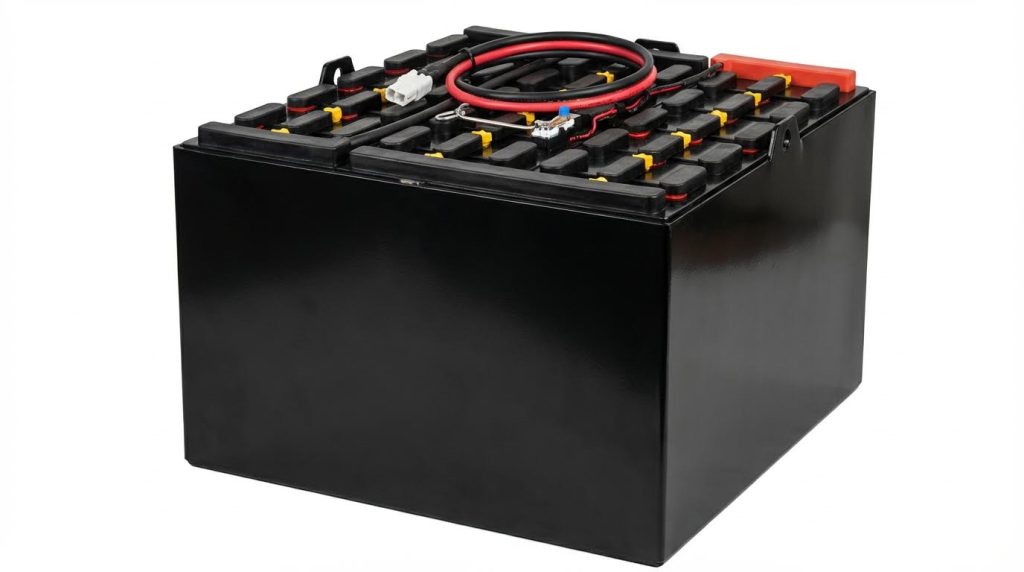
Selecting the right electric forklift weight means matching truck mass and battery size to your floor capacity, racking, and duty cycle so you stay within structural limits without wasting energy or shortening battery life.
When people ask “how much does an electric forklift weigh,” the practical answer is “as much as your building, slabs, and mezzanines can safely carry over a full shift.” You are not just buying capacity in kg; you are buying axle loads, point loads, and daily energy use.
- Clarify the question: “How much does an electric forklift weigh?” – Frame it as truck + battery + load + floor capacity.
- Start from the building: Check slab and mezzanine ratings before looking at truck brochures – Prevents expensive rework or structural upgrades.
- Think in ranges, not a single number: A 1,500–7,000 kg capacity truck can weigh 3,030–11,905 kg – Keeps you realistic about total mass on the floor.
- Include attachments and options: Sideshifts, clamps, and larger batteries add weight – Stops you from accidentally exceeding design limits.
💡 Field Engineer’s Note: On older slabs and mezzanines, the limiting factor is almost never lift height; it is front axle point load when the mast is tilted forward with a near‑capacity pallet. Always ask for axle-load data at rated capacity, not just “service weight.”
Matching truck weight to building and mezzanine limits
Matching truck weight to building limits means choosing a forklift whose service weight and axle loads stay within your slab, mezzanine, and dock ratings, with margin for loads, attachments, and traffic patterns.
Electric forklifts with 1,500–7,000 kg load capacity typically weigh 3,030–11,905 kg before you even add the pallet on the forks (service weight range). Many warehouse models in common use fall in the 3,255–4,420 kg operating-weight band including oil and water (typical 1.6–2.0 t class). That is why the question “how much does an electric forklift weigh” must always be tied to a capacity and a floor rating.
| Truck Capacity Class | Typical Service Weight | Example Axle Loads (loaded) | Where It Usually Fits | Operational Impact |
|---|---|---|---|---|
| 1,500–2,000 kg electric | ≈2,968–3,311 kg truck weight (48V class) | Front/rear ≈4,725 kg / 525 kg at load (representative) | Most modern warehouse slabs, light mezzanines | Good choice where floors are 3–5 kN/m² and aisles are tight. |
| 3,000–3,500 kg electric | ≈4,110 kg at 3,000 kg capacity (example) | Front/rear up to ≈7,265 kg / 865 kg at load (upper range) | Heavier slabs, ground floors, robust docks | May overload older mezzanines or light rack tunnel areas. |
| Up to 7,000 kg electric | ≈11,905 kg truck only (upper bound) | Front axle commonly >10,000 kg at capacity | Heavy industrial floors, outdoors, yards | Usually unsuitable for suspended slabs and typical mezzanines. |
- Check slab rating in kN/m² or kg/m²: Compare worst-case axle load footprint to slab design – Prevents cracking and long-term settlement.
- Watch mezzanines and raised docks: Many are designed for pallet jacks, not 4,000+ kg trucks – Reduces risk of structural failure.
- Include payload in the math: A 4,110 kg truck carrying 3,000 kg puts ≈7,000 kg onto the floor – Realistic view of total mass.
- Respect point loading: Solid tires and small contact patches create very high local stress – Important for older concrete and tiled areas.
How to quickly screen a truck against your floor
1) Get the truck data sheet and note service weight and loaded axle loads. 2) Ask your building engineer for slab and mezzanine ratings. 3) Compare front axle load at rated capacity with the weakest area you plan to drive over. If you are close to the limit, either reduce truck size, restrict routes, or upgrade the structure.
Balancing weight, energy use, and duty cycle
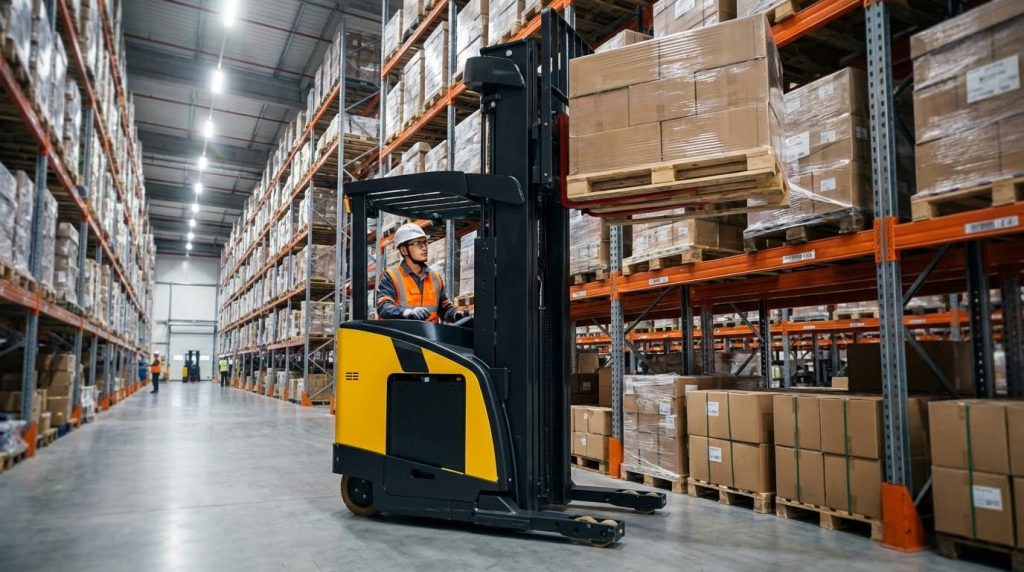
Balancing forklift weight, energy use, and duty cycle means picking the lightest truck and battery that still meet capacity and runtime, so you minimize kWh consumption and floor stress while avoiding mid-shift dead batteries.
Heavier trucks and batteries give stability and longer runtime, but they cost you more energy every hour. For example, a 48 V 4-wheel electric with 1.6–2.0 t capacity consumes about 4.2–4.5 kWh per hour in standard to performance modes (typical values). Battery weight alone can be 856–1,013 kg for 48 V systems with 525–750 Ah capacity (battery mass), which is a big share of “how much does an electric forklift weigh” in daily operation.
| Design Choice | Typical Weight Effect | Energy / Duty-Cycle Effect | Best For… |
|---|---|---|---|
| Higher-capacity truck than you need (e.g., 3,500 kg truck for mostly 1,200 kg pallets) | Truck moves into 4,000+ kg service-weight range | Higher base kWh/h, more tire and floor wear | Sites with occasional very heavy loads and robust floors. |
| Large lead-acid battery (e.g., 48 V, 630–750 Ah) | Battery ≈1,013 kg (heavy block) | Long runtime but more mass to accelerate and brake each cycle | Intensive multi-shift operations with limited charging windows. |
| Lithium-ion battery instead of lead-acid | Often 30–50% lighter than equivalent lead-acid systems (weight reduction) | Supports fast opportunity charging, consistent power, less downtime (charging) | High-throughput warehouses where chargers are close to the work area. |
| Moderate truck weight, optimized routes | Keeps truck mass in 3,000–3,500 kg band for 1.5–2.0 t capacity | Energy use around 4.2–4.5 kWh/h in typical duty (consumption) | Most standard pallet warehouse operations on good floors. |
- Map your duty cycle: Hours per shift, lifts per hour, average load mass – Determines realistic battery size instead of guessing.
- Right-size capacity: Choose the smallest capacity class that covers 95% of your loads – Reduces truck and battery weight, saving kWh.
- Use lithium-ion where charging is easy: Fast, partial charges in breaks support smaller, lighter batteries – Lowers total truck mass and floor stress.
- Consider energy recovery: Modern AC trucks with regenerative braking cut the penalty of extra mass – Helps offset some weight-related energy cost.
Quick sizing checklist: weight vs energy
1) Confirm maximum pallet weight and attachment weight. 2) Select the lowest truck capacity that still has margin at your lift heights. 3) Choose lead-acid or lithium-ion based on charging windows and maintenance capability. 4) Verify that truck service weight + battery + load fit your worst-case floor and mezzanine ratings. 5) Ask suppliers for kWh/h at your duty cycle to compare real operating cost between options.
Final Considerations On Electric Forklift Weight
Electric forklift weight is not just a catalog number. It is a design tool that links stability, battery choice, and floor safety. Truck mass, battery chemistry, and counterweight sizing set axle loads, which your slab, mezzanine, and docks must carry for every shift of the truck’s life.
When you ask “how much does an electric forklift weigh,” you really ask, “what combined truck, battery, and load can my structure and process support?” A heavier truck gives stability and long runtime but raises point loads, energy use, and wear. A lighter, lithium-based truck cuts mass and kWh, but only works safely if the counterbalance and axle loads still meet the stability envelope.
The best practice is simple. Start from the building, not the brochure. Get slab and mezzanine ratings, then match truck capacity, service weight, and axle loads to those limits with margin. Right-size capacity to your real pallet weights and duty cycle. Use battery chemistry and size to fine-tune mass, runtime, and charging strategy.
Operations and engineering teams that follow this approach choose trucks that feel stable, protect floors, and run efficiently. Atomoving can then help you fill any gaps with lighter handling equipment where full forklifts are not structurally suitable.
Frequently Asked Questions
How much does an electric forklift weigh?
An electric forklift’s weight depends on its capacity and design. For example, a 5,000 lb capacity electric forklift typically weighs around 8,000 lbs. Larger models, like those with a 12,000 lb capacity, can weigh up to 16,840 lbs. The weight includes the battery, which is a significant component in electric forklifts.
- Smaller electric forklifts (3,500 lb capacity) weigh approximately 7,645 lbs.
- Mid-range models (5,000–6,000 lb capacity) usually weigh between 8,000–16,000 lbs.
- Heavy-duty models (12,000 lb capacity) can exceed 16,000 lbs.
What factors influence the weight of an electric forklift?
The weight of an electric forklift is influenced by several factors, including its lifting capacity, battery size, and build materials. Forklifts designed for heavier loads require stronger frames and larger batteries, increasing their overall weight. Additionally, cushion tires are often used in indoor settings, contributing less weight compared to pneumatic tires used outdoors.
- Lifting capacity directly impacts the structural weight.
- Battery size adds significant weight to electric models.
- Tire type (cushion vs. pneumatic) affects the total weight.