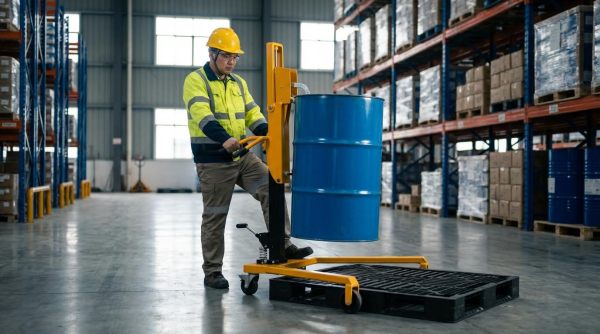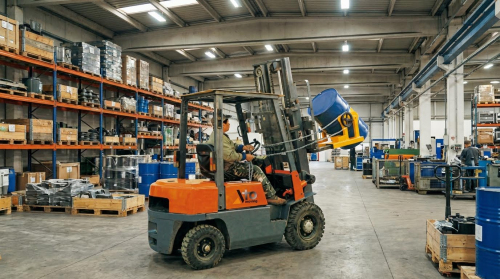
Industrial drum handling combined high masses, hazardous substances, and mobile equipment, so poor controls historically caused severe injuries and chemical releases. This article used a structured approach from hazard recognition and risk profiling through to engineered solutions and operating practices. It addressed mechanical and chemical drum hazards, regulatory expectations, and risk assessment of storage and traffic flows. It then examined how to specify and integrate drum trucks, lifters, forklift attachments, AGVs, cranes, and cobots, including the role of digital twins and AI in design and maintenance. Finally, it translated these concepts into practical inspection routines, stacking and bunding layouts, traffic control, and data-driven training programs, ending with a concise implementation roadmap for existing plants.
Understanding Drum Hazards And Risk Profiles
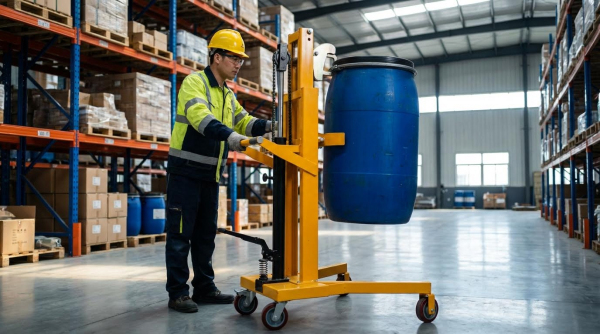
Industrial drum handling exposed workers to combined risks from mass, contents, and the surrounding environment. Engineers needed a structured view of these hazards to select appropriate equipment, define layouts, and set safe work limits. A clear risk profile linked drum characteristics, handling methods, and workplace conditions to specific failure modes. This section framed those links so plants could design controls that matched their actual drum inventory and traffic patterns.
Common Injury Modes In Drum Handling Tasks
Typical injury modes in drum handling included acute musculoskeletal strains, crush injuries, and chemical exposure. Manual rolling, tilting, or upending 210 litre or 55 gallon drums often required high forces and awkward postures, which increased musculoskeletal disorder risk. Fingers and toes were vulnerable at chimes, pallet edges, and under rolling drums, especially when operators crossed hands or worked near stacked drums. Leaking drums introduced contact or inhalation exposure, so unlabeled or deteriorated drums required treatment as hazardous until identified via labels and Safety Data Sheets. Impact incidents also occurred when drums tipped from unstable stacks, from overloaded drum trucks, or from sudden stops during transport.
Chemical, Pressure, And Structural Drum Hazards
Drums created hazards not only through weight but also through their contents and construction. Polyethylene or PVC lined drums usually indicated strong acids or bases; puncturing the liner could cause rapid leaks and corrosive spray. Exotic metal drums, such as stainless steel, nickel, or aluminum, often stored high value or extremely hazardous materials and required strict segregation and fire or explosion controls. Single walled drums used as pressure vessels had fittings for inert gas and product, which signaled potential overpressure, reactive, or flammable contents. Structural deterioration from corrosion, denting, or bulging weakened drum shells and chimes, raising the likelihood of sudden rupture during lifting, stacking, or impact. Air monitoring and, where relevant, ground penetrating systems supported detection of buried or compromised drums in legacy sites.
Regulatory And Standards Framework (OSHA, HSE, ISO)
OSHA, HSE, and ISO frameworks provided complementary requirements for drum safety engineering. OSHA and OSH training guidance emphasized hazard communication, SDS availability, manual handling risk reduction, and use of mechanical aids such as drum trucks, lifters, and forklift attachments. HSE guidance treated drums as part of major hazard installations, addressing corrosion, design faults, external events, fire and explosion, human error, and structural failure through design codes, bunding, emergency response, and inspection regimes. ISO and related international standards supported safe design and operation of lifting accessories, industrial trucks, and storage systems, requiring defined load ratings, stability factors, and periodic inspection. Together, these frameworks required employers to consult workers, select engineered controls, classify hazardous areas, and maintain documented procedures and permits to work for higher risk drum operations.
Risk Assessment For Drum Storage And Traffic Flows
Risk assessment for drums needed to link storage patterns, handling routes, and equipment selection. Engineers evaluated drum type, fill level, weight range, and chemical classification, then mapped where drums entered, were decanted, and exited the plant. Storage assessments considered stacking limits, typically a maximum of two drums high and two drums wide, to maintain stability and inspection access without ladders. Layout reviews checked bunding capacity, segregation of incompatible chemicals, and visibility for leak detection. Traffic flow analyses examined forklift, drum truck, and pedestrian interactions, focusing on turning radii, gradients, surface condition, and congestion points that increased impact or tip over risk. The outcome was a documented set of engineered controls and operating envelopes that constrained drum movements to predictable, defendable paths.
Engineering Controls And Equipment For Safe Handling
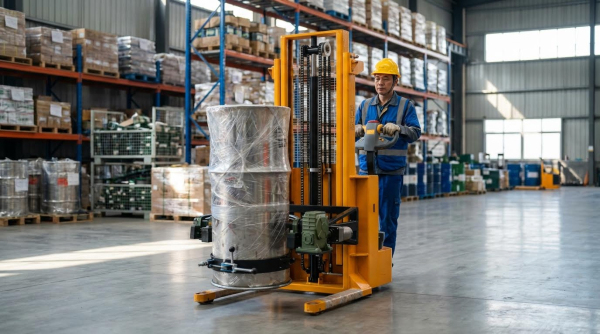
Engineering controls for drum handling focused on eliminating manual lifting and uncontrolled movements. Plants increasingly relied on purpose-designed trucks, lifters, and attachments to keep operators outside the line of fire. Correct selection and integration of these devices with site layouts, traffic flows, and digital systems significantly reduced injury rates and spill incidents. This section examined how to specify, design, and integrate equipment so that safe handling became the default operating mode.
Selection Criteria For Drum Trucks, Lifters, And Attachments
Selection started with mass, drum type, and task definition. Typical 210 litre (55 gallon) drums weighed between 180 kg and 360 kg, with some applications exceeding 400 kg when filled with high-density liquids. Equipment capacity needed at least a 25% safety margin above maximum drum mass, including dynamic effects during tilting or travel over uneven floors. Engineers also considered drum material and geometry, since steel, plastic, and fibre drums required different chime grips, band clamps, or diameter-based clamping systems.
Compatibility with process tasks drove the choice between trucks, stackers, tippers, and dedicated lifters. For example, mobile drum trucks with 350 kg rating suited pallet loading, short-distance transport, and horizontal dispensing. Powered vertical lifters with rotation and tilt functions were better for decanting into hoppers or reactors. Vacuum and gripping systems up to roughly 250–270 kg enabled frequent lifting and rotation with minimal operator effort, which suited high-throughput filling or keg-handling lines.
Stability and footprint were critical selection parameters. Wheelbase length, wheel diameter, and track width determined stability over thresholds and expansion joints. Four-wheel drum trucks with low-mounted axles and 45° cradles carried the full drum weight without requiring operator support, reducing tip-over risk. Attachments for forklifts or cranes required verification of residual truck capacity, centre-of-gravity shift, and compliance with the original equipment manufacturer’s derating curves.
Interface with existing infrastructure also influenced equipment choice. Forklift drum clamps, rotating forks, and crane-mounted drum grabs needed adequate overhead clearance, aisle width, and turning radii. Plants handling hazardous chemicals prioritised devices with positive-locking mechanisms, secondary latches, and features that prevented accidental drum release. Engineering specifications referenced relevant standards and internal design guides to ensure consistent selection across sites.
Ergonomic And Mechanical Design To Reduce MSD Risk
Ergonomic design aimed to keep operators within acceptable force, posture, and repetition limits. Drum handling tasks historically involved high push and pull forces, awkward reaches around chimes, and frequent tilting, which contributed to musculoskeletal disorders. Modern drum trucks and lifters used optimised fulcrum positions, long handles, and low-friction wheels to reduce initial tilting forces and rolling resistance. This allowed a single operator to move a fully loaded drum while remaining below recommended push–pull force thresholds.
Handle geometry and control placement strongly affected posture. Ergonomic trolleys used height-adjustable or looped handles so operators could keep wrists neutral and elbows close to the body. Controls for powered lifters, such as push-button raise and lower, sat within easy reach without requiring trunk twisting. Designers limited required hand changes and ensured operators did not cross arms over the drum chime while rolling, which reduced finger and hand crush risks.
Mechanical design features further reduced MSD risk by eliminating manual lifting phases. Powered or counterbalanced lift columns took over vertical motion, so operators only guided horizontal travel. Outside-diameter clamps and rim-grip mechanisms allowed engagement from a standing position, avoiding deep bending or crouching. Safety interlocks prevented drum release when elevated, reducing the need for emergency manual intervention.
Ergonomic devices also reduced cumulative strain in high-frequency operations. Vacuum lifters and servo-assisted manipulators cut operator effort by more than 80% in repetitive lifting and stacking cycles. This reduction translated into lower rates of back pain, shoulder injuries, and lost-time incidents. When specifying equipment, engineers reviewed task cycle times, daily drum counts, and required postures to justify investment in higher-end ergonomic solutions.
Integrating Forklifts, AGVs, Cranes, And Cobots With Drums
Integration of drum handling equipment with mobile and overhead systems required a systems-engineering approach. Forklifts equipped with drum clamps or rotators handled palletised loads and high stacking but introduced collision and impact risks. Automated guided vehicles (AGVs) and autonomous mobile robots moved drums along predefined routes, reducing manual transport but demanding precise
Safe Operating Practices And Layout Design
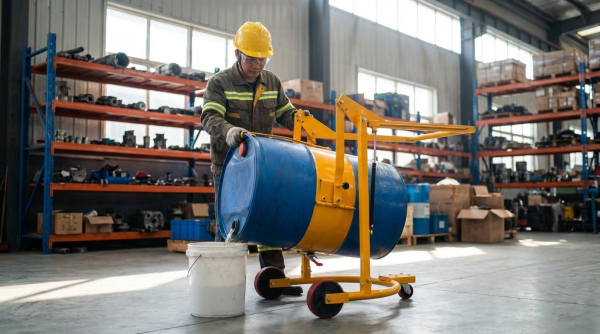
Safe operating practices and layout design formed the operational layer that complemented engineering controls for drum handling. Plants that integrated procedural discipline, clear visual management, and well-engineered traffic layouts significantly reduced musculoskeletal injuries, chemical exposures, and impact incidents. The focus extended from individual operator checks to system-level design of storage, access, and emergency response. The following subsections outlined how inspections, stacking rules, pathway design, and data-driven training frameworks worked together as a coherent safety system.
Pre-Use Inspection, Labeling, And SDS-Based Controls
Pre-use inspection started with verifying drum identification. Operators checked labels for hazard pictograms, UN numbers, and text describing corrosive, toxic, flammable, or pressurized contents. If a drum lacked legible labeling, facilities treated it as hazardous by default until characterization tests and documentation confirmed the contents.
Visual inspection targeted leaks, corrosion, deformation, and missing closures. Personnel examined bungs, lids, chimes, and weld seams, and replaced or tightened closures before any movement. When leaks appeared, operators isolated the area, consulted the Safety Data Sheet (SDS), and followed defined spill response procedures, including compatible absorbents and ventilation requirements.
Plants embedded SDS-based controls into standard operating procedures. This included specifying required PPE, acceptable handling temperatures, and incompatibility rules for adjacent storage. Operators cross-checked drum type, such as steel, plastic, or lined, against the SDS to anticipate corrosion or permeation risks. For reactive or pressure-rated drums, procedures required air monitoring and ignition control before handling. Supervisors documented inspections and lock-out of unsafe drums, supporting traceability and regulatory compliance.
Drum Stacking, Racking, And Bunding Layout Guidelines
Safe stacking practices limited mechanical loads and preserved inspectability. For typical 210 liter or 55 gallon drums, guidance restricted floor stacking to a maximum of two drums high and two drums wide per row. This configuration maintained stability despite minor dimensional variations and allowed direct visual access to each drum surface.
Racking systems used rated beams and decks designed for drum point loads rather than uniform pallet loads. Engineers verified deflection limits and impact factors according to relevant design codes. Where pallets carried three or four drums, layout rules avoided mixed stacking patterns that created uneven support and rocking. Periodic inspections checked for rack damage, corrosion, and loose anchors.
Bunding design ensured secondary containment for the largest likely spill scenario. Engineers sized bund volume to at least 110% of the largest single drum or a defined fraction of the aggregate volume, depending on jurisdiction. Layouts segregated incompatible chemicals into separate bunds with physical barriers and clear signage. Walkways and inspection aisles remained outside bunded areas or used grating with adequate slip resistance. Drainage, sump access, and firewater interactions were addressed in the bund design to support emergency response.
Pathway Design, Traffic Control, And Impact Protection
Pathway design aimed to minimize sharp turns, gradients, and surface irregularities that destabilized drum handling equipment. Engineers specified minimum aisle widths based on the largest handling unit, such as forklifts with drum clamps or mobile drum trucks, including clearance for turning envelopes. Floor surfaces were kept level, non-slip, and free from potholes or cable crossings that could induce sudden jolts.
Traffic control separated pedestrian routes from powered industrial trucks wherever feasible. Plants used marked walkways, guardrails, and one-way traffic patterns to reduce crossing conflicts. Speed limits, stop lines at intersections, and convex mirrors at blind corners improved visibility and reaction time. High-risk zones near drum storage, decanting stations, and loading bays received enhanced lighting and signage.
Impact protection focused on both structural assets and drums. Bollards, crash barriers, and rack end-guards were positioned based on vehicle impact calculations and stopping distances. Drum stacks facing traffic lanes used buffer zones or low barriers to prevent direct contact from vehicles. Procedures required smooth, progressive acceleration and braking when transporting drums, especially those containing hazardous or pressurized materials. Regular reviews of near-miss reports guided refinements in pathway geometry and barrier placement.
Training, Procedures, And Predictive Safety Analytics
Effective drum handling relied on trained operators who understood both equipment and hazards. Training programs covered manual techniques for rolling, tipping, and upending drums using leg power rather than spinal loading, as well as correct use of drum trucks, lifters, and forklift attachments. Curricula linked practical skills with hazard recognition, including deteriorated drums, incompatible materials, and
Summary And Implementation Roadmap For Plants
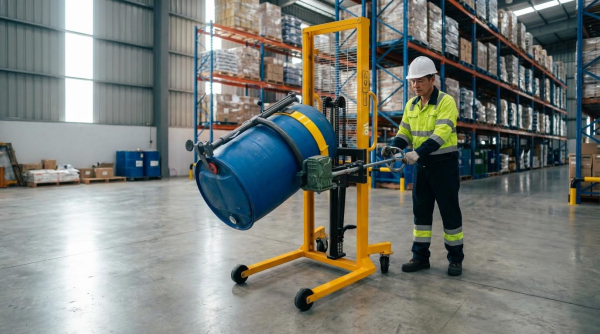
Engineering controls for drum handling had provided the most reliable way to reduce injuries, chemical exposures, and equipment damage. Plants that combined appropriate handling equipment, robust layout design, and disciplined operating practices achieved lower musculoskeletal disorder rates and fewer spill events. A structured roadmap helped align procurement, engineering, operations, and safety functions around the same risk-reduction objectives.
Key findings from industrial practice and guidance documents showed that manual drum handling should be minimized and substituted with mechanical aids wherever practicable. Purpose-designed drum trucks, lifters, tippers, vacuum lifters, and forklift attachments handled weights up to roughly 400 kg while maintaining control of tilt, rotation, and decanting. Safe storage limits, such as stacking 210 L drums no more than two high and two wide, improved inspection access and stability. Systematic pre-use inspections, PPE, SDS-based controls, and adherence to OSHA and HSE expectations formed the procedural backbone around these engineering measures.
For implementation, plants benefited from a phased approach. Phase one mapped current drum flows, weights, contents, and storage patterns, then performed a formal risk assessment for each node: receipt, internal transfer, processing, and waste. Phase two selected equipment based on load range, drum types, frequency of handling, and environment, ensuring compatibility with existing forklifts, AGVs, or overhead cranes. Phase three optimized layouts for clear pathways, segregated pedestrian–vehicle routes, bunded storage, and impact protection, then embedded standard operating procedures, permit-to-work controls, and targeted training. Finally, plants increasingly deployed sensors, digital twins, and basic analytics to monitor near misses, equipment condition, and stacking compliance, enabling continuous improvement.
Future trends pointed toward greater use of ergonomic lift-assist devices, collaborative robots for repetitive drum tasks, and AI-supported scheduling to smooth peak handling loads. However, the core principles remained stable: eliminate high-force manual tasks, control chemical and structural hazards at source, and design the physical system so that the safest method was also the easiest to use. Plants that treated drum handling as an engineered system, rather than a series of manual tasks, positioned themselves for higher reliability, regulatory compliance, and long-term workforce health.