Order picking is where warehouse productivity, accuracy, and safety all meet on the floor. This guide explains what warehouse workers actually use to pick orders, from simple carts and manual tools to advanced warehouse order picker trucks, pick-to-light, and goods-to-person systems. You will see how different equipment affects throughput, ergonomics, and compliance, and how to match tools to your SKU profile and layout. If you are asking what do warehouse workers pick orders with, this article walks through the full spectrum of order picking machines so you can choose and justify the right solution for your operation.
Core Order Picking Methods And Equipment
Manual picking tools and mobile carts
When operations leaders ask what do warehouse workers pick orders with, the starting point is still manual tools and mobile carts. Typical basic tools include:
- Paper pick lists or RF scanners for instructions and confirmation
- Handheld barcode readers to reduce keying errors
- Pallet jacks, dollies, or platform trucks to move heavier loads
- Mobile picking carts with shelves, totes, or cartons for multi-order picking
Well-designed pick carts let one operator work on many orders at once, often 8–16 in parallel, which cuts walking distance and boosts lines picked per hour compared with one-order-at-a-time methods. In engineered systems, operators using pick carts for multiple discrete orders in a single pass have achieved 10% to 25% less staff requirement, 10% to 30% higher accuracy, and 25% to 40% less order processing time versus purely manual walk-and-pick approaches. Documented results show these ranges in structured pick-cart systems
For supervisors, the key engineering decisions around manual tools and carts include:
- Cart footprint vs. aisle width to avoid congestion and reduce turning time
- Shelf and tote layout to minimize bending, reaching, and re-handling
- Wheel type and bearing quality to keep push forces within ergonomic limits
- Integration with scanners or mobile devices so pickers do not handle paper and devices at the same time
When manual carts make the most sense
Manual picking carts are usually optimal in small to mid-size facilities, operations with many SKUs but moderate daily volume, and environments where flexibility matters more than full automation. They also serve as a low-risk pilot step before investing in conveyor, pick-to-light, or goods-to-person systems.
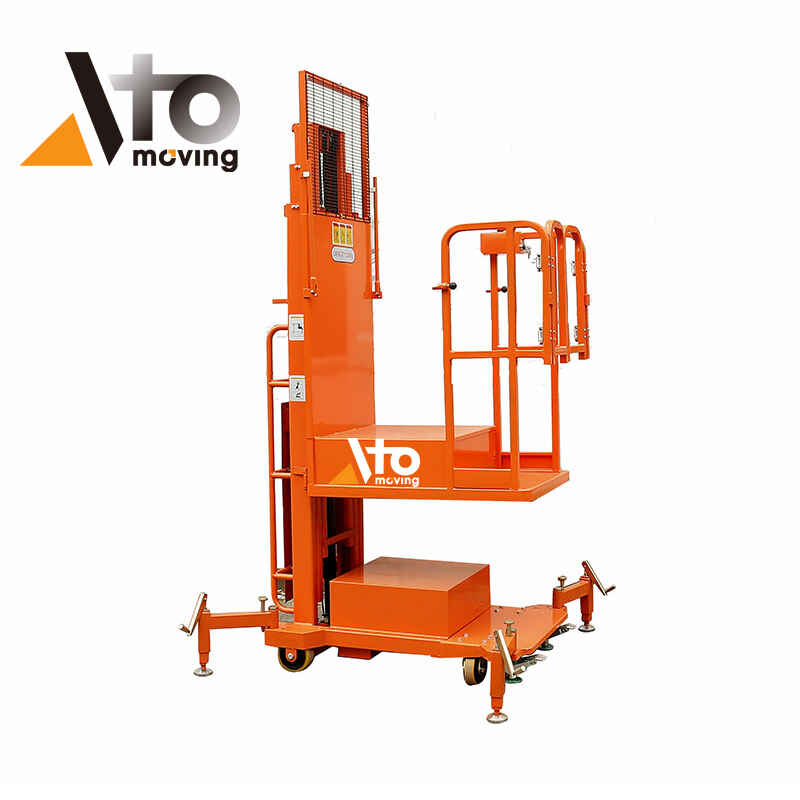
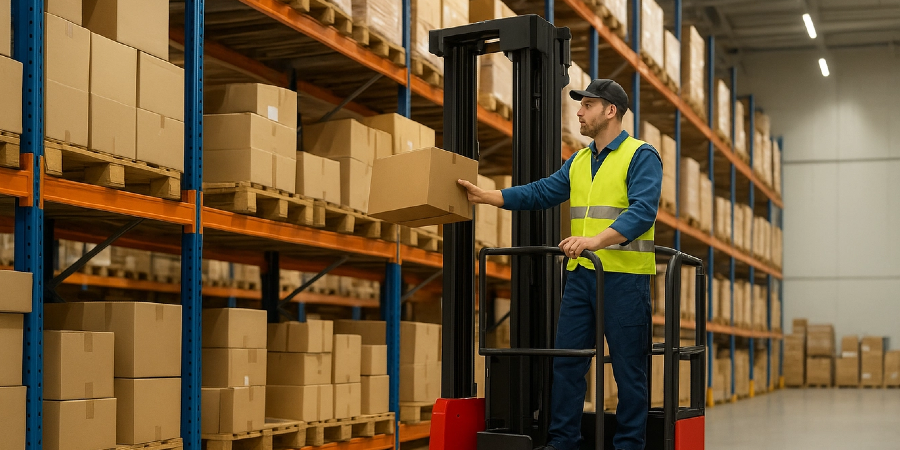
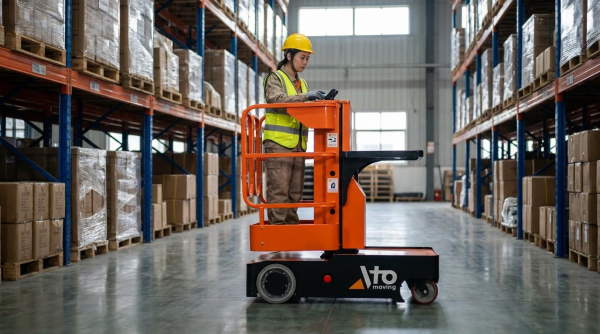
Low-level and high-level order picker trucks
For higher throughput and pallet or case picking in racking, what do warehouse workers pick orders with often shifts from carts to powered low-level and high-level order picker trucks. Low-level order pickers keep the operator close to the floor and are designed to pick from the first level or two of racking. Typical low-level units handle loads in the roughly 1,200 kg to 2,500 kg range, with load centers between about 600 mm and 1,200 mm, and truck lengths around 2,400 mm to 3,700 mm. Published specs list these capacity and geometry ranges Travel speeds commonly reach about 9–13 km/h, with or without load depending on configuration, to support fast horizontal moves in longer aisles. Representative models operate in this speed band
High-level order pickers lift the operator platform so workers can pick directly from upper rack levels instead of bringing pallets down with reach trucks. Typical high-level machines reach up to about 12 meters, which maximizes vertical cube utilization and allows higher storage density in the same footprint, but they cost more and require tighter safety controls than low-level units. Comparisons commonly cite low-level heights around 2.5 m and high-level heights up to 12 m
From an engineering and safety perspective, several design and regulatory factors affect how these trucks are applied:
- Speed limits: when an operator platform is raised above 36 inches, standards restrict maximum horizontal speed to about 2.5 miles per hour (around 1.12 m/s) to reduce tip and collision risk. Regulations specify this speed cap for elevated platforms
- Travel with elevated platforms: trucks generally may not travel with platforms above roughly 3.86 m unless they run in guide rails or use guided/inching controls that return to neutral when released. Rules define these restrictions for elevated travel
- Warning and presence systems: flashing lights must activate automatically when platforms exceed about 6 feet and trucks move, and low-level units often use full-floor operator presence sensors to remove trip hazards while allowing free movement up to platform heights of roughly 1,000 mm. Safety codes call for automatic warning lights at defined heights Low-level machines increasingly use full-floor presence sensing
- Energy and braking: many modern picker trucks use AC drive motors with regenerative braking to reduce brake wear and recover energy during deceleration, which extends battery runtime and cuts maintenance compared with purely mechanical braking systems. Low-level order pickers commonly implement regenerative braking
Where low-level vs high-level pickers fit best
Low-level order pickers suit fast-moving SKUs in the first rack levels and cross-dock style operations. High-level order pickers are more appropriate when vertical storage density is a priority, SKU counts are high, and there is a clear justification for the added capital, training, and safety controls required for elevated work.
Technical Deep Dive: From Trucks To Automation
Performance, batteries, and drive technology
When operations ask what do warehouse workers pick orders with, the answer increasingly includes warehouse order picker trucks with advanced drive and battery technology. Modern machines use AC traction motors and regenerative braking to deliver faster acceleration and smoother handling while feeding energy back into the battery during deceleration, which cuts brake wear and extends run time through energy-efficient operation. Lithium-ion batteries further improve availability with longer shifts between charges and much faster opportunity charging compared with traditional lead–acid packs by reducing downtime and maintenance. Low-level order pickers typically run at 9–13 km/h with or without load, so matching speed, battery capacity, and aisle layout is critical to keep travel productive without compromising control across different model configurations.
| Parameter | Typical low-level picker range |
|---|---|
| Load capacity | 1,200–2,500 kg depending on model |
| Travel speed | 9–13 km/h with or without load for typical units |
| Turning radius | ≈2,100–2,800 mm based on truck length |
For higher-level picking, standards limit horizontal speed when the platform exceeds 36 inches to around 2.5 mph to control kinetic energy at height and reduce tip and collision risk. Regenerative braking and AC drives help meet these safety constraints while still delivering responsive handling, especially in narrow aisles and dense racking. For automated and semi-automated systems, fleet energy demand, charger placement, and potential use of shared depots become major cost drivers, with dedicated automation depots alone adding thousands of dollars per month to operating costs in some deployments depending on location and power capacity. Engineering teams therefore size batteries, chargers, and motor technology as an integrated system, balancing throughput, shift patterns, and energy costs.
Safety, ergonomics, and regulatory compliance
As facilities scale up from carts to low- and high-level order pickers, the answer to what do warehouse workers pick orders with must also cover safety systems and ergonomics. Regulations specify that elevated order picker platforms must not travel above certain heights unless the truck runs in rails, uses electronic guidance, or moves only under inching control that returns to neutral when released to prevent uncontrolled movement at height. Trucks need securely attached work platforms at least 20 inches wide with standard guardrails on all open sides, and where guardrails are not possible, personal fall arrest systems must limit free fall to under 4 feet and avoid contact with lower levels with lanyards arranged to avoid trip hazards. In high-bay aisles, guide rails or electronic guidance are required to prevent collisions with racking and stored material, which is essential when operators work at 10–12 m elevation in high-level order pickers where storage density is highest.
Ergonomics has become a core engineering focus to reduce fatigue and musculoskeletal risk during long picking shifts. Spacious cabins with intuitive controls, height-adjustable features, and anti-fatigue flooring reduce strain and allow operators to change stance while moving and picking improving comfort and control. Low-level trucks often include full-floor presence sensors instead of discrete pedals so operators can walk freely on the platform without trip hazards while still ensuring the truck stops if no one is present across the entire standing area. Advanced machines add automatic speed reduction in turns, load stability systems, auto-braking, flashing warning lights that activate when the platform exceeds 6 feet during travel, and connectivity for real-time monitoring and maintenance planning to support both compliance and incident prevention.
Pick-to-light, goods-to-person, and system TCO
Beyond trucks, many operations that ask what do warehouse workers pick orders with now rely on pick-to-light, zone routing, and goods-to-person systems to raise throughput and reduce walking. Order picking machines using pickcarts through defined SKU zones can cut staff requirements by 10–25%, increase accuracy by 10–30%, and reduce processing time by 25–40% versus purely manual methods by synchronizing inventory, labor, and automation. Zone route conveyor systems push this further by routing totes only through zones with actual picks, which has been shown to cut staffing by 10–40% and reduce order time by 25–100% while eliminating long pick paths and unnecessary walking. Goods-to-person and automated kitting systems store inventory in high-density buffers and bring cartons, totes, or trays directly to ergonomic workstations, which can support up to about 700 picks per hour per station and increase throughput while shrinking the footprint and reducing shrinkage with real-time control and visibility.
Total cost of ownership (TCO) considerations
Pick-to-light and automation introduce substantial upfront and ongoing costs that must be weighed against labor savings and accuracy gains. Basic pick-to-light installations can start around tens of thousands of dollars, with full system hardware, software, and licensing ranging from about $15,000 to $120,000 for core components, plus $1,000–$4,000 per station and additional integration, installation, and training costs that can lift total project budgets for small sites into the $40,000–$90,000 range and mid-sized sites into the $150,000–$300,000 band depending on station count and integration complexity. Premium multi-zone, analytics-heavy deployments with 12 or more stations can reach $280,000–$520,000 or more, and large enterprise systems may exceed $1 million when advanced software, security, and custom integration are included especially in high-cost regions. For robotics-based goods-to-person fleets, TCO also includes automation depots, hardware procurement or leasing, field service labor, cloud processing, and spare parts, which together can add hundreds of thousands of dollars per year depending on fleet size and service model through a mix of fixed and variable expenses. Engineering and operations teams therefore build multi-year models that compare the capital and operating costs of automation against expected gains in pick rate, labor reduction, and accuracy to choose the right point on the manual-to-automated spectrum for their facility.
Matching Picking Tools To Your Operation
Choosing equipment for SKU profile and layout
When you ask what do warehouse workers pick orders with, the best answer is “it depends on your SKUs and layout.” The right mix of manual carts, low-level pickers, high-level pickers, and automation comes from matching equipment to SKU size, velocity, and storage height. Start by segmenting SKUs into fast, medium, and slow movers, and by physical characteristics such as weight, cube, and handling constraints.
- Fast movers in dense areas: Use low-level order pickers with pallet or cage attachments for floor-level and first-level racking. They offer high travel speeds of about 9–13 km/h, which supports frequent trips across larger zones. Typical models carry 1,200–2,500 kg with turning radii around 2.1–2.8 m, which influences aisle width and turning pockets.
- Slow movers and high storage: High-level order pickers are better where vertical space is heavily used. They can reach up to about 12 m, maximizing storage density but require narrower, well-controlled aisles and stricter safety controls than low-level trucks. Low-level machines typically work up to about 2.5 m, so reserve upper rack levels for SKUs that justify high-level picking or reserve storage.
- Batch and cluster picking: For high-order-count ecommerce, pick carts and manual trolleys still play a major role. In cart-based systems, operators can handle up to 16 discrete orders in a single pass through a zone, grouped by SKU category. This type of solution has shown 10–25% less staff required, 10–30% higher accuracy, and 25–40% less processing time than purely manual, single-order walks. These gains come from better routing and consolidation logic.
- Conveyor and zone routing: In long or complex buildings, a zone route system sends totes or cartons only to zones where picks exist. This eliminates unproductive walking and long pick paths. Reported results include 10–40% staff reduction, 10–30% accuracy improvement, and 25–100% faster order processing.
Layout and aisle design considerations
When you select order picking equipment, reverse-engineer from your building constraints. Turning radius and truck length define minimum aisle widths and staging zones. For example, low-level order pickers with overall lengths around 2.4–3.7 m and turning radii near 2.1–2.8 m set a practical lower limit on clear aisle width, especially where pedestrians and carts share space. Narrower aisles push you toward guided very-narrow-aisle trucks, rail or wire guidance, and stricter traffic management. Collision-prevention measures such as guide rails or electronic guidance are required in many jurisdictions for storage aisles to avoid rack impacts, particularly with high-level equipment.
Cost, throughput, and scalability considerations
To decide what do warehouse workers pick orders with in a cost-effective way, you must balance capex, labor savings, and throughput targets. A structured comparison of options helps you avoid under- or over-investing.
| Solution type | Typical role | Main cost drivers | Throughput impact |
|---|---|---|---|
| Manual carts & manual pallet jack | Low-volume, flexible picking | Very low capex, high labor content | Limited by walking distance and fatigue |
| Low-/high-level warehouse order picker | Medium–high volume case and piece pick | Truck price, batteries, operators, maintenance | Higher travel speed and vertical reach; good for mixed SKUs |
| Conveyor + zone routing | High-volume carton/tote flow | Conveyor hardware, controls, integration | Removes long walks, stabilizes flow between zones |
| Goods-to-person / put-to-store | Very high volume, dense storage | Automated storage, shuttles/robots, software | High sustained pick rates with low walking |
Automated and semi-automated systems can shift the cost structure dramatically. In a put-to-store configuration, inventory containers move from storage to fulfillment zones, eliminating dedicated pick faces for each SKU and shortening walking distances. Such systems have achieved 1.5–3× higher pick rates, which directly boosts throughput per labor hour. Automated kitting systems that bring parts to goods-to-person workstations also increase throughput and storage density while reducing shrink and improving ergonomics. They provide higher kitting throughput and more capacity in the same or smaller footprint.
Advanced technologies such as pick-to-light add another dimension. Hardware, software, and licensing for a basic pick-to-light setup typically range from about $15,000 to $120,000 for core infrastructure, with each station adding roughly $1,000–$4,000 in hardware. Wiring and integration can add $4,000–$60,000, while installation labor often falls between $6,000 and $60,000. For most small facilities, the total project cost lands in the $40,000–$90,000 band, whereas mid-sized deployments can reach $150,000–$300,000 and enterprise systems may exceed $1,000,000. Annual maintenance and support usually add $1,000–$12,000 per year.
To compare options, calculate cost per order line and cost per shipped unit under realistic volume assumptions. For example, a zone route or goods-to-person solution that reduces staff needs by 10–40% and improves accuracy by 10–30% can justify higher capital costs if your order volume is stable and growing. These systems have also shown 25–100% reductions in order processing time, which supports tighter cut-off times and better service levels.
Scalability and future-proofing tips
When you select order picking tools, design for modular growth. Choose equipment families where you can add more trucks, carts, or workstations without reworking your entire layout. For automation, favor architectures that allow incremental expansion, such as adding more shuttles, robots, or pick-to-light stations as volume grows. Consider not just equipment costs but also supporting infrastructure like charging, IT, and maintenance; automation fleets, for example, may require dedicated depot or charging space with monthly lease and power costs that scale with fleet size. Finally, ensure your WMS and control software can orchestrate both manual and automated flows so you can evolve from cart-based picking to conveyors and goods-to-person without a disruptive system change.
“”
Final Thoughts On Optimizing Order Picking Tools
Order picking performance depends on how well you align tools with load geometry, travel paths, and operator limits. Manual carts, low-level trucks, high-level pickers, and goods-to-person systems all manage the same physics of mass, speed, and stability, just at different scales and cost levels. If you oversize loads, push speeds at height, or ignore aisle geometry, you drive up tip risk, fatigue, and damage rates.
Regulatory rules on elevated platforms, speed caps, guardrails, and presence sensing exist because kinetic energy rises fast with speed and height. Lithium batteries, AC drives, and regenerative braking help control that energy while keeping trucks productive over long shifts. Ergonomic cabins, full-floor sensors, and guided aisles then turn that capability into safe, repeatable work.
The best practice is to design from the SKU profile outward, then test choices with cost-per-line and cost-per-unit models. Use manual carts and low-level order pickers as flexible building blocks, add high-level units where vertical density pays back, and introduce pick-to-light or goods-to-person only when volume and labor rates justify the TCO. Teams that follow this structured approach can scale from manual tools to advanced Atomoving order picking machines while keeping safety, throughput, and cost in balance.
Frequently Asked Questions
What tools or equipment do warehouse workers use to pick orders?
Warehouse workers typically use tools and equipment like pallet jacks, forklifts, and hand-held scanners to efficiently pick orders. In some cases, automated systems such as conveyors or robotic picking systems may also be used. These tools help workers locate, retrieve, and transport items from warehouse shelves to the packing area.
What skills are needed to be an effective order picker in a warehouse?
To be an effective order picker, workers need several key skills:
- Attention to detail to ensure accurate picking.
- Good physical fitness and stamina for lifting and moving items.
- Time management skills to meet deadlines.
- Ability to work well in a team environment.
These skills help ensure efficient and error-free order fulfillment Picker Skills Guide.
What is the order picking process in a warehouse?
The order picking process involves locating and retrieving products from warehouse shelves based on customer orders. This process typically includes receiving the pick list, traveling to the correct location, selecting the items, and bringing them to the packing station. Efficiency in this process is critical to meeting delivery timelines Warehouse Picking Tips.