Electric forklifts cover a wide capacity band, from small warehouse trucks that handle around 3,000 lb up to heavy-duty units exceeding 20,000 lb, with some specialized designs going beyond 40,000 lb depending on design and application. If you are asking how much can an electric forklift hold in the real world, the answer depends on load center, mast height, attachments, and battery and motor specs, not just the big number on the data plate. This guide breaks down typical capacity ranges, the engineering factors that limit lift capacity, and how to match a truck’s rating to your aisles, heights, and duty cycle. Use it as a practical, numbers-first framework to size electric forklift capacity safely and efficiently for your operation.
Understanding Electric Forklift Capacity Ratings

Typical Capacity Ranges And Use Cases
If you are asking “how much can an electric forklift hold,” the answer spans a wide range. Most electric counterbalance trucks in warehouses fall between 1,500 kg and 5,000 kg, but specialized units go far beyond this. The tables below give realistic capacity bands and where each band is typically used.
| Rated Capacity | Approx. Pounds | Typical Use Case |
|---|---|---|
| 1,000–1,500 kg | 2,200–3,300 lb | Light pallet handling, small warehouses, retail backrooms |
| 1,500–3,500 kg | 3,300–7,700 lb | General warehouse work, dock loading, manufacturing lines (common electric forklift range) |
| 4,000–5,000 kg | 8,800–11,000 lb | Heavy pallets, block stacking, moderate outdoor work (higher-capacity warehouse trucks) |
| Up to 10,000 kg | Up to ~22,000 lb | Steel, lumber, large molds, heavy industry indoors/outdoors (heavy‑duty electric forklifts) |
| ~3,000–9,000 kg | ~6,600–20,000 lb | Broad “typical” electric forklift capacity band for many models (3,000–20,000 lb typical range) |
| > 18,000 kg | > 40,000 lb | Specialized heavy-lift electric forklifts for oversized loads (special models over 40,000 lb) |
So, how much can an electric forklift hold in a normal warehouse setting? In practice, most operations use trucks rated between 1,500 kg and 3,500 kg, which comfortably cover standard pallet loads, cartons, and crates. Heavy industry, ports, and construction yards move into the 4,000–10,000 kg class or specialized units when load size and density demand it.
Key points about typical electric forklift capacity
- “Everyday” electric forklifts usually fall in the 1.5–3.5 tonne range.
- Capacities up to 10 tonnes are common for heavy-duty electric models.
- Some specialized electric forklifts exceed 40,000 lb capacity for extreme applications. (high-capacity examples)
- Always remember: the “headline” capacity only applies at the specified load center and lift height.
How Capacity Is Stated On The Data Plate
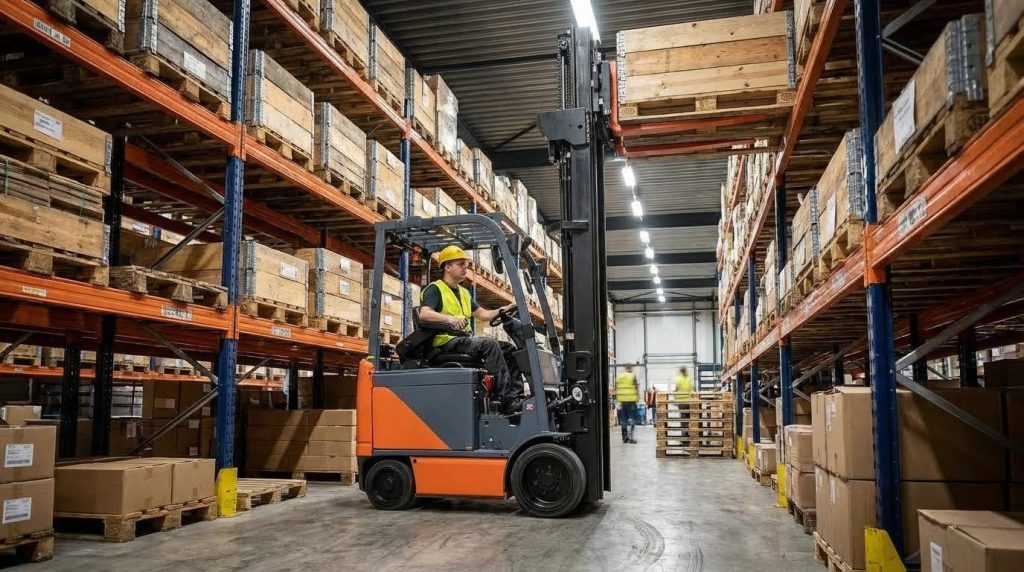
The data plate (also called the nameplate or rating plate) is the only place that officially answers “how much can an electric forklift hold” for that specific truck. It combines capacity, load center, and lift height into one rating so operators know the safe working envelope.
- Rated capacity: Maximum load the truck can lift under specified conditions (for example, 3,000 kg).
- Load center: Distance from the fork face to the load’s center of gravity, often 500–600 mm (about 24 in is standard in many markets). (definition of load center)
- Rated lift height: Height at which that capacity still applies, typically around 3,000 mm for standard masts, with options up to about 8,000 mm on some electric forklifts. (typical lift heights)
- Attachments and notes: Information on clamps, sideshifters, fork extensions, and how they change the rating.
| Typical Data Plate Line | What It Means In Practice |
|---|---|
| 3,000 kg @ 500 mm LC | Truck can safely lift 3,000 kg only when the load’s center of gravity is 500 mm from the fork face. |
| 2,400 kg @ 600 mm LC | Capacity drops when the load center increases, because the load moment is higher. |
| Rated height: 3,000 mm | Above this height, effective capacity may reduce further depending on mast and attachment. |
This reduction with increasing load center is not arbitrary; it follows basic load-moment physics. For example, a truck rated 4,000 lb at a 24 in load center only safely handles about 2,666 lb at a 36 in load center, because the same maximum load moment must not be exceeded. (4,000 lb @ 24 in vs 36 in example)
How to read your data plate safely
- Find the rated capacity and load center (for example, 2,500 kg @ 500 mm).
- Confirm the lift height at which that rating applies.
- Check if any attachments are listed and whether they reduce capacity.
- Assume the truck can lift less than the plate rating if your load is longer, higher, or offset.
Engineering Factors That Limit Lift Capacity
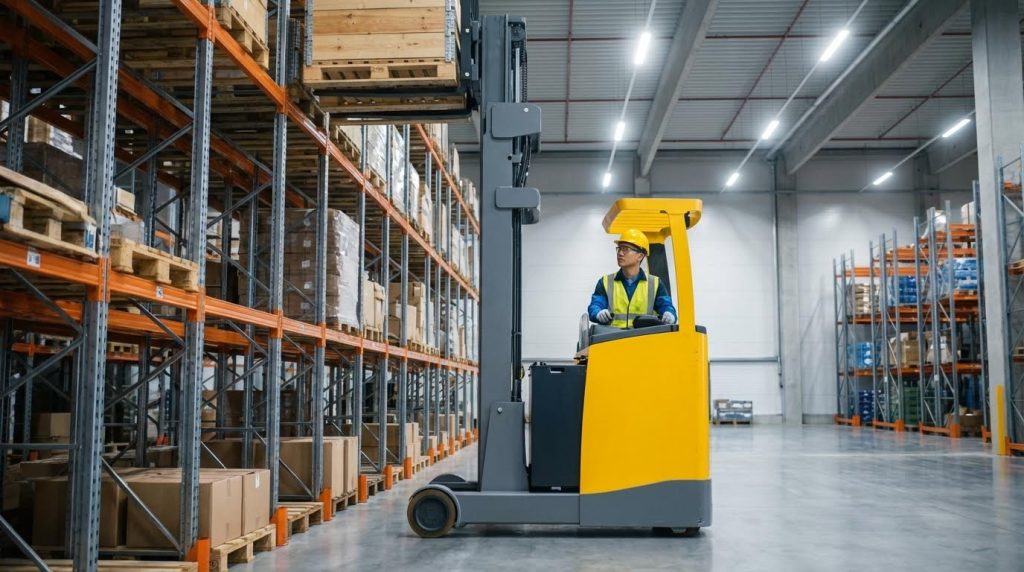
Engineering limits decide how much can an electric forklift hold in real-world use, not just the number on the data plate. The key drivers are geometry (load center and mast), added attachments, and the relationship between battery, motors, and the truck’s center of gravity.
Load Center, Load Moment, And Stability Triangle
These three concepts explain why the same truck can safely lift one load but not another with the same weight. They also answer the question “how much can an semi electric order picker hold at different load shapes and fork positions.”
- Load center: Distance from the fork face to the load’s center of gravity.
- Load moment: Load weight × horizontal distance to the front axle.
- Stability triangle: The area between the two front wheels and the pivot point of the rear axle.
When the combined center of gravity of truck and load stays inside the stability triangle, the truck remains upright. As you raise or extend the load, the combined center of gravity moves toward the triangle’s edge, reducing safe capacity.
| Concept | What It Means | Effect On Capacity |
|---|---|---|
| Rated load center | Standard design point, often 24 in for palletized loads for a 48 in × 48 in load | Data-plate capacity applies only at this distance. |
| Actual load center | Real distance to the load’s center of gravity | If greater than rated, safe capacity drops. |
| Load moment | Weight × distance from front axle (inch‑pounds) | Must not exceed the design moment or the truck can tip. |
| Stability triangle | Three-point support polygon of the truck defining tip limits | Combined center of gravity must stay inside this area. |
Capacity falls quickly as the load center increases. For example, a truck rated 4,000 lb at a 24 in load center may only be safe for 2,666 lb at a 36 in load center. OSHA provides this example to show how sensitive capacity is to distance.
Worked example: Load moment limit
If a forklift is rated “3,000 lb at 24 in,” its maximum load moment is 72,000 in‑lb. 3,000 lb × 24 in = 72,000 in‑lb. For a longer load at a 30 in load center, to keep the same moment you must reduce weight: 72,000 ÷ 30 = 2,400 lb. So even though the nameplate says 3,000 lb, the engineering limit says 2,400 lb at that longer load center. This aligns with OSHA guidance.
Good load positioning helps keep the center of gravity close to the front axle and low. Recommended practices include carrying the load as close as possible to the front wheels, placing the heaviest part of the load against the mast, and keeping the load level and centered across both forks. OSHA emphasizes these points for stability.
Mast Height, Attachments, And Range Of Motion
Mast geometry and attachments change both the effective load center and the truck’s center of gravity. That is why the answer to “how much can an warehouse order picker hold at full height with an attachment” is often very different from the base rating.
- Mast height: Higher lift heights (for example, up to 8,000 mm) are available on many electric trucks, but capacity usually derates at the top stages.
- Range of motion: Reach, tilt, and side-shift functions move the load center forward or sideways.
- Attachments: Clamps, fork positioners, and extensions add dead weight and move the load outward.
| Factor | How It Changes Geometry | Typical Capacity Effect |
|---|---|---|
| High mast (tall lift) | Raises load center of gravity, increases overturning leverage | Capacity at maximum height is lower than at ground level. |
| Forward tilt | Rotates mast and load away from truck body | Effective load center increases, so safe load weight drops. |
| Reach function | Extends carriage and forks forward beyond the mast | Significant derating, especially at full reach and height. |
| Side‑shift | Moves load left/right relative to truck centerline | Can push combined center of gravity toward triangle edge. |
| Attachments | Add weight to the carriage and often increase load center | OSHA/ANSI require updated data plates to show new capacity. Manufacturer approval is mandatory. |
Factory load ratings for trucks with built-in reach, tilt, and side-shift already assume a “worst-case” range of motion. That means the printed capacity is valid only when you respect those original components and settings. If you add aftermarket attachments such as fork extensions or clamps, you change that worst-case geometry and must get a revised capacity rating and data plate.
Why aftermarket attachments reduce capacity
Attachments do two things that hurt capacity: they add dead weight directly on the mast, and they push the load’s center of gravity farther from the front axle. Both effects increase load moment. Because the truck’s counterweight and wheelbase do not change, the only way to keep the load moment within design limits is to reduce the allowable load weight. Guidelines require updated plates and approvals whenever these changes occur.
Battery, Motor Specs, And Truck Center Of Gravity
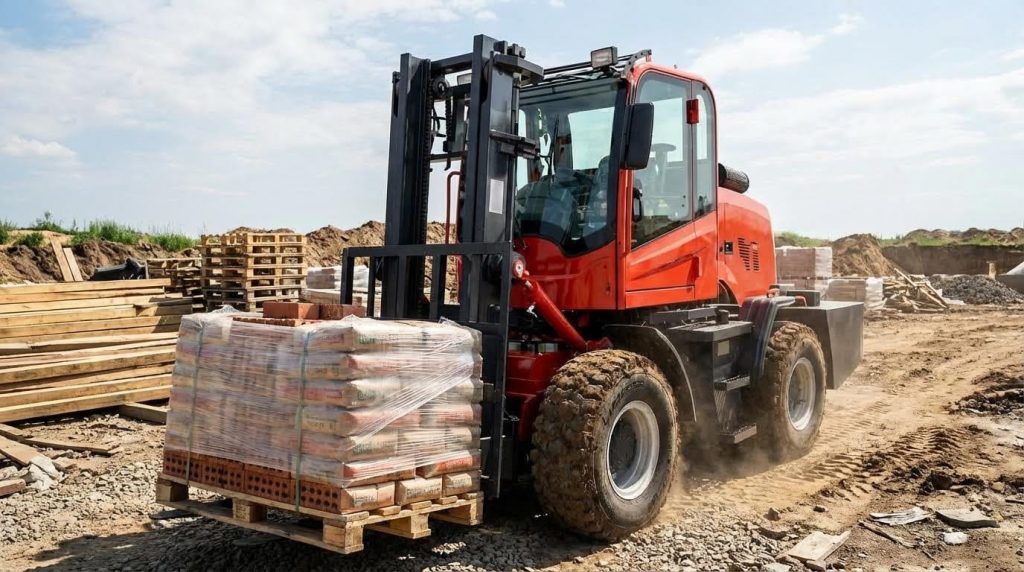
For electric trucks, the power source is also a structural component. Battery weight, motor power, and truck layout all influence how much can an order picking machines hold and still remain stable and productive.
- Battery weight: Acts as part of the counterweight and is critical to capacity ratings.
- Motor specs: Define how fast the truck can lift and travel at a given load.
- Truck center of gravity: Depends on wheelbase, truck style, and where the battery sits.
| Parameter | Typical Range / Note | Impact On Capacity And Use |
|---|---|---|
| Electric lift capacity | About 1,000–10,000 kg for common electric models, with some designs up to 20,000 lb and more for specialized units (1,000–10,000 kg typical) and higher for special trucks | Defines upper bound for “how much can an electric forklift hold” before any derating. |
| Battery system | Lead‑acid or lithium‑ion, often 500–630 Ah for many warehouse trucks supporting long shifts | Heavier, approved batteries help maintain designed counterweight and stability. |
| Motor performance | High‑efficiency traction and lift motors sized to rated capacity with voltage/current matched to load | Ensures the truck can lift rated loads without overheating or stalling. |
| Truck center of gravity | Varies by truck type, wheelbase, and battery location (stand‑up vs. sit‑down, etc.) | Determines how far forward the load can move before leaving the stability triangle. |
Using a lighter‑than‑specified battery reduces counterweight and shifts the truck’s center of gravity forward. That directly reduces safe capacity and can even void the original rating. Guidance for electric forklifts stresses using only batteries approved for that truck model and avoiding lighter substitutes. This is essential for maintaining rated capacity.
How power and stability interact in practice
Even if the counterweight and geometry allow a certain load moment, the electrical system must still deliver enough torque to lift and move that load at the required speed. Advanced lithium‑ion systems and high‑performance motors can support higher duty cycles and near‑rated lifting performance across a shift. Sources note that these technologies enable higher effective capacities by keeping performance consistent as the battery discharges, but they do not remove the geometric limits set by load center and the stability triangle.
Matching Forklift Capacity To Your Application
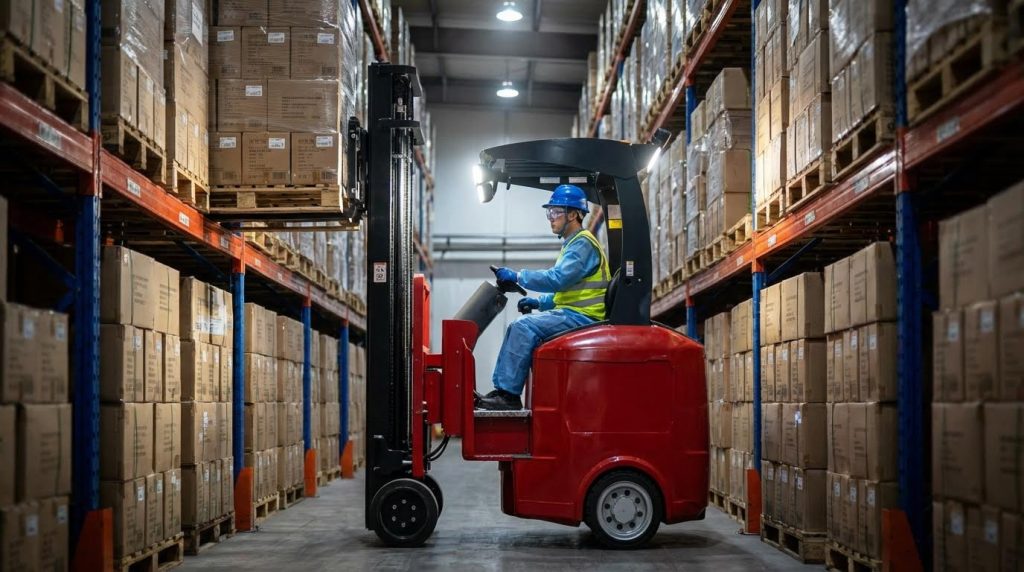
Calculating Safe Capacity For Real Loads
When you move from catalog ratings to real pallets, the key question is not just “how much can an semi electric order picker lift?” but “how much can an electric forklift hold in my exact configuration and load shape.” The answer comes from adjusting the nameplate rating for your actual load center, load length, and any attachments. This lets you turn a theoretical capacity into a safe working number for your operators.
| Step | What You Do | Why It Matters |
|---|---|---|
| 1. Read the data plate | Note rated capacity, rated load center (often 24 in / 600 mm), and rated lift height. | This is the starting point for how much can an electric forklift hold under ideal conditions. |
| 2. Measure your load | Measure load length front-to-back and estimate where its center of gravity sits on the forks. | Longer or uneven loads push the center of gravity forward and reduce capacity. Non-uniform load centers can reduce effective capacity |
| 3. Calculate actual load center | For a uniform load, load center ≈ half the load length (e.g., 48 in load → 24 in load center). | If your load center exceeds the rated value, you must de-rate capacity. Capacity decreases as load center increases |
| 4. Adjust for longer load center | Use OSHA’s rule of thumb: Safe capacity ≈ (Rated load center ÷ Actual load center) × Rated capacity. | This simple ratio method gives a conservative safe capacity for longer loads. OSHA describes this de‑rating method |
| 5. Check load moment | Multiply load weight by load center distance from the fork face or pivot. | Staying below the rated load moment keeps the combined center of gravity inside the stability triangle. Load moment = weight × distance |
| 6. Factor in attachments | Account for added weight and extra load center from clamps, extensions, or sideshifters. | Attachments add dead weight and move the load forward, so standards require revised data plates. Attachments influence load ratings |
OSHA provided a simple numeric example: a truck rated 4,000 lb at a 24 in load center only has about 2,666 lb capacity when the load center stretches to 36 in. A 50% increase in load center cuts capacity by roughly one‑third
The same principle lets you quickly estimate how much can an electric forklift hold for your own long or awkward loads. If your 5,000 lb truck is rated at 24 in but you regularly handle 56 in loads with a 28 in load center, the safe capacity drops to about 4,285 lb using the ratio method. This is a typical de‑rating example
Quick rules of thumb for real‑world capacity
- Keep loads tight to the carriage; avoid gaps on the forks.
- Keep the heaviest part of the load toward the mast to shorten the effective load center. Proper positioning improves stability
- Lower the load when traveling; a low center of gravity increases stability.
- Never exceed the de‑rated capacity for long, high, or off‑center loads.
- Get a revised capacity plate when you add or change attachments.
Selection Criteria For Aisles, Heights, And Duty Cycles
Once you know the de‑rated working capacity for your actual loads, you still need to check that the truck fits your building and your shift pattern. Aisle width, rack height, and daily run time all drive which electric forklift class and capacity band you should choose. The goal is to match how much can an electric forklift hold with how high, how far, and how often it must move that weight.
| Selection Factor | What To Check | Typical Engineering Impact |
|---|---|---|
| Aisle width & turning radius | Measure clear aisle and intersections; compare to truck turning radius and right‑angle stacking requirement. | Compact electric forklifts can turn in about 1,650–4,080 mm depending on size, so narrower aisles usually mean lower capacity or different truck style. Typical turning radii fall in this range |
| Lift height | Confirm your highest rack beam or stacking height and required clearance. | Standard electric masts lift around 3,000 mm, with options to about 8,000 mm. Higher masts usually require more base capacity for stability. Common lift height ranges |
| Load weight band | Define your 80–90% most common load weights plus worst case. | Electric forklifts commonly cover about 1,000–10,000 kg, with many units in the 1,500–5,000 kg band for warehouse work. Typical capacity ranges |
| Load geometry | Note pallet size, overhang, and any long or tall loads. | Longer loads increase load center and reduce effective capacity, even if their weight is within the nameplate rating. Capacity falls as load center grows |
| Duty cycle | Estimate operating hours per shift and per day, and percent of time under load. | Heavier duty cycles demand higher battery capacity (Ah rating) and robust motors to maintain performance at rated capacity. Batteries often range 500–630 Ah |
| Battery weight & type | Confirm approved battery weight range and chemistry. | Battery weight is part of the counterweight; lighter, non‑approved batteries can reduce stability and capacity. Battery weight is critical to ratings |
| Attachments & range of motion | List any clamps, sideshifts, fork positioners, or extensions and typical tilt/reach angles used. | Attachments and extreme tilt/reach increase the overturning moment, so manufacturers rate capacity for worst‑case range of motion and require updated plates. Range of motion affects capacity |
- If you work mainly in standard warehouse aisles with 1,500–3,500 kg pallets and lift to about 3,000 mm, a mid‑range electric counterbalance or reach truck usually covers both capacity and space. These models are common in warehouses and factories
- For narrow aisles, you often trade some capacity for a smaller turning radius and specialized mast geometry.
- For heavy loads near the top of the 10,000 kg electric range, you need wider aisles, heavier truck frames, and higher‑capacity batteries to keep performance and stability. Heavy‑duty electric units serve this range
Checklist before finalizing capacity and model
- Confirm your maximum required lift height and compare to standard and optional mast heights.
- Measure actual aisle widths and turning clearances, not just drawing dimensions.
- List your top 10–20 real loads with weight and size, then de‑rate capacity for load center and attachments.
- Check that the chosen truck’s de‑rated capacity still exceeds your heaviest real load with at least 10–20% margin.
- Verify approved battery specifications so you do not unintentionally reduce capacity with a lighter pack.
- Plan for inspection and recordkeeping so capacity changes and attachment additions are documented. Guidelines call for periodic examinations and records
Final Thoughts On Sizing Electric Forklift Capacity
Electric forklift capacity is never just a headline number. Real safety depends on how load center, mast height, attachments, and battery weight interact to keep the combined center of gravity inside the stability triangle. When that balance shifts forward or upward, the true safe capacity drops fast.
Engineering teams should treat the data plate as a starting point, then de‑rate for actual load geometry and working height. Simple load‑moment checks and OSHA’s ratio method turn catalog ratings into hard limits for real pallets, long loads, and clamps. Operations leaders must lock in approved batteries and attachments, since lighter packs or add‑ons can quietly remove the safety margin the truck was designed to have.
The best practice is clear. Size trucks so their de‑rated capacity still exceeds your heaviest real load with at least a modest buffer. Verify aisle widths and lift heights before choosing truck class. Keep loads tight, low, and centered on the forks. When in doubt, step down the load, not up the risk. By following these principles and working with specialists such as Atomoving, you align power, geometry, and stability so electric forklifts stay productive and safe over their full life.
Frequently Asked Questions
How much can an electric forklift hold?
An electric forklift’s load capacity depends on its design and intended use. Typically, most standard electric forklifts have a maximum lift capacity of up to 6,000 lbs (2,721 kg). However, specialized models may handle more weight depending on their configuration. For exact capacities, always check the manufacturer’s specifications. Warehouse Forklift Rentals Guide.
What factors determine the lifting capacity of an electric forklift?
The lifting capacity of an electric forklift is influenced by several factors:
- Mast type: A quad mast allows higher lifting heights compared to simpler designs.
- Tire type: Cushion tires are ideal for indoor use and support heavier loads on smooth surfaces.
- Battery power: Stronger batteries can support heavier loads without performance loss.
- Design balance: The counterweight and stability features affect how much weight the forklift can safely carry.