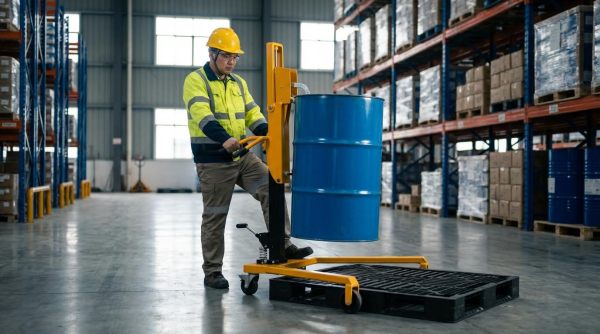
If you are asking “can I transport a 55 gallon drum of toluene,” the answer is yes—but only if you follow strict regulatory and safety rules. This guide explains how laws, engineering controls, and facility practices work together to keep flammable chemical drum moves compliant and low-risk. You will see how drum design, palletizing, grounding, ventilation, and emergency planning all affect real-world operations. Use it as a checklist to align your procedures, equipment, and training with current safety expectations for flammable liquid drums.
Legal Framework For Moving 55-Gallon Flammable Drums

The legal framework for moving 55-gallon toluene drums ties DOT hazmat rules to OSHA workplace safety, so “can I transport a 55 gallon drum of toluene” is answered by how it’s classified, packaged, marked, and handled.
DOT and OSHA definitions for toluene drums
DOT treats toluene in a 55-gallon (≈200 L) drum as a regulated flammable liquid, while OSHA focuses on worker exposure, safe storage, and handling during filling, staging, and loading.
- DOT hazardous material: Toluene is a Class I flammable liquid – its flash point and volatility make it regulated hazmat once offered for transport.
- “Bulk” package threshold: A 55-gallon (≈200 L) drum is a bulk package – it triggers the stricter bulk packaging and placarding rules.
- OSHA flammable liquid: OSHA treats toluene as a flammable liquid that must be kept in closed, labeled containers – this controls vapors and ignition risk where people work.
- Closed container rule: Category 1–3 flammable liquids must be in closed containers when not in use, and spills must be promptly disposed of according to OSHA – this directly applies when staging drums for shipment.
- Worker protection: OSHA requires PPE, labeling, and site-specific safety plans for drum handling – you must brief workers on inhalation, skin, and fire hazards before moving toluene drums.
How this affects “can I transport a 55 gallon drum of toluene?”
If the drum is a closed, labeled container of a Class I flammable liquid, DOT will treat it as hazmat cargo, and OSHA rules will govern how your employees handle, stage, and load it. You are not free to “just move it” like a non-hazardous product.
💡 Field Engineer’s Note: In practice, the biggest compliance gap is not paperwork but staging: open bungs, missing labels, or unprotected ignition sources near loading areas will put you out of compliance with OSHA long before the truck rolls.
UN-rated drum types and packing groups
UN-rated drums for toluene must be performance-tested steel packages matched to the correct packing group, so they survive drops, stacking, and leak tests defined in 49 CFR Parts 173 and 178.
For the question “can I transport a 55 gallon drum of toluene,” regulators first ask whether the drum is an authorized UN performance-tested design and whether it matches the substance’s packing group.
| Regulatory Element | What It Means For Toluene Drums | Operational Impact |
|---|---|---|
| UN performance-tested drum | Steel drum tested for drop, stack, and leak-proofness under 49 CFR Parts 173 and 178 | Withstands normal transport shocks; reduces risk of rupture in a 1.2 m–drop scenario. |
| Authorized drum type | Drum design and closure follow specific test and closure instructions for Class I flammables | Improper or non-UN drums can make the shipment non-compliant even if the drum “looks” strong. |
| Packing group (PG I–III) | Defines how severe the hazard is and sets maximum fill limits and test levels | Overfilling beyond the allowed percentage can cause expansion and leaks during temperature swings. |
| Closure instructions | Specified bolt torque, gasket use, and bung engagement for that drum design | Incorrect torque or missing gaskets is a common cause of seepage during transit. |
- Steel UN drum preference: Steel UN drums are preferred for Class I flammables like toluene – they resist impact and are compatible with aromatic solvents.
- Fill level control: Maximum fill levels by packing group limit liquid expansion – this prevents hydraulic pressure from blowing out gaskets on hot days.
Why packing group matters for a 55-gallon drum
The packing group determines test severity and fill limits. A 200 L drum of a more dangerous PG I liquid must survive tougher tests and may require lower fill levels than PG II or III, even if the drum size is the same.
💡 Field Engineer’s Note: In the field, leaks from “good-looking” drums almost always trace back to ignored closure instructions—especially under-torqued ring bolts or reused, flattened gaskets on UN-rated steel drums.
When a 55-gallon drum becomes “hazmat cargo”
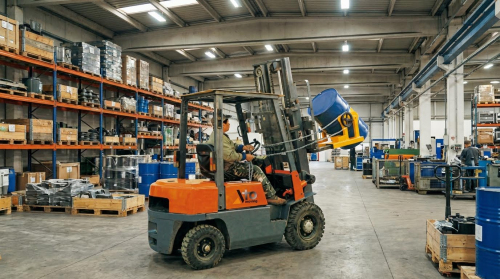
A 55-gallon drum of toluene becomes hazmat cargo as soon as it is offered for transportation as a filled, closed container of a regulated flammable liquid, triggering DOT hazmat, packaging, and securement rules.
If you are asking “can I transport a 55 gallon drum of toluene,” the practical answer is: yes, but only as a fully regulated hazmat load with compliant packaging, marking, documentation, and securement.
| Condition | Regulatory Status | Operational Impact |
|---|---|---|
| Empty, cleaned drum with no residue | Generally not hazmat if properly cleaned and free of vapors | May be shipped as non-hazardous, but many facilities still treat as potentially contaminated. |
| “Empty” drum with toluene residue and vapors | Often still regulated as hazardous due to flammable vapors | Must be closed, labeled, and handled as hazmat to avoid fire risk during transport. |
| Full 55-gallon (≈200 L) drum of toluene | Clearly hazmat cargo as a bulk package of a Class I flammable liquid | Triggers hazmat shipping papers, emergency information, and placarding on the vehicle. |
| Staged drums in a storage/dispensing room | OSHA flammable liquid storage and handling rules apply | Requires closed containers, spill control, and no ignition sources within 15 m (50 ft) at the point of use. |
- Storage vs. transport: While drums sit in your facility, OSHA storage rules dominate; once you load them for shipment, DOT hazmat rules take over – both apply during staging and loading.
- Ignition source separation: Flammable liquids may only be used where no open flames or ignition sources exist within about 15 m (50 ft) under OSHA – this covers loading and unloading zones.
Practical checklist before treating it as hazmat cargo
Before you move a 55-gallon drum of toluene on public roads, confirm: the drum is UN-rated and undamaged; closures are tightened per instructions; labels and markings match the content; staging areas follow OSHA rules for flammable liquids; and the vehicle will secure drums to prevent shifting.
💡 Field Engineer’s Note: From a risk standpoint, the moment you palletize and strap a full toluene drum for outbound shipping, treat it as hazmat even if paperwork is not printed yet—fire does not wait for documentation to be completed.
Engineering Controls For Safe Drum Transport
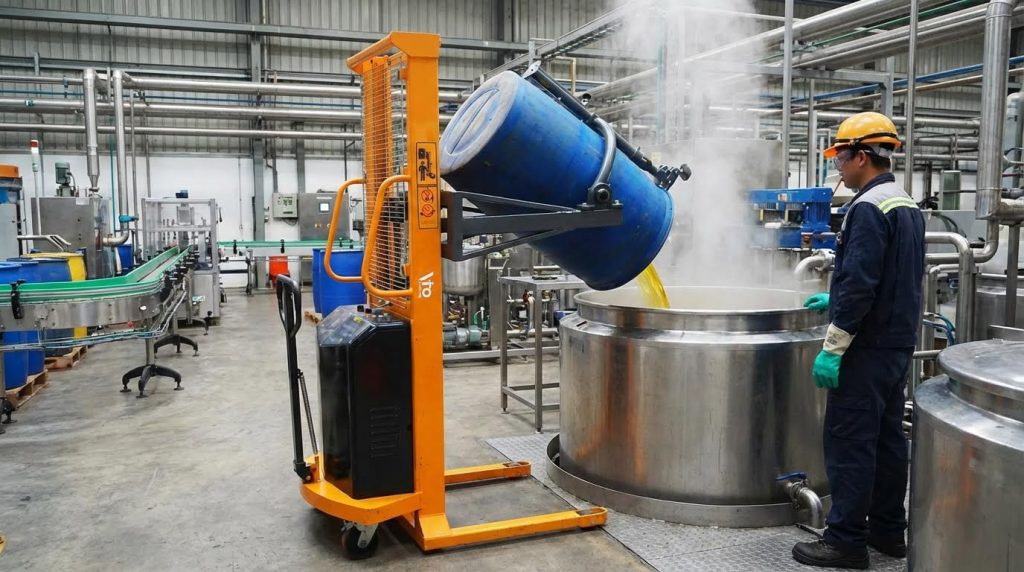
Engineering controls for safe drum transport focus on drum design, palletizing, and static control so a 55-gallon (200 L) toluene drum stays sealed, upright, and non-ignited from filling to delivery.
If you are asking “can I transport a 55 gallon drum of toluene,” the engineering controls below are what make the move compliant and physically safe, as long as you also meet legal hazmat rules covered elsewhere.
Drum and closure design for Class I flammables
Class I flammable liquids like toluene must go in UN performance-tested drums with closures installed exactly as specified by the manufacturer to survive normal transport shocks and prevent leaks.
- UN-rated steel drum: Use a UN performance-tested steel drum sized for 200 L (55 gallons) – Provides resistance to impact, stacking, and rough handling.
- Regulatory basis: Drums must comply with 49 CFR Parts 173 and 178 for authorized types, tests, and fill limits by packing group – Aligns your packaging with federal hazmat transport rules.
- Performance testing: Drums undergo drop, stack, and leak-proofness tests – Reduces the chance of rupture if the pallet is jolted or the truck hits a pothole.
- Closure instructions: Follow the drum’s written closure torque and gasket requirements – Ensures the UN mark remains valid and threads do not weep under vibration.
- Headspace and fill level: Respect maximum fill limits for the packing group – Leaves expansion space so the liquid does not force vapors or product past the gaskets.
How drum design ties into “can I transport a 55 gallon drum of toluene”
You can transport a 55-gallon drum of toluene only if the drum type, UN rating, and closure method match the liquid’s hazard class and packing group, and you apply the manufacturer’s closure instructions.
| Design Feature | Typical Requirement For Class I Flammables | Operational Impact |
|---|---|---|
| Drum material | UN-tested steel drum per 49 CFR 173/178 | Resists puncture if struck by forks or other cargo. |
| Nominal capacity | 200 L (55 gallons) | Matches common handling equipment and pallet patterns. |
| Performance tests | Drop, stack, leak-proofness | Helps drum survive transport shocks without leaking. |
| Closures | Bungs and rings tightened per closure instructions | Prevents vapor and liquid leaks in transit. |
| Fill limit | Set by packing group and liquid properties | Leaves vapor space for thermal expansion. |
💡 Field Engineer’s Note: In hot climates, marginally overfilled drums of toluene often “sweat” or weep at bungs after a few hours on a trailer. Keeping fill below the regulatory maximum and strictly following closure torque specs dramatically cuts these nuisance leaks and rejection at receiving docks.
Palletizing, blocking, and cargo securement rules
Safe drum transport depends on how you palletize, band, and block drums so they cannot tip, slide, or punch through the deck when the vehicle brakes, swerves, or hits uneven floors.
- Pallet type: Use hardwood or plastic pallets with plank gaps under 20 mm – Supports the drum chime evenly and avoids point loading that can dent or crack the shell.
- Strapping: Apply at least two metal or high-strength plastic straps over the drums to the pallet – Clamps drums down so they cannot bounce or walk off the deck.
- Corner protection: Fit corner cleats or edge protectors under straps – Prevents straps from cutting into drum sides and maintains tension.
- Unitization: Band multiple drums together on one pallet – Creates a single rigid load, reducing relative movement between drums.
- Overpack slipcover: Use a full-height 2-ply or 3-ply cardboard slipcover, vertically banded in two directions – Adds side impact protection and keeps labels readable.
- Weight limits: Respect pallet and trailer weight ratings – Maintains vehicle stability and compliance with cargo securement rules.
| Palletizing Element | Typical Practice | Operational Impact |
|---|---|---|
| Pallet construction | Hardwood or plastic, gaps < 20 mm | Prevents drum bottom from deforming between deck boards. |
| Drum pattern | 2×2 or 3×2 drums per pallet, tight-packed | Improves stability and forklift handling. |
| Strap count | ≥ 2 straps per palletized unit | Holds drums to pallet during emergency braking. |
| Overpack cover | Full-height cardboard, 2–3 ply | Protects labeling and reduces minor impact damage. |
| Securement in vehicle | Blocked, braced, or tied down per cargo securement rules | Prevents drum pallets from sliding into doors or bulkheads. |
What happens if pallet gaps exceed 20 mm?
Large gaps concentrate load on narrow drum areas. Under vibration, this can dent the chime or shell, loosening closures and creating leak paths, especially with heavy 200 L drums of dense liquids.
💡 Field Engineer’s Note: The most common failure I see is not drum rupture but pallet collapse. Cheap, damaged pallets with wide deck gaps let 55-gallon drums tilt and chew through boards on rough roads. Upgrading pallet quality is often the cheapest safety improvement you can make.
Grounding, bonding, and static control during transfers
Grounding and bonding controls are mandatory when transferring toluene to or from drums because static discharge can ignite vapor clouds even when there are no obvious ignition sources.
- Ground the vehicle or rack: Connect the truck or drum rack to a verified earth ground before starting transfer – Gives static a low-resistance path away from the vapor space.
- Bond all containers: Attach bonding cables between the transfer system and each drum before opening bungs or starting pumps – Equalizes electrical potential and prevents arcing between metal surfaces.
- Maintain oil-tight connections: Keep all pipe connections and fill caps oil-tight during filling or discharging – Reduces vapor release and leakage around fittings.
- Follow bonding rules: When transferring Category 1, 2, or 3 flammable liquids between containers, bond them unless a metallic floorplate or bond wire already provides continuity. OSHA requires electrical interconnection to prevent static buildup – Directly addresses ignition risk from static discharge.
- Control nearby ignition sources: Keep open flames and other ignition sources at least 15 m (about 50 ft) away when handling Category 1–3 flammable liquids. OSHA requires flammables used only where there are no nearby ignition sources – Prevents a small static spark from becoming a major fire.
| Static Control Measure | Key Requirement | Best For… |
|---|---|---|
| Grounding | Vehicle or rack connected to earth ground | Any loading/unloading of drums on trucks or fixed racks. |
| Bonding cables | Metallic connection between drum, pump, and receiving container | Drum-to-drum or drum-to-tank transfers of toluene. |
| Oil-tight fittings | No visible seepage at caps or couplings | Minimizing vapor cloud size around the transfer point. |
| Ignition source distance | No open flames within about 15 m (50 ft) | Work areas where drums are being filled or emptied. |
Do I need bonding if drums sit on a metal floor?
If a verified metallic floorplate provides continuous electrical contact between the fill stem and container, that may satisfy bonding requirements. However, many facilities still use explicit bonding cables as a safer, auditable practice.
💡 Field Engineer’s Note: In dry climates or cold, low-humidity rooms, plastic hose sections and non-bonded funnels can build surprising static. I have seen visible sparks when operators lifted funnels off toluene drums. Dedicated bonding clamps and anti-static hoses are cheap insurance compared to a flash fire.
Facility Practices, Equipment Choice, And Route Planning
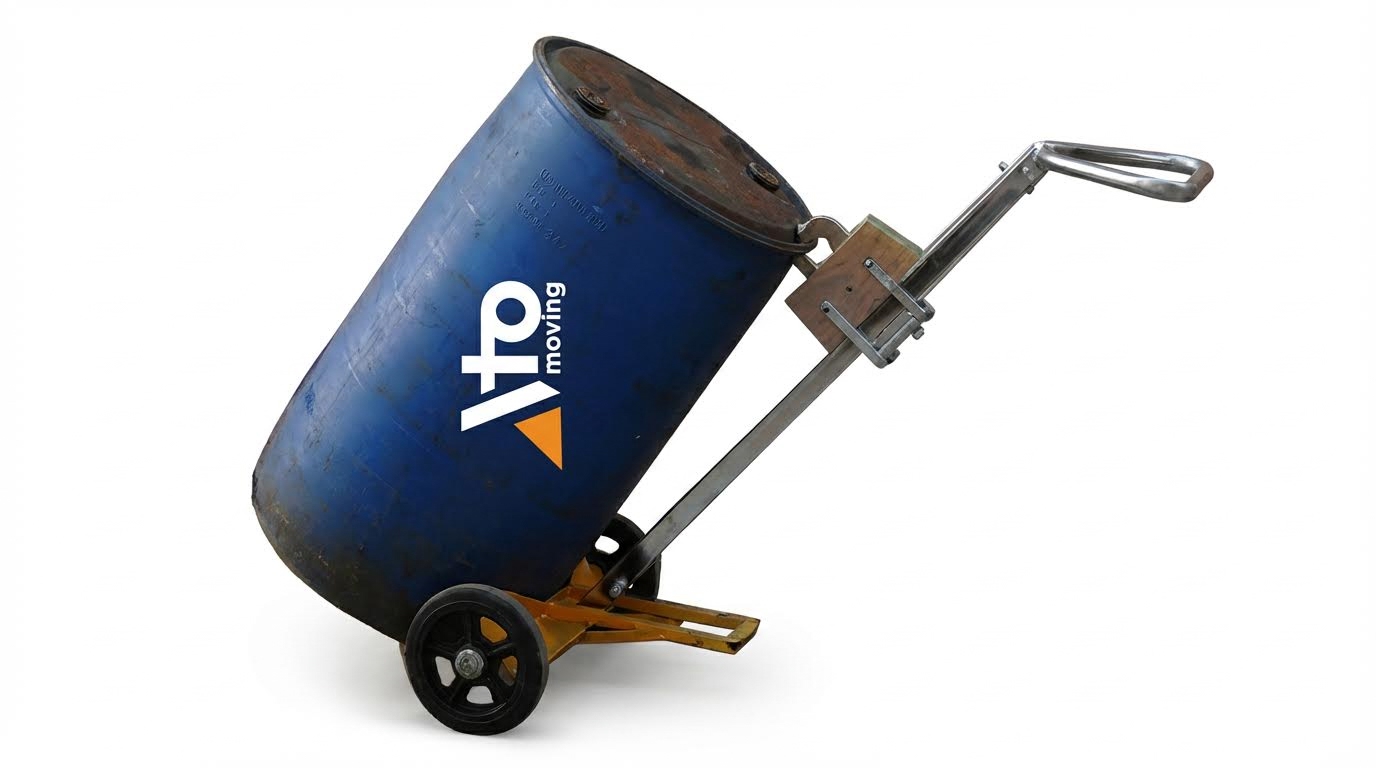
Facility practices, equipment choice, and route planning determine whether you can transport a 55 gallon drum of toluene safely, legally, and without leaks, fires, or worker exposure during day‑to‑day operations.
Selecting handling equipment for flammable drum moves
Handling equipment for flammable toluene drums must control movement, prevent puncture or drop, and support proper grounding and bonding during any transfer.
- Drum trucks and dollies: Use models with curved backs that support the drum chime – reduces denting that could compromise UN performance-tested drums specified in 49 CFR Parts 173 and 178.
- Pallet jacks and forklifts: Move only palletized drums with tight deck boards (gap under 20 mm) – prevents point loading on drum bottoms and chimes during transport.
- Drum clamps and grabs: Use positive-locking clamps around the drum body or chime – prevents slip-offs when crossing dock plates or rough floors.
- Spill pallets and sumps: Place drums on rated containment pallets – captures leaks and supports EPA secondary containment volume requirements.
- Grounding and bonding hardware: Equip transfer areas with fixed grounding lugs and flexible bonding cables – controls static during pumping or gravity dispensing of toluene.
Whenever you ask “can I transport a 55 gallon drum of toluene inside my plant,” the real question is whether your equipment keeps the drum upright, restrained, and bonded from storage rack to truck bed.
How to match equipment to drum condition
Use full-wrap clamps for slightly dented drums and avoid rim-only grabs on plastic or severely deformed steel drums. For sweating or lightly corroded drums, use spill pallets and keep lifts slow to avoid sudden impact loads.
💡 Field Engineer’s Note: Manual drum trucks and pallet jacks struggle on even small ramps; once slope exceeds about 2–3%, a 200 L flammable drum can run away from the operator. Design routes to avoid slopes or use powered equipment with brakes in flammable drum corridors.
Secondary containment and storage room ventilation
Secondary containment and ventilation for toluene drum storage must limit spill spread and keep vapor concentrations below ignition and exposure limits.
- Containment volume: Design sumps to hold at least 10% of total drum volume or the largest single drum, whichever is greater – prevents a single 200 L drum failure from escaping the bunded area.
- Floor slope and drainage: Slope containment bases or provide controlled drains – allows safe removal of rainwater or minor spills while maintaining freeboard.
- Elevated storage: Use grating or pallets above the floor inside containment – keeps drum bottoms out of standing liquid and reduces corrosion.
Inside storage rooms with flammable liquids must have gravity or mechanical exhaust that provides at least six air changes per hour, starting no more than 300 mm above the floor where vapors accumulate. If you dispense Category 1–3 flammable liquids in the room, any mechanical ventilation must interlock with lighting on a switch outside the door, with an electric pilot light showing when the system is on. OSHA ventilation rules for inside storage rooms
| Design Element | Typical Requirement | Operational Impact |
|---|---|---|
| Containment volume | ≥10% of total volume or largest drum | One 200 L drum failure stays inside bunded area |
| Air change rate | ≥6 room air changes per hour | Limits toluene vapor buildup near floor |
| Exhaust inlet height | ≤300 mm above floor | Captures heavier-than-air vapors where they collect |
| Vent/lighting switch | Common external switch with pilot light | Operator confirms ventilation is running before entry |
Storage cabinets vs. rooms
Approved flammable liquid cabinets are suitable up to 60 gallons (≈227 L) of Category 1–3 liquids per cabinet, with a maximum of three cabinets per area. Larger quantities of 55-gallon toluene drums usually require inside storage rooms with dedicated ventilation and containment. OSHA cabinet capacity limits
💡 Field Engineer’s Note: In cold climates, high air-change ventilation can pull in very cold air; metal drums then sweat, accelerating corrosion at the chime. Use coated pallets and regular inspection of chime rust in high-ventilation toluene rooms.
Driver inspections, routing, and emergency readiness
Driver inspections, routing, and emergency readiness answer the practical side of “can I transport a 55 gallon drum of toluene on public roads” by verifying roadworthiness, securement, and contingency planning.
- Vehicle pre-trip inspection: Drivers must check brakes, tires, lights, steering, and couplings – reduces mechanical failures that could overturn or jar drum cargo.
- Cargo area inspection: Verify deck integrity, cleanliness, and absence of protrusions – prevents punctures or abrasion of drum shells during transit.
- Drum condition and closures: Confirm no leaks, bulges, or corrosion and that bungs/closures are tight – minimizes in-transit loss of containment.
- Palletizing and securement: Use hardwood or plastic pallets with gaps under 20 mm, at least two straps, and vertical banding where applicable – keeps drums from shifting, tipping, or rubbing through.
- Route selection: Plan routes that avoid tunnels, dense urban centers, and sensitive environmental areas when possible – reduces impact if a release occurs.
- Alternate routes: Pre-identify backups for closures, accidents, or severe weather – avoids ad hoc detours through high-risk locations.
- Emergency equipment: Carry appropriate fire extinguishers, absorbents, and PPE – allows first response to small leaks or fires.
| Check Item | What to Verify | Operational Impact |
|---|---|---|
| Drum closures | All bungs and rings fully tightened | Prevents sloshing leaks on rough roads |
| Pallet condition | No broken boards, small deck gaps | Maintains even support for 200 L drums |
| Strapping | ≥2 straps per pallet, tight, undamaged | Controls lateral movement in sudden braking |
| Vehicle systems | Brakes, tires, lights, steering OK | Reduces crash risk with flammable cargo |
| Route plan | Primary + alternate low-risk paths | Limits exposure in populated or sensitive areas |
Fire extinguisher placement
For rooms storing over 227 L of flammable liquids, at least one 20-B rated extinguisher must be within 3 m of the door. Each fueling or service area needs a 20-B:C extinguisher within 23 m of pumps or dispensers. OSHA extinguisher distance rules
💡 Field Engineer’s Note: Many incidents with 55-gallon flammable drums happened not from crashes but from slow strap loosening over hundreds of kilometers. Train drivers to recheck strap tension at early stops—thermal expansion and vibration can relax even properly applied cargo straps.
Key Compliance Takeaways For Toluene Drum Transport
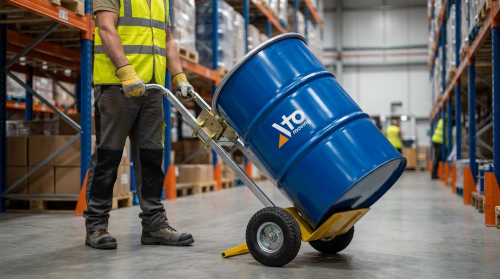
You can transport a 55-gallon (≈200 L) drum of toluene only if you treat it as regulated flammable hazmat, using UN-rated drums, compliant securement, labeled storage, and strict transfer, ventilation, and emergency controls.
- Answering “can I transport a 55 gallon drum of toluene”: Yes, but only as hazmat – you must use UN-rated drums, follow DOT/OSHA rules, and train drivers and handlers.
- Use compliant UN performance-tested drums: Select steel UN-tested drums that meet 49 CFR Parts 173 and 178 – this ensures drop, stack, and leak integrity for Class I flammable liquids like toluene.
- Respect drum closure instructions: Follow the drum manufacturer’s closure torque and gasket instructions – prevents leaks that can turn a minor bump into a fire or environmental incident.
- Design storage with secondary containment: Size containment for ≥10% of total volume or one full drum, whichever is larger – captures a full 200 L drum loss and meets EPA-style containment expectations.
- Keep pallets and banding to standard: Use pallets with gaps <20 mm and at least two high-strength straps per pallet – reduces drum denting, tipping, and load shift in braking or cornering.
- Secure multi-drum pallets as one unit: Banded groups plus full-height slipcovers vertically strapped to the pallet – create a rigid “block” that behaves predictably in transport.
- Inspect vehicle and drums pre-trip: Check brakes, tires, lights, couplings, and drum closures and leaks – catches mechanical or packaging failures before they become road emergencies.
- Plan low-risk routes: Avoid tunnels, dense population centers, and sensitive water bodies when alternatives exist – limits impact if a toluene spill or fire occurs.
- Ground and bond before any transfer: Attach bonding cables between transfer system, vehicle, and drum before opening – equalizes potential and reduces static-spark ignition risk.
- Label and treat drums as hazardous until proven otherwise: Keep compliant labels on every closed drum; treat unlabeled drums as hazardous – prevents accidental mixing or mishandling of toluene.
- Train workers and issue PPE: Brief staff on inhalation, skin-contact, and fire hazards, and provide gloves, goggles, and flame-resistant clothing as needed – reduces injury during normal handling and spills.
- Use approved flammable storage cabinets for small quantities: For indoor staging above 95 L but under typical cabinet limits, use approved cabinets built to OSHA construction rules – adds a fire barrier between toluene drums and the workspace.
- Ventilate storage rooms adequately: Provide gravity or mechanical ventilation with at least six air changes per hour, starting ≤300 mm above the floor – flushes heavy flammable vapors that pool low.
- Keep extinguishers close to drum areas: Place 20-B or 20-B:C rated extinguishers within required distances of storage and transfer points – allows rapid first attack on a drum fire.
- Use automatic-closing nozzles and approved pumps: Transfer toluene only with approved, leak-tight, automatic-closing equipment – minimizes accidental discharge and splash.
- Control ignition sources near drums: Keep open flames and hot work at least 15 m away from toluene handling, unless a more conservative distance is required – prevents vapor ignition during filling or unloading.
- Respect outdoor tank and bulk spacing if using intermediate storage: Keep portable tanks at least several meters from buildings and each other with fire access lanes – prevents fire spread and allows firefighters room to work.
- Handle spills immediately and safely: Keep toluene in closed containers when not in use and clean leaks promptly – reduces vapor buildup and slip/fire hazards around drum areas.
- Control heating equipment in drum areas: Install heaters at specified minimum heights and protect them from impact – avoids hot-surface ignition near vapors and vehicles.
- Document and audit your system: Maintain written procedures for inspection, securement, transfer, emergency response, and routing – proves due diligence and keeps day-to-day operations consistent.
Quick checklist before moving a 55-gallon toluene drum
- Step 1: Confirm drum is UN-rated and compatible – ensures regulatory and mechanical integrity.
- Step 2: Verify labels, closures, and no leaks – prevents misidentification and in-transit release.
- Step 3: Place on compliant pallet and strap per rules – stops shifting and tipping in transit.
- Step 4: Ground and bond before any transfer – controls static during pumping or gravity feed.
- Step 5: Check vehicle, route, and emergency gear – reduces risk if something goes wrong on the road.
💡 Field Engineer’s Note: When you ask “can I transport a 55 gallon drum of toluene,” regulators effectively hear “can I move a mobile fire and vapor cloud.” Treat every move as a full hazmat operation, not a routine freight job, and your incident rate drops dramatically. Consider using specialized equipment such as a drum dolly or drum transporter to ensure safe handling. Additionally, tools like a forklift drum grabber double grips can help manage large volumes efficiently.

Key Compliance Takeaways For Toluene Drum Transport
Moving a 55-gallon drum of toluene safely depends on how well you align law, engineering, and day-to-day practice. DOT and OSHA rules define the hazard, but your packaging, palletizing, and routing choices decide whether that hazard stays controlled. UN-rated steel drums, correct fill levels, and properly torqued closures keep product inside the package when trucks hit potholes or pallets flex. Good pallets, tight strapping, and solid blocking stop drums from shifting, tipping, or punching through decks under hard braking.
Grounding, bonding, and ventilation manage invisible risks from vapors and static. Secondary containment, drainage, and air changes per hour turn a storage room into a controlled environment instead of a potential flash-fire box. Inside and outside the plant, driver inspections and route planning close the loop by catching defects early and avoiding high-consequence corridors.
The best practice is simple but strict: treat every full toluene drum as mobile fire load. Use UN-tested drums, quality pallets, and purpose-built handling gear from Atomoving. Ground and bond every transfer. Ventilate and contain every storage zone. Plan routes and train people as if a release is always possible. When you do that, compliance and real safety move in step.
Frequently Asked Questions
Can I transport a 55-gallon drum of toluene?
No, you cannot transport a 55-gallon drum of toluene unless it is in compliance with specific transportation regulations. Toluene must be transported in originally sealed containers or in approved safety cans with a capacity of 5 gallons or less. For larger quantities, specialized truck-mounted equipment designed for hazardous chemicals is required. NYSDOT Toluene Guidelines.
What are the storage conditions for toluene?
Toluene must be stored under strict conditions due to its classification as a hazardous air pollutant. It should be kept in durable, sealed containers made of materials like carbon fiber steel that comply with EPA and DOT regulations. Avoid plastic drums as they may not meet safety standards. Hazardous Material Storage Tips.
Is toluene restricted?
Yes, toluene is subject to restrictions as it is regulated as a hazardous air pollutant by the EPA. Its use and transportation are governed by emission limitations and safety guidelines within the synthetic organic chemicals manufacturing industry. Toluene Regulations Overview.