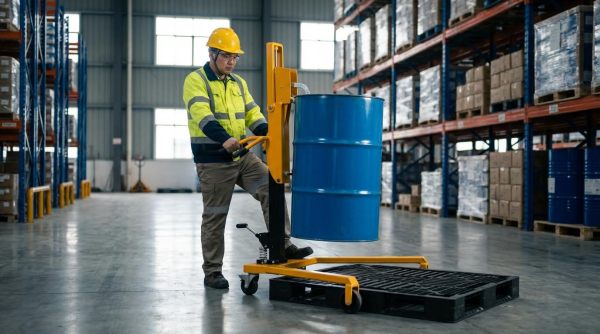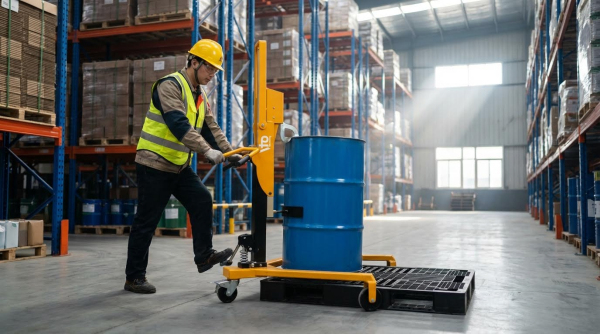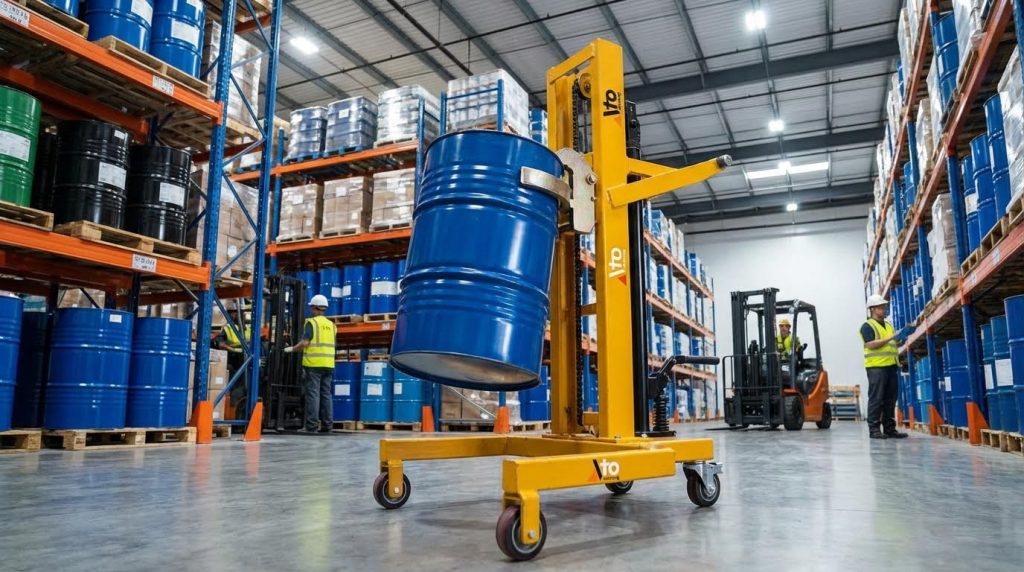
This guide explains exactly how many drums on a pallet you can store safely, and how to arrange them for stability, containment, and code compliance. You will see standard drum sizes, 2×2 patterns, stacking limits, and how pallet choice affects center of gravity and floor loads.
Engineering Basics Of Drum Pallet Patterns
Engineering basics for drum pallet patterns explain how drum diameter, pallet footprint, and clearances dictate how many drums on a pallet you can store safely without losing stability or violating handling limits.
In this section we translate drum geometry into practical pallet layouts and clearances. You will see why a “standard” four‑drum pallet works, and what changes when drums, pallets, or regulations are different.
Standard drum sizes and pallet footprints
Standard drum sizes and pallet footprints set the geometric limit for how many drums on a pallet you can place without overhang or instability.
A typical 200 L (55‑gallon) steel drum has an outside diameter of about 584 mm and a height around 880–900 mm. Engineers normally treat 600 mm as a design diameter to allow for tolerances and out‑of‑round shells. Recommended lateral clearance between drums on a pallet is about 25–50 mm to absorb these tolerances and make placement practical without binding or interference between chimes. Guidance documents highlight this clearance range.
Once you know drum diameter and required clearance, the pallet footprint becomes a straightforward geometry problem. For four drums in a 2×2 pattern, you need two drum diameters plus two clearance gaps in each direction, and you must keep the combined center of gravity inside the pallet perimeter during handling.
| Item | Typical Value / Range | Engineering Note | Operational Impact |
|---|---|---|---|
| Standard drum nominal volume | 200 L (55‑gallon) | Most industrial liquid drums use this size as the design basis. | Defines default assumptions for pallet layouts and containment sizing. |
| Outside drum diameter | ≈584 mm | Often rounded to 600 mm for layout calculations. | Controls how many drums on a pallet can fit without overhang. |
| Drum height | ≈880–900 mm | Impacts stack height and sprinkler clearance. | Affects how many tiers you can stack under a given ceiling. |
| Recommended drum‑to‑drum clearance | 25–50 mm | Allows for out‑of‑round drums and placement tolerances. | Reduces risk of chime damage and binding during loading. |
| Preferred pallet for 4 drums | 1,219 × 1,219 mm (48″ × 48″) | Provides robust support and edge clearance for a 2×2 layout. | Standard answer to how many drums on a pallet: four 200 L drums. |
| Minimum pallet for 4 drums | ≈1,168 × 1,168 mm | Industry notes this as a lower limit with tighter tolerances. Reference layout data. | Less forgiving for damaged pallets or slightly oversized drums. |
| Typical spill pallet for 2 drums | ≈686 × 1,245 × 356 mm (W×L×H) | Dedicated footprints for two 200 L drums with sump below. Spill pallet geometry. | Used where secondary containment is mandatory but space is tight. |
| Typical spill pallet for 4 drums | ≈1,245 × 1,245 × 356 mm | Matches a 2×2 drum footprint with integrated sump. | Allows four drums with compliant containment in one module. |
From a pure geometry standpoint, a 1,219 mm by 1,219 mm pallet comfortably fits four 584 mm drums in a square pattern with modest edge clearance. Anything smaller than roughly 1,170 mm square begins to push drums toward the pallet edge and increases the risk of overhang, especially with dented or bulged drums.
- Key takeaway: A standard 1,219 mm square pallet is optimized for four 200 L drums – this is why “four drums per pallet” became the industry default answer to how many drums on a pallet.
- Non‑standard drums: Tall, slim, or plastic drums can change the usable count – you must re‑check diameter and required clearances, not just copy the 4‑drum pattern.
- Deck board design: Narrow or widely spaced boards create point loads at the drum chime – this can dent shells and reduce allowable stacking height.
How to do a quick pallet fit check in the field
Take the measured drum diameter (in mm), add 25–50 mm for clearance, then double it for a 2×2 pattern. If that total exceeds the pallet width or length, you will either have overhang or inadequate clearance. Always verify both directions and remember that damaged drums can be several millimeters out‑of‑round.
💡 Field Engineer’s Note: When you are close to the geometric limit, always test with your worst drums first—the slightly bulged, dented, or rust‑banded ones. If those fit with at least 25 mm clearance and no overhang on a 1,219 mm pallet, your clean drums will be fine. If they do not, downgrade that zone to a three‑drum or two‑drum layout instead of forcing a tight four‑drum pattern that will fight operators and damage chimes.
Clearances, stability, and center of gravity
Clearances, stability, and center of gravity control whether a given drum count per pallet is only “geometrically possible” or actually safe under OSHA and fire‑code driven handling conditions.
Even when four drums fit on the pallet by measurement, you still need enough clearance for safe handling, strapping, and inspection, and you must keep the combined center of gravity within the pallet footprint. Symmetric 2×2 layouts do this naturally; asymmetric patterns can pull the center of gravity toward one corner and increase tip‑over risk during forklift acceleration, braking, or turning.
- Symmetry: Place drums in a tight square centered on the pallet – this keeps the center of gravity near the pallet centerline and minimizes overturning moments.
- Edge clearance: Maintain visible edge margin, not just drum‑to‑drum gaps – operators need tolerance for imperfect placement and pallet skew on forks.
- Vertical alignment: When stacking pallets, align upper pallets over the lower pallet center – this keeps load paths straight and avoids eccentric loading on rack beams or floor.
Clearance also interacts with containment and access. Spill pallets for one to four drums provide fixed pockets that hold drums away from the edge while keeping tops accessible for pumps and funnels. Typical four‑drum containment pallets around 1,245 mm by 1,245 mm maintain drum centers inside the sump perimeter and protect against small placement errors. Containment pallet designs illustrate this balance.
| Design Aspect | Typical Practice | Why It Matters | Best For… |
|---|---|---|---|
| Drum‑to‑drum clearance | 25–50 mm | Prevents metal‑to‑metal rubbing and allows for out‑of‑round drums. | General warehouse storage and transport. |
| Drum‑to‑edge clearance | Visible gap, ideally ≥25 mm | Keeps center of gravity inside pallet and protects drums from impacts. | Forklift handling, loading into racks or trailers. |
| Layout symmetry | 2×2 square centered on pallet | Minimizes eccentric loading and tipping risk. | Standard four‑drum pallets. |
| Containment sump perimeter | Drum centers inside sump walls | Ensures leaked liquid remains captured. | Hazardous liquid storage with regulatory containment. |
| Clearance for handling tools | Space for clamps, hooks, or pumps | Prevents tool interference and accidental drum strikes. | Areas using drum handlers or installed pumps. |
From a stability standpoint, the basic rule is simple: if you shift one drum outward or remove a drum from a four‑drum pattern, you must re‑evaluate the center of gravity. Three‑drum layouts on a square pallet can be safe, but only when you keep the remaining drums close to the pallet center and avoid “L‑shaped” patterns that drag the center of gravity toward one corner.
Quick center‑of‑gravity check for a 4‑drum pallet
For a symmetric 2×2 pattern, imagine the pallet as a square and place each drum center at the corners of a smaller square inside. The combined center of gravity sits at the intersection of the diagonals of that inner square, which is also the pallet center. As long as every drum is within its marked pocket and you have no overhang, the center of gravity will remain well inside the pallet footprint.
💡 Field Engineer’s Note: If operators keep “losing” drums off one side of a pallet during tight forklift turns, it is usually not a strapping problem—it is an off‑center layout problem. Paint or stencil a simple 2×2 drum grid on the pallet deck or spill pallet grating. Once drum centers sit on those marks, your effective center of gravity comes back to the pallet center, and tip‑over events drop dramatically, even at busy shift speeds.
Safe Loading Patterns And Stack Engineering
This section explains how many drums on a pallet you can safely place, how to stack them, and how to keep floor and rack loads within engineering and code limits.
For standard 200 L (55-gallon) drums, safe palletization is less about “how many drums on a pallet” in theory and more about drum diameter, pallet footprint, load rating, and stacking rules that keep the center of gravity and floor loads under control.
2×2 drum layouts on 48″ and spill pallets
A 2×2 pattern on a square pallet is the default engineering answer to how many drums on a pallet for 55-gallon drums: four drums on about 1,200 mm × 1,200 mm, with controlled gaps and no overhang.
Standard 55-gallon drums have an outside diameter around 584 mm and height about 880–900 mm. Engineers normally allow 25–50 mm lateral clearance between drums to absorb manufacturing tolerances and out‑of‑round conditions while still keeping the center of gravity inside the pallet footprint. Guidance on drum dimensions and clearances shows why a tight but symmetric layout matters.
| Configuration | Typical Pallet / Deck Size | Drum Count | Key Geometry | Operational Impact |
|---|---|---|---|---|
| Standard 2×2 on square pallet | 1,219 × 1,219 mm recommended; 1,168 × 1,168 mm minimum | 4 × 208 L drums | Drum Ø ≈ 584 mm; small edge and inter-drum gaps | Keeps overall center of gravity inside pallet and avoids drum overhang in racks and on forks. |
| 2-drum steel spill pallet | ≈ 686 × 1,245 × 356 mm (L × W × H) | 2 drums | Dedicated footprints in a row | Good where aisle depth is tight but you still need pump/funnel access on top. Reference for spill pallet dimensions |
| 4-drum steel spill pallet | ≈ 1,245 × 1,245 × 356 mm | 4 drums | Square containment footprint | Matches a 2×2 pattern while keeping drum centers inside sump perimeter for compliant secondary containment. |
| 6-drum containment deck | ≈ 3,400 × 1,600 × 460 mm | 6 drums | 2 or more rows with service aisles | Bulk storage; allows inspection gaps and attachment access while providing up to ≈1,100 L sump volume. |
| 10-drum containment deck | Elongated basin up to ≈1,600 L sump volume | 10 drums | Multiple rows | Used as a storage zone, not a single “pallet” for transport; requires planned aisles and handling routes. |
- Symmetric 2×2 pattern: Place four drums in a tight square with equal gaps – this keeps the combined center of gravity close to the pallet centerline and reduces tipping risk during forklift turns.
- No overhang rule: Drum chimes must sit fully on the deck boards – overhang dents shells, creates point loads, and undermines rack stability.
- Deck-board spacing: Use pallets with tight deck spacing and sound stringers – large gaps create local bearing points on the drum bottom and can lead to corrosion sites.
- Spill pallet fit: Use spill pallets sized specifically for 1–4 drums – this maintains sump coverage and pump/funnel access while keeping drum centers inside the containment perimeter.
💡 Field Engineer’s Note: When operators ask “Can we squeeze a fifth drum on there?”, the engineering answer is no. Any layout that forces overhang or asymmetric placement usually violates rack clearances, overloads deck boards locally, and invalidates spill-containment geometry.
How many drums on a pallet in special cases?
For non-standard drums (smaller diameters, plastic drums, or tight warehouse constraints), engineers sometimes use 3-drum layouts or custom pallets. The same rules still apply: keep the center of gravity within the footprint, avoid overhang, and maintain enough clearance for handling tools, strapping, and labels.
Load ratings, floor loads, and rack interfaces
Safe drum pallet patterns depend on matching drum weight, pallet rating, floor capacity, and rack beam ratings so the full stack remains within mechanical and code limits.
A typical 55-gallon drum filled with a water-like liquid weighs around 200–220 kg including tare. With a specific gravity of 1.5, the same drum approaches 300 kg. Industry guidance on drum weights and density effects shows why you cannot assume one fixed drum mass. For a 2×2 pallet, that means roughly 800–1,200 kg per palletized load before adding pallet and dunnage mass.
| Element | Typical Engineering Check | What To Verify | Operational Impact |
|---|---|---|---|
| Pallet load rating | Must exceed drum + pallet + dunnage mass | For four drums at up to ~300 kg each, design for ≥ 1,200 kg plus margin | Prevents deck or stringer failure during handling and in racks. Guidance on pallet load ratings |
| Floor load (slab) | Convert total mass to kN/m² | Include pallet, dunnage, and stacked tiers; compare to slab rating with safety factor | Avoids slab cracking and differential settlement in high-density drum storage zones. Reference on floor load checks |
| Rack beam capacity | Check per-pallet and per-level rating | Four-drum pallets can reach 1,000 kg+; confirm beam labels and deflection limits | Prevents beam yielding or connector failure under long-term static loads. |
| Post / point loads | Check bearing under rack uprights | Concentrated loads may need base plates or load spreaders | Protects floors from punching shear and local crushing. |
| Containment volume | EPA-type rules (e.g., 110% of largest drum or 25% of total) | Spill pallet sump must handle worst-case leak | Keeps storage compliant and limits clean-up footprint after a leak. Reference for containment rules |
- Use rated pallets only: Never guess; confirm the pallet’s dynamic and static load rating – this is critical when contents can reach specific gravity 1.5 and push drum mass toward 300 kg.
- Account for dunnage and strapping: Add the mass of plywood sheets, planks, and securing systems – this keeps floor and rack load calculations honest.
- Respect rack labels: Do not exceed posted per-level and per-bay capacities – overloading a single beam level with heavy drum pallets is a common failure mode.
- Signage and zoning: Post maximum tiers and floor load limits in each zone – this prevents operators from adding “just one more pallet” during peak shifts.
💡 Field Engineer’s Note: In drum warehouses, failures rarely start with the drum. They start with an underrated pallet or rack beam that was never designed for repeated 1,000+ kg loads, especially when forklifts impact uprights or drop pallets hard into beams.
How to approximate floor load from drum pallets
Take total stack mass (drums + pallets + dunnage) and divide by the contact area of the pallet or rack base. Convert to kN/m² and compare with the slab design rating. If concentrated through rack posts, use the post base area instead and check bearing stress against concrete capacity.
Stacking limits, dunnage, and blocking design
Stack height for drum pallets is limited by drum strength, liquid density, temperature, and the quality of dunnage and blocking used between tiers.
Industry practice and regulations allow steel drums with contents up to specific gravity 1.5 to stack four-high when they pass 49 CFR top-load tests equivalent to a 3 m column for 24 hours. For heavier contents or ambient temperatures above 30 °C, stacks typically reduce to three-high, with overall palletized heights around 3.0 m for three tiers and 4.2 m for four tiers to preserve stability and sprinkler effectiveness. Guidance on drum stacking heights and conditions ties these limits to real test data.
- Symmetric stacking: Keep each upper pallet centered over the lower one – this minimizes eccentric loading and overturning moments.
- Dunnage between tiers: Use planks, plywood sheets, or full pallets as interlayers – they spread load evenly to lower drum chimes and prevent point loading.
- Dunnage stiffness: Select thickness and grade that do not bow noticeably under full stack weight – bowing shifts load to outer drums and increases chime stress.
- Chocking and blocking: Chock the bottom tier on both sides and block any drums on their sides – this satisfies OSHA requirements that stacked materials be blocked and secured to prevent sliding or collapse.
- Visual stack limits: Mark maximum allowed tiers directly on rack uprights or walls – operators see the limit at a glance instead of guessing.
| Stack Condition | Typical Limit | Key Constraints | Best For… |
|---|---|---|---|
| Standard SG ≤ 1.5, moderate temperature | Up to 4 pallets high | Overall height ≈ 4.2 m; compliant with NFPA/OSHA guidance | Indoor, controlled warehouses with good rack protection and inspections. |
| High SG > 1.5 or hot zones > 30 °C | Limit to 3 pallets high | Overall height ≈ 3.0 m; reduced shell and chime stress | Chemicals with high density or storage near roof decks with heat build-up. |
| Mixed drum condition or older drums | 2 pallets high or floor-only | Used where inspection shows dents, corrosion, or label loss | Quarantine areas, rework zones, or exterior storage. |
💡 Field Engineer’s Note: If you see dunnage bowing or drums “leaning” in a stack, treat it as a near-miss. Reduce stack height immediately and upgrade dunnage; leaning stacks are early warnings of chime overload or pallet distortion.
Practical blocking and inspection tips
Use timber or engineered chocks that match drum curvature so the load transfers over a broad area, not a line contact. During weekly inspections, look for rust, bulging, dented chimes, or unreadable markings. Any suspect drum should leave stacked service and move to a controlled area, and stack height in that bay should be reviewed until root causes are understood.
Selecting Pallets, Containment, And Handling Systems
Selecting pallets and containment for drums means matching footprint, load rating, sump volume, and handling method so your chosen pattern for how many drums on a pallet stays stable, compliant, and automation-ready over its full lifecycle.
This section links pallet material, spill deck geometry, and AGV/forklift interfaces to real drum layouts, so you can decide how many drums per pallet you can store safely in your specific facility.
Steel vs polyethylene pallets and spill decks
Steel and polyethylene drum pallets both carry four 200 L (55-gallon) drums, but they behave very differently under load, chemicals, and heat, which directly affects safe pallet patterns and stack height.
Use the table below to align material choice with typical drum counts and operating conditions.
| Feature | Steel Drum/Spill Pallets | Polyethylene Drum/Spill Pallets | Operational Impact |
|---|---|---|---|
| Typical 4-drum spill pallet size | ≈1,245 mm × 1,245 mm × 356 mm for four 208 L drums steel containment pallet dimensions | Poly units sized for 1–4 drums with similar footprints and integrated sumps of about 60–66 gallons (≈230–250 L) polyethylene spill pallet layouts | Both support standard 2×2 layouts; exact footprint drives aisle clearances and rack fit. |
| Load behavior | High stiffness and low deflection under concentrated drum chime loads steel spill pallet designs | More elastic; noticeable deflection under high mass or heat, especially near support ribs polyethylene spill pallet designs | Steel better for tall stacks or high specific gravity liquids; poly better for moderate loads and chemical resistance. |
| Temperature and fire exposure | Tolerates hot drums and sparks; better fire behavior steel vs polyethylene designs | Excellent chemical resistance but softens at elevated temperatures and needs fire-risk review | Hot fill lines and welding areas favor steel; indoor chemical stores often favor poly with fire controls. |
| Sump capacity | Two-drum: ≈686 mm × 1,245 mm × 356 mm; four-drum: ≈1,245 mm × 1,245 mm × 356 mm, sized to meet 110%/25% containment rules sump capacity requirements | Integrated sumps around 60–66 gallons (≈230–250 L) for up to four drums | Both can meet EPA 40 CFR 264.175 by design; always verify label vs your largest drum size. |
| Chemical compatibility | Good for oils, fuels, many organics; may corrode with aggressive chemicals | Excellent for many corrosives and aqueous chemicals | Check SDS and compatibility charts before locking in pallet material for a product family. |
| Typical drum count per module | 2, 4, 6, or 10-drum systems; six-drum footprints around 3,400 mm × 1,600 mm × 460 mm with up to ≈1,100 L sump; ten-drum units up to ≈1,600 L sump six- and ten-drum containment arrangements | Commonly 1–4 drums per deck; larger systems combine modules into rows | Use 2- or 4-drum units for flexible layouts; 6- or 10-drum basins for bulk storage zones with service aisles. |
| Weight and handling | Heavier; often moved only by forklift | Lighter; easier to reposition, sometimes by two-person manual handling | Poly simplifies re-layout projects; steel suits fixed, long-term installations. |
| Lifecycle and cost | Higher purchase price but long life and strong mechanical robustness lifecycle tradeoffs | Lower mass and often lower initial cost; life depends heavily on UV, impacts, and chemical exposure | Run a lifecycle cost vs risk comparison, not just a purchase price comparison. |
- Containment-first selection: Size the sump to the largest drum on the pallet – this constrains how many drums on a pallet you can store in one containment cell while still meeting EPA 40 CFR 264.175.
- Footprint vs aisle width: Verify that 2-drum and 4-drum pallet widths leave legal egress and forklift clearance – this avoids “perfect on paper” layouts that fail in real aisles.
- Access for pumps and funnels: Choose deck designs that keep drum tops clear – operators can install pumps without climbing on pallets or over sumps.
- Stacking strategy: Use steel pallets where you plan three- or four-high drum stacks – reduced deflection keeps load paths predictable.
- Cleaning and leak visibility: Prefer smooth, sloped sumps with removable grates – faster cleanup and easier leak detection during inspections.
💡 Field Engineer’s Note: In mixed fleets, I specify a single “standard” 4-drum spill pallet footprint and then build every layout around that module; it simplifies training, rack fit checks, and answers to how many drums on a pallet per bay without re-calculating each time.
How many drums on a pallet: tying material choice to drum count
With standard 584 mm diameter drums, both steel and poly 1,219 mm × 1,219 mm pallets comfortably support four drums in a 2×2 square, which is the practical upper limit for a single pallet layer in most facilities. Larger 6- and 10-drum containment pallets simply repeat these 2×2 or 2×3 modules in rows, keeping clear inspection aisles between groups.
AGV-ready pallets, four-way entry, and automation
AGV-ready, four-way-entry pallets keep drum loads repeatable and centered so automated trucks can reliably pick up, move, and store drum pallets without fighting misaligned fork pockets or unstable patterns.
Automation does not change the geometry of how many drums on a pallet you can place, but it tightens tolerances on pallet dimensions, fork openings, and under-clearance.
| Feature | Typical Specification | Why It Matters For Drum Pallets | Best For… |
|---|---|---|---|
| Four-way fork entry | Fork access on all four sides of the pallet four-way entry | Allows approach from multiple angles while keeping a tight 2×2 drum pattern; reduces need for spin moves in narrow aisles. | High-throughput warehouses and retrofits where aisle width is fixed. |
| AGV under-clearance | ≈90–110 mm from floor to pallet bottom AGV compatibility | Ensures AGV forks or lift tables can enter without scraping sumps or dragging on uneven floors. | Automated storage zones and transfer points between manual and AGV handling. |
| Dimensional tolerance | Tight control of pallet length, width, and fork pocket positions for repeatable docking AGV docking reliability | Reduces AGV mis-picks and collisions, especially with tall drum stacks where a small skew becomes a big moment arm. | Facilities with high automation uptime targets. |
| Standard drum layout | Four 55-gallon (≈208 L) drums in a 2×2 pattern on 1,220 mm × 1,220 mm pallets pallet selection and layout | Keeps combined center of gravity near pallet centerline, which AGVs depend on for stable travel and turning. | Baseline pattern for both manual forklifts and AGVs. |
| Load rating vs drum mass | Each filled drum ≈200–220 kg for water-like liquids; up to ≈300 kg at specific gravity 1.5 drum weight vs density | Four drums can easily exceed 800–1,000 kg; AGV and pallet ratings must exceed this with margin. | Any operation stacking or moving full hazardous drums. |
| Digital twin validation | Simulation of 48″ × 48″ (≈1,219 mm × 1,219 mm) pallets and spill decks with various drum counts digital twins for layout optimization | Lets you test AGV paths, turning radii, and rack approaches before cutting steel or buying pallets. | Greenfield sites and major retrofits. |
- Keep patterns simple: Standardize on four-drums-per-pallet in a 2×2 pattern for AGV lanes – this makes software logic and safety rules far easier to maintain.
- Align pallet spec with AGV forks: Fix fork pocket spacing and height in your pallet spec – AGV integrators can then tune docking algorithms once and reuse them.
- Check floor flatness vs under-clearance: If floors are uneven, aim for the higher end of the 90–110 mm under-clearance – this prevents AGVs from grounding on high spots under heavy drum loads.
- Use symmetric loading: Place drums symmetrically around the pallet centerline – AGV stability models assume this; asymmetric loading can trigger nuisance faults or tip risks.
- Combine with predictive maintenance: Use sensor data on lift cycles and load weights to schedule fork and mast inspections – this is critical when moving 400–1,000 kg drum pallets repeatedly predictive maintenance strategies.
💡 Field Engineer’s Note: When commissioning AGVs for drum work, I always run a “worst-case” test with four maximum-density drums at the tallest allowed stack height; if the AGV can stop, turn, and dock smoothly with that load, everything else is inside the safety envelope.
How automation changes your answer to “how many drums on a pallet”
Automation rarely increases the drum count per pallet beyond four standard 55-gallon drums on a 1,220 mm × 1,220 mm footprint. Instead, it locks that pattern in and pushes you to standardize pallets, fork openings, and stack heights so AGVs and cob
Final Engineering Considerations And Best Practices
This section converts pallet and drum theory into a short, practical checklist so you can answer “how many drums on a pallet” safely, repeatedly, and in compliance with codes and floor limits.
- Confirm how many drums on a pallet structurally: Multiply drum mass by drum count and compare to pallet rating – Prevents hidden overloads and deck failure.
- Start from drum geometry, not guesswork: Use actual drum diameter and clearance to choose pallet footprint – Keeps the center of gravity inside the pallet.
- Design for the worst liquid, not the average: Size pallets and stacks for the highest specific gravity you store – Maintains safety margin when contents change.
- Use symmetric 2×2 layouts as your default: Place four drums in a tight square around the pallet centerline – Minimizes tipping and rack beam torsion.
- Integrate containment rules early: Check sump volume against EPA-style 110% / 25% criteria – Avoids rework of layouts later.
A standard 208 L (55-gallon) drum is about 584 mm in diameter, so four drums need roughly 1,168 mm by 1,168 mm of clear footprint with small gaps. Industry guidance therefore treats a 1,219 mm by 1,219 mm pallet as the practical standard for four-drum 2×2 layouts, keeping the combined center of gravity well inside the pallet edges. Reference data shows 1,168 mm by 1,168 mm as a minimum, but 1,219 mm by 1,219 mm gives better handling tolerance.
From a load perspective, a water-like product gives each filled drum a mass around 200–220 kg, so a four-drum pallet runs at roughly 800–880 kg before adding pallet and dunnage mass. For denser liquids with specific gravity near 1.5, each drum can approach 300 kg, pushing a four-drum pallet near 1,200 kg. Source guidance therefore recommends checking pallet ratings against the heaviest foreseeable liquid, not just water.
- Rule-of-thumb answer to how many drums on a pallet: Use four 208 L drums on a 1,219 mm by 1,219 mm pallet with no overhang – Balancing capacity, stability, and code-compliant stacking.
- Limit exotic layouts: Avoid five- or six-drum patterns on a standard pallet unless validated by testing – Prevents eccentric loading and aisle encroachment.
- Match pallet material to environment: Use steel near heat or sparks and polyethylene where chemical attack dominates – Reduces deformation and leak risk.
💡 Field Engineer’s Note: When you move from four to six drums on extended containment decks, the limiting factor often becomes floor load in kN/m² rather than pallet strength. Always re-run slab and rack bearing checks before adding “just two more drums” to a bay.
How to quickly sanity-check floor loads
Estimate total palletized mass (drums plus pallet plus dunnage) and divide by pallet contact area in m² to get kN/m². Compare this to the slab or mezzanine rating with a conservative safety factor. Where rack posts or narrow pallets create concentrated loads, use spreader plates or reduce tiers.
Containment pallets and spill decks follow the same geometric logic but add sump capacity and chemical compatibility. Two-drum steel containment pallets often use footprints near 686 mm by 1,245 mm by 356 mm, while four-drum units move to about 1,245 mm by 1,245 mm by 356 mm, keeping drum centers within the sump perimeter and leaving access for pumps and funnels. Polyethylene spill pallets for one to four drums integrate sumps in the 60–66 gallon range, balancing drum spacing with required containment volume. Reference designs show six- and ten-drum containment systems scaling this concept up to 3,400 mm by 1,600 mm footprints with 1,100–1,600 liter sumps for bulk storage zones.
Regulatory rules such as EPA 40 CFR 264.175 require containment for the greater of 110% of the largest single drum or 25% of the total stored volume. That means your answer to “how many drums on a pallet” must always be cross-checked against sump volume, especially where different drum sizes or mixed liquids share the same deck. Steel spill pallets give higher mechanical strength and temperature resistance, while polyethylene units offer lighter handling and better chemical resistance but deform more under high point loads and heat. Lifecycle comparisons weigh purchase cost, service life, and disposal options.
- Verify containment before adding drums: Compare sump volume against 110% / 25% regulatory criteria – Prevents under-sized spill capacity in multi-drum layouts.
- Keep drum centers inside sump edges: Match pallet footprint to drum diameter and spacing – Ensures spills land in the basin, not on the floor.
- Respect access zones: Leave space for pumps, funnels, and sampling – Reduces operator shortcuts and unsafe reach-in behavior.
On the stacking side, OSHA and NFPA 30 guidance, along with 49 CFR test criteria, limit how many tiers of pallets and drums you can safely use. For steel drums with liquids up to specific gravity 1.5, tested conditions allow four-high stacking with total heights around 4.2 m, provided pallets and drums are in good condition and ambient temperatures stay moderate. When contents exceed specific gravity 1.5 or ambient temperatures rise above 30 °C for long periods, stack limits typically drop to three-high with maximum heights near 3.0 m. Industry practice emphasizes that damaged pallets or corroded drums invalidate these limits.
OSHA 1910.176(b) and 1926.250(a)(1) require stacked drums to be blocked, interlocked, or otherwise secured to prevent sliding or collapse. In practice, that means symmetric stacking, chocks on bottom tiers, and dunnage between layers until the stack becomes self-supporting. Fire codes and sprinkler rules add further constraints by protecting egress routes and vertical clearances, usually keeping drum stack tops a safe distance below sprinkler deflectors so spray patterns develop properly. Guidance documents also stress that stacks must not block fire equipment or exits.
- Control total stack height, not just tiers: Check overall height in meters against fire and sprinkler limits – Maintains suppression effectiveness.
- Always combine chocking with strapping: Use chocks or wedges plus straps or clips – Prevents both rolling and uplift during handling.
- Remove weak links early: Scrap damaged pallets and suspect drums before they enter tall stacks – Avoids progressive collapse.
Finally, modern facilities increasingly rely on automation, digital twins, and predictive monitoring to keep drum pallet systems stable over their lifecycle. Digital twins simulate layouts using standard 1,219 mm by 1,219 mm pallets and larger spill decks to test forklift aisles, AGV routes, and emergency egress. By modeling “how many drums on a pallet” under different stack heights and aisle widths, engineers find congestion points and non-compliant zones before committing to racking steel or concrete. Simulation tools also help validate AGV docking geometry and four-way entry requirements.
Predictive maintenance programs monitor lift-truck and AGV sensors for lift cycles, load weights, and vibration when handling 400–1,000 kg palletized drum loads. Data analytics then predict wear on forks, hydraulics, drive components, and AGV wheels, triggering maintenance before failures threaten stack stability or containment integrity. Combined with regular rack inspections and pallet checks, this closes the loop between engineering design and day-to-day operations. Lifecycle-focused approaches reduce incidents while extending pallet and rack service life.
- Use digital twins before drilling anchors: Simulate pallet patterns, AGV paths, and emergency routes – Prevents costly layout rework.
- Instrument your handling fleet: Log load weights and impact events – Identifies abuse and hotspots before damage escalates.
- Standardize on a reference pattern: Make “four drums on a 1,219 mm pallet, 2×2” your default and train around it – Simplifies SOPs and reduces operator guesswork.
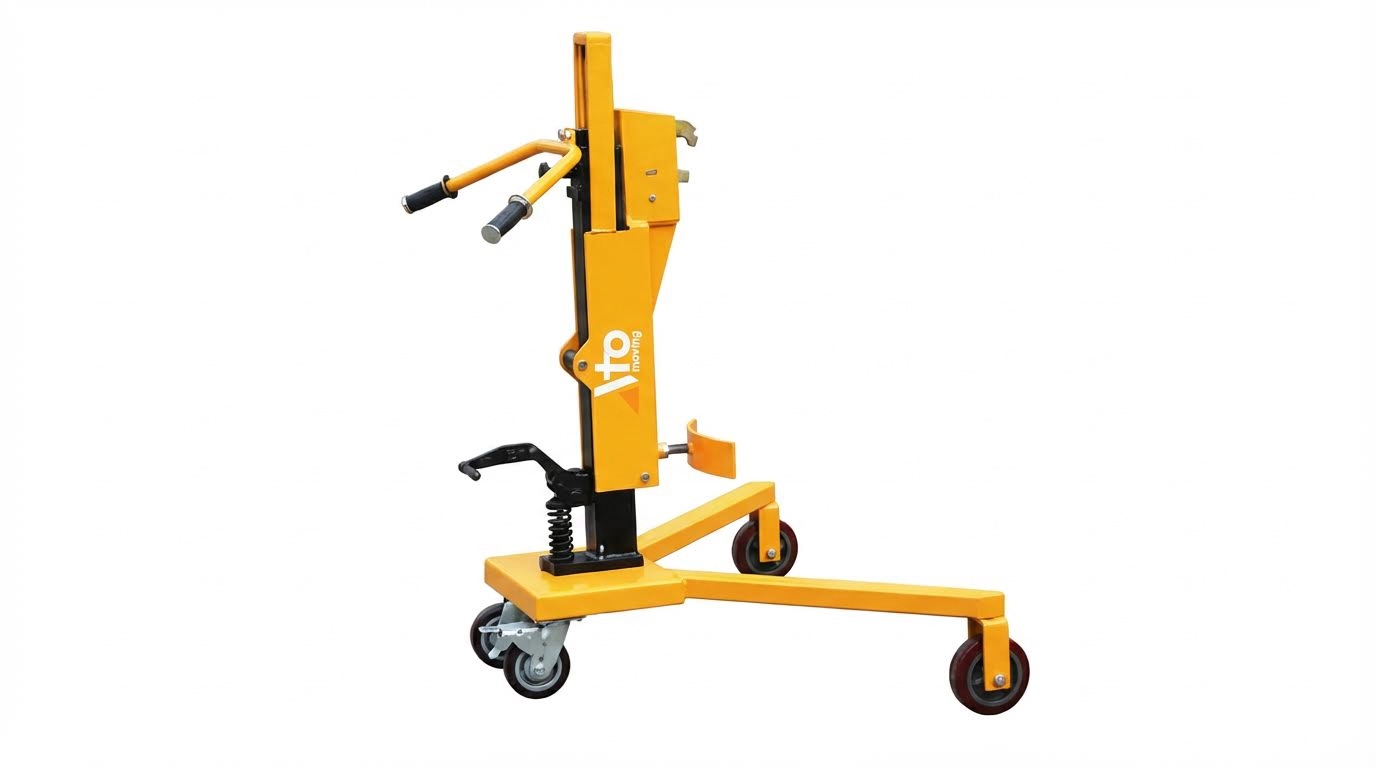
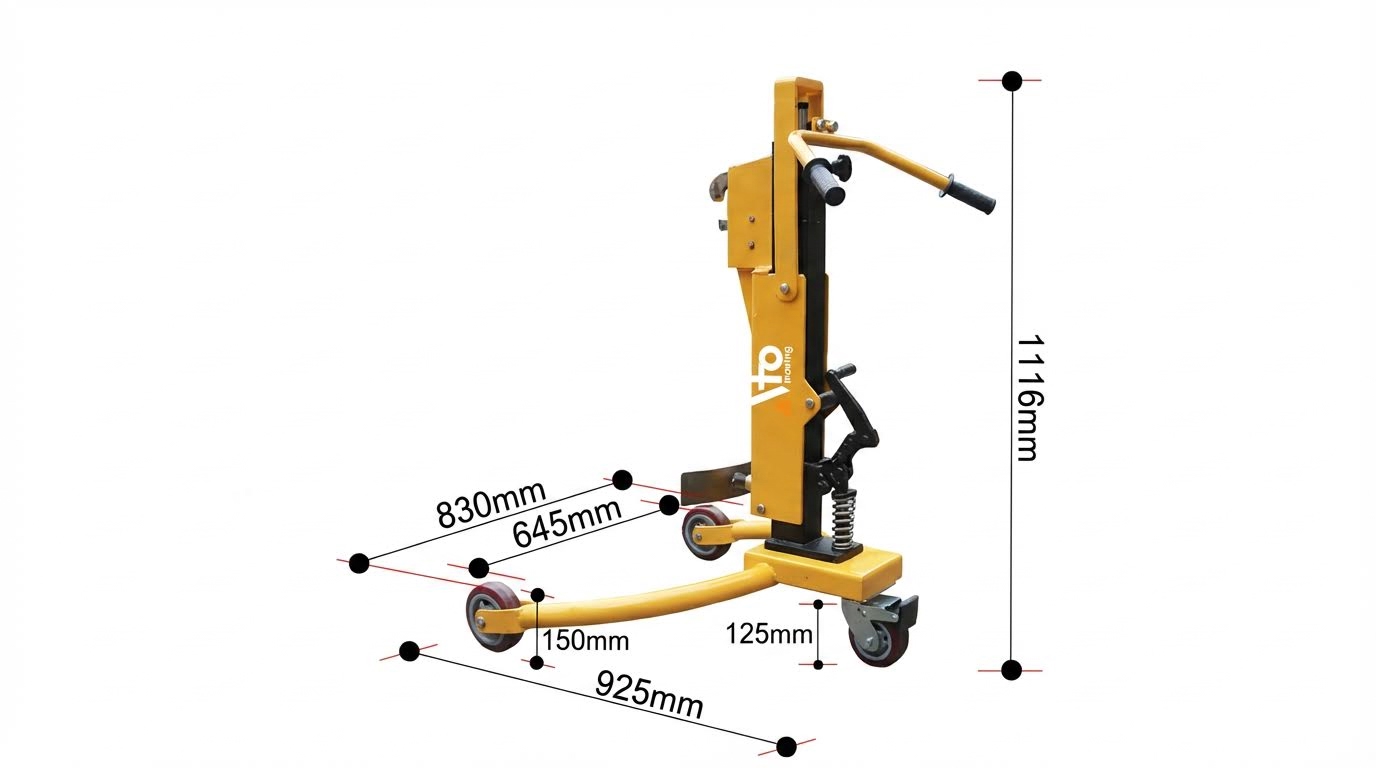
A drum dolly can assist in moving individual drums efficiently across the warehouse floor. Additionally, a hydraulic pallet truck ensures smooth transportation of fully loaded pallets without strain. For heavier tasks, consider using a electric drum stacker, which provides controlled lifting and rotation capabilities. Lastly, a manual pallet jack remains an essential tool for quick adjustments and positioning in tight spaces.

Final Engineering Considerations And Best Practices
Safe drum palletization depends on treating geometry, load paths, and containment as one integrated system, not separate checks. Drum diameter and clearances set the maximum drum count per pallet, while symmetry and edge margins keep the center of gravity inside the footprint during real forklift or AGV moves.
Load ratings, floor capacity, and rack limits then define how high you can stack and where you can place heavy pallets without cracking slabs or overstressing beams. Containment rules add a further filter, because your “how many drums on a pallet” answer only stands if sump volume and chemical compatibility still meet code.
In practice, operations teams should standardize on four 55‑gallon drums in a 2×2 pattern on a 1,219 mm square pallet, with no overhang and verified pallet ratings. Use steel or polyethylene containment modules sized to the heaviest liquid and largest drum, and reduce stack height when density, temperature, or drum condition move away from the ideal case.
The best results come when engineering, safety, and warehouse teams lock in one reference pattern, validate it with floor and rack checks, and then enforce it through training, markings, and periodic inspection. That approach turns a simple count of drums per pallet into a repeatable, code‑compliant handling standard across the full Atomoving drum‑handling workflow.
Frequently Asked Questions
How many drums can fit on a pallet?
The number of drums that can fit on a pallet depends on the drum size and pallet dimensions. For standard 55-gallon drums, a 48×48 inch pallet can hold up to four drums without overhang. Pallet Capacity Guide.
How does drum size affect pallet packing?
Drum size significantly impacts how many can be loaded onto a single pallet. Here’s a breakdown:
- 5-gallon drums: Up to 54 per pallet.
- 30-gallon drums: Approximately 15 per pallet.
- 55-gallon drums: Typically 8 per pallet.
- 110-gallon drums: Only 2 per pallet.