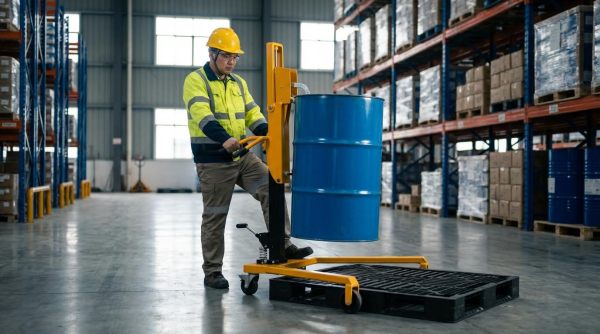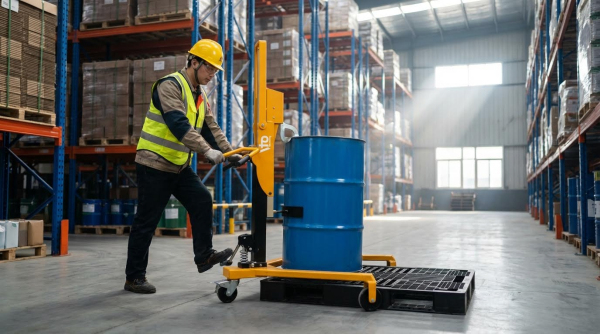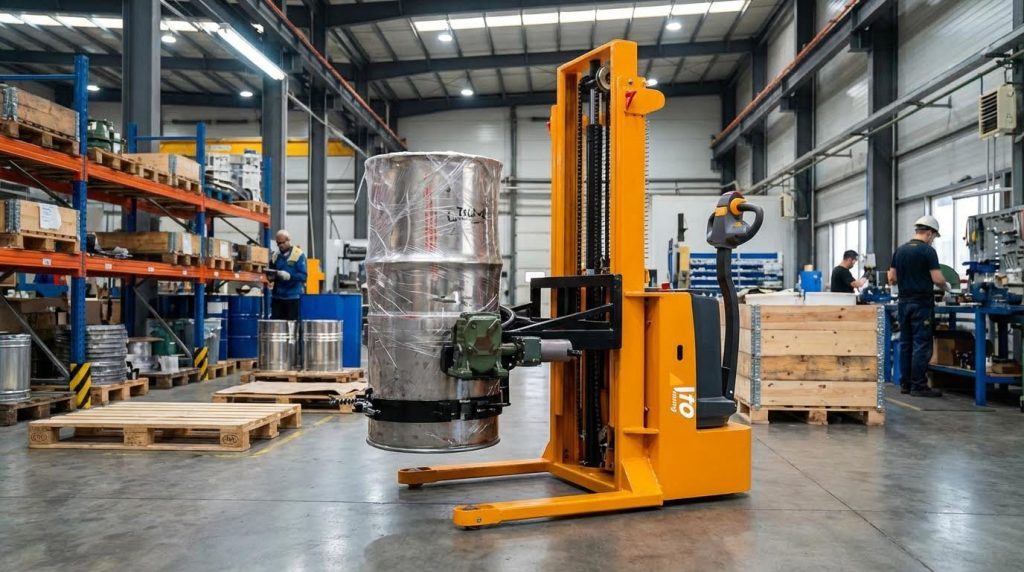
Heavy drums can easily exceed 180–360 kg, so knowing how to prevent injuries when handling drums starts with respecting their mass and stability. This guide explains hazards, safe equipment choices, ergonomics, and chemical controls so you can move drums efficiently without back strains, crush injuries, or spills.
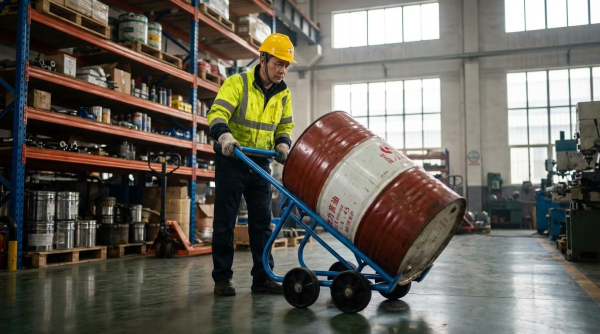
Understanding Drum Handling Hazards And Limits
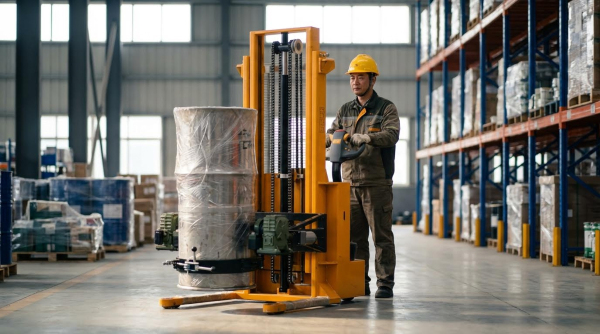
Understanding drum handling hazards and limits is the foundation of how to prevent injuries when handling drums in any warehouse, plant, or loading area. This section explains typical drum masses, injury mechanisms, and the regulatory framework that defines safe limits and controls.
Typical Drum Weights And Injury Mechanisms
Typical full industrial drums weigh far beyond safe manual limits, so most serious injuries come from overexertion, crush points, and loss of control when drums roll, tip, or fall. Knowing real drum masses and how injuries occur lets you choose the right handling method instead of relying on guesswork or “strong backs.”
| Drum Type / Condition | Typical Capacity | Approx. Mass Range | Main Injury Risks | Operational Impact |
|---|---|---|---|---|
| Standard steel drum, 210–205 L, full | 200–210 L | 180–360 kg | Back strain, crushed toes/fingers, impact from tipping or falling drums | Always treat as a load for mechanical handling, not manual lifting |
| Standard steel drum, empty | 200–210 L | 20–30 kg (typical) | Strain from awkward posture, finger pinch at chime/rim | May be lifted by one or two people with strict technique and limits |
| Leaking or dented drum | Varies | Same as above | Chemical exposure, slips, corrosion weakening drum, sudden failure | Requires inspection, containment, and often remote/mechanical handling |
| Rolling drum on floor | Any | Up to 360 kg | Crushed feet/hands, collisions, loss of control on slopes | Freehand rolling should be prohibited; use trucks, dollies, or cradles |
Handling drums exposed workers to acute back strains, crushed toes and fingers, and impact injuries because full 210-litre drums often weighed between about 180–360 kg. Uncontrolled rolling or drums falling from pallets during transport caused some of the most severe injuries. CCOHS guidance on drum handling explained these typical masses and injury patterns.
- Overexertion and back injury: Trying to lift or catch a tilting drum – Spinal discs and ligaments overload far beyond ergonomic limits.
- Crush and pinch injuries: Hands, feet, and legs caught under rims, between drums, or against pallets – High local forces from 200–300 kg drums cause fractures and amputations.
- Impact injuries: Drums toppling from stacks or pallets – Even a short fall height multiplies impact energy on the body.
- Slip and chemical exposure: Leaks create slippery films and fumes – Falls plus inhalation or skin contact add secondary injury mechanisms.
When workers moved a standing drum manually, safe technique required standing close, feet apart, knees slightly bent, hands on the upper rim, and gently rocking before tilting to the balance point. Mechanical aids such as drum-tilting levers or stands reduced the force needed and lowered the risk of sudden loss of control. CCOHS manual drum movement recommendations described this controlled rocking and tilting method.
Guidance also stated that workers should never manually lift stacked drums and should instead use cranes or lift trucks, and that stacks should not exceed two drums high and wide to allow inspection and reduce collapse risk. Pallets needed to be flat, undamaged, and free of protruding nails or splinters to avoid sudden loss of support under a heavy drum. Stacking guidance for drums emphasized these basic engineering controls.
How drum mass translates to injury risk
A 250 kg drum only needs a small horizontal push or a 10–15° tilt before gravity takes over. Once moving, a worker cannot safely stop it by hand without exceeding safe joint and spine loads, especially on slopes or uneven floors.
💡 Field Engineer’s Note: In real plants, most serious drum injuries happened not during the main lift but when a drum “almost fell” and someone tried to save it. Engineering controls should assume that once a full drum starts to tip or roll, the correct rule is to let it go and protect escape paths, not to rely on human strength to recover it.
Regulatory And Standards Framework (OSHA/ANSI)
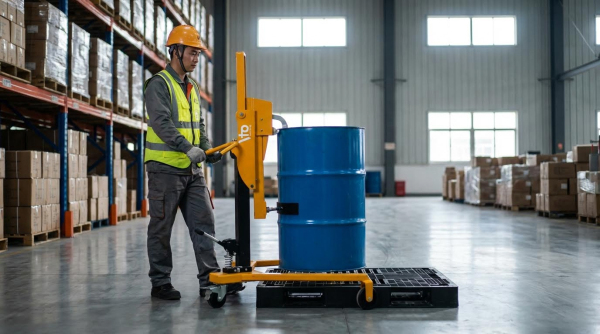
The regulatory and standards framework for drum handling focuses on preventing overexertion, crush, and chemical exposure by enforcing mechanical handling, safe stacking, and spill control, which are all core to how to prevent injuries when handling drums. Regulations and consensus standards set minimum expectations for equipment, layout, and procedures, even when local laws differ.
- Mechanical handling expectation: Full drums above typical manual handling limits must be moved by trucks, hoists, or lifters – Reduces overexertion and crush risk.
- Safe stacking and storage: Limits on stack height and pallet condition – Prevents collapse and falling drums.
- Chemical hazard control: Use of labels, Safety Data Sheets (SDS), and compatible storage – Mitigates exposure, fire, and reactivity risks.
- Equipment suitability: Drum lifters and attachments must be rated and used correctly – Prevents dropped loads and structural failures.
Guidance on safe use of drum lifters required that floors and contact surfaces be clean and dry, that the lifter be suitable for the drum type and mass, and that operators avoid shock loads after lifting. It also warned against releasing the lifter before the drum sat stable on the ground and called for extra precautions if contents were hazardous. Drum handling equipment guidance outlined these usage rules and inspection needs.
Where chemicals were present, best practice required identifying drum contents via labels and Safety Data Sheets, securing loose bungs or lids, and training workers in spill response. It also called for separating incompatible chemicals, using spark-resistant tools around flammable liquids, and limiting stacks to two drums high and wide so leaks could be seen and contained quickly. drum cart tied mechanical handling directly to chemical safety.
Where OSHA/ANSI typically apply to drums
In many jurisdictions, general material handling rules, powered industrial truck standards, and hazard communication standards applied to drum work. These required capacity markings, operator training, safe stacking, and SDS-based controls, even if they did not mention “drums” by name in every clause.
💡 Field Engineer’s Note: When auditing sites, the quickest way to check compliance was to walk the drum storage area: if you saw mixed chemicals on the same pallet, missing labels, and manual wrestling with full drums, you could safely assume broader OSHA/ANSI non-compliance and high hidden injury risk.
Engineering Controls And Equipment For Safe Drum Handling
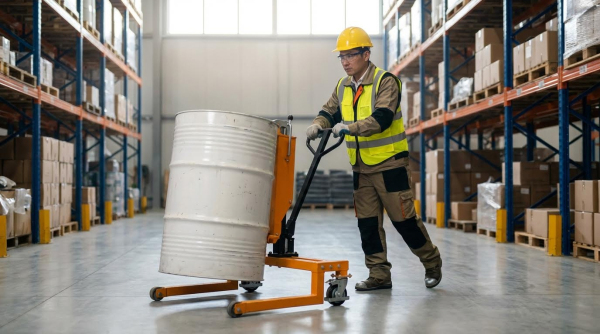
Engineering controls and purpose-built equipment are the most reliable way to prevent injuries when handling drums, by keeping human bodies out of high-force, crush, and chemical exposure zones.
This section links specific drum handling tools to their safe operating envelope, so you can choose equipment that matches drum mass, frequency of moves, route geometry, and chemical hazards.
Selecting Between Forklifts, Trucks, Dollies, And Hoists
Choosing between forklifts, hand trucks, dollies, and hoists for heavy drums depends on drum mass, travel distance, floor quality, and how often you move drums.
Used correctly, this selection step is one of the highest-impact ways to decide how to prevent injuries when handling drums in warehouses, plants, and loading docks.
| Equipment Type | Typical Capacity Range | Best Application | Key Safety Advantages | Operational Impact |
|---|---|---|---|---|
| Forklift + drum attachment | Up to and above 400 kg per drum, depending on truck rating and attachment | Frequent moves, long distances, loading/unloading, stacking | Keeps operator off the load, controls height and tilt, handles full 210 L drums safely | Efficient for high-throughput drum traffic; reduces manual handling to near zero |
| Drum/hand truck (manual) | Around 450–500 kg WLL for heavy-duty units | Short moves on good floors, low to moderate handling frequency | Supports the drum during tilt; avoids full dead-lift of 180–360 kg drums | Flexible in tight aisles; depends on operator strength and floor flatness |
| Drum dolly (upright) | Typically one full 205–210 L drum | Short, flat routes; moving drums within work cells | Lowers push forces by rolling on castors; keeps drum upright to limit slosh | Excellent in congested areas; not suited for ramps or rough floors |
| Hoist with drum lifter | Approx. 120–270 kg per lift, depending on hoist and lifter | Vertical lifts to platforms, mezzanines, or process inlets | Removes manual lifting; allows precise vertical positioning | Slower travel but very controlled; ideal where floor space is limited |
| Vacuum lifter (single or multi-drum) | Around 270 kg per tool for multi-drum systems | Batch handling of oil or chemical drums in filling/decanting lines | Even clamping force; low manual effort; reduces dropped-drum events | Boosts throughput on repetitive tasks while protecting operators’ backs and shoulders |
- Match equipment to drum mass: Use forklifts or hoists once drums approach 180–360 kg – this removes high spinal loads from workers.
- Consider route and distance: Choose forklifts or powered movers for long routes – this avoids fatigue and loss of control late in the shift.
- Check floor and slope: Reserve dollies and manual trucks for smooth, level floors – this prevents runaways and over-exertion on ramps.
- Factor handling frequency: Use powered or vacuum systems for repetitive moves – this controls cumulative strain and repetitive motion injuries.
- Account for chemical hazard: Combine handling gear with bunded bases and corrosion-resistant materials – this limits exposure if a drum leaks during travel.
💡 Field Engineer’s Note: When you add a drum attachment, always re-check the truck’s residual capacity at the new load center; under-rated forklifts handling 400 kg drums are one of the most common hidden overturn risks in drum plants.
How to decide if a forklift is justified
If most drums are full 210 L units, moved more than 20–30 m per trip, or handled in batches, a forklift with a drum grab or rotator usually pays back quickly in reduced injuries and higher throughput.
Drum Grabs, Rotators, And Stability Calculations
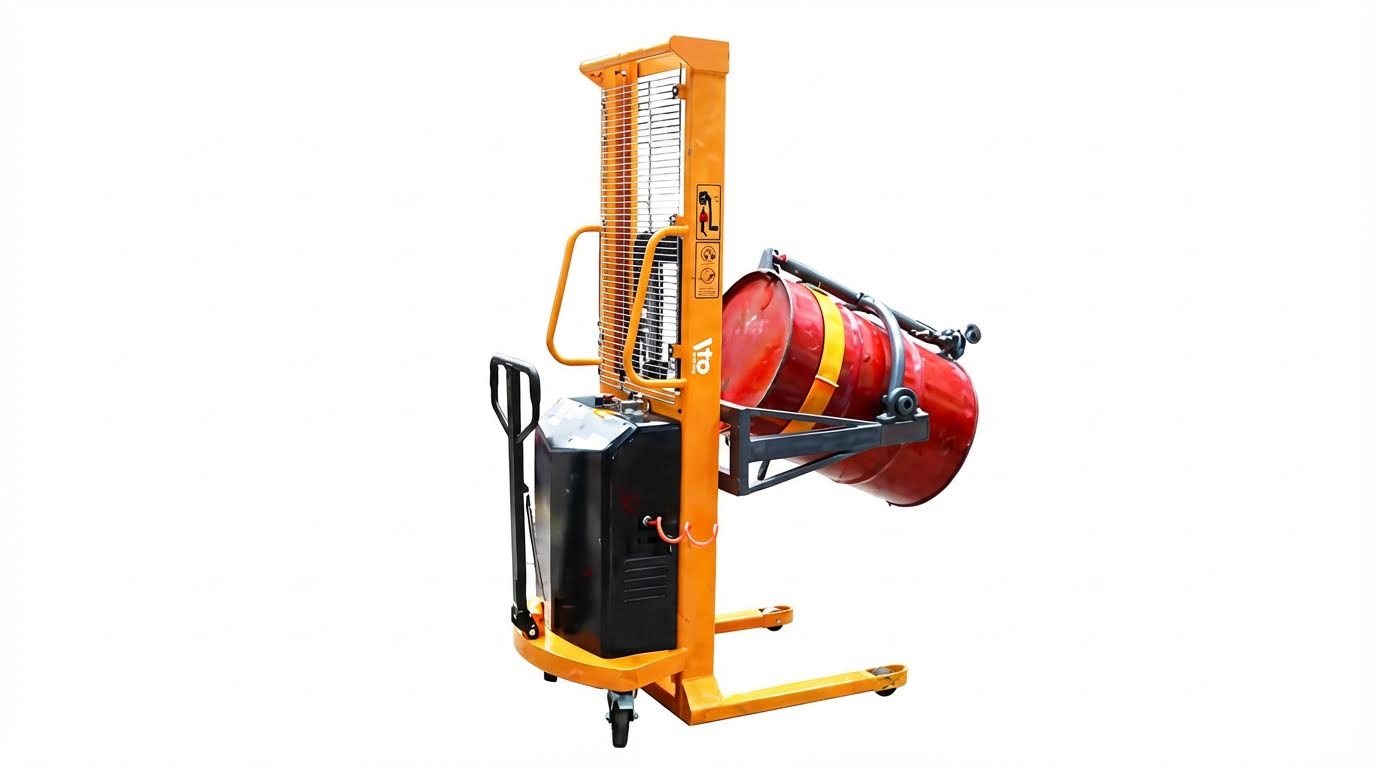
Drum grabs and rotators control the drum at its rim or waist, but they only stay safe if you respect the attachment’s Working Load Limit (WLL) and the truck’s stability envelope.
For heavy liquid drums, understanding how the combined mass, load center, and sloshing affect stability is central to how to prevent injuries when handling drums with forklifts or hoists.
| Attachment Type | Typical Function | Critical Engineering Checks | Stability / Injury Risk If Misused |
|---|---|---|---|
| Rim grab / clamp | Grips drum at top rim for vertical transport | Rim integrity, drum type (steel/plastic), WLL vs. drum mass | Dropped drum if rim deforms; crush and spill hazards near truck |
| Waist / band gripper | Clamps around drum body for higher stability | Correct drum diameter, clamp force, surface friction | Slip or rotation on impact; sudden shift of center of gravity |
| Hydraulic drum rotator | Rotates drum for controlled pouring or mixing | Truck residual capacity at load center ≥ 1.0 m, WLL often near 1,000 kg | Forward tip risk if load center is underestimated; high spill consequence |
| Hoist drum lifter | Suspends drum from overhead hook | Even loading of legs, correct angle, no shock loading | Swinging loads and dropped drums if lifter is side-loaded or jerked |
- Verify combined mass: Add drum, contents, and attachment mass – this ensures you stay within WLL and truck capacity.
- Check load center distance: Use the attachment’s rated load center (often ≥ 1,000 mm) – this keeps the truck within its stability triangle.
- Control drum slosh: Accelerate, brake, and rotate slowly with liquid drums – this avoids dynamic overloads and side tipping.
- Inspect gripping surfaces: Confirm rims and drum bodies are not dented, oily, or corroded – this prevents slip and sudden release.
- Avoid shock loads: Never jerk a hoist or forklift with a suspended drum – this can momentarily double forces and exceed design limits.
Safe driving technique is part of the engineering control: operators should keep forks roughly 150–200 mm above the floor and apply slight mast tilt so the drum remains seated and clear of ground impacts while travelling. Guidelines also prohibit pushing drums with forks or releasing them before the truck comes to a complete stop, to avoid uncontrolled rolling and crushed-foot incidents. These practices are widely recommended for drum handling with forklifts.
💡 Field Engineer’s Note: When you introduce hydraulic rotators, train drivers to pause a few seconds after each tilt change; dense liquids in 200 L drums can keep moving after the drum stops, adding a delayed overturning moment that catches inexperienced operators off guard.
Quick stability check before first lift
Before using a new drum attachment, perform a test lift with a known-mass drum in a clear area, mast vertical, at maximum planned lift height, and slowly tilt and travel. If the rear wheels feel light or steering changes noticeably, your capacity margin is too small.
Ergonomic Limits And Safe Manual Handling Techniques
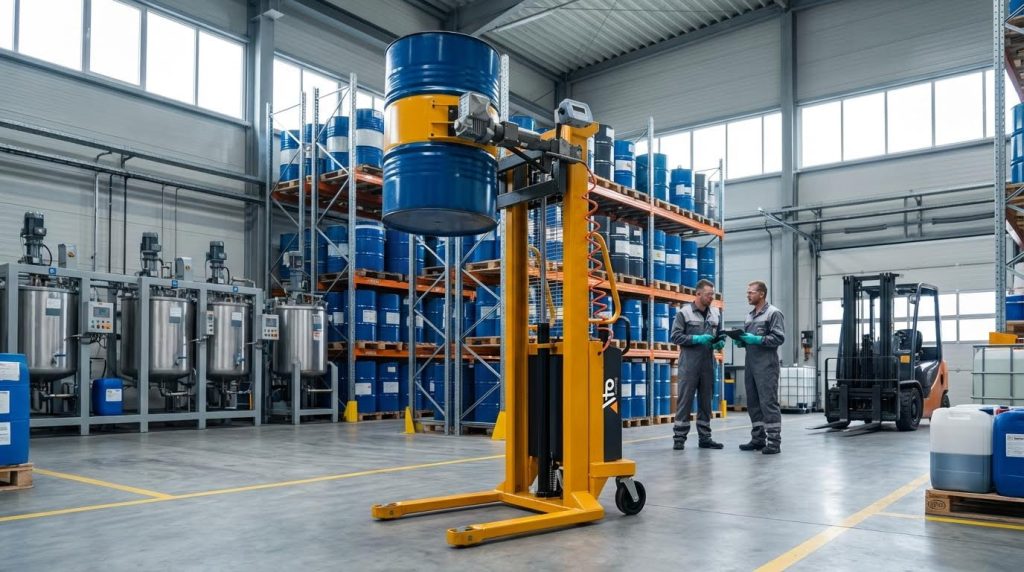
Even with good equipment, workers will sometimes tip, roll, or position drums by hand, so clear ergonomic limits and correct techniques are essential to prevent musculoskeletal injuries.
The core principle is that workers should never manually lift full drums of 180–360 kg; they should only lever, tilt, or guide them, using mechanical aids for the heavy work.
- Ban manual lifting of full drums: Treat any full 200–210 L drum as a no-lift load – this removes extreme spinal compression risks.
- Use two-person lifts only for light drums: Reserve team lifts for empty or lightly filled drums – this keeps individual loads within safe limits.
- Leverage, don’t dead-lift: Use drum trucks, cradles, or tilting levers to raise one edge – this converts high vertical force into manageable rotational force.
- Control posture and distance: Keep the drum close, feet apart, knees bent, and back straight – this minimizes bending moments on the spine.
- Limit push–pull forces: Set rules for maximum sustained push on trucks and dollies, and require two-person operation where forces are marginal – this prevents gradual overuse injuries.
When manually raising an empty drum from horizontal, operators should stand at one end with one foot forward, bend hips and knees while keeping the back straight, grasp the rim about 150 mm from the ground, and lift mainly with leg muscles. For two-person lifts, both workers use similar technique on opposite sides to keep the load balanced. These techniques are documented in ergonomic guidance on drum handling.
To move a standing drum, workers should stand close with feet apart and knees slightly bent, place hands firmly on the upper rim, rock the drum gently, then tilt it by extending the back leg and shifting weight to the front leg until reaching the balance point. Mechanical aids like drum-tilting levers or stands further cut the required effort and reduce the chance of losing control. Freehand rolling of drums, especially on slopes or rough floors, should be prohibited due to the high rate of crushed hands and feet reported in incident data. Industry guidance highlights these ergonomic and impact risks.
💡 Field Engineer’s Note: In facilities without formal ergonomics programs, one of the fastest wins is a simple rule: “If you need to tilt a full drum, you must use a truck, cradle, or lever.” That single rule has eliminated many back and hernia claims on sites I’ve audited.
When manual handling is unavoidable
If you must manually reposition a drum in a tight spot, keep it upright, use small controlled tilts, and slide or pivot rather than lift. Schedule these tasks for teams, not individuals, and keep them low-frequency so they do not become routine high-risk jobs.
Safe Operations, Layout, And Chemical Risk Controls
Safe operations, good layout, and chemical controls are the backbone of how to prevent injuries when handling drums, because they reduce crush hazards, spills, and chemical exposure before they happen.
This section links day‑to‑day drum movements with storage design, spill control, and chemical information so you can engineer a low‑risk, high‑throughput drum area.
Drum Movement, Stacking, And Storage Design
Safe drum movement and stacking start with using mechanical aids, limiting stack height, and designing storage so drums are stable, inspectable, and easy to access.
Drums weighing 180–360 kg for a full 210 L unit put workers at high risk of back strains, crushed toes, and impact injuries if they roll or fall unexpectedly. Proper movement methods, conservative stacking rules, and sound pallet and rack choices are therefore critical to injury prevention. Guidance on drum risks and manual handling supports these controls.
- Use mechanical aids for heavy moves: Drum trucks, dollies, lifters, and forklifts carry the mass – this removes most spinal loading and crush risk from manual lifting.
- Avoid freehand rolling: Do not roll drums by hand on edges – this is a common source of crushed hands and feet when drums slip or change direction suddenly.
- Control manual tilting: Use drum cradles or tilting levers – operators lever the load instead of lifting, so force stays within ergonomic limits.
- Keep travel paths smooth and clear: Maintain flat, debris‑free floors – this prevents sudden stops that can topple drums or throw them off dollies.
- Limit slopes: Avoid moving drums on ramps or steep gradients – heavy drums can run away from operators and become impossible to stop safely.
Where forklifts move drums, operators should keep forks about 150–200 mm above the floor with slight mast tilt and never push drums with the forks. Smooth acceleration and braking reduce liquid surge inside filled drums and lower spill risk. Forklift drum handling guidelines emphasize controlled driving and correct attachment use.
- Match attachments to drum type: Use rim clamps, grabs, or waist grippers that suit steel or plastic drums – this keeps the drum seated and prevents mid‑air slips.
- Travel with drums low: Keep the drum just clear of the floor – this maximizes truck stability and minimizes drop height if something fails.
- Stop before lowering or releasing: Never adjust loads while moving – this avoids side loads that can tip trucks or twist drums off attachments.
Stacking and storage design are where many long‑term stability and inspection issues appear. Drums should never be lifted manually into stacks; cranes or lift trucks are required once drums are above floor level. Safe stacking recommendations advise conservative stack geometry.
| Design Element | Best Practice | Operational Impact |
|---|---|---|
| Stack height | Limit to 2 drums high | Reduces collapse risk and keeps manual inspection and handling within safe reach |
| Stack width | Limit to 2 drums wide | Allows visual leak checks and safe access without climbing or overreaching |
| Pallet condition | Flat, undamaged, no protruding nails | Prevents point loading, punctures, and sudden drum tilting |
| Access aisles | Provide clear aisles for trucks and dollies | Enables straight, controlled approaches and safe turning radii |
| Mechanical lifting | Use cranes or lift trucks for stacking | Removes manual lifting from high‑risk vertical moves |
- Keep inspection faces open: Arrange stacks so all bungs and labels face aisles – this speeds leak checks and content verification.
- Separate full and empty drums: Store empties in a clearly marked, separate area – this avoids overestimating capacity and mishandling assumed “light” drums.
- Plan turning space: Lay out aisles to match your typical truck or dolly turning radius – tight corners are where drums clip racks and fall.
How to review an existing drum storage layout
Walk the full route from delivery to final storage with a loaded drum truck or forklift, noting any tight turns, slopes, door thresholds, or mixed pedestrian traffic. Mark collision points on a plan and adjust pallet positions, aisle widths, or traffic rules until you can move drums without sudden steering changes or close passes to people.
💡 Field Engineer’s Note: In many plants, the biggest drum incidents did not come from equipment failure but from improvised shortcuts in cramped corners. If a truck operator must “wiggle” a loaded drum through a gap, redesign that section: move racking, change flow direction, or switch to smaller handling equipment for that zone.
Spill Containment, Corrosion Resistance, And SDS Use
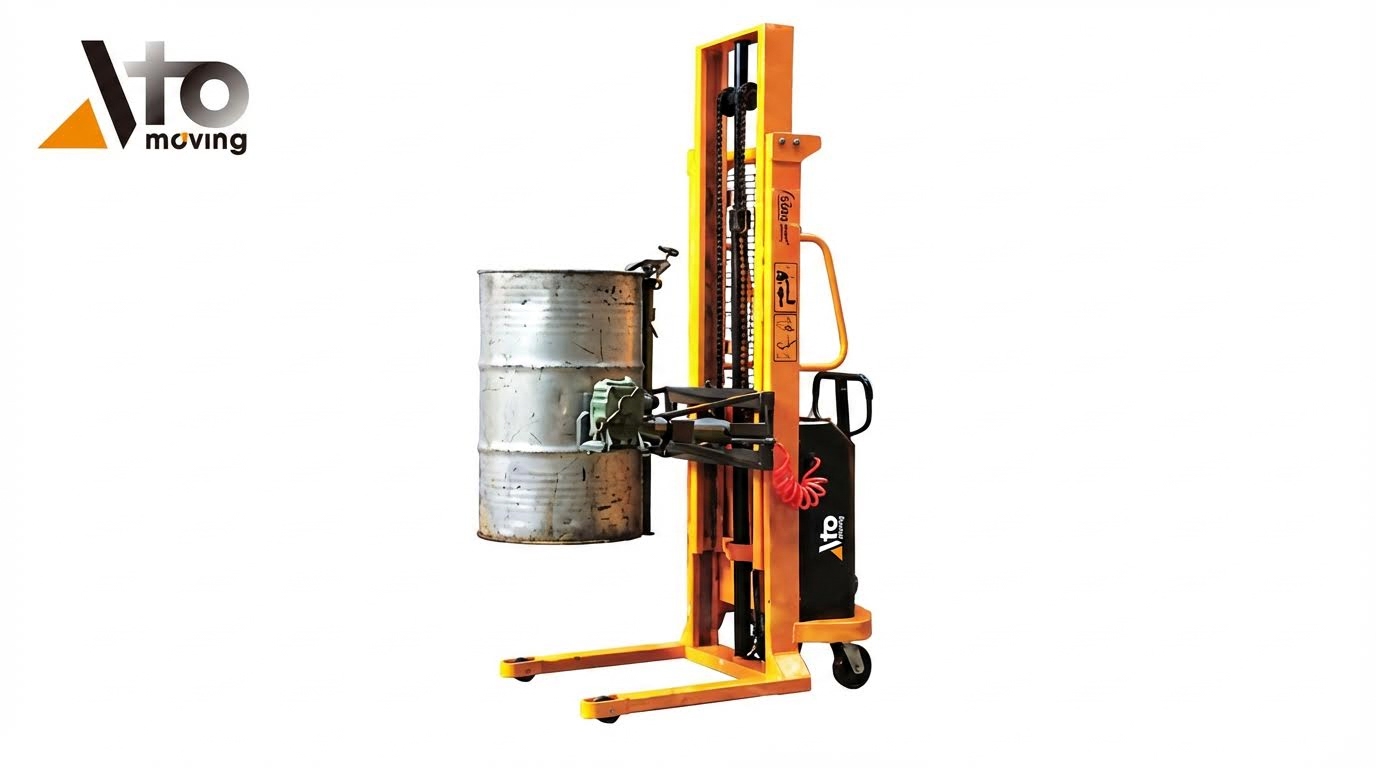
Spill containment, corrosion‑resistant equipment, and disciplined SDS use are essential to prevent chemical injuries when handling drums, especially where leaks, dents, or punctures are possible.
Leaks from damaged drums can expose workers to hazardous chemicals, flammable vapours, or corrosive liquids. Controls start with knowing what is in each drum, containing any loss within a bunded footprint, and choosing materials that resist the stored chemical. Guidance on chemical exposure and spill control highlights these steps.
- Identify contents before handling: Read labels and Safety Data Sheets (SDS) before moving drums – this tells you the PPE, ignition control, and segregation rules.
- Check integrity: Inspect for leaks, dents, rust, or punctures before lifting – damaged drums are more likely to fail when you tilt or stack them.
- Secure closures: Tighten bungs and lids before movement – this prevents drips on floors that can cause slips or chemical contact.
- Separate incompatibles: Store oxidizers, acids, bases, and flammables in segregated, labelled zones – this prevents violent reactions if leaks occur.
- Use spark‑resistant tools: Around flammable liquids, avoid steel tools that can spark – this reduces ignition risk when opening or adjusting bungs.
Spill containment is often integrated directly into the handling equipment and storage layout. Polyethylene bunded drum trolleys and bases capture leaks from 205 L drums and resist many acids, alkalis, and weathering conditions. Stainless‑steel or coated steel frames support hygiene and corrosion resistance in wash‑down or aggressive environments. Examples of bunded and corrosion‑resistant drum equipment illustrate these concepts.
| Control | Typical Implementation | Best For… |
|---|---|---|
| Spill pallets / bunded bases | Polyethylene sumps under 1–4 drums | Capturing slow leaks and making small spills easy to clean |
| Bunded drum trolleys | Low platform with integrated sump and castors | Short moves of full 200 L drums in chemical stores |
| Corrosion‑resistant frames | Stainless steel or coated steel | Food, pharma, or corrosive chemical areas with frequent wash‑down |
| Segregated storage bays | Dedicated, labelled zones with bunding | Keeping incompatible chemicals apart and simplifying emergency response |
- Keep leaks visible: Avoid stacking more than two drums high and wide – workers must be able to see under and around drums to spot early leaks.
- Protect drainage routes: Position bunds away from floor drains – this stops chemicals reaching sewers before you can contain them.
- Standardize spill kits: Place compatible absorbents and neutralizers near drum areas – fast response limits spread and exposure.
Using SDS to shape your drum‑handling procedure
For each product, review SDS sections on handling, storage, exposure controls, and stability. Translate these into simple rules at the drum area: minimum PPE, maximum stack height, segregation group, and whether you need non‑sparking tools, ventilation, or temperature control. Post these rules at eye level where drums are stored and moved.
💡 Field Engineer’s Note: Many sites file SDS documents but never connect them to drum‑handling rules. A quick win is to add a small colour code or symbol from each SDS onto the drum location label (for example, “corrosive,” “oxidizer,” “flammable”). Operators then see at a glance when a move demands extra PPE, bunding checks, or ignition control before they even touch the drum.
Final Recommendations For Injury-Free Drum Handling
To understand how to prevent injuries when handling drums, you must lock in a few non‑negotiable rules on weight limits, equipment choice, layout, and chemical control, then train and enforce them relentlessly.
- Respect drum mass limits: Treat full 200–210 L drums as 180–360 kg loads – always assume they are beyond safe solo manual lifting capacity.
- Make mechanical aids the default: Use drum trucks, dollies, forklifts, hoists, or lifters for any full drum move – this removes the main source of back and crush injuries.
- Ban freehand rolling and dragging: Prohibit pushing drums with feet, hands, or forklift tines – this cuts crushed toes/fingers and runaway-drum incidents.
- Match equipment to route and frequency: Use forklifts or powered solutions for frequent or long-distance moves, and dollies or drum trucks for short, smooth routes – this keeps push–pull forces within ergonomic limits.
- Control tilt and rotation: Use drum cradles, rotators, or tipping stands for pouring – these support the drum during rotation and prevent sudden liquid surge or loss of control.
- Limit stack height: Keep drum stacks to a maximum of two high and two wide on sound pallets – this reduces collapse risk and makes leak inspection practical.
- Use proper manual techniques only for light tasks: Reserve manual lifting for empty drums and follow correct posture and two-person lifts where needed – this minimizes acute back strain.
- Design clear, flat routes: Maintain smooth, debris‑free floors and avoid slopes for drum handling paths – this stabilizes dollies and trucks and reduces required push force.
- Secure, inspect, and label chemicals: Check bungs, lids, dents, and corrosion before moving; verify contents via labels and SDS – this prevents surprise leaks and exposure events.
- Integrate spill containment: Use bunded trolleys, sumps, or trays in storage and transfer zones – this confines leaks from 200 L drums and simplifies cleanup.
- Separate incompatibles: Store acids, alkalis, oxidizers, and flammables in segregated zones – this avoids secondary fires or toxic reactions if a drum fails.
- Ground and use non-sparking tools: Around flammable liquids, bond/ground drums and use spark‑resistant tools – this mitigates ignition risk during opening or transfer.
- Train for routine and emergency tasks: Drill staff on normal moves, stuck drum recovery, and spill response – this turns “panic moments” into controlled procedures.
- Audit push forces and near misses: Measure push–pull forces for carts and track incidents – this highlights where you need better equipment or layout changes.
- Enforce PPE and exclusion zones: Require safety shoes and gloves and keep bystanders clear of drum paths – this protects feet and hands if a drum tips or slips.
How to turn these rules into a site standard
Convert these recommendations into a short, visual drum-handling standard: one page of “must-do” rules at each loading dock and decanting area, plus a simple checklist for supervisors. Review them after any incident and update limits, equipment, or layouts as needed.
Applied together, these practices give you a practical, engineering-based system for how to prevent injuries when handling drums while also controlling spills and chemical exposure.

Final Recommendations For Injury-Free Drum Handling
Effective drum safety depends on treating every full drum as a high‑energy object, not just a heavy package. The article shows that mass, geometry, and liquid slosh quickly exceed human strength, so engineering controls must carry the load. When you default to drum trucks, dollies, stackers, and rotators, you remove peak forces from workers’ spines and keep hands and feet out of crush zones.
Stability and layout are just as important as equipment choice. Short, flat, well‑planned routes, conservative stack heights, and sound pallets keep the center of gravity inside safe limits and cut the chance of runaways or collapses. Chemical controls then close the loop. Spill bunds, corrosion‑resistant frames, and strict SDS‑based rules turn leaks from major events into contained, manageable tasks.
For operations and engineering teams, the best strategy is simple. Make mechanical handling the default for any full drum, design storage for two‑high, two‑wide access, and tie every handling step to the SDS for that product. Back this with training, inspections, and clear “no‑go” rules on freehand rolling and manual lifting. If you need new equipment, work with Atomoving to match trucks, stackers, and bunded systems to your drum weights, routes, and chemicals. Done this way, injury‑free drum handling becomes a stable, repeatable part of your plant design, not a daily gamble.
Frequently Asked Questions
What are the appropriate procedures for handling drums safely?
Handling drums safely depends on several factors, including proper lifting techniques, using the right equipment, and ensuring a stable working environment. Follow these steps to minimize the risk of injury:
- Use mechanical aids like drum handlers or lifters whenever possible.
- Ensure a firm grip on the drum with both hands, keeping it close to your body.
- Avoid twisting your body while lifting; instead, pivot with your feet.
- Wear protective gloves to improve grip and prevent hand injuries.
- Work in teams for heavier drums to distribute the weight evenly.
How can drummers protect their hands from injuries?
Drummers can protect their hands by adopting preventive measures such as using specialized gear and maintaining good technique. Here are some tips:
- Apply protective tape, like eucalyptus-infused fabric tape, to reduce friction and prevent blisters.
- Develop a consistent warm-up routine to condition hand muscles and tendons.
- Focus on proper drumming posture and grip to avoid unnecessary strain.
- Take regular breaks to allow your hands to rest and recover during long sessions.