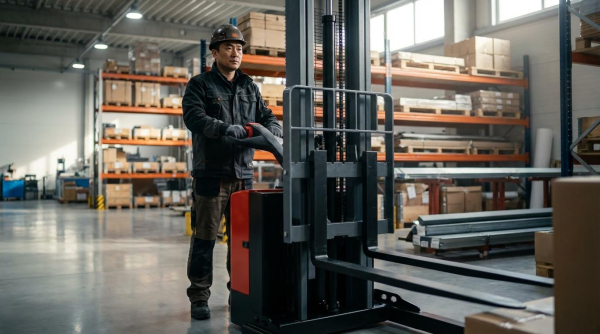
A walkie stacker is a pedestrian‑operated powered lift truck designed to lift, stack, and move palletized loads in tight warehouse spaces. If you have ever asked “what is a walkie stacker” and when to use one instead of a forklift, this guide gives you clear, engineering‑level answers. We will break down how walkie stackers work, key types and components, and how to match specifications like capacity, lift height, and aisle width to real warehouse layouts for safer, more efficient material flow.
What Is a Walkie Stacker and How Does It Work?
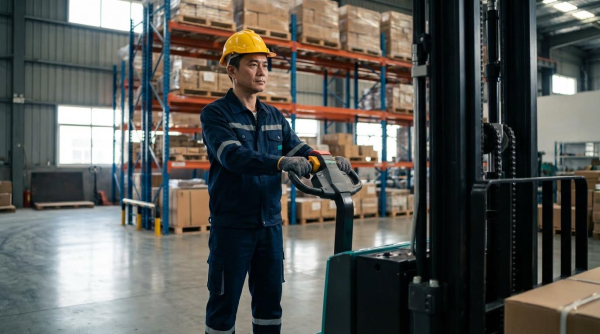
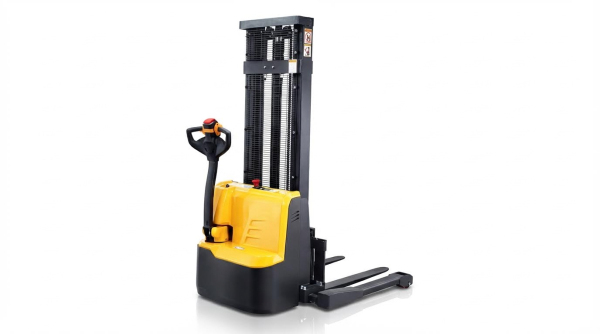
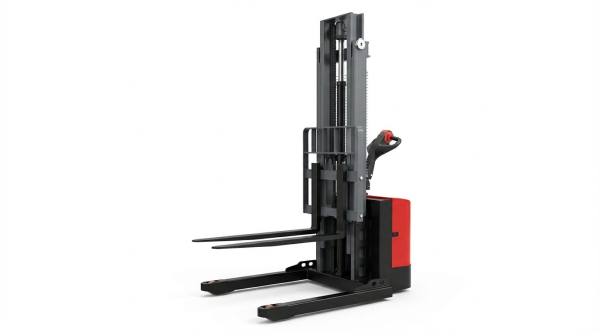
A walkie stacker is a pedestrian-operated, powered lift truck used to raise, lower, and move palletized loads in tight warehouse spaces. When people ask “what is a walkie stacker,” they usually mean this compact alternative to a forklift that you walk behind instead of ride.
Walkie stackers use an electric drive motor, an electric-hydraulic lift system, and a tiller arm with controls so the operator walks beside or behind the machine while steering and lifting. They are optimized for short travel distances, narrow aisles, and stacking loads into racking up to about 4,800–5,400 mm high. Typical warehouse stacker applications and lift heights show how they fit between basic manual pallet jacks and full forklifts.
- Typical capacity range: 900–2,000 kg – Enough for most standard pallet loads. Representative model capacities
- Typical lift height range: 2,600–5,500 mm – Covers low to medium racking levels. Model lift height examples
- Power source: 24 V battery systems – Quiet, zero‑emission indoor operation. Common 24 V stacker platforms
💡 Field Engineer’s Note: In real warehouses, walkie stackers shine when aisles are too narrow for counterbalance forklifts but you still need to reach the second or third rack beam without investing in a full reach truck.
Core function and operating principle
The core function of a walkie stacker is to lift and stack palletized loads vertically while the operator walks and steers from the ground. It combines powered lifting like a forklift with the compact footprint of a pallet truck.
Mechanically, most walkie stackers follow the same basic operating principle: an electric traction motor drives the load wheels, and an electric pump pressurizes hydraulic oil to extend the mast cylinders and raise the forks. The operator uses a tiller arm with fingertip controls to command travel, lift, and lower functions.
| Subsystem | What it does | How it works | Operational impact |
|---|---|---|---|
| Drive & steering | Moves the stacker | Electric motor powers drive wheel; tiller arm steers | Allows precise movement in aisles under about 2.5–3.0 m wide |
| Hydraulic lift | Raises/lowers forks | 24 V pump pressurizes oil to lift mast cylinders | Stacks pallets up to roughly 2,600–5,500 mm high depending on model Representative lift heights |
| Mast & carriage | Guides the load vertically | Rolled steel channels with chains/rollers | Maintains alignment with racking to reduce pallet and rack damage |
| Chassis & outriggers | Provides stability | Low-slung frame and support legs around the pallet (on straddle/fork‑over types) | Improves stability without needing a heavy counterweight |
| Battery & controls | Powers and manages systems | 24 V battery, controllers, variable speed controls, diagnostics | Efficient, smooth operation and quick fault finding for less downtime Onboard diagnostics and variable speed |
Modern walkie stackers use variable speed controls to let operators feather travel and lift speeds for precise positioning. This is critical when placing pallets into tight rack openings or working near production equipment. Onboard diagnostics help maintenance teams pinpoint issues quickly, which minimizes downtime and keeps fleets available for peak shifts. Energy-efficient stacker designs also reduce battery strain in multi-shift operations.
Typical walkie stacker work cycle
1. Operator walks to the pallet with forks low and level. 2. Forks fully insert under the pallet. 3. Load lifts just clear of the floor (about 100–200 mm) for travel. 4. Stacker travels to the rack or drop-off point. 5. Load raises to target beam height. 6. Stacker inches forward and lowers the pallet into position. 7. Forks withdraw and return to travel height.
Key advantages over forklifts and pallet trucks
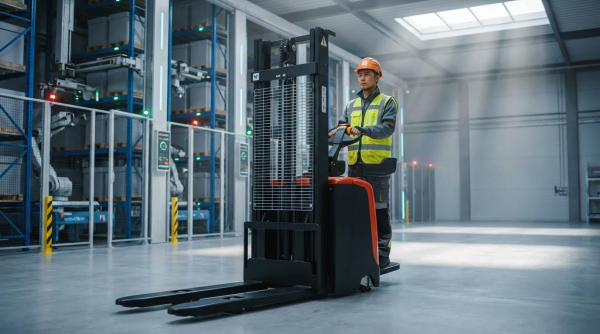
Walkie stackers bridge the gap between basic pallet trucks and full forklifts by offering powered vertical lift with a smaller footprint and lower total cost. They are ideal where you need stacking but want to limit ride‑on equipment in pedestrian-heavy zones.
| Equipment type | Typical capability | Where it excels | Operational impact |
|---|---|---|---|
| Manual/Powered pallet truck | Ground-level pallet moves only; minimal lift | Truck loading, simple transport | Lowest cost, but cannot use vertical storage |
| Walkie stacker | Lift 900–2,000 kg up to ~2,600–5,500 mm Representative capacity and height | Narrow aisles, short runs, light–medium stacking | Unlocks racking storage without full forklift investment |
| Counterbalance forklift | Higher capacities and lift heights; longer travel | Yard work, dock work, mixed indoor/outdoor | More versatile, but larger turning radius and higher risk near pedestrians |
- Space efficiency: Compact chassis and walk‑behind control – Operates safely in narrow aisles and small rooms.
- Lower infrastructure cost: Lighter axle loads – Reduces floor slab and dock reinforcement requirements.
- Safety in pedestrian zones: Walking operator with good sightlines – Helps reduce contact incidents in busy pick aisles.
- Energy efficiency: 24 V electric systems with efficient hydraulics – Lower energy use and less heat in tight spaces. Durability and energy efficiency claims
- Task flexibility: Suitable for rack storage, bulk storage, and narrow aisles – Covers most indoor warehouse tasks without multiple truck types. Typical stacker applications
💡 Field Engineer’s Note: If your pallets rarely exceed about 1,500 kg and your travel runs are under 30–40 m, a walkie stacker usually beats a sit‑down forklift on total cost per handled pallet, especially in narrow aisles.
When a walkie stacker is the wrong choice
Walkie stackers are not ideal for steep ramps, rough outdoor yards, very high racking above roughly 5,500 mm, or heavy pallets near 3,000 kg and above. In those cases, a ride‑on reach truck or counterbalance forklift is usually safer and more productive.
Matching Walkie Stackers to Your Warehouse Needs
Choosing the right counterbalanced stacker starts with your loads, racking height, and aisle width, then narrows down by capacity, duty cycle, and operator safety requirements. This section turns “what is a walkie stacker” into “which walkie stacker fits my site.”
Walkie stackers are ideal where you handle palletized loads in tight aisles, short travel distances, and mixed storage like rack, bulk, and buffer zones. They reduce congestion and pedestrian risk compared with full counterbalance forklifts when correctly matched to the task. Typical applications include case-pick and machine-feed areas.
Step 1: Define Loads, Pallets, and Racking
The first sizing step is to define your heaviest load, pallet style, and top storage height, then work backwards to capacity and mast height. This prevents under-spec selection that causes instability and downtime.
| Selection Factor | What To Capture | Typical Range / Example | Operational Impact |
|---|---|---|---|
| Maximum load weight | Heaviest pallet including packaging | Up to 2,000 kg for double pallet stackers (DT Series) | Drives required rated capacity and model family |
| Required lift height | Top beam height plus 150–200 mm clearance | Up to 5,500 mm for narrow-aisle rack storage (ST/SX, ES, ET Series) | Determines mast type and hydraulic oil volume |
| Pallet type | Open-bottom vs closed-bottom, stringer vs block | Standard 1,200 × 1,000 mm pallets common | Decides fork-over vs straddle or counterbalance |
| Storage style | Rack, bulk floor, buffer, machine feed | Rack storage and bulk storage are dominant uses across series | Impacts turning space and visibility needs |
- Define worst-case load: Use your heaviest, highest pallet – this sets the minimum capacity and lift height.
- Check pallet underside: Open-bottom pallets suit fork-over; closed-bottom may require straddle or counterbalance – avoids jamming on entry.
- Confirm rack beam heights: Measure to the top storage level – prevents under-spec masts that cannot reach the top bay.
How to measure required lift height correctly
Measure from floor to top of the highest pallet load, then add at least 150–200 mm for fork clearance and mast deflection. Compare this with rated lift heights such as 3,655 mm for light-duty walkie stackers or up to 5,500 mm for higher-performance models used in narrow aisles. Multiple series cover 2,600–5,500 mm ranges.
💡 Field Engineer’s Note: When you push mast heights above 4,500 mm, even small floor slopes or pallet overhangs can create noticeable sway. Always keep some reserve capacity above your calculated maximum load to maintain stability at full height.
Step 2: Match Walkie Stacker Type to Application
Once you know load and racking, you select between fork-over, straddle, reach, counterbalance, platform, or double pallet designs based on aisle width and pallet access. Each type optimizes a different compromise between capacity, maneuverability, and flexibility.
| Stacker Type | Typical Capacity (kg) | Max Lift Height (mm) | Best For… |
|---|---|---|---|
| Light-duty walkie stacker | Up to 900 kg (M Series) | Up to 3,655 mm | Low–medium racks, short runs, small warehouses |
| Fork-over pallet stacker | Up to 1,200–1,600 kg (WF / ES / ET Series) | 4,400–5,400 mm for rack and bulk storage | Standard open-bottom pallets, compact aisles |
| Straddle stacker | Up to 1,500–1,800 kg (ST/SX, SH Series) | Up to 5,500 mm | Mixed pallets, narrow aisles, higher racking |
| Reach stacker | Up to 1,600 kg (SHR Series) | Up to 4,875 mm | Deep racks, tight aisles, improved visibility |
| Counterbalance stacker | Up to 1,800 kg (SHC Series) | Up to 4,365 mm | Closed pallets, docks, and transport tasks |
| Double pallet stacker | Up to 2,000 kg (DT Series) | Up to 2,600 mm | Two-pallet moves, dock work, buffer zones |
Where people ask “what is a walkie stacker” in practical terms, the answer is that it is a walk-behind, electric-powered pallet stacker optimized for short travel and vertical handling, with configurations tuned to specific pallet and aisle constraints.
- Choose fork-over: For standard open pallets and lowest purchase cost – ideal in production cells and small stores.
- Choose straddle: For mixed or closed pallets – legs go around the pallet, not under it.
- Choose reach: For deeper racks or tight aisles – reach mechanism shortens turning radius.
- Choose counterbalance: For dock work and closed pallets – behaves more like a small forklift without outriggers.
- Choose double pallet: For high-throughput dock and shuttle – moves two pallets at once to cut cycle time.
Step 3: Check Aisle Width, Travel Distance, and Throughput
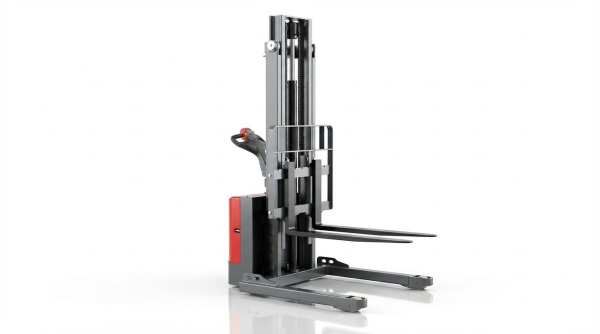
The third step is to confirm that your chosen stacker type can physically turn in your aisles and sustain your target pallets-per-hour at realistic walking speeds. Ignoring this step often leads to congestion and operator fatigue.
- Aisle width: Measure rack-to-rack clear distance at the narrowest point – this controls turning radius and model choice.
- Travel distance: Short shuttles (under 30–40 m) suit walk-behind; longer runs may justify platform or rider versions – reduces fatigue.
- Throughput: Estimate pallets per hour per truck – ensures you buy enough units for peak demand.
Many walkie stackers are used where loads are stored up to about 4,875 mm and travel distances are relatively short, making maneuverability more important than top speed. Stacker designs emphasize agility in tight rack and bulk areas.
When to upgrade to a platform or rider stacker
If operators routinely walk more than a few hundred meters per hour with a walk-behind unit, fatigue and cycle times climb quickly. A platform or rider stacker with capacities around 1,600 kg and lift heights up to 5,400 mm can maintain productivity over longer runs while still working in narrow aisles. Platform models support rack and bulk storage at full height.
Step 4: Align Power, Battery, and Duty Cycle
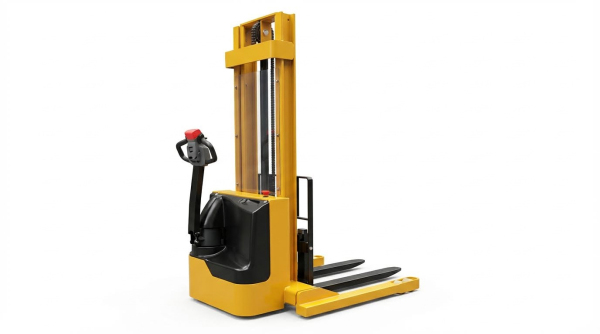
The fourth step is to match battery voltage, capacity, and charging strategy to your shift pattern and utilization, so the stacker runs full shifts without damaging the battery. Undersized batteries create heat, downtime, and short service life.
Many walkie stackers operate on 24 V battery systems, which are well suited to light and medium warehouse duty. The referenced models all use 24-volt batteries, simplifying charger standardization.
- Match charger to battery: Voltage and capacity must align – prevents overheating and premature battery failure.
- Avoid deep discharge: Recharge when indicators approach minimum – extends lead-acid life and maintains performance.
- Plan charging zones: Provide ventilation during charging – limits hydrogen accumulation and meets safety standards.
Good practice is to park in a designated area, forks lowered, power off, and brakes applied before connecting the charger. Operators also inspect casings for cracks and terminals for corrosion as part of routine care. These battery practices improve stacker uptime and safety.
💡 Field Engineer’s Note: In multi-shift sites, a 24 V system can still work if you design in fast or opportunity charging during breaks. Trying to stretch a single small battery across two full shifts without a plan is a guaranteed path to sulfation and early replacement.
Step 5: Build in Safety, Training, and Maintenance
The final matching step is to ensure your walkie stacker choice is supported by operator training and a realistic maintenance plan, so the equipment stays safe and productive over years, not months. Ignoring this step cancels out any performance gains from good specification.
- Operator training: Formal instruction must cover controls, stability, and site hazards – aligns with standards such as CSA B335-15 and OHSA.
- Daily pre-use checks: Inspect forks, hydraulics, wheels, controls, brakes, and battery in about five minutes – catches issues before a breakdown.
- Preventive maintenance: Use tiered schedules (daily, weekly, monthly, quarterly, six-monthly) – extends life of chains, hydraulics, and brakes.
Daily checks include looking for hydraulic leaks, verifying reservoir levels, and testing both service and parking brakes. Maintenance teams keep brake clearances within ranges such as 0.2–0.8 mm and respond quickly to symptoms like drifting masts or unusual noises. Prompt attention prevents small problems becoming long outages.
Example preventive maintenance structure
Daily: visual checks, horn and emergency stop tests, short travel and lift test. Weekly: clean battery tops and polish contactors. Monthly/quarterly: technician checks powertrain, lift chains, electrical systems, and safety devices. Six-monthly: partial strip-down, measure fork and chain wear, replace degraded components. Structured schedules support predictable uptime.
When you combine correct sizing, the right stacker type, matched battery and duty cycle, and disciplined maintenance, a walkie stacker becomes a low-cost, high-control alternative to a forklift in many warehouses. That is the practical, operational answer to “what is a walkie stacker” for modern material handling teams.

Matching Walkie Stackers to Your Warehouse Needs
Walkie stackers deliver safe, low-cost pallet handling when engineering limits guide every choice. Capacity, lift height, and aisle width must work together. If you overshoot any one of these, you risk tip‑over, rack strikes, or blocked aisles. Start from the worst‑case pallet and top beam height, then select mast, stacker type, and battery to suit that envelope with clear safety margin.
Geometry and stability go hand in hand. Straddle legs, fork‑over designs, or counterweights control the load’s center of gravity relative to the wheelbase. Correct pairing with pallet style and aisle width keeps the truck stable at full height and during tight turns. Battery sizing and charging practice then protect performance over full shifts without overheating or voltage sag.
Operations teams should lock in five habits: define loads and heights accurately, choose the right stacker family, verify aisle fit, match battery to duty cycle, and enforce training plus preventive maintenance. When you follow this engineering‑led process, a walkie stacker from Atomoving becomes a predictable, safe tool rather than a daily constraint. The result is higher storage density, lower incident rates, and a clear, repeatable spec for future fleet upgrades.
Frequently Asked Questions
What is a walkie stacker?
A walkie stacker, also known as a walk-behind forklift or pallet stacker, is a compact and maneuverable material handling machine commonly used in warehouses, distribution centers, and retail environments. Its primary function is lifting and transporting pallets and other heavy loads over short distances. Forklift Guide.
Do you have to be certified to use a walkie stacker?
Yes, OSHA requires formal instruction and hands-on evaluation for all powered industrial truck operators, including walkie stackers. Certification ensures safe operation and compliance with workplace safety standards. OSHA Forklift Classes.
What class is a walkie stacker?
A walkie stacker falls under Class III: Electric Motor Hand Trucks or Hand/Rider Trucks. These include electric pallet jacks and walkie stackers, designed for low-lift operations. Truck Classifications.
Is a walkie stacker a pallet jack?
A walkie stacker is similar to a pallet jack but offers additional functionality. While both are used for moving pallets, a walkie stacker can lift and stack loads at various heights, making it more versatile than a standard pallet jack. Pallet Stacker Rentals.