Electric forklifts typically hold between 1,000 kg and 10,000 kg, with specialized models exceeding 18,000 kg, but real usable capacity depends heavily on load center, lift height, attachments, and battery weight. This guide explains how much an electric forklift can hold in practice, what derates its capacity, and how to read data plates so you stay inside safe limits while maximizing productivity.
Understanding Electric Forklift Capacity Basics
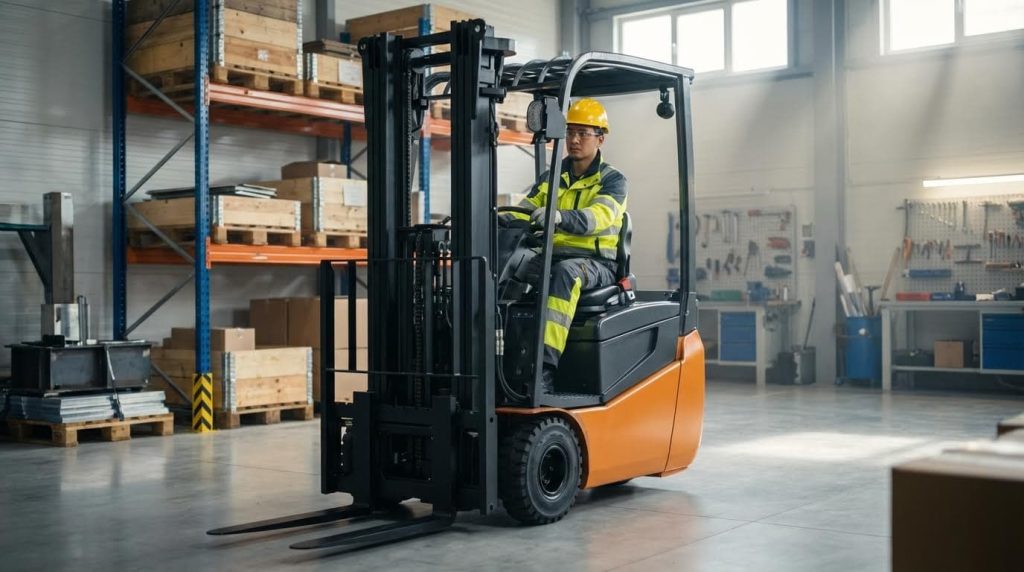
Electric forklift capacity basics explain how much can an electric forklift hold in theory versus what it can safely lift in real operations. You need to understand truck class ranges, rated capacity, and the data plate before looking at any “maximum kg” claim.
Typical capacity ranges by truck class
Typical electric forklift capacity ranges show that most warehouse trucks handle 1,500–3,500 kg, while specialized units exceed 10,000 kg. The right “how much can an electric forklift hold” answer always depends on truck class and application.
| Electric truck type / class (typical) | Common rated capacity range | Typical load center on data plate | Best for… / Operational impact |
|---|---|---|---|
| 3‑wheel electric counterbalance | 1,000–2,000 kg | 500 mm | Tight indoor aisles, light pallets, turning within narrow spaces. |
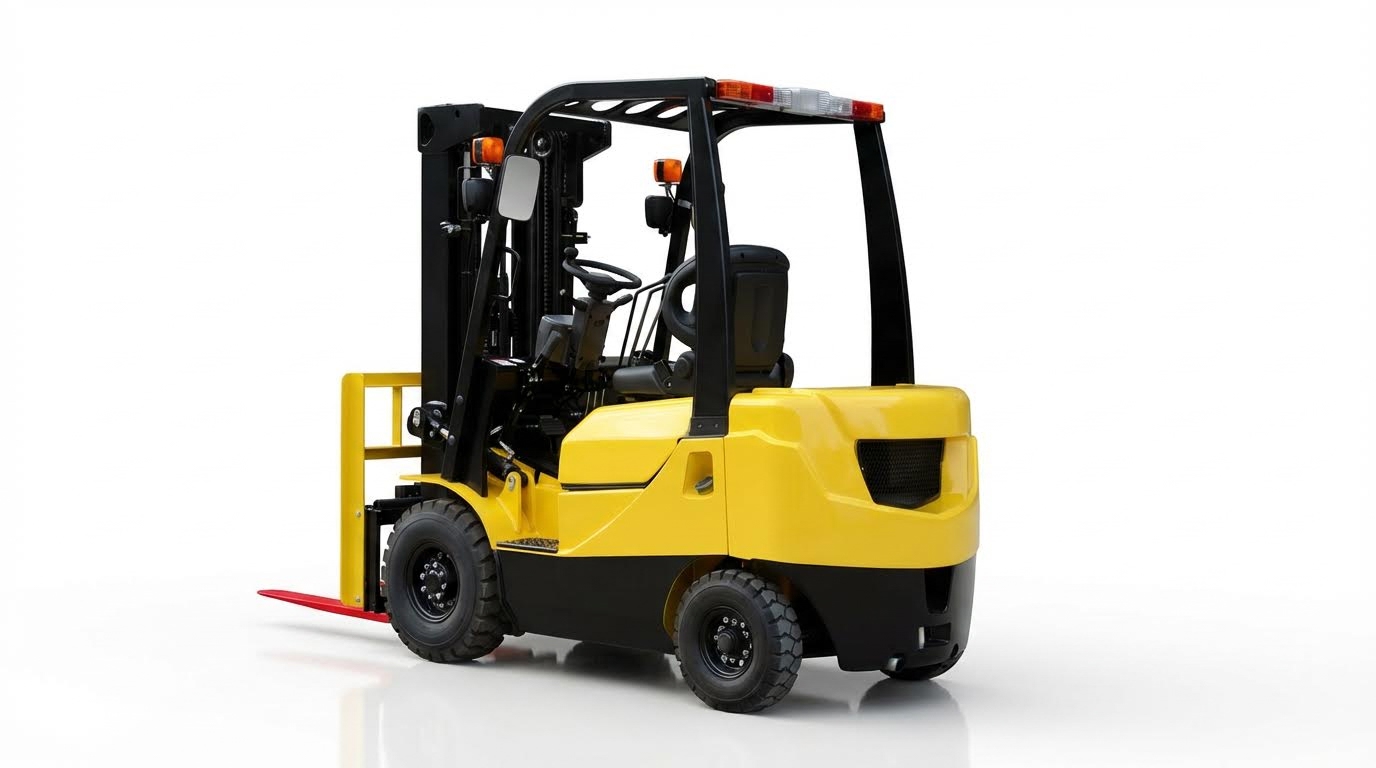
| 4‑wheel electric counterbalance | 1,500–5,000 kg (many warehouse units) | 500 mm | General warehouse work, dock loading, most palletized loads. |
| Heavy‑duty electric counterbalance | 6,000–18,000 kg | 600–900 mm | Steel, timber, machinery; often outdoors or in heavy industry. |
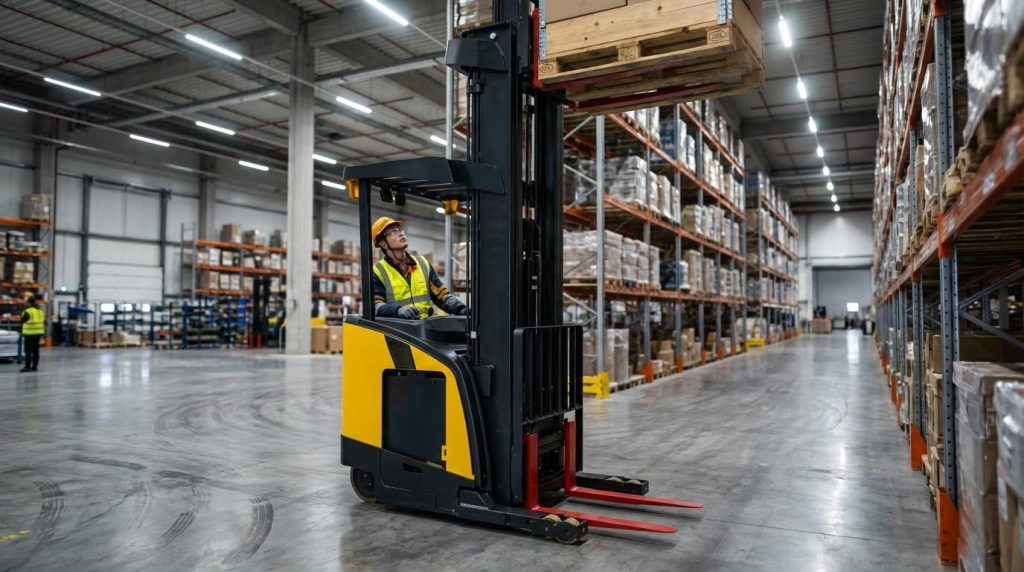
| Narrow‑aisle / reach truck | 1,000–2,000 kg | 600 mm (effective, because the load is reached out) | High racking in 2.5–3.0 m aisles; capacity drops as you reach and lift higher. |
| Very heavy special electric trucks | Up to and above 18,000 kg | 600–1,200 mm | Ports, foundries, very heavy equipment; need wide aisles and strong floors. |
This means that when someone asks how much can an electric forklift hold, the realistic range is about 1,000–10,000 kg for most sites, with specialized units going higher for niche heavy-duty work.
- Small warehouse fleets: 1,500–3,500 kg – Ideal for standard pallets up to roughly 1,200 mm deep.
- Mixed indoor/outdoor work: 3,000–5,000 kg – Covers heavier pallets, bricks, and bulk bags.
- Heavy industry: 6,000–18,000 kg – Reserved for large coils, blocks, or machinery skids.
💡 Field Engineer’s Note: When you get above about 5,000 kg on electric trucks, floor capacity and ramp gradients become the limiting factor long before the nameplate capacity does. Always confirm slab design load and dock rating before ordering a high‑capacity machine.
How to quickly estimate if a truck size is enough
Take your heaviest realistic pallet weight, add 10–20% for variation, then check that against the common ranges above. If you are close to the top of a range, step up one size for safety and future growth.
Rated capacity, load center, and data plates
Rated capacity, load center, and the data plate tell you the official answer to “how much can an electric forklift hold” under specific, controlled conditions. If your real load is longer, higher, or uses attachments, the true safe capacity is lower.
The data plate (capacity plate) is your primary reference for safe lifting on any electric forklift. It lists the rated capacity, the corresponding load center distance, and often the maximum lift height for that rating. For example, a plate reading “3,000 kg @ 500 mm LC” means the truck can safely lift 3,000 kg only when the load’s center of gravity sits 500 mm from the fork face. If the load center increases to 600 mm, the safe capacity can drop to around 2,400 kg according to regulatory guidance. OSHA examples show this derating effect clearly.
| Data plate entry (example) | What it means in practice | Operational impact |
|---|---|---|
| “2,500 kg @ 500 mm LC, 3,000 mm lift” | 2,500 kg is allowed only if the load center is 500 mm and lift height is within 3,000 mm. | Standard pallets up to about 1,000–1,100 mm deep are fine at normal rack heights. |
| “2,000 kg @ 600 mm LC, 6,000 mm lift” | Capacity reduced because of taller mast and longer load center. | High‑bay racking; must keep heavy loads lower or accept reduced weight at top levels. |
| Attachment noted on plate (e.g., clamp) | Rated capacity already reduced for attachment weight and shifted center of gravity. | Do not use “bare fork” capacity figures; always follow the updated plate. |
- Rated capacity: The maximum load (in kg) the truck may lift under the exact conditions stated on the plate – Not a general “anytime” number.
- Load center (LC): Horizontal distance from fork face to the load’s center of gravity – Longer loads increase tipping moment and reduce safe kg.
- Lift height: Maximum height at which the rated capacity still applies – At higher masts, capacity is derated to keep the center of gravity inside the stability triangle.
- Attachments: Extra equipment (clamps, sideshifters, fork positioners) that add weight and move the load center forward – They always reduce net lifting capacity unless the plate already accounts for them.
Regulatory guidance explains that when the load center increases, the safe capacity decreases in proportion to the change in load moment. One example shows a truck rated 4,000 lb at 24 in load center only being allowed about 2,666 lb at a 36 in load center, because the longer load increases the overturning moment. OSHA uses this case to illustrate why operators must respect the plate values.
- Always read the plate before the brochure: – The plate reflects the exact truck, mast, battery, and attachment combination on your floor.
- Do not guess for odd loads: – If the load is longer or higher than normal, assume the real capacity is lower than the nameplate.
- Get the plate updated after modifications: – Standards require manufacturer approval and a revised plate if you add attachments or change major components.
💡 Field Engineer’s Note: In the field, the fastest capacity sanity check is to compare your actual load center to the plate value. If your pallet is 1,600 mm deep, your load center is roughly 800 mm. On a truck rated at 500 mm LC, you are already in derated territory and should either split the load or use a higher‑capacity truck.
How to read a confusing data plate
If the plate shows multiple lines, read across a single line: capacity (kg), load center (mm), and max lift height (mm) all belong together. Treat each line as a separate “scenario,” and only operate within one of those scenarios at a time.
“`html
Engineering Factors That Derate Lifting Capacity
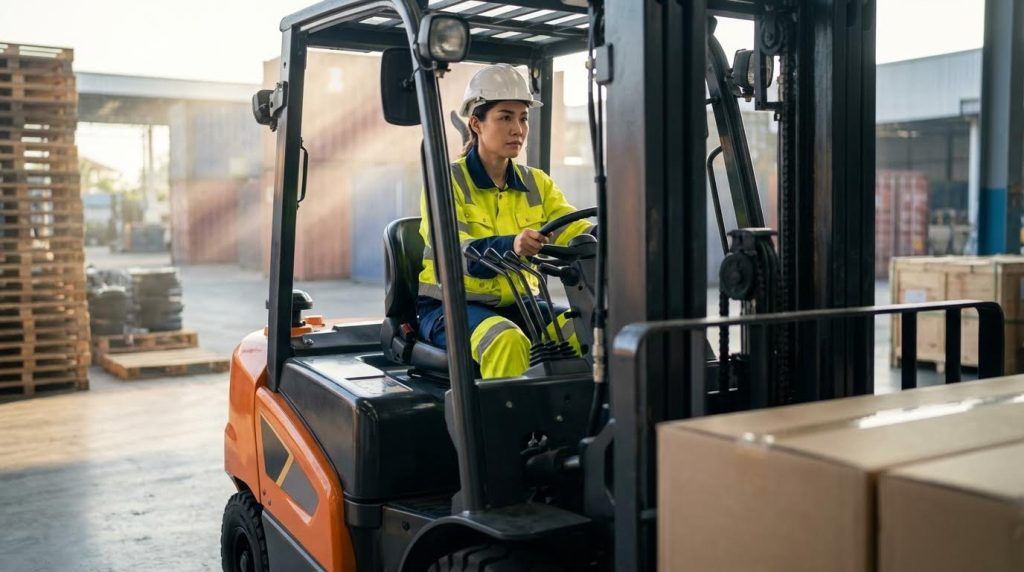
Engineering factors like load center, mast height, attachments, and battery weight directly answer “how much can an electric forklift hold” by reducing real‑world safe capacity below the number printed on the data plate. These limits protect the stability triangle and prevent tip‑overs.
- Key Point: Rated capacity is valid only at a specific load center, mast height, and configuration – change any of these and your usable capacity drops.
- Why It Matters: Overlooking derating is one of the fastest ways to overload a truck that still “looks fine” to the operator – a major OSHA violation and accident trigger.
Below are the three big engineering levers that silently change how much an electric forklift can safely carry in day‑to‑day work.
Load center, load moment, and stability triangle
Load center and load moment explain why the same electric forklift can legally hold 3,000 kg in one case and under 2,500 kg in another, even with the same pallet weight. The stability triangle defines the tipping limit as that load moves.
Most electric forklifts in warehouses are rated somewhere between 1,500–3,500 kg at a 500 mm load center according to OSHA guidance. Typical capacity ranges and rating format show a data plate entry like “3,000 kg @ 500 mm LC”. Once the actual load center grows beyond that 500 mm, the truck’s safe capacity drops because the overturning moment increases.
| Rated condition | Changed condition | Approx. safe capacity | Operational impact |
|---|---|---|---|
| 3,000 kg @ 500 mm LC | Load center increases to 600 mm | ≈2,400 kg (80% of rating) | 1 pallet that was legal at 500 mm becomes overload at 600 mm |
| ≈1,800 kg @ 610 mm LC (4,000 lb @ 24 in) | Load center increases to 915 mm (36 in) | ≈1,200 kg (2,666 lb) | Long loads force you to drop about one‑third of capacity |
These examples follow OSHA’s explanation that capacity falls as load center increases because load moment (load × distance) grows. OSHA load‑center examples and industry guidance echo a similar rule of thumb: Safe capacity ≈ (Rated load center ÷ Actual load center) × Rated capacity.
The stability triangle is the other half of the story. The three points are the two front wheels and the rear axle pivot. The combined center of gravity (truck + battery + load) must stay inside this triangle to avoid tipping. As you push the load farther out or higher up, that combined center of gravity walks toward the front edge of the triangle, shrinking your safety margin. OSHA’s stability triangle explanation makes this the foundation of operator training.
- Keep load close: Position the pallet heel tight to the fork face – this minimizes load center and preserves capacity.
- Heaviest side to mast: Put denser product against the carriage – this pulls the combined center of gravity back into the triangle.
- Evenly across forks: Avoid off‑center loading – side‑to‑side imbalance can flip the truck faster than front‑to‑back overload.
How to estimate your actual load center
Measure the load depth from the fork face to the far end. Divide by 2. That distance in mm is your actual load center. Compare it to the data plate value (often 500 mm). If your number is larger, your real safe capacity is lower than the plate rating.
💡 Field Engineer’s Note: In practice, the worst offenders are long but “light” loads like 3,000 mm crates or ducts. Even if the weight is under the nameplate rating, the long load center can pull the center of gravity right to the edge of the stability triangle, especially on slight ramps or when braking hard.
Mast height, lift charts, and high‑reach derating
Mast height and lift charts quietly cap how much an electric forklift can hold at high racking levels, even if it lifts that same load easily at floor level.
Manufacturers and regulations recognize that as the mast extends, stability decreases and capacity must be derated. OSHA and related guidance note that while “standard” masts might lift to around 3,000 mm at full rated capacity, masts extending toward 8,000 mm or more usually require reduced capacity at maximum height. Higher masts and derating requirements make this explicit for industrial trucks.
| Lift height | Typical capacity behavior | Operational impact |
|---|---|---|
| Ground to ≈3,000 mm | Often close to full rated capacity | Truck can usually handle nameplate load on low racks |
| ≈3,000–6,000 mm | Capacity begins to derate | Heavier pallets may need to stay on lower beam levels |
| ≈6,000–8,000+ mm | Noticeable derating; stability margin shrinks | High‑bay storage may require higher‑capacity or specialized trucks |
This is why lift curve charts or capacity tables are mandatory when you ask “how much can an electric forklift hold at 7,000 mm?” The answer is never just the big number on the side of the truck. Instead, you read the chart that cross‑references lift height and load center for the specific mast and attachment set‑up. Industry guidance on load curves and derating stresses using these charts rather than guessing.
- Know your top beam height: Compare racking height to the mast’s rated lift – you may be operating in the derated zone more than you think.
- Check the data plate for height ratings: Many plates list a second or third capacity at higher lift heights – those lower numbers govern high‑reach work.
- Plan for growth: If you expect to add another beam level later – spec extra capacity now to avoid derating surprises.
Why capacity drops as the mast goes up
As the mast extends, the load sits higher and further from the truck’s base. The center of gravity moves forward and upward, increasing overturning moment and reducing the stabilizing effect of the counterweight and battery. Wind, floor unevenness, and mast deflection all have more leverage at height, so standards require derating.
💡 Field Engineer’s Note: In high‑bay warehouses, I often see trucks that “can lift it” off the ground but stall or feel unstable near the top beam. That is your real‑world sign you are beyond the practical derated capacity, even if the hydraulics still have power.
Attachments, battery weight, and truck configuration
Attachments, battery weight, and truck configuration can easily cut 10–30% from how much an electric forklift can hold, even before you move the load.
Attachments such as clamps, fork positioners, side‑shifters, and fork extensions add dead weight and push the load center forward. Both effects reduce net lifting capacity. Industry examples show a truck dropping from about 2,270 kg (5,000 lb) nominal capacity to roughly 1,800 kg (4,000 lb) once a heavy attachment is fitted. Attachment‑driven capacity reductions are common across clamp and carton‑handling applications.
Regulators require that any attachment or modification that affects capacity be approved and reflected on an updated data plate. OSHA rules on attachments and revised ratings state that manufacturers must authorize the new capacity, and operators must use that lower figure, not the original rating.
| Configuration change | Typical effect on capacity | Operational impact |
|---|---|---|
| Add side‑shifter / fork positioner | Capacity reduced by attachment weight and new load center | Truck that once lifted 1,800 kg may be limited closer to 1,500 kg |
| Install carton clamp or roll clamp | Significant derating common | May require upsizing truck to handle same product weight |
| Use lighter‑than‑specified battery | Reduced counterweight and stability | Legal capacity drops; original rating no longer valid |
Battery weight is a critical part of the counterweight system on electric trucks. Guidance in federal rules emphasizes that using batteries lighter than specified reduces stability and capacity and can put the combined center of gravity outside the stability triangle. Federal guidance on battery weight and stability treats approved battery weight ranges as part of the truck’s design, not an optional choice.
- Always read the updated plate: After adding any attachment – ignore the side decal; use the new lower capacity on the plate.
- Match battery to spec: Never swap to a lighter battery “just because it fits” – you are removing counterweight and stability.
- Account for all extras: Cab enclosures, fork extensions, or special tires – all add weight or shift geometry and should be considered in capacity calculations.
How attachments answer “how much can an electric forklift hold?”
Start with the rated capacity and load center from the original plate. Subtract the attachment’s weight from the rated load, then adjust again for the new, longer load center using the same ratio method (Rated LC ÷ Actual LC). The result is your approximate new capacity, which should match the manufacturer’s revised plate.
💡 Field Engineer’s Note: A common field mistake is to add fork extensions for a rare oversized load and then keep using them all day. Those extensions permanently increase effective load center while installed, so every “normal” pallet you lift that day is operating on reduced, often undocumented, capacity.
Matching Forklift Capacity To Real-World Applications
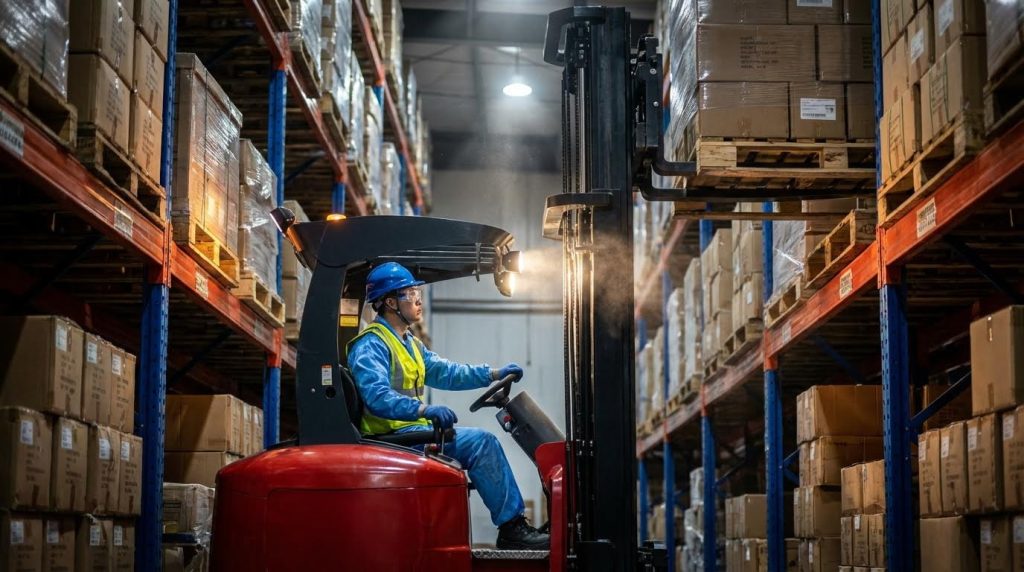
This section explains how to turn the nameplate rating into a safe, usable figure in your building, so you truly know how much can an electric forklift hold with your actual loads, aisles, and racking.
Most users never lift the “catalogue” capacity because real pallets are long, high, off‑center, and handled in tight aisles. Here we translate engineering limits into simple rules you can apply on the floor.
Calculating safe capacity for actual loads
To calculate safe capacity for real loads, you start from the data plate, measure your load dimensions, adjust for the longer load center, and then derate again for mast height and any attachments.
- Start from the data plate: Read the rated capacity, load center, and lift height – this is the only legally valid answer to “how much can an electric forklift hold.” The plate might read “3,000 kg @ 500 mm LC.” Data plate example
- Measure your load: Measure load length (fork face to far end), width, and height – these set the true load center and stability risk.
- Calculate actual load center: For a uniform pallet, load center ≈ half the load length – longer loads instantly cut capacity.
- Apply OSHA rule of thumb: Safe capacity ≈ (Rated load center ÷ Actual load center) × Rated capacity – simple way to estimate derating for longer loads. Rule-of-thumb method
- Check lift height: Use the truck’s load chart to see how capacity drops at higher mast elevations – high stacking always reduces “how much it can hold.” Height derating
- Account for attachments: Side‑shifters, clamps, fork positioners, and extensions add weight and move the load center forward – they can easily remove 10–25% of capacity and must appear on the updated data plate. Attachment rules
- Verify battery weight: Ensure the battery matches the approved weight range – a lighter battery reduces the counterweight and real capacity. Battery weight and stability
| Example Scenario | Rated Spec (from plate) | Actual Load Geometry | Estimated Safe Capacity | Operational Impact |
|---|---|---|---|---|
| Standard pallet load | 3,000 kg @ 500 mm LC | 1,000 mm long load → 500 mm LC | ≈3,000 kg (no derate) | Full nameplate capacity usable to rated height on standard pallets. |
| Long load (doors, panels) | 3,000 kg @ 500 mm LC | 1,600 mm long load → 800 mm LC | ≈(500/800)×3,000 ≈ 1,875 kg | Capacity cut by ~38%; need higher‑capacity truck or different handling method. |
| Same long load, high lift | 3,000 kg @ 500 mm LC, 6,000 mm lift | 1,600 mm long, lift to 6,000 mm | Load chart may drop to ~60–70% of above | Safe capacity around 1,100–1,300 kg at top bay; often forces re‑slotting. |
| Attachment fitted | 3,000 kg @ 500 mm LC | Side‑shifter installed, new plate 2,500 kg @ 500 mm | Now work from 2,500 kg, not 3,000 kg | Real “how much it can hold” is attachment‑rated value, not original rating. |
How to measure load center correctly
Measure from the fork face (vertical heel) to the center of gravity of the load, not to the pallet end. For a uniform 1,200 mm deep pallet, the load center is typically 600 mm. Irregular loads may have the center of gravity closer to one side; in that case, use the worst‑case (farthest) distance when estimating capacity.
These calculations show why two trucks with the same nameplate rating can safely lift very different real‑world loads. Geometry, not just kilograms, decides stability.
💡 Field Engineer’s Note: In audits I often find operators using “it lifted it yesterday” as the capacity check. Any change in load length, stacking height, or attachment can push the combined center of gravity outside the stability triangle and turn a “routine” lift into a tip‑over, even though the truck still feels normal at floor level.
Selecting capacity for aisle width, racking, and shifts
To choose electric forklift capacity for a site, you balance the heaviest realistic load against aisle width, racking height, and shift pattern, then add a safety margin so the truck never runs at 100% of rating.
- Start from real loads, not catalogues: List your heaviest, longest, and highest‑stacked pallets – these define the minimum capacity and mast height.
- Map racking heights: Note the top beam level and add clearance (typically 150–300 mm) – this sets required lift height, which directly affects capacity derating. Mast height effects
- Check aisle widths: Measure clear aisle between pallet faces, not just rack uprights – wide‑aisle trucks need about 3.2–3.8 m, narrow‑aisle units can work in 1.8–2.4 m but with lower capacities. Common capacities by type
- Match truck class to aisle type: Counterbalance trucks (1,500–5,000 kg typical) suit wide aisles; narrow‑aisle and reach trucks often run 1,000–2,000 kg – tight aisles usually mean lower capacity. Capacity ranges
- Consider duty cycle and shifts: Multi‑shift sites need enough capacity and battery to avoid running at the limit all day – higher‑capacity trucks with larger or Li‑ion batteries handle long shifts better. Runtime examples
- Build in a capacity buffer: Aim to operate daily at 60–80% of rated capacity – this covers load variation, uneven floors, and future growth without re‑specifying trucks.
- Check floor and environment: Slopes, docks, and rough concrete reduce practical capacity even if the nameplate stays the same – treat ramps and poor floors as an extra derating factor. Surface and slope impact
| Application | Typical Aisle Width | Typical Racking Height | Recommended Electric Capacity Range | Best For… |
|---|---|---|---|---|
| Standard pallet warehouse | 3.2–3.8 m | Up to 6,000 mm | 1,500–3,000 kg | General 1,000 × 1,200 mm pallets, mixed SKUs, single‑shift operations. |
| High‑bay distribution center | 2.4–3.0 m (with reach trucks) | 8,000–10,000 mm | 1,200–2,000 kg (reach), 2,500–3,500 kg (dock trucks) | Deep pallet racking with heavy but regular loads, multi‑shift. |
| Narrow‑aisle storage | 1.8–2.4 m | 8,000–12,000 mm | 1,000–1,600 kg (VNA / turret) | High density storage where space is more critical than maximum kg. |
| Heavy manufacturing | 3.5–4.5 m | 4,000–6,000 mm | 4,000–10,000 kg | Tooling, dies, coils, and fixtures that push the upper end of electric capacity. |
Rule of thumb for choosing nameplate capacity
1. Take your heaviest realistic load (including pallet and packaging). 2. Multiply by 1.3–1.5 to allow for longer load centers, height derating, and future growth. 3. Round up to the next standard truck capacity (for example, from 2,200 kg to a 3,000 kg truck). This keeps daily work in the 60–80% range of the nameplate, which improves safety and reduces wear.
When you combine these steps, “how much can an electric forklift hold” stops being a guess and becomes a documented, site‑specific number. That is what safety audits and standards expect, and it is what keeps trucks upright when the real world does not match the brochure.
💡 Field Engineer’s Note: In tight aisles I often down‑spec capacity slightly and up‑spec mast and battery: a 2,000 kg narrow‑aisle truck with the right mast and energy package will move more pallets per shift than a cramped 3,000 kg counterbalance that constantly struggles to turn or reach the top beam.
Final Thoughts On Specifying Electric Forklift Capacity
Electric forklift capacity is never a single fixed number. Geometry, height, and configuration decide how much the truck can safely lift on your site. Load center and mast height shift the combined center of gravity inside the stability triangle. Attachments and battery choice change that balance again. These factors work together to prevent tip‑overs, broken racking, and floor damage.
Operations and engineering teams must treat the data plate and load charts as design inputs, not paperwork. Start with the heaviest and longest real loads, then calculate actual load center and check capacity at the top beam height. Add attachments and battery details, then confirm that the revised plate still covers the job with a clear safety margin.
The best practice is to size trucks so daily work sits in the 60–80% range of rated capacity. This buffer covers uneven floors, ramps, and future growth. It also keeps trucks stable and productive over long shifts. When in doubt, step up a capacity class or adjust the storage plan instead of pushing limits. That is how Atomoving designs and selects material handling equipment that stays safe, compliant, and efficient in real warehouses, not just in catalogues.
Frequently Asked Questions
How much can an electric forklift hold?
An electric forklift’s load capacity depends on its design and intended use. Typically, models like the Electric Warehouse Forklift with cushion tires can lift up to 6,000 lbs. However, capacities may vary depending on factors such as mast type and tire configuration. For specific details, check manufacturer specifications or consult a qualified dealer. Warehouse Forklift Rentals.
What is the maximum lifting height of an electric forklift?
The maximum lifting height of an electric forklift also varies by model. For example, some Electric Warehouse Forklifts with quad masts can reach heights of up to 20 ft. Always ensure that the forklift you choose matches your operational needs in terms of both capacity and height. Warehouse Forklift Rentals.