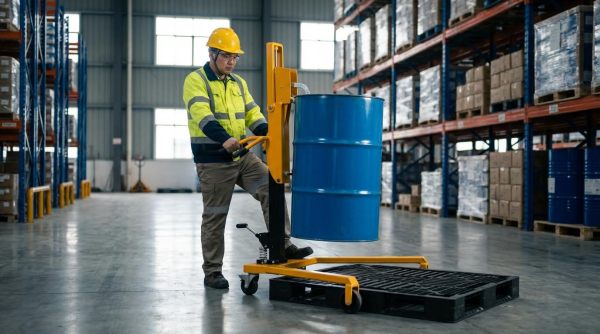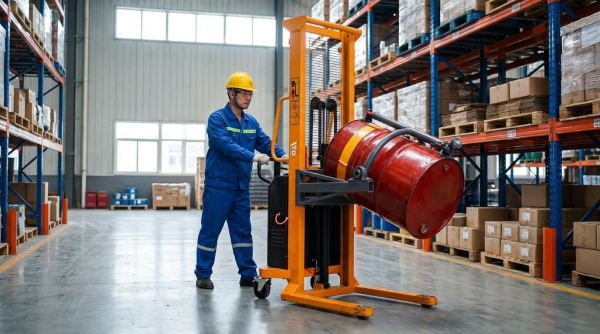
This guide explains what drum dollies and cylinder dollies do, how their engineering design affects safety, and which OSHA rules apply to each. You will see how to match dolly type, load rating, and wheel design to your drums, cylinders, and floor conditions so operators move heavy containers safely and compliantly.
Core Functions Of Drum And Cylinder Dollies
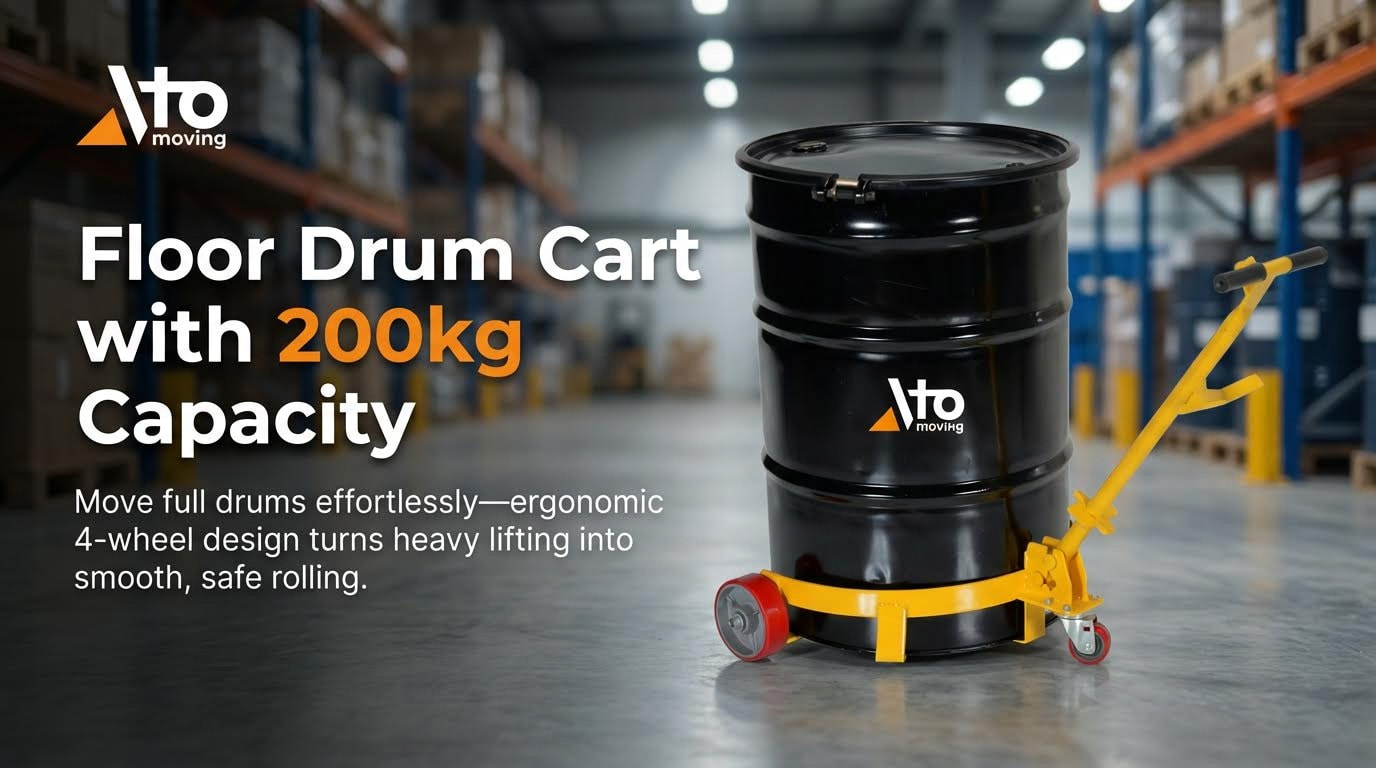
When people ask “what do drum dollies and cylinder dollies do,” the core answer is that they move heavy drums and gas cylinders safely with less manual force, keeping loads upright, restrained, and stable along defined routes between storage and use areas. Both are handling aids, not containment or impact protection, and they are central to reducing lifting, tipping, and crush risks in OSHA-regulated workplaces.
- Drum dollies: Support and roll heavy round containers – cut push–pull force and avoid tilting 200 L (55-gallon) drums by hand.
- Cylinder dollies: Cradle and secure compressed gas cylinders – keep tall cylinders upright and restrained over flat or uneven ground.
- Shared role: Reduce manual lifting and balance – shift work from the operator’s back and arms into wheels, frames, and restraints.
- OSHA alignment: Keep containers sound, upright, and controlled – support compliance with 29 CFR 1910, 1915, and 1926 expectations for safe drum and cylinder handling.
Quick answer: what do drum dollies and cylinder dollies do?
They act as engineered wheeled supports that let one person move heavy drums or gas cylinders with controlled force, while keeping containers upright, restrained, and away from impact and tip-over hazards.
💡 Field Engineer’s Note: In most plants, I see more injuries from “short moves” done without a dolly than from long hauls. If a drum or cylinder is heavy enough to hurt your foot when it lands, it is heavy enough to justify a properly rated dolly every time it moves.
How Drum Dollies Support Heavy Round Containers
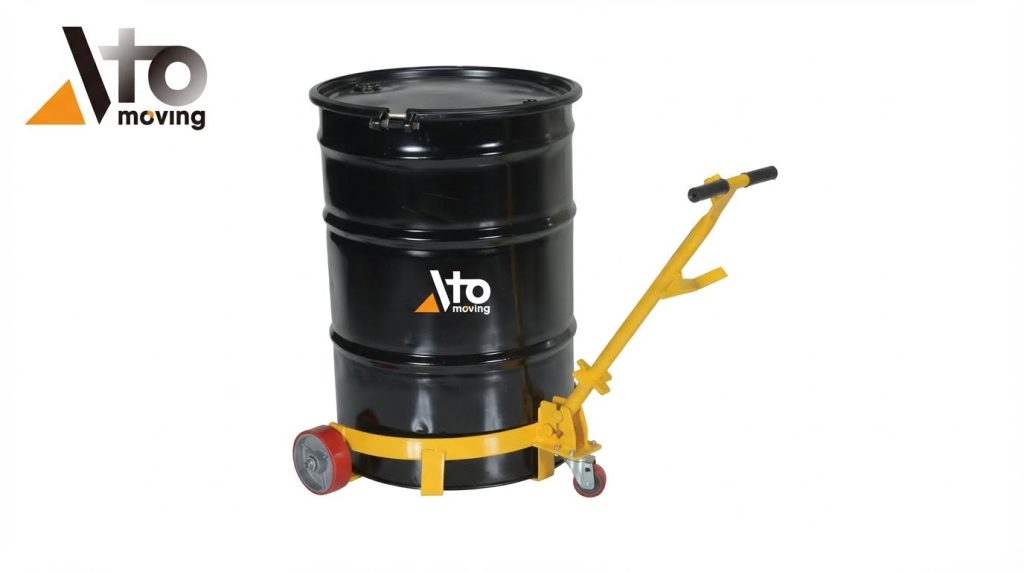
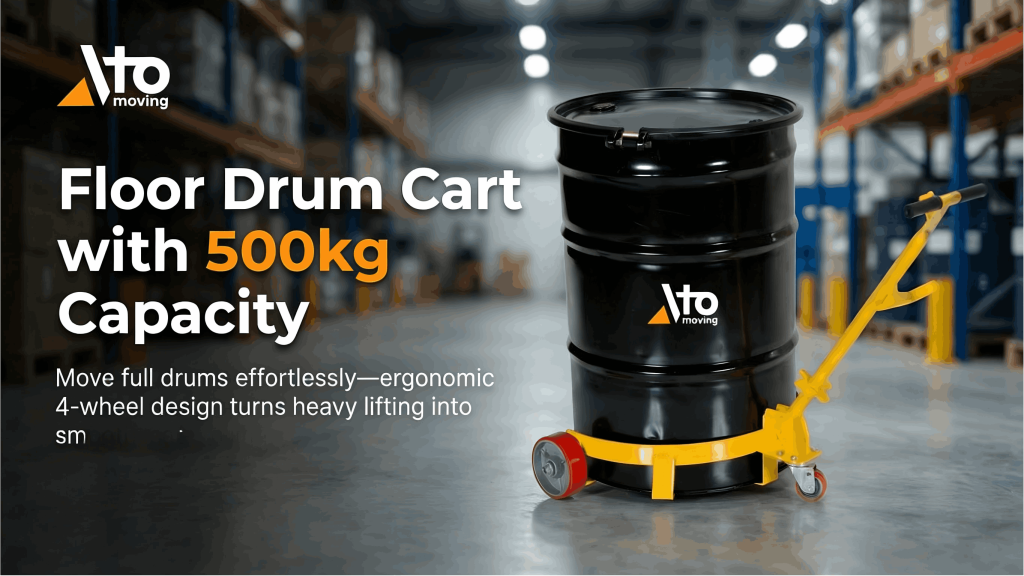
Drum dollies support heavy round containers by acting as low, wheeled platforms or rings that carry the full drum weight and let operators roll 30–55 gallon (110–200 L) drums across flat floors instead of tilting or “walking” them. Their circular or cross‑brace frames keep the drum’s center of gravity low and centered inside the wheelbase, which sharply reduces tip-over risk during routine moves.
- Primary function: Move heavy drums on wheels, not by rolling on the rim – avoids back strain and uncontrolled drum movement.
- Typical drum sizes: 5, 30, and 55 gallons (≈20, 110, 200 L) – covers most plant and warehouse containers.
- Common contents: Oils, solvents, coatings, food ingredients, waste – especially where spills or contamination are critical concerns.
- Typical environments: Plants, warehouses, maintenance shops – smooth concrete floors and tight aisles.
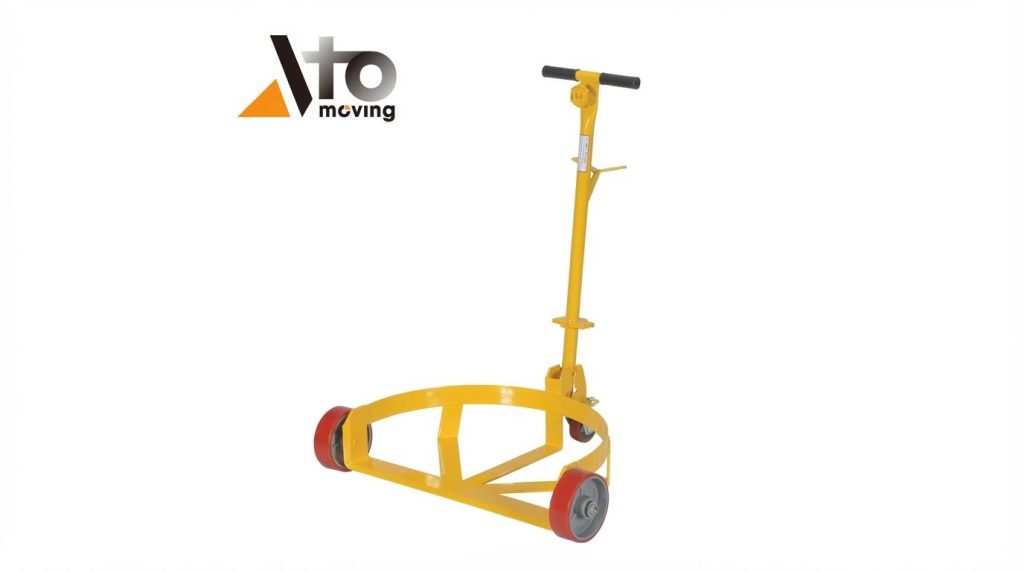
Most drum dollies work as either a circular ring or an X-shaped (cross‑brace) deck that supports the drum base around its circumference or at several strong contact points. The drum is usually lifted or placed onto the dolly using a hoist, drum lifter, or manual pallet jack to avoid manual lifting. Once loaded, the operator only needs to overcome rolling resistance on the casters, not dead-lift the drum weight. This dramatically reduces push–pull forces and the chance of the drum slipping or rolling away. Technical description of drum dolly function and geometry
| Drum Dolly Function | How It Works | Operational Impact |
|---|---|---|
| Support heavy round containers | Ring or X-deck carries drum base instead of rim | Prevents drums from rolling away or digging into floors |
| Reduce push–pull force | Four swivel casters carry full weight | Allows one operator to move ≈200 L drums safely |
| Keep center of gravity low | Low profile deck close to floor | Improves stability when crossing joints or thresholds |
| Allow multi-directional movement | Four swivel casters rotate 360° | Enables tight turns in aisles ≈1.8–2.4 m wide |
| Manage spills and washdown | Open or cross‑brace decks let liquids drain | Reduces debris buildup and cleaning time in wet zones |
Frame and deck style strongly affect how drum dollies behave around spills and cleaning. Cross‑brace and open‑deck designs let spills and wash water pass through the center opening, which minimizes standing liquid and sludge buildup under the drum. Solid‑deck versions, by contrast, intentionally catch drips on the platform to keep floors cleaner at the cost of more frequent dolly cleaning. Heavy‑duty and adjustable models add deeper rings or tiered X‑shaped decks to handle higher capacities and multiple drum diameters without sacrificing stability. Use cases and deck options for drum dollies
- Cross‑brace/open deck: Spills and wash water drain through – ideal for washdown and spill‑prone areas.
- Solid deck: Captures drips on the dolly – better where floor contamination must be minimized.
- Tiered X‑deck: Supports 5–55 gallon drums – one dolly covers multiple drum sizes with drainage.
- Heavy‑duty frames: Deeper rings and stronger welds – handle higher impact and reduce drum slippage.
Where are drum dollies most useful?
They are most effective in indoor areas with smooth concrete floors, frequent 30–55 gallon drum moves, and either washdown requirements (open decks) or strict housekeeping rules (solid decks). They are not designed for rough outdoor terrain.
💡 Field Engineer’s Note: If your operators still “roll” drums on their chime for short moves, you have an incident waiting to happen. A low-profile drum dolly with a proper ring often prevents both back strains and dented drum rims after the first week of use.
How Cylinder Dollies Secure Compressed Gas Cylinders
Cylinder dollies secure compressed gas cylinders by holding one or two tall cylinders upright in molded pockets or cradles, then carrying that load on large wheels—often pneumatic—so the cylinders stay capped, vertical, and restrained over flat or uneven ground. They are engineered to meet OSHA expectations that cylinders remain upright, protected from impact, and kept away from heat and sparks during movement.
- Primary function: Move tall, narrow gas cylinders safely – eliminates rolling cylinders on their side or dragging by hand.
- Typical cylinder types: Oxygen, nitrogen, inert gases, fuel gases – including common welding pairs such as oxygen–acetylene.
- Common environments: Welding shops, labs, maintenance, outdoor job sites – anywhere compressed gases are stored or consumed.
- Load range: ≈110 kg (250 lb) for single units, ≈225 kg (500 lb) for dual units – covers most industrial cylinder combinations.
Cylinder dollies usually use a narrow, cart‑like frame with molded wells or saddles to locate the cylinder bases and keep the load path straight down into two large wheels. Many designs use polyethylene frames for corrosion resistance and non‑sparking behavior, which is critical around flammable gases or aggressive chemicals. The large‑diameter wheels—often around 420 mm (16.5 in)—let operators roll cylinders across rough concrete, yards, and exterior slabs that would stop or damage small casters. Construction and typical capacities of cylinder dollies
| Cylinder Dolly Function | How It Works | Best For… |
|---|---|---|
| Secure one cylinder | Single pocket or cradle with strap/chain | Point-of-use work with one oxygen or inert cylinder |
| Secure gas pairs | Dual pockets plus shared handle and tool tray | Oxygen–acetylene welding sets up to ≈225 kg total |
| Maintain upright position | Vertical frame, base wells, and restraints | OSHA-compliant movement of compressed gas cylinders |
| Navigate rough ground | Large pneumatic wheels, wide tread | Construction sites, yards, uneven exterior concrete |
| Resist corrosion and sparks | Polyethylene or similar non-sparking materials | Flammable gas service and chemical exposure areas |
Because compressed gas cylinders store energy at high pressure, OSHA expects them to remain upright, capped, and secured during any move. A compliant cylinder dolly therefore does more than just “carry weight”: it must keep cylinders vertical, resist side loads from bumps and turns, and provide attachment points for straps or chains that prevent cylinders from falling or bouncing out of the cradle. Tool trays for regulators and hoses help keep accessories under control and off the floor, reducing trip and impact hazards. Use cases and safety roles for cylinder dollies
- Single-cylinder dollies: One gas cylinder plus strap – ideal for maintenance techs moving a single bottle to point-of-use.
- Dual-cylinder dollies: Two cylinders plus tray – suited to welding sets that always travel as a pair.
- Large pneumatic wheels: Roll over cracks, gravel, and outdoor slabs – reduce shock loads into valves and regulators.
- Polyethylene frames: Corrosion-resistant and non-sparking – support safe use around flammable gases and chemicals.
Where are cylinder dollies most useful?
They are essential anywhere cylinders routinely move between storage racks and workstations, especially where floors are rough, slopes exist, or hot work and flammable gases are present. They are not a substitute for proper cylinder storage racks.
💡 Field Engineer’s Note: I treat every cylinder move as a potential “projectile event” if something goes wrong. A well-designed cylinder dolly with tight base pockets and correctly tensioned straps is cheap insurance against a valve shear that could turn a cylinder into a rocket.
Engineering Design Differences And Safety Impacts
Engineering design differences between drum dollies and cylinder dollies directly control stability, tipping risk, and where each can safely operate. Understanding frame geometry, wheels, and materials explains what do drum dollies and cylinder dollies do in real workplaces.
Frame geometry, stability, and load paths
Frame geometry defines how each dolly carries the load, where the center of gravity sits, and how likely it is to tip during a sudden stop or side impact.
| Feature | Drum Dollies | Cylinder Dollies | Operational Impact |
|---|---|---|---|
| Typical container supported | 30–55 gallon (≈110–200 L) drums and overpacks | 1–2 compressed gas cylinders up to ≈300 mm diameter | Matches geometry to wide vs tall loads for safer moves |
| Frame shape | Circular ring or X-shaped cross-brace frame supporting full drum footprint (steel, welded) | Narrow cart-like frame with molded wells or saddles for cylinder bases (polyethylene common) | Drum dollies spread load; cylinder dollies localize load at base pockets |
| Center of gravity (CoG) | Low and centered inside a four-caster wheelbase, improving tipping resistance for 30–55 gallon drums source | High, tall CoG directly above 2-wheel axle; stable in rolling direction, less stable sideways | Drum dollies better against side hits; cylinder dollies must be kept upright and secured |
| Load path | Drum weight flows through ring/X-deck into 3–4 casters, distributing forces uniformly | Load runs straight down from cylinder into base pockets and into 2 large wheels source | Drum dollies resist point loads; cylinder dollies concentrate loads at axle and pockets |
| Typical load capacity | Approx. 900–1,200 lb (≈410–545 kg) uniform load, with frame mass ≈10–13 kg source | Approx. 250 lb (≈115 kg) for single, 500 lb (≈225 kg) for dual units source | Drum dollies sized for very heavy, dense liquids; cylinder dollies sized for tall, lighter bases |
| Restraint features | Raised lips or rings to prevent drums sliding off; optional straps on multi-position units source | Cradles/wells plus straps or chains to hold cylinders upright and capped | Prevents roll-off during sudden stops and floor joints, as expected by OSHA |
- Wide, low drum support: Circular or X-deck frames keep the drum footprint fully supported – this lowers overturning moments when you hit a joint or ramp.
- Narrow, tall cylinder support: Cart-like frames with base pockets manage slender cylinders – good in the rolling direction but sensitive to side pushes.
- Four-point vs two-point contact: Drum dollies spread forces into multiple casters – cylinder dollies concentrate forces into a single axle, so axle and weld quality are critical.
- OSHA alignment: Both designs aim to keep containers upright, restrained, and stable – which is exactly what OSHA expects for safe drum and cylinder handling.
How frame geometry answers “what do drum dollies and cylinder dollies do?”
In engineering terms, drum dollies create a low, wide base to move very heavy, round containers with minimal tipping risk. Cylinder dollies create a guided, upright path for tall gas cylinders so they stay vertical, capped, and controlled between storage and point-of-use.
💡 Field Engineer’s Note: When you see frequent near-miss “wobbles” on ramps, it is usually a geometry issue, not an operator issue. Widening the wheelbase or lowering the cradle by even 25–50 mm often stabilizes borderline loads without changing procedures.
Wheels, casters, and floor or terrain conditions
Wheel and caster design decides where each dolly can safely run, how much push force is needed, and how much shock transfers into the drum or cylinder.
| Feature | Drum Dollies | Cylinder Dollies | Best For… |
|---|---|---|---|
| Wheel / caster type | Usually 4 swivel casters, ≈75 mm diameter, ≈32 mm wide, rubber or cast-iron treads for smooth floors source | 2 large pneumatic wheels ≈420 mm diameter for rough concrete and outdoor yards source | Drum: tight indoor aisles. Cylinder: uneven yards, construction sites, exterior concrete. |
| Mobility pattern | Omni-directional; can move sideways or spin in place with small turning radius | Mainly forward/backward; turns by pivoting the frame around wheels | Drum: ideal in cramped plants. Cylinder: ideal for longer, straighter runs. |
| Surface sensitivity | Sensitive to cracks, gaps, and debris; needs relatively smooth, level floors | Handles cracks, joints, and small obstacles due to large pneumatic tires | Choose casters for sealed indoor concrete; choose pneumatic for rough or outdoor routes. |
| Push-pull ergonomics | Low rolling resistance on smooth floors but higher shock at joints | Pneumatics absorb shock but increase rolling resistance on soft ground | Balance operator effort vs shock to fragile or pressurized contents. |
| Chemical compatibility | Rubber, cast-iron, or polyurethane wheels selected for spill exposure and floor protection source | Pneumatic tires plus corrosion-resistant hubs for outdoor and chemical atmospheres | Prevents tread degradation and bearing seizure in chemical or wet areas. |
- Indoor drum handling: Small, hard casters on drum dollies minimize turning radius – perfect for 2.0–2.5 m aisles, but operators must avoid damaged floor sections.
- Outdoor cylinder handling: Large pneumatic wheels on cylinder dollies climb over rough concrete and gravel – critical when cylinders travel between yard storage and shop use.
- Wheel hardness trade-off: Harder wheels roll easier but transmit more vibration – softer treads protect fragile contents and floors but need more push force.
- OSHA and route planning: OSHA expects safe routes that avoid hot work and high-traffic zones; correct wheels make those routes practical and reduce manual strain.
Choosing wheels for mixed indoor/outdoor routes
For operations that move drums or cylinders from indoor storage to outdoor loading, consider hybrid strategies: drum dollies with larger polyurethane casters for door thresholds, and cylinder dollies with medium-pressure pneumatics to limit bounce while still crossing rough ground.
💡 Field Engineer’s Note: Many “mysterious” drum leaks trace back to small casters hammering over the same floor joint every day. Upgrading to slightly larger diameter casters or repairing that 10–15 mm gap often cuts container damage incidents without changing the dolly model.
Load ratings, materials, and corrosion resistance
Load rating and material selection determine whether a dolly will survive real-world impacts, chemical exposure, and long-term fatigue without sudden failure.
| Aspect | Drum Dollies | Cylinder Dollies | Operational Impact |
|---|---|---|---|
| Typical rated capacity | ≈900–1,200 lb (≈410–545 kg) uniform load for steel, welded frames source | ≈250 lb (≈115 kg) single; ≈500 lb (≈225 kg) dual-cylinder units source | Drum dollies sized for full 200 L drums; cylinder dollies sized for common industrial gas pairs. |
| Frame material | Welded steel with powder-coated finish; heavy-duty cross-braces and deeper support rings for higher loads source | Corrosion-resistant polyethylene frames; non-sparking for compressed gas environments source | Steel suits high static loads; polyethylene suits chemical and spark-sensitive areas. |
| Corrosion resistance strategy | Painted or powder-coated carbon steel for dry indoor; galvanized or stainless for wet/corrosive atmospheres source | Inherently corrosion-resistant polymer frames; hardware and wheel hubs must also resist chemicals | Prevents frame thinning and weld failure, especially around sumps and washdown zones. |
| Chemical compatibility | Wheel treads and seals matched to oils, solvents, or food ingredients handled with 30–55 gallon drums source | Materials selected for exposure to compressed gas environments and outdoor weather | Reduces swelling, cracking, and seizure of wheels and bearings. |
| Inspection focus | Check welds, rings, and coatings for rust, pitting, and deformation; verify capacity plate is legible source | Inspect polymer for cracking, UV damage, and distortion at cylinder pockets; confirm straps/chains are intact | Supports OSHA expectations for sound equipment and documented inspections. |
- Capacity must exceed worst-case load: Engineers should match rated capacity to the heaviest drum or cylinder plus a safety margin – this avoids frame fatigue and sudden failures under impact.
- Material matches environment: Powder-coated steel works in dry warehouses; galvanized, stainless, or polymers are better in washdown or chemical areas – corrosion is a slow but serious structural risk.
- Non-sparking for gases: Polyethylene cylinder dollies help mitigate ignition risk around flammable gases – supporting OSHA’s focus on keeping cylinders away from sparks and heat.
- Maintenance extends life: Lubricating bearings, replacing worn wheels, and repairing coatings reduce total cost of
Selecting The Right Dolly For Your Application
Selecting the right dolly starts with container type, floor conditions, and OSHA rules on stability and restraint. The best answer to “what do drum dollies and cylinder dollies do” is: they move heavy containers safely with minimal manual force.
Question Use Drum Dolly Use Cylinder Dolly Operational Impact Container type 5–55 gallon (≈20–200 L) drums, overpacks, wide round containers Compressed gas cylinders up to ≈300 mm diameter Matches cradle geometry to container shape for stability Typical contents Oils, solvents, coatings, food ingredients, waste Oxygen, acetylene, nitrogen, specialty gases Aligns handling tool with spill, fire, or pressure hazards Floor / terrain Smooth indoor concrete with minimal joints Rough concrete, outdoor yards, uneven surfaces Reduces push force and tip risk on actual route OSHA focus Prevent rolling, dropping, and impact to large liquid containers Keep cylinders upright, capped, and secured during movement Supports compliance with 29 CFR 1910/1915/1926 handling rules Typical capacity ≈400–550 kg (900–1,200 lb) uniform load ≈110 kg (250 lb) single, ≈225 kg (500 lb) dual Ensures rated load exceeds heaviest container plus margin Best for… Short moves between drum storage, filling, and waste areas Moving cylinders from storage racks to points of use Minimizes manual lifting and crush / tip-over risk 💡 Field Engineer’s Note: Before buying any dolly, walk the actual route with a tape measure. Check door widths, ramps, floor joints, and slopes; many tip-overs happen where a small floor defect meets an overloaded or poorly matched dolly.
Matching dolly type to container and environment
Matching the dolly to container and environment is the practical answer to what do drum dollies and cylinder dollies do in real plants: they turn risky manual moves into controlled, low-effort transport tailored to your loads and floors.
Selection Factor Drum Dolly – Recommended Choice Cylinder Dolly – Recommended Choice Operational Impact Container geometry Circular or cross-brace frames that support full drum circumference for 30–55 gallon drums ring/X-deck geometry Narrow cart-like frame with molded wells or saddles for one or two vertical cylinders up to ≈300 mm diameter cylinder cradle Keeps center of gravity low and contained inside wheelbase for each container type Floor and terrain Four small swivel casters ≈75 mm diameter for smooth indoor concrete and tight aisles indoor floors Two large pneumatic wheels ≈420 mm diameter for rough concrete, yards, and uneven exterior slabs outdoor terrain Minimizes push-pull force and shock to the load on the actual route Spill and washdown Open or cross-brace decks where washdown and spills are common; solid decks where drips must be contained on the platform spill control Corrosion-resistant polyethylene frames for chemical and outdoor exposure non-sparking frames Reduces cleanup time and corrosion, supports environmental and fire-safety programs Load rating Steel drum dollies with welded frames typically ≈400–550 kg capacity and self-weight ≈10–13 kg uniform loads Polyethylene cylinder dollies ≈110 kg for single and ≈225 kg for dual units typical capacities Ensures rated capacity exceeds heaviest filled drum or gas pair plus safety margin Hazard profile Flammable or toxic liquids in 30–55 gallon drums; may need spill pans or dikes per storage rules drum storage rules High-pressure compressed gas; must remain upright, capped, and away from heat or sparks compressed gas rules Aligns dolly features with specific OSHA and fire-code hazard controls - Container-first selection: Start from drum or cylinder geometry – this dictates whether a ring deck or cylinder cradle is even safe to use.
- Route mapping: Walk the full path from storage to point-of-use – choose casters or pneumatic wheels that roll easily over every joint and ramp.
- Environment match: Assess chemicals, washdown, and weather – spec corrosion-resistant frames and wheel treads where needed.
- Capacity margin: Compare rated load to heaviest filled container – add a realistic safety margin rather than running at 100% of rating.
- Task frequency: For frequent moves, prioritize maneuverability and ergonomic push forces – this cuts fatigue and long-term injury risk.
How to quickly size a dolly for your drums or cylinders
Measure drum diameter at the widest point and height in mm. For cylinders, measure diameter and confirm gas type. Then compare to manufacturer fit ranges and capacity, ensuring the drum sits fully within the ring or the cylinder base sits fully inside the cradle pocket.
OSHA-driven criteria, training, and maintenance
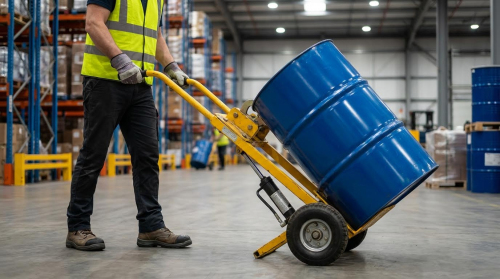
OSHA-driven criteria, training, and maintenance ensure that what drum dollies and cylinder dollies do in theory—reduce lifting, keep loads upright, and control movement—actually happens every day on the floor.
- Use dollies as handling aids only: OSHA treats drums, pressure vessels, and cylinders as distinct hazards; dollies are not primary containment or impact protection handling aids – never rely on a dolly as a spill basin or crash barrier.
- Stability and restraint: Cylinders must remain upright, capped, and secured; drums must not roll or bounce off during stops or floor transitions upright and secured – choose designs with proper lips, rings, and straps.
- Capacity and center of gravity: Engineers must match rated capacity to the heaviest container plus margin; stability depends on wheelbase width, platform height, and load center of gravity stability requirements – low cradles and wide wheelbases are safer for tall loads.
- Written procedures and training: Employers must provide written procedures for selection, inspection, loading, and transport and explain why certain actions are prohibited employer duties – operators should know that rolling drums on their rims or moving unrestrained cylinders is not acceptable.
- Pre-use inspections: Operators should verify identification plates, rated capacity, frame condition, and wheel or caster integrity before use inspection steps – this catches bent frames, cracked welds, or seized wheels before a failure under load.
- Safe operating practices: Position the dolly on level floors, push rather than pull, avoid sudden stops, and keep routes away from hot work and high-traffic areas loading and transport – this minimizes tip-over and collision risk.
- Maintenance program: Lubricate wheel bearings and swivel joints, replace worn wheels, and repair coatings in corrosive areas on a set schedule preventive maintenance – keeps push forces low and prevents sudden wheel failures.
- Integration with powered traffic: Define traffic rules and protected crossings where forklifts or AGVs share space with manual dollies traffic controls – prevents side impacts that can topple drums or cylinders.
Training checklist for drum and cylinder dolly operators
Cover at minimum: how to identify the correct dolly for each container; reading capacity plates; using straps, chains, or lips correctly; safe push techniques and route rules; pre-use inspection points; and incident reporting if a drum or cylinder shifts, leaks, or tips while on a dolly.
Final Considerations For Safe, Compliant Dolly Use
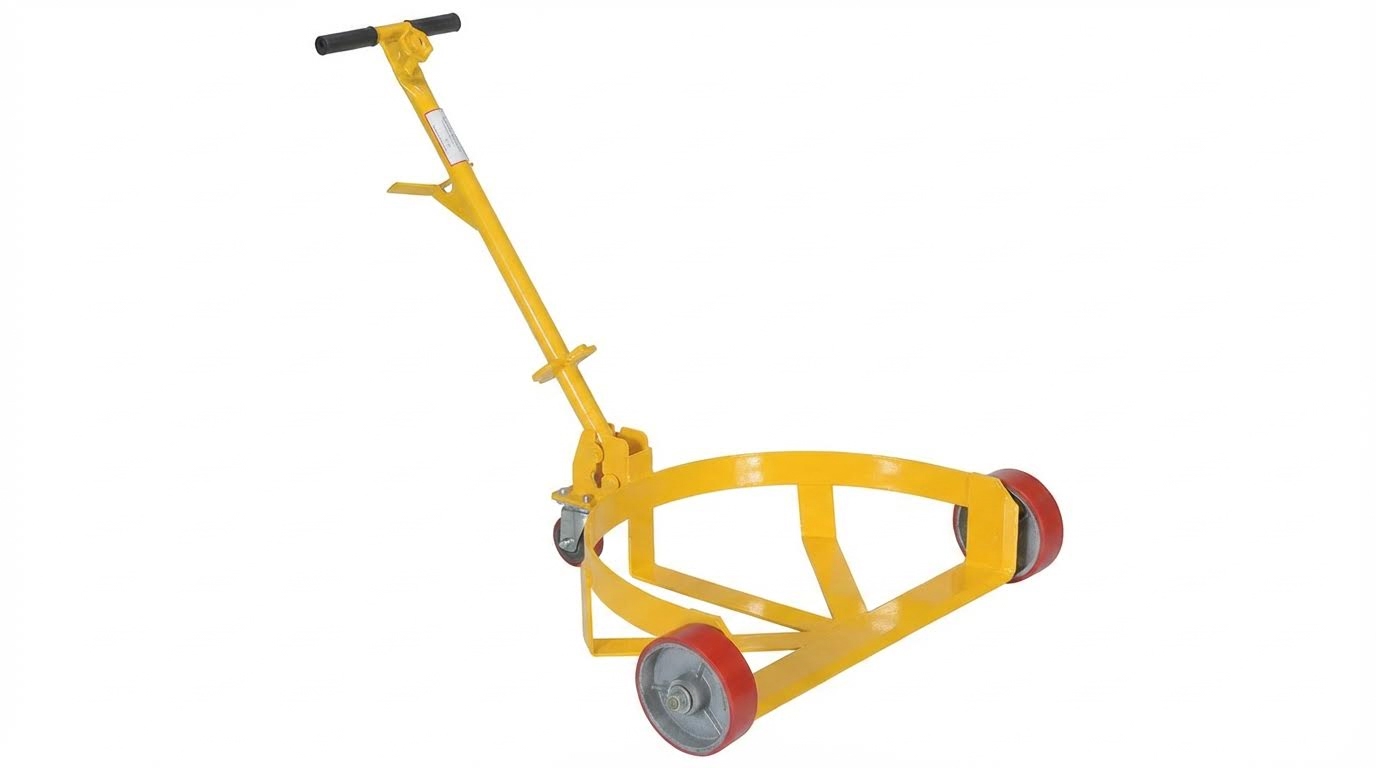
Final safe use of drum and cylinder dollies comes down to matching design to risk, enforcing OSHA-driven procedures, and maintaining equipment so stability and containment are never compromised in day-to-day operations.
By this point, you should clearly answer “what do drum dollies and cylinder dollies do” in your own facility: they reduce manual lifting, keep drums and cylinders upright, and provide controlled rolling support between storage and point-of-use areas. To lock in those benefits, you need consistent rules for selection, inspection, operation, and integration with other material-handling traffic.
Practical OSHA-aligned rules you should standardize
These are the non‑negotiables that keep you aligned with OSHA expectations for drums, containers, and compressed gas cylinders.
- Use dollies as handling aids only: Do not treat them as containment or impact guards – they are for movement, not spill or blast protection.
- Keep containers upright and restrained: Cylinders must stay vertical, capped, and strapped; drums must sit fully inside rings or cradles – this preserves integrity during bumps and stops.
- Avoid rolling or dropping containers: Always move drums and cylinders on suitable dollies or trucks – this mitigates shell damage and valve shear risk.
- Respect flammable and toxic zones: Plan routes that avoid hot work, open flames, and traffic pinch points – this reduces combined fire and impact hazards.
- Match capacity with a safety margin: Rate dollies above the heaviest expected drum or cylinder – this prevents overload-induced frame or caster failure.
- Provide written procedures and training: Document how to select, inspect, and operate each dolly type – this turns OSHA rules into repeatable habits.
How this ties back to OSHA parts 1910, 1915, and 1926
OSHA sections on drums, containers, and compressed gases require containers to remain sound, upright, and protected from impact, with cylinders capped and secured during movement. Dollies are explicitly treated as handling aids that must support these conditions, not replace proper storage or containment systems.
Inspection and maintenance routines that actually prevent incidents
Routine checks and simple preventive maintenance keep both drum dollies and cylinder dollies within their original design envelope.
- Pre-use visual check: Confirm ID plate legibility, rated capacity, and absence of bent frames or cracked welds – this flags overload or impact damage early.
- Wheel and caster spin test: Rotate each wheel by hand to detect flat spots, seized bearings, or loose fasteners – this avoids sudden steering loss under load.
- Restraint system check: Inspect straps, chains, and clamps for wear, cuts, and proper latching – this ensures cylinders and drums stay seated over floor joints and ramps.
- Surface and coating inspection: Look for rust, pitting, and coating failure, especially in wet or chemical areas – this prevents structural thinning and unexpected breakage.
- Planned lubrication: Grease wheel bearings and swivel joints on a set schedule – this keeps push forces low and reduces operator strain.
- Wheel replacement policy: Replace worn or chemically attacked treads proactively – this preserves grip and avoids tread delamination under emergency braking.
Corrosion and chemical compatibility checklist
Use painted carbon steel for dry, non‑corrosive indoor areas. Choose galvanized or stainless frames where washdown or corrosive vapors exist. In aggressive chemical zones, specify polymer frames or chemically resistant coatings and ensure wheel treads and seals are compatible with the liquids handled.
Operational discipline: loading, moving, and unloading
How operators actually move loads matters as much as the engineering design of the dolly.
- Step 1: Position on level, clear floor – this minimizes initial tipping risk as the load is placed.
- Step 2: Center the drum or cylinder fully in the support area – this keeps the center of gravity inside the wheelbase.
- Step 3: Secure restraints before motion – this prevents vertical bounce or side slip over joints and thresholds.
- Step 4: Push, do not pull – pushing gives better control and reduces back and shoulder strain.
- Step 5: Walk, do not run, and avoid sudden stops – this limits inertial loads that could exceed restraint capacity.
- Step 6: Use planned routes that bypass hot work and vehicle pinch points – this reduces multi-hazard exposure.
- Step 7: Chock or brake during loading/unloading – this stops unintended rolling as weight shifts.
💡 Field Engineer’s Note: Most “mystery tip-overs” happen at floor transitions, dock plates, or shallow ramps. Treat every joint or slope as a test of your restraint system and wheel choice; if operators feel a sharp jolt, you are too close to your true stability limit.
Integrating dollies with forklifts, AGVs, and site traffic
Safe drum and cylinder dolly use also depends on how they coexist with powered trucks and automated systems.
- Define shared-traffic rules: Set speed limits, right-of-way, and crossing points between forklifts, AGVs, and manual dolly routes – this prevents side-impact collisions with tall, narrow cylinder loads.
- Create fixed loading zones: Use wheel stops, floor markings, and guides – this standardizes where drums and cylinders transfer between dollies and other equipment.
- Use interlocks with AGVs: Prevent AGV motion until loads on dollies or carts are properly restrained – this stops “drive-off” events with unsecured cylinders.
- Separate lanes where practical: Install bollards or barriers to segregate manual dolly paths from heavy forklift traffic – this reduces crush and tip-over risk.
Controls for human error you should formalize
Prohibit riding on dollies, using cylinders as rollers, or moving unrestrained cylinders “just a short distance.” Require route planning for large or hazardous loads and empower supervisors to stop unsafe shortcuts immediately. Reinforce that dollies assist safe handling but never justify ignoring valve caps, spill control, or fire protection rules.
When you combine the right drum or cylinder dolly design with disciplined procedures, you fully answer “what do drum dollies and cylinder dollies do” in OSHA terms: they become engineered controls that cut manual handling forces, maintain container stability, and support compliant movement of hazardous contents across your site.

Final Considerations For Safe, Compliant Dolly Use
Drum and cylinder dollies only deliver real safety when engineering choices, OSHA rules, and daily habits align. Frame geometry keeps centers of gravity low and inside the wheelbase. Correct wheels match floor joints, slopes, and terrain. Load ratings and materials resist impact, fatigue, and corrosion. Together, these factors prevent tip-overs, leaks, and structural failures that turn routine moves into recordable incidents.
Operations and engineering teams should treat dolly selection as a risk-control decision, not a commodity purchase. Start with container geometry and contents. Map actual routes. Then choose drum or cylinder dollies that keep loads upright, restrained, and stable with push forces that operators can sustain. Back this up with written procedures, OSHA-aligned training, and a simple inspection and lubrication schedule.
The best practice is clear: never roll drums on rims or drag cylinders “for a short distance.” Always use a correctly rated, well-maintained dolly, and keep cylinders capped and strapped and drums fully seated in their rings. When you combine sound engineering, disciplined operation, and periodic maintenance, drum and cylinder dollies become reliable engineered controls that support safe, compliant material handling across your site—especially when sourced from specialists such as Atomoving.
Frequently Asked Questions
What do drum dollies and cylinder dollies do?
Drum dollies and cylinder dollies are tools designed to move heavy cylindrical objects like drums or gas cylinders safely and efficiently. They reduce the risk of injury by eliminating the need to manually lift these heavy items. Safe Drum Transport Guide.
- They help in positioning and transporting heavy drums or cylinders with minimal effort.
- These dollies keep the load stable during movement, reducing the chance of accidents.
How do you use a drum dolly?
To use a drum dolly, push it up to the base of the drum, position its feet securely, and engage the locking mechanism. Tilt the dolly slightly forward and pull it back so that the drum rests on the dolly’s wheels for easy transport. Drum Dolly Safety Instructions.
- Position the dolly at the base of the drum.
- Engage the lock and tilt until the dolly wheels support the drum.