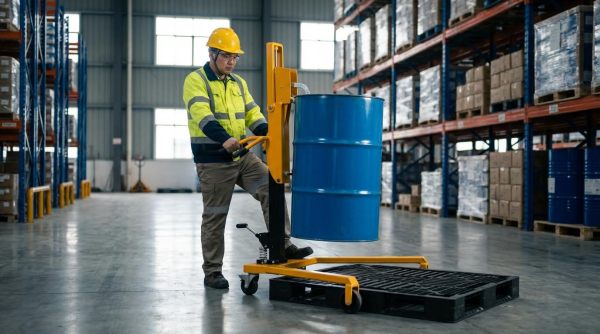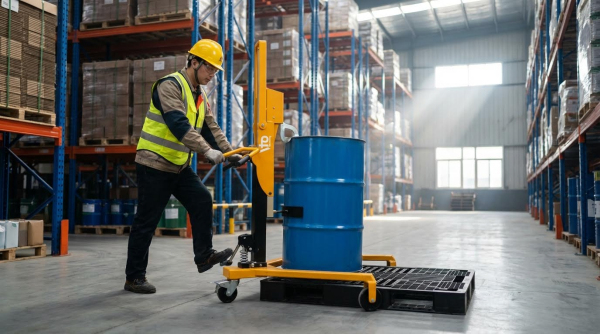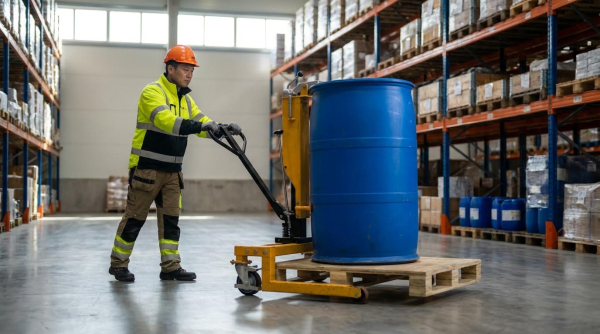
Yes, you can transport diesel in a 55-gallon (≈200L) drum, but only if the drum is UN-approved, correctly filled, clearly labeled, and properly secured. This guide explains when diesel drum transport is legal, how to control fire and spill risk, and which handling equipment and storage practices keep operations compliant and efficient. If you have ever asked “can you transport diesel in a 55 gallon drum” on public roads or around your site, this article walks through the engineering, regulatory, and safety rules you must meet.

When Is Diesel Transport In Drums Actually Legal?
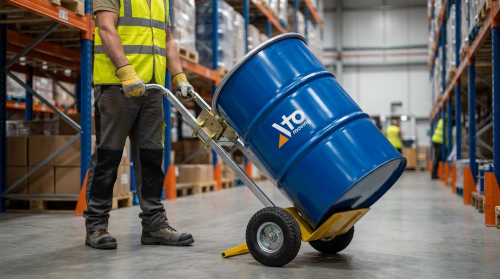
Diesel transport in drums is legal when you use approved UN/DOT-rated containers, stay within capacity limits, apply correct hazard markings, and secure drums to meet worker-safety and road-transport regulations. In practice, this is exactly how you answer “can you transport diesel in a 55 gallon drum” for regulators and insurers.
| Legal Factor | Typical Requirement | Operational Impact |
|---|---|---|
| Container type | UN/DOT-approved steel or HDPE drum for combustible liquids | Allows road transport without repacking fuel |
| Maximum drum capacity | ≈ 200–230 L (up to about 60 US gallons) | Standard 55-gallon (≈ 208 L) drum is within size limits |
| Fill level | Max ≈ 95% of drum nominal volume | Reduces pressure rise from thermal expansion during transport |
| Orientation | Drums upright with closures up | Minimizes leak risk through bungs and gaskets |
| Securement | Blocking, chocks, cradles, and rated tie-downs | Prevents rolling, tipping, and impact in transit |
| Marking & labeling | Proper UN number, hazard class, product ID, and signal words | Enables enforcement, emergency response, and insurance compliance |
Regulatory frameworks typically treat diesel as a combustible liquid with specific limits on container size, total quantity in a vehicle or building, and how drums are stored and secured. OSHA-type rules focus on worker safety, while transport rules focus on packaging performance, hazard communication, and load restraint.
💡 Field Engineer’s Note: Many violations arise not from the drum itself, but from missing labels or poor tie-downs; inspectors often check securement and markings before they ever question drum size.
How this applies to a single 55-gallon drum
A single 55-gallon (≈ 208 L) diesel drum usually falls within legal container size limits when it is a UN/DOT-rated drum, filled to about 95% maximum, correctly labeled, and properly secured upright on a suitable vehicle bed.
How Diesel Is Classified For Transport Codes
Diesel is classified as a combustible liquid with a higher flash point than gasoline, and that classification drives container design, labeling, and separation rules during storage and transport.
- Combustible liquid category: Diesel falls into a combustible liquid class (often Class II or similar) – this still supports fire and requires strict controls.
- Packaging performance codes: Drums for diesel must meet UN performance packaging codes – they pass drop, leak, and pressure tests to survive transport abuse.
- Hazard communication: Codes require hazard class wording, symbols, and UN numbers on drums – this tells drivers and firefighters exactly what is inside.
- Quantity management: Rules limit how much combustible liquid can be outside approved storage areas – prevents small sites turning into high-hazard fuel depots.
| Classification Aspect | What It Means For Diesel | Operational Impact |
|---|---|---|
| Flash point | Higher than gasoline but still ignitable | Requires fire separation and ignition control |
| Liquid class | Combustible (e.g., Class II type) | Triggers specific drum and storage requirements |
| Hazard class label | Combustible/flammable liquid symbol and wording | Must be visible on every drum in transport |
| Regulatory focus | Worker safety and transport safety | Applies both in warehouses and on public roads |
Because diesel is still a fire-supporting liquid, codes demand that every drum used in transport is performance-tested and clearly marked. That is why “can you transport diesel in a 55 gallon drum” is always followed by “only if it is an approved, correctly labeled drum.”
Why classification matters in the field
Misclassifying diesel as “non-hazardous” leads to using non-rated drums, missing labels, and poor separation from ignition sources, which all increase fire and enforcement risk.
Approved Drum Types, Sizes, And UN Markings
Approved diesel drums are UN/DOT-rated steel or HDPE containers up to about 60 US gallons, with specific UN markings that prove they passed drop, leak, and pressure tests for fuel service.
| Drum Feature | Typical Spec For Diesel | Operational Impact |
|---|---|---|
| Material | Steel or high-density polyethylene (HDPE) | Steel: better fire and impact resistance; HDPE: corrosion resistance and lower weight |
| Max capacity | ≈ 60 US gallons (about 227 L) | Standard 55-gallon (≈ 208 L) drum is accepted size |
| UN approval | UN performance packaging code stamped on drum | Shows drum passed drop, leak, and pressure tests for transport |
| Closures | Threaded bungs with fuel-resistant gaskets | Reduces evaporation, water ingress, and leak risk |
| Color coding | Yellow typically used for diesel | Helps avoid cross-filling with gasoline or other liquids |
| Label content | Product name, hazard class, UN ID number, fill date, emergency contact | Meets hazard communication and emergency response needs |
- Steel drums: Offer high mechanical strength and better fire resistance – preferred where impact or radiant heat is likely.
- HDPE drums: Provide corrosion resistance and lower mass – useful for aggressive environments but must carry correct UN fuel markings.
- Capacity alignment: Regulations cap drum sizes around 200–230 L – the common 55-gallon drum fits neatly inside this band.
- Marking discipline: Missing or unreadable UN markings put you out of compliance – even if the drum was originally approved.
💡 Field Engineer’s Note: When reusing drums, always confirm the original UN code and service rating; many sites illegally refill chemical drums with diesel that were never tested or marked for fuel duty.
Quick check: Is my 55-gallon drum acceptable?
For a 55-gallon (≈ 208 L) drum to be legally used for diesel transport, verify: it is steel or HDPE with a clear UN performance code for liquids, capacity not exceeding about 60 gallons, closures in good condition with fuel-resistant gaskets, and external labels showing diesel product details, hazard class, and UN identification number.
Engineering Rules For Filling, Sealing, And Securing Drums

Engineering rules for filling, sealing, and securing drums define how far you can fill diesel, how you control pressure, and how you physically lock and restrain each 200 L (55‑gallon) drum so it survives real-world transport without leaks or deformation.
If you are asking can you transport diesel in a 55 gallon drum, these rules are the difference between a compliant load and a rolling fire risk. They tie together fill percentage, closure hardware, gaskets, venting, pallets, and tie-downs into one engineered system.
- Fill control: Limit diesel to about 95% of drum volume – Prevents hydraulic overpressure when temperature rises.
- Sealed closures: Use threaded bungs and fuel‑rated gaskets – Minimizes leaks, vapor loss, and water ingress.
- Mechanical restraint: Keep drums upright, blocked, and strapped – Stops rolling, tipping, and impact damage in transit.
💡 Field Engineer’s Note: Treat every 200 L drum like a small pressure vessel on wheels: a few extra millimeters of thermal expansion clearance and one more ratchet strap are far cheaper than one leaking drum on a public road.
Fill Limits, Thermal Expansion, And Pressure Control
Fill limits, thermal expansion, and pressure control ensure that a diesel drum has enough free space and structural margin to absorb temperature swings without bulging, leaking, or rupturing.
Industry guidance recommends that diesel should not fill more than about 95% of a drum’s nominal capacity to allow for thermal expansion and reduce hydraulic overpressure risk. This applies directly when you decide can you transport diesel in a 55 gallon drum, because the answer is “yes, but only if you respect that 5% vapor space and use approved containers.” Guidance on 95% fill and sealing systems
| Parameter | Typical Engineering Rule | Why It Matters | Operational Impact |
|---|---|---|---|
| Maximum fill level | ≈95% of nominal volume | Leaves expansion space for diesel as temperature rises. | For a 200 L drum, fill ≈190 L to avoid bulging on a hot 35°C day. |
| Drum capacity limit | Up to about 60 US gal (≈227 L) | Aligns with UN/DOT performance-tested drum sizes for diesel. | Standard 55-gallon (≈208 L) drum is within typical regulatory limits. |
| Temperature range to consider | From lowest loading temp to worst-case transit/storage temp | Predicts maximum volumetric expansion of diesel. | Cold filling at 5°C then parking in sun at 40°C can raise internal pressure sharply. |
| Headspace function | Vapor and expansion cushion | Reduces risk of hydraulic lock in sealed drum. | Prevents drum chimes from distorting and gaskets from being extruded. |
| Pressure control devices | Non‑vented for normal transport; vented/relief where heated or pumped | Limits pressure rise during abnormal heating or pumping. | Used in fixed systems, hot rooms, or where drum is part of a pumping loop. |
- Do not “top off” drums: Leave visible ullage at the bung – Gives room for daily temperature swings.
- Account for journey conditions: Fill colder if route includes hot climates – Reduces pressure spike on arrival.
- Use only UN/DOT‑rated drums: Choose drums tested for drop, leak, and pressure – Ensures the shell can tolerate internal pressure and handling shocks.
- Avoid heating sealed drums: Do not park them in direct sun against dark walls – Cuts the rate of pressure rise and drum deformation.
How to estimate safe fill volume for a 55-gallon drum
As a rule of thumb, multiply the drum’s nominal volume by 0.95. For a 55-gallon (≈208 L) drum, 0.95 × 208 ≈ 198 L. Many operators stay slightly lower, around 190–195 L, to add extra safety margin for thermal expansion and loading angle.
💡 Field Engineer’s Note: In hot coastal yards, I have seen drums filled to the brim at 15°C start to “oil can” and seep around bungs by mid‑afternoon. A conservative 90–95% fill and shaded staging area eliminated those leaks without changing anything else.
Closure Hardware, Gaskets, And Venting Devices
Closure hardware, gaskets, and venting devices form the primary containment system that keeps diesel inside the drum and air, water, and dirt out during storage and transport.
Approved diesel drums use threaded bungs and closures with fuel‑resistant gaskets that have been tested for leak tightness under UN performance standards. Proper sealing is non‑negotiable if you want a compliant answer to can you transport diesel in a 55 gallon drum, because regulators expect tight closures with no seepage, even after vibration and minor impacts. Details on bungs, gaskets, and venting
| Component | Typical Design / Requirement | Failure Mode if Wrong | Operational Impact |
|---|---|---|---|
| Main closures (bungs) | Threaded steel or HDPE plugs matched to drum openings | Cross‑threading, loose fit, or incompatible threads cause leaks. | Must be torqued correctly after each fill; verify thread compatibility. |
| Gaskets | Fuel‑resistant material (e.g., nitrile, viton-type) sized to bung | Swelling, cracking, or hardening leads to seepage and vapor loss. | Replace on a schedule; never reuse obviously flattened or cut gaskets. |
| Closure rings (for open-head drums) | Bolted or lever‑lock rings with correct bolt torque | Under‑torque allows lid movement; over‑torque distorts drum chime. | Use a torque wrench and follow manufacturer’s torque range. |
| Venting / pressure relief | Normally closed for transport; vented caps or relief where heated or pumped | Overpressure can bulge drum; under‑venting during pumping causes cavitation. | Fit relief devices only where process conditions justify them; keep them clean. |
| Sealing verification | Visual check plus short dwell time on its side (if allowed) to spot leaks | Missed micro‑leaks become major stains and slip hazards in transit. | Stage filled drums in a controlled area for a brief leak check before loading. |
- Match bung to drum: Use only closures rated and marked for that drum type – Maintains UN performance rating.
- Use fresh gaskets: Replace gaskets when drums change product or show age – Cheap insurance against leaks.
- Torque systematically: Standardize torque settings and tools – Reduces human error and uneven sealing.
- Keep threads clean: Protect openings from grit and rust – Improves seal life and makes future opening safer.
When to use vented closures on diesel drums
For normal road transport of closed drums, non‑vented bungs are standard, relying on the expansion headspace for pressure control. Vented caps or relief devices become relevant when drums sit in heated rooms, are connected to pumps, or are part of recirculating systems where internal pressure can rise beyond what thermal expansion alone would generate.
💡 Field Engineer’s Note: The closures that fail most often are not the bungs you just installed, but the old ones you “trusted” from a previous fill. In high‑throughput yards, a simple color code or date mark on bungs and rings makes it obvious when hardware is past its planned service life.
Load Restraint, Pallets, And Material Handling Equipment
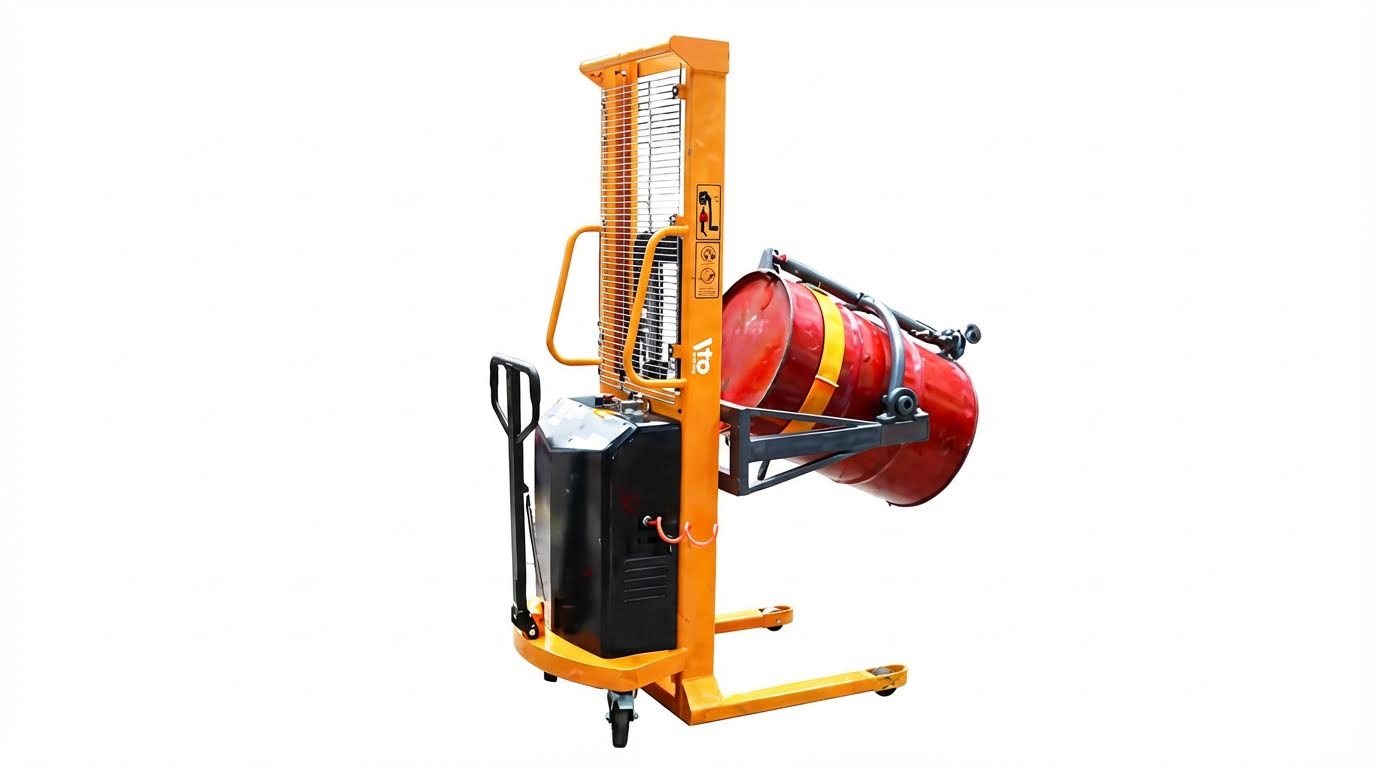
Load restraint, pallets, and manual pallet jack turn individual diesel drums into a stable, controllable load that can survive braking, cornering, and minor impacts without shifting or falling.
During transport, diesel drums must remain upright and secured using blocking, chocks, or cradles to prevent rolling and tipping, with ratchet straps or chains rated above the drum mass anchoring them to fixed tie‑down points. These practices are central to any compliant method where can you transport diesel in a 55 gallon drum, because regulators expect proof that drums are properly secured and handled with mechanical aids, not rolled free across truck decks. Guidance on loading and securing diesel drums
| Element | Engineering Rule / Practice | Risk if Ignored | Operational Impact |
|---|---|---|---|
| Drum orientation | Always upright; bungs on top | Side‑lying drums can roll, damage chimes, and stress closures. | Design racks and pallets for vertical storage and tie‑down. |
| Pallet type | Rated for concentrated loads; compatible with 200 L drums | Weak pallets can crack, dropping drums during forklift moves. | Use heavy‑duty wooden, plastic, or steel pallets sized for 2–4 drums. |
| Blocking and chocks | Blocks at drum bases; wedges or cradles for round shells | Unblocked drums can roll under braking or on slight slopes. | Simple timber blocks or steel cradles prevent movement in 2–3 directions. |
| Straps / chains | Ratchet straps or chains rated above total drum mass | Under‑rated tie‑downs can snap in emergency stops. | Use multiple straps across each row; avoid sharp edges that cut webbing. |
| Vehicle bed condition | Flat, clean, free of sharp edges and oil | Uneven or slippery beds increase tip and slide risk. | Inspect decks before loading; patch protrusions and clean spills. |
| Handling equipment | drum cart, lifters, pallet jacks, forklifts | Manual rolling and “kicking” drums cause injuries and drops. | Choose gear sized for 200–230 L drums and train operators properly. |
- Step 1: Inspect pallets and bed – Removes hidden weak points before loading heavy drums.
- Step 2: Place drums upright in tight rows – Minimizes movement gaps and concentrates mass over supports.
- Step 3: Install blocking and chocks – Prevents rolling before straps are tensioned.
- Step 4: Apply straps or chains above drum mid‑height – Controls both sliding and tipping during braking.
- Step 5: Re‑check tension after first kilometers – Compensates for settling and vibration.
Material handling equipment selection tips
For short moves on flat floors, a simple drum truck or dolly rated above 300 kg is often enough. For loading vehicles or stacking, use forklifts with drum clamps or pallets so the forks never contact the drum shell directly. Avoid lifting a full 200 L drum by a single chime or improvised hooks; use purpose‑built grabs or slings rated for the mass.
💡 Field Engineer’s Note: Most transport incidents I investigated did not start with a leaking bung; they started with a drum that fell because someone skipped one strap or used a rotten pallet. If you can’t push hard on the load without it moving, it is not ready for the road.
Designing Safe Drum Storage, Handling, And Response
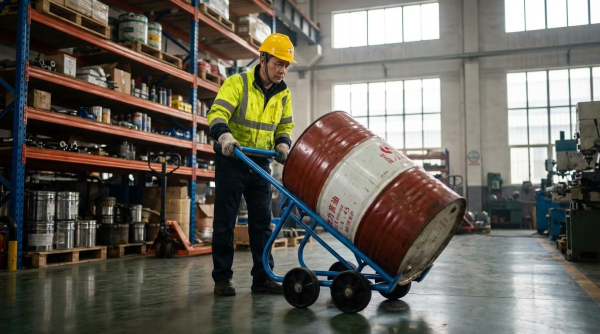
Designing safe diesel drum storage, handling, and response means controlling leaks, fire, and human error with correct layouts, containment, inspection, and training so 200L (55-gallon) drums stay stable, traceable, and compliant.
If you are asking can you transport diesel in a 55 gallon drum, regulators also expect that your fixed storage and handling setup matches the same safety logic used during road transport: approved drums, controlled spill paths, and trained people.
- Goal: Keep every drum upright, identifiable, and contained – limits fire, slip, and environmental risks.
- Method: Use color coding, labels, secondary containment, and clear procedures – turns chaotic “drum yards” into controlled systems.
- Proof: Inspections, training records, and manifests – demonstrate compliance when inspectors arrive or incidents occur.
💡 Field Engineer’s Note: In real yards, most diesel incidents start as “small seeps” at bungs or chimes. Good storage design assumes slow leaks will happen and makes sure they are easy to see and automatically captured in containment before anyone smells fuel.
Color Coding, Labeling, And Signage Standards
Color coding, labeling, and signage for diesel drums provide instant visual confirmation of contents and hazards so operators do not mix fuels, overload areas, or ignore fire risks.
Standard practice assigns yellow to diesel drums, with printed labels and fixed signs backing up the color code. A compliant diesel drum typically carries clear product and hazard information, while the storage area itself broadcasts “fuel rules” to anyone walking in. Reference
| Visual Control | Typical Requirement / Practice | Operational Impact |
|---|---|---|
| Drum Color | Yellow body or lid for diesel; red for gasoline; blue for kerosene; green for lubricants Source | Reduces mis-fueling; a quick glance tells drivers and mechanics which drums they may use. |
| Product Identification | Label with “Diesel Fuel”, grade, and sometimes sulfur content | Prevents mixing on mixed-fuel sites; supports correct engine and emissions system use. |
| Hazard Class & Pictograms | Combustible/flammable liquid symbol and wording per applicable code | Reminds workers that diesel still burns readily, even with higher flash point than gasoline. |
| UN Identification Number | UN number for diesel fuel on drum label and shipping documents | Aligns storage with transport paperwork; speeds emergency response and reporting. |
| Fill Date & Batch | Date, batch, or delivery reference printed or stamped on label | Supports stock rotation and traceability if quality or contamination issues arise. |
| Emergency Contact Details | Phone number, site or supplier contact, sometimes SDS reference | Gives responders a fast way to reach a responsible person in an incident. |
| Area Warning Signs | “FLAMMABLE – KEEP FIRE AND FLAME AWAY” and “NO SMOKING” signs in storage zones Source | Sets behavioral rules for everyone, including visitors and truck drivers. |
- Color coding: Paint or specify yellow for diesel drums and storage racks – prevents confusion when multiple fuels share the same yard.
- Durable labels: Use solvent-resistant labels and inks – ensures information stays readable despite rain and splashes.
- Consistent wording: Match drum labels to transport papers – avoids disputes during roadside checks and audits.
- Sign locations: Place signs at entries, loading pads, and eye level near drums – keeps rules visible from approach to handling point.
How to standardize labeling across multiple sites
Create a single label template for all diesel drums that includes product, hazard class, UN number, fill date, and emergency contact. Require contractors and suppliers to match this template so labels look the same on every site.
Secondary Containment, Fire Protection, And Separation
Secondary containment, fire protection, and separation ensure that if a diesel drum leaks or ignites, fuel stays within a controlled footprint and away from buildings, drains, and ignition sources.
Secondary containment systems for diesel drums are sized to capture at least 110% of the largest single drum or a regulatory percentage of total stored volume, whichever is higher. Spill pallets for two or four 55-gallon (about 200L) drums typically use steel or HDPE with grated decks for leak visibility and four-way forklift access. Reference
| Design Element | Typical Specification / Practice | Operational Impact |
|---|---|---|
| Containment Capacity | ≥110% of largest drum volume or code-defined % of total volume Source | One failed 200L drum does not escape to soil, drains, or neighboring properties. |
| Spill Pallet Construction | Steel or HDPE spill pallets with grated decks and integrated sump | Supports drum weight, allows visual leak checks, and captures drips and ruptures. |
| Forklift Access | Four-way fork pockets on spill pallets | Allows safe relocation of full drum sets without manual handling. |
| Pad Layout | Curbed or bermed pads, often concrete, draining into a controlled sump | Prevents fuel from running offsite or into storm drains during large spills. |
| Fire Extinguishers | Class B or ABC extinguishers placed within easy reach of drum areas Source | Enables early attack on small fires before they involve multiple drums. |
| No-Ignition Zones | “NO SMOKING” and similar rules marked with paint and signage | Keeps hot work, smoking, and vehicles away from drum groupings. |
| Bonding & Grounding | Bonding cables and earth connections during filling/emptying | Limits static discharge that could ignite vapors when pumping diesel. |
| Separation Distances | Setback from buildings, property lines, and ignition sources (often tens of meters) Source | Buys time for evacuation and firefighting if a drum fails or ignites. |
- Spill pallets: Use dedicated pallets for 2–4 drums instead of bare floors – turns every drum group into a self-contained “mini tank.”
- Outdoor pads: Elevate and slope pads away from drains – keeps diesel from entering stormwater systems.
- Fire coverage: Map extinguisher reach to drum positions – ensures no drum is more than a short walk from firefighting gear.
- Equipment interface: Check pallet and pad dimensions against forklift tines and drum trucks – prevents awkward lifts that damage drums or containment.
Positioning drums for safe transport loading
When you plan where drums sit on spill pallets or pads, leave clear forklift aisles and turning radii. This reduces the chance that a driver clips a drum or containment wall when loading for transport, especially when moving full 200L drums weighing over 200 kg.
💡 Field Engineer’s Note: For outdoor storage in hot climates, shade roofs above drum groups dramatically cut internal pressure swings and slow gasket aging. This simple steel canopy often prevents the weeping bungs and bulged drum walls that show up on sunny, unshaded pads.
Inspection, Maintenance, Training, And Documentation
Inspection, maintenance, training, and documentation turn a compliant diesel drum layout into a controlled process that consistently catches problems before they become spills or fires.
Regular inspections should check for corrosion, dents, bulging, wet spots, or fuel odor before moving drums. Planned maintenance includes replacing gaskets and bungs on a defined schedule and maintaining coatings to limit corrosion, especially outdoors. Reference Training and documentation then show that people know the rules and that you actually apply them day to day.
| Control Area | Key Actions | Operational Impact |
|---|---|---|
| Routine Drum Inspection | Check chimes, sidewalls, bungs, and pallet sump for corrosion, dents, bulging, wet spots, or fuel odor before each move Source | Stops damaged drums from going onto trucks, where vibration and impact could turn a seep into a major leak. |
| Planned Maintenance | Replace gaskets and bungs on schedule; repaint or recoat exteriors as needed | Extends drum life and keeps closures tight, especially in coastal or industrial atmospheres. |
| Containment Integrity | Inspect spill pallets, berms, and pads for cracks, corrosion, or blocked gratings | Ensures containment still holds the required 110% volume when you actually need it. |
| Level & Leak Monitoring | Use visual level checks, dip measurements, or sensors where justified | Helps detect unexplained inventory losses or slow, hidden leaks. |
| Task-Specific Training | Train staff on container approval, 95% fill limit, labeling, PPE, and handling equipment use Source | Reduces overfilling, dropped drums, and misuse of forklifts or drum trucks. |
| Emergency Response Planning | Define roles for spill containment, notification, isolation, and cleanup | Gives crews a script to follow during leaks or fires, cutting reaction time. |
| Documentation | Keep training logs, inspection and maintenance forms, manifests, and written procedures | Provides evidence that diesel drum storage and transport are managed systems, not ad-hoc practices. |
- Inspection frequency: Check drums before every move and on a fixed schedule in storage – movement is when marginal drums usually fail.
- Maintenance triggers: Replace closures after defined years in service or when signs of hardening or cracking appear – aged gaskets are a common leak source.
- Training scope: Include both handling equipment (forklifts, drum trucks, pallet jacks) and fuel hazards – operators must understand both mechanics and chemistry.
- Record discipline: Use simple, one-page checklists – operators are more likely to complete and keep them accurate.
Linking storage controls to transport compliance
When you document inspections, fill limits, and labeling in storage, you create a clean audit trail that follows the drum onto the truck. This directly supports compliance when authorities ask not just “can you transport diesel in a 55 gallon drum” but also “how do you prove this drum was safe and correctly labeled before it hit the road?”.
💡 Field Engineer’s Note: Many sites invest in good hardware but skip simple inspection routines. In practice, a 2-minute visual check at each drum move prevents more spills than any premium pallet or bung system you can buy.
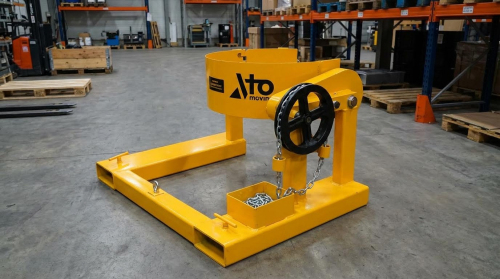
For handling such drums efficiently, consider using a drum cart or drum dolly. Additionally, a barrel lifter can be useful for lifting heavy drums safely.

Final Considerations For Diesel Drum Transport Compliance
Legal, safe diesel drum transport depends on one joined system: approved containers, controlled filling, tight closures, secure restraint, and disciplined storage and inspection. Each rule exists to manage predictable physics. Thermal expansion, impact loads, vibration, and human error will occur. Your job is to give every 55‑gallon drum enough structural margin, headspace, and mechanical support so these forces never turn into leaks or fires.
Operations teams should treat each diesel drum like a small mobile tank. Select only UN‑marked steel or HDPE drums. Cap fill at about 95% and protect drums from heat. Use matched bungs and fresh gaskets, torqued with standard tools. Keep drums upright on sound pallets, blocked and strapped so a hard brake or corner cannot move them. Back this up with color coding, clear labels, spill containment, and fire protection.
Finally, lock performance in with routine inspections, planned closure replacement, task‑specific training, and simple checklists that follow drums from yard to truck. When you design handling around purpose‑built equipment from Atomoving instead of manual rolling, you cut both injury and spill risk. Done this way, the answer to “can you transport diesel in a 55‑gallon drum” is yes, reliably and compliantly, day after day.
Frequently Asked Questions
Can You Transport Diesel in a 55-Gallon Drum?
Yes, you can transport diesel in a 55-gallon drum, but the drum must meet specific safety and regulatory requirements. Diesel must be carried in a UN-approved container that complies with packaging standards, such as those outlined in ADR Part 4. Steel drums are often recommended due to their durability and ability to meet transportation regulations like IATA Dangerous Goods and DOT hazmat laws. UK Carriage Guidelines.
What Kind of Container Can I Use for Diesel Fuel?
Diesel fuel should be stored and transported in approved safety containers designed for flammable liquids. Recommended options include steel drums or portable gas cans for smaller quantities. Steel drums are ideal for larger volumes because they are durable and meet hazardous material transportation standards. Plastic containers are not suitable unless specifically approved for diesel storage. Fuel Storage Safety Tips.