Electric scissor lifts do not always require on‑board fire extinguishers by law, but many job sites still need them to meet OSHA, MSHA, and NFPA 10 travel‑distance and escape‑route rules. This article explains when regulations trigger on‑board units, how to size and mount them, and how to build a maintenance program that actually works in the field. If you are asking “does electric scissor lifts require fire extinguishers,” you will see how the answer changes between warehouses, construction sites, mining, and military projects.
When Are On‑Board Extinguishers Required?
On electric scissor lifts, on‑board fire extinguishers are only legally required in specific high‑risk or regulated environments, but many sites install them voluntarily to meet travel‑distance rules and reduce entrapment risk. This section answers “does electric scissor lifts require fire extinguishers” in plain regulatory language.
From a compliance standpoint, the answer to “does electric scissor lifts require fire extinguishers” depends on where and how the lift operates. OSHA, MSHA, NFPA 10, and military criteria all trigger different obligations for on‑board units versus nearby wall‑mounted extinguishers.
| Regime / Standard | On‑Board Extinguisher Legally Required? | Key Trigger Condition | Operational Impact For Electric Scissor Lifts |
|---|---|---|---|
| OSHA General Industry (29 CFR 1910.157) | No, not specifically on the lift | Extinguisher must be within prescribed travel distance | Use fixed extinguishers; add on‑board units if any working position exceeds travel‑distance limits |
| MSHA Mining (30 CFR 56.4230 / 57.4230) | Yes, in many cases | Fire could impede escape or endanger others | Self‑propelled scissor lifts generally need a mounted extinguisher or suppression system in mines |
| NFPA 10 (Selection & Placement) | No direct mandate for lifts | Maximum travel distance to an extinguisher by hazard class | On‑board ABC units are a common engineering solution to meet spacing rules |
| Military / UFC Project Specs | Often yes | One extinguisher per vehicle, minimum capacity and rating | Electric scissor lifts on military sites typically carry a 9 kg‑class dry chemical extinguisher |
💡 Field Engineer’s Note: When you map extinguisher travel distances on a floor plan, scissor lifts working in high‑bay racking or atriums often “fall outside the circle.” Adding a small on‑board ABC unit is usually cheaper than redesigning the whole extinguisher layout.
OSHA, MSHA, NFPA 10 And What They Actually Say
OSHA, MSHA, and NFPA 10 do not use the phrase “electric scissor lift,” but their rules still decide when an on‑board extinguisher is mandatory versus optional.
- OSHA – General Industry (29 CFR 1910.157): OSHA requires employers to provide portable extinguishers suited to the hazards and located within maximum travel distances, but it does not explicitly demand that extinguishers be mounted on scissor lifts. Extinguishers can be on walls, columns, or the lift, provided the operator can reach them within the required distance. OSHA interpretation letters confirm this approach.
- NFPA 10 – Selection, Sizing, Spacing: NFPA 10 sets selection and spacing criteria for portable extinguishers but does not single out scissor lifts. For most Class A and B hazards, maximum travel distance to an extinguisher is about 15–23 m depending on the hazard level. If a lift can operate beyond those radii from fixed units, engineers often specify a small ABC extinguisher on the platform or chassis to maintain compliance.
- MSHA – Mining (30 CFR 56.4230 / 57.4230): MSHA requires a fire extinguisher or manually actuated fire suppression system on self‑propelled equipment if a fire could impede the operator’s escape or endanger others. The extinguisher must be mounted on the equipment or located within roughly 30 m. OSHA’s discussion of similar requirements highlights this “blocked escape” trigger.
How travel‑distance rules push you toward on‑board units
Indoors, Class B hazards typically require extinguishers within about 15 m travel distance, while many Class A layouts allow around 23 m. If an electric scissor platform lift can drive deep into racking aisles, mezzanines, or atriums where no fixed extinguisher can meet those distances, the simplest solution is to mount an ABC extinguisher on the lift itself. Outdoors, natural ventilation helps with smoke, but large open yards often exceed travel‑distance limits, again making on‑board units attractive.
- Regulatory trigger logic for “does electric scissor lifts require fire extinguishers”: If any credible fire on or near the lift could trap the operator at height or place them beyond NFPA 10/OSHA travel distances, you should treat an on‑board extinguisher as effectively required, even if the text does not name scissor lifts explicitly.
💡 Field Engineer’s Note: In real projects, I treat “blocked escape” conservatively. If a lift can be 8–10 m up with only one way down, I assume any under‑deck fire on the chassis could trap the operator and I specify an on‑board ABC extinguisher, even outside mining.
Mining, Military And Other Special Environments
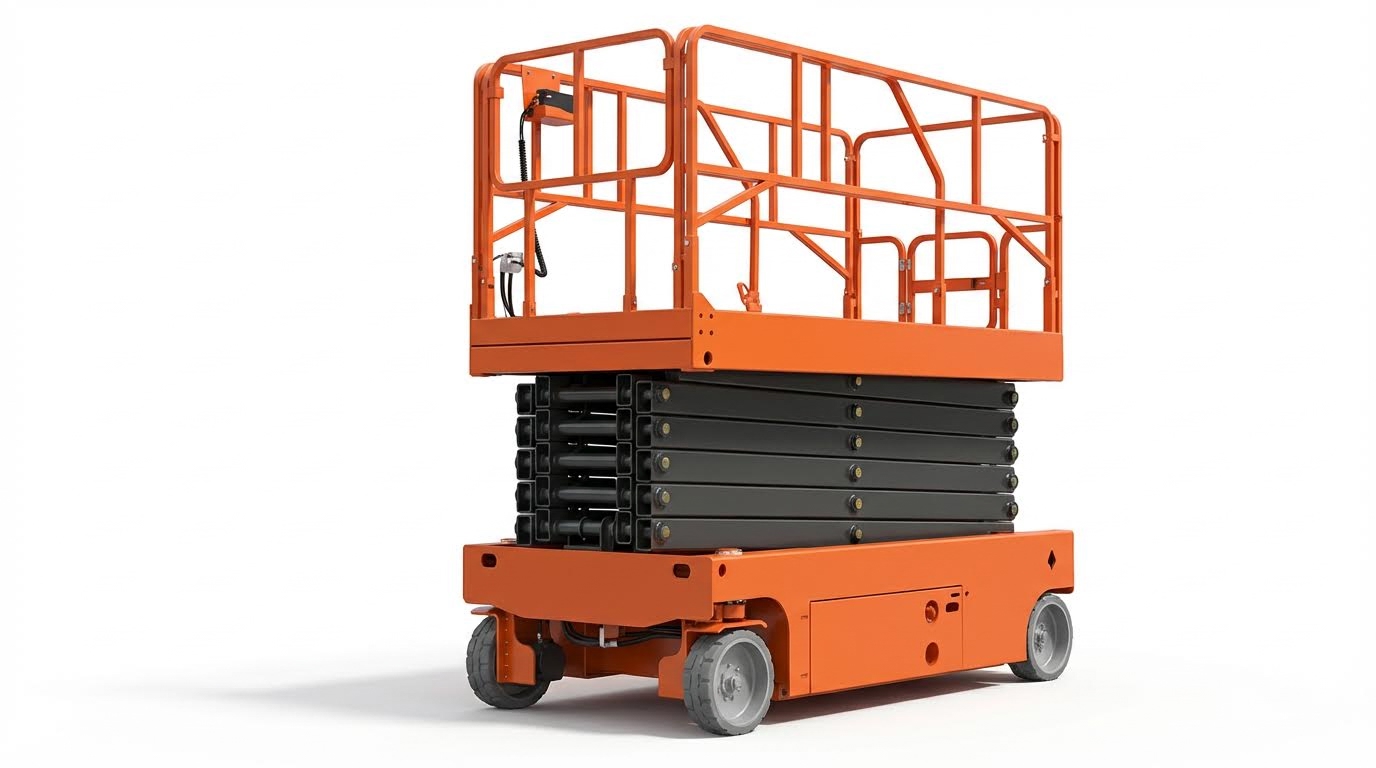
Mining, military, and other special environments shift “does electric scissor lifts require fire extinguishers” from a design choice to a hard requirement in many cases.
- Mining (MSHA‑regulated sites): Self‑propelled units such as electric scissor lifts must carry an extinguisher or a manually actuated suppression system if a fire could block escape or endanger others, with the unit mounted on the machine or within about 30 m of it. Narrow drifts, poor visibility, and limited escape paths mean this condition is often met.
- Military / Unified Facilities Criteria (UFC): UFC and typical military project specifications commonly require at least one portable extinguisher on each vehicle, often a 9 kg dry chemical unit with Class C capability where electrical equipment is present. Travel distance in work zones is often capped at about 15 m, which electric scissor lifts easily exceed when operating around aircraft, vehicles, or munitions, so on‑board extinguishers are standard practice.
- High‑hazard industrial tasks: Even outside mining or military work, certain tasks effectively demand on‑board coverage:
- Hot work from the platform: Welding or cutting creates sparks and slag that can ignite hydraulic oil residues or combustible dust.
- Paint / coating booths: Flammable vapors and overspray increase Class B and C fire risk around electric drives and controls.
- Battery‑charging areas: Hydrogen gas pockets and electrical faults can turn a minor incident into a serious platform fire.
- High‑plastic warehouses: Tall racking with shrink‑wrap and plastic totes creates rapid vertical fire growth, so quick initial attack with a nearby extinguisher is critical.
Coordinating with site fire‑protection layouts
Engineers overlay lift operating envelopes on fire‑protection drawings. If any planned lift position falls outside NFPA 10/OSHA travel distances to a suitable extinguisher, options include relocating wall units, restricting lift travel, or installing on‑board extinguishers. Digital floor plans and telematics data help visualize real‑world lift positions and close any coverage gaps.
💡 Field Engineer’s Note: On military airfields and mine sites, I assume every self‑propelled lift is a “vehicle” for extinguisher purposes. Arguing semantics with auditors is pointless; a 2–4 kg ABC extinguisher on each electric scissor lift is cheap insurance against downtime and citations.
Fire Risk Profile And Extinguisher Specification
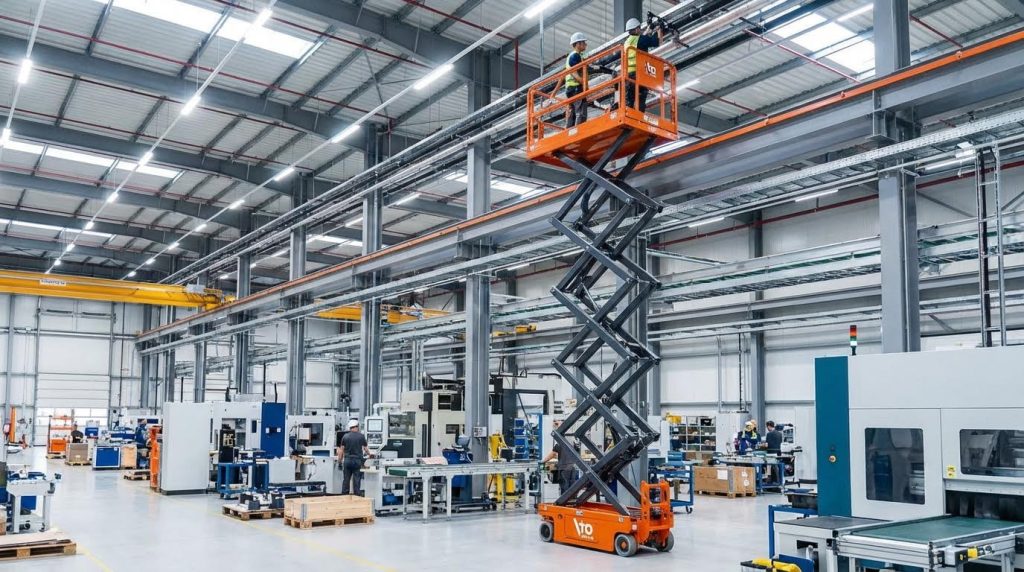
Electric scissor lifts combine Class A, B, and C fire hazards, so most fleets treat them as mixed-risk mobile work platforms and size onboard extinguishers using NFPA 10 selection, rating, and travel‑distance rules.
From an engineering and compliance perspective, the answer to “does electric scissor lifts require fire extinguishers” is: not always by law, but their fire risk profile often makes onboard ABC units the most practical way to meet OSHA/NFPA travel‑distance and hazard-coverage requirements.
Classes Of Fire On Electric Scissor Lifts
Electric scissor lifts typically involve three fire classes at once, so you should assume a mixed A/B/C hazard whenever you assess if an onboard extinguisher is needed.
- Class A – Ordinary combustibles: Platform debris, packaging, timber, cardboard, rags and plastic wrap – These ignite easily from hot work or electrical faults.
- Class B – Flammable/combustible liquids: Hydraulic oil, lubricants, cleaning solvents, paints – Leaks or spills can flash if they contact energized parts or hot surfaces.
- Class C – Energized electrical equipment: Batteries, chargers, wiring looms, contactors, control boards and drive motors – Short circuits and overheating can start confined fires in the chassis or platform control box.
Regulatory guidance for self‑propelled equipment in mining specifically notes ignition sources such as battery chargers, contactors, hydraulic hoses, and wiring looms as credible fire origins that can impede escape at height, triggering a requirement for an onboard extinguisher or suppression system when a fire could block egress within the lift structure.
- Why ABC is preferred: A multipurpose dry chemical extinguisher with an ABC rating covers Class A debris, Class B hydraulic fluids, and Class C energized components with one unit – This avoids the confusion and delay of choosing between multiple extinguisher types during an emergency.
- High‑risk tasks: Hot work from the platform, work in paint/coating booths, battery charging nearby, or warehouses with high plastic loads – These significantly increase both the likelihood and growth rate of any fire.
How this affects extinguisher selection
Because the lift carries its ignition sources and can be positioned far from fixed wall units, many engineers select an onboard ABC extinguisher as the default, then increase size or add additional units in high‑fuel‑load or restricted‑egress areas.
💡 Field Engineer’s Note: Treat the scissor lift as a moving fire load: if you routinely park it under mezzanines, in racking aisles, or inside paint lines, assume access for the fire brigade will be slow and size your onboard extinguisher for rapid self‑rescue in those worst‑case positions.
Recommended ABC Ratings And Sizing
Most electric scissor lifts are adequately covered by a compact ABC dry chemical extinguisher, typically starting at 2A:10B:C and scaling up where escape paths are poor or fire loads are higher.
| Typical Work Scenario | Suggested Minimum Rating | Approx. Agent Mass | Operational Impact / Best For… |
|---|---|---|---|
| Standard indoor maintenance, good egress, light combustibles | 2A:10B:C | ~2–4 kg | Covers small debris and hydraulic‑oil fires; compact enough for platform or chassis mounting. |
| Busy warehouses, higher plastic load, moderate travel distances | 3A:20B:C | ~4–6 kg | More agent for pallet, packaging, and spill fires while still manageable for most operators. |
| Mining, military, remote outdoor sites with limited escape | 4A:40B:C or higher | ~6–9 kg | Addresses larger fuel loads and delayed fire department response; often specified by site rules or project specs. |
Industry guidance for scissor lifts notes that a multipurpose dry chemical extinguisher with at least a 2A:10B:C rating is generally recommended for typical mixed hazards, while high‑risk environments such as mining may call for higher ratings like 4A:40B:C to address greater fire loads and constrained egress paths. OSHA interpretations referencing NFPA 10 emphasize selecting extinguishers by hazard type and expected fire size rather than by vehicle type alone.
- Electric scissor lifts (general industry): At least 2A:10B:C ABC dry chemical – Balances weight, discharge time, and coverage for routine indoor work.
- High‑hazard or limited‑egress lifts: 3A:20B:C to 4A:40B:C – Provides more agent when the operator may be delayed in reaching a secondary extinguisher or exit.
- Compatibility considerations: Choose units with corrosion‑resistant cylinders, vibration‑rated brackets, and temperature ranges suited to the site – Prevents pressure loss and bracket failures on rough floors or outdoor yards.
Weight and ergonomics check
Before standardizing on 6–9 kg units, verify that operators can safely lift and aim them from the platform without overreaching. In many fleets, a 4–6 kg 3A:20B:C extinguisher is the best compromise between fire power and manual handling limits.
💡 Field Engineer’s Note: When in doubt between two ratings, pick the larger extinguisher but upgrade the mounting hardware: use heavy‑duty brackets with secondary straps and lock pins so the extra mass does not become a projectile when the lift crosses thresholds or expansion joints.
Indoor Vs Outdoor Use And Travel Distance Limits
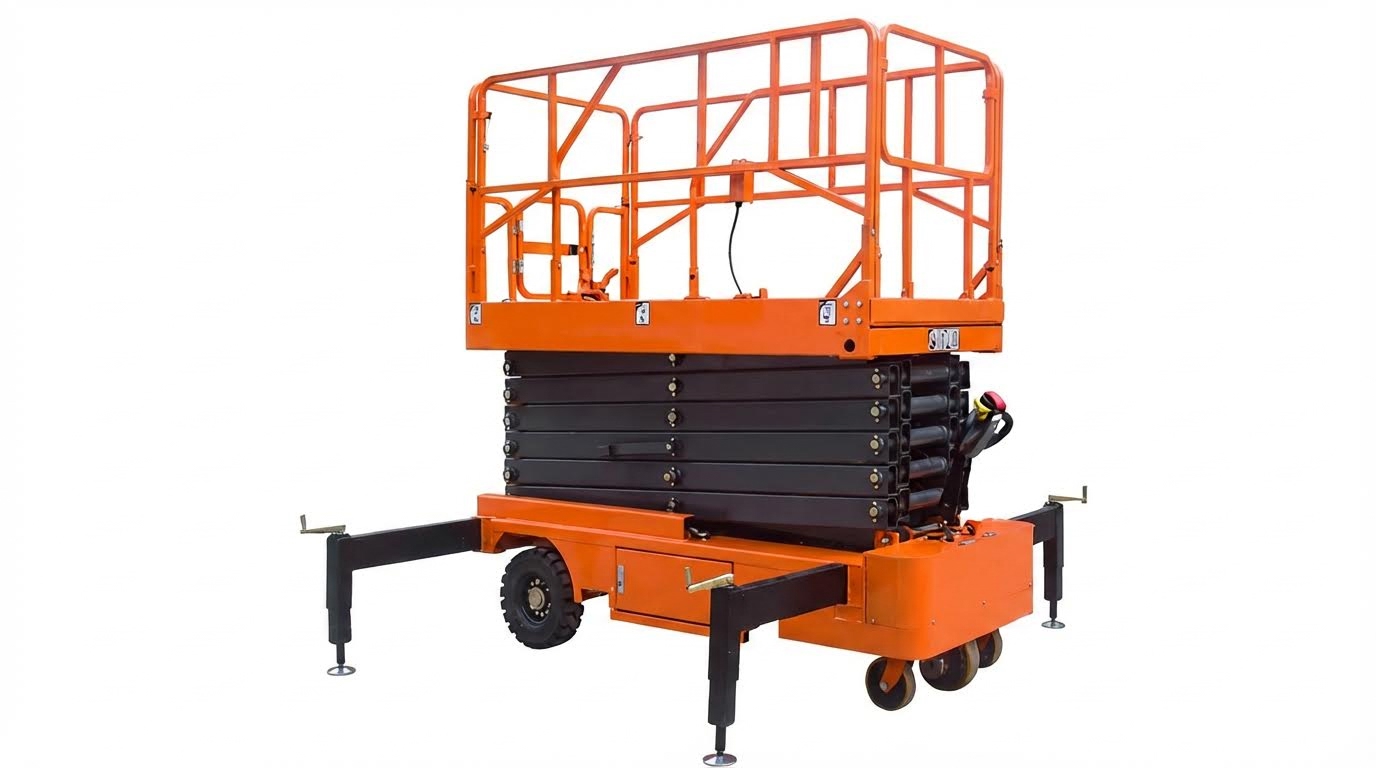
Indoors, travel‑distance rules in OSHA and NFPA 10 often drive the decision to fit onboard extinguishers, while outdoors the issue is less smoke buildup and more about how far the lift can roam from the nearest compliant unit.
| Environment | Key Travel‑Distance Criteria | Typical Engineering Response | Operational Impact |
|---|---|---|---|
| Indoor – Class A hazards (general combustibles) | Max. travel distance about 23–25 m to an extinguisher for many layouts per NFPA 10 guidance | Map lift work zones; if any position exceeds allowed distance, add wall units or onboard ABC extinguisher. | Ensures operators never walk more than one bay or room to reach an extinguisher. |
| Indoor – Class B hazards (flammable liquids) | Stricter limits, often around 15 m maximum travel distance to suitable units | In areas with oils, solvents or paints, onboard units are often the simplest way to maintain coverage as the lift moves. | Reduces time to first attack on fast‑growing liquid fires near the lift. |
| Outdoor yards and construction sites | Distances can easily exceed 23 m as lifts move away from fixed points | Use onboard ABC units when fixed extinguishers or vehicles cannot stay within travel limits. | Maintains compliance even when the lift is parked at the far edge of a work zone. |
OSHA’s portable extinguisher rules require employers to provide approved units suited to expected fire types and mounted for quick access, while NFPA 10 sets out the maximum travel distances for Class A and Class B hazards, typically 15 m for many Class B layouts and up to roughly 23–25 m for many Class A arrangements. OSHA interpretations clarify that these rules apply to scissor lifts through the general requirement for accessible extinguishers, even though they do not always mandate mounting them directly on the equipment.
- Indoor lifts with long travel paths: If a lift can be positioned beyond the 15–23 m limits from any wall extinguisher, an onboard unit is usually the most efficient fix – This avoids redesigning the whole building’s extinguisher layout.
- Outdoor or partially enclosed areas: Natural ventilation reduces smoke, but distance and terrain slow access – Onboard extinguishers compensate for scattered or temporary work locations.
- Restricted‑egress zones (mezzanines, tunnels, tight aisles): When a fire could trap the platform and block escape, self‑propelled equipment regulations and mining rules treat onboard extinguishers or suppression as mandatory – They provide immediate means of escape when ground‑based units are unreachable.
How to apply travel‑distance rules to mobile lifts
Use site fire protection drawings and typical lift positions to trace worst‑case walking paths from the platform landing point to the nearest extinguisher. If any realistic working position exceeds NFPA 10 travel distances, either add extinguishers to the building or standardize onboard ABC units for that fleet.
💡 Field Engineer’s Note: When mapping travel distances, measure walking routes, not straight lines through walls or racking. On multi‑level jobs, include stairs and gates; a 15 m “as‑the‑crow‑flies” distance on a drawing can easily become 30–40 m of real escape travel once you factor in barriers and one‑way routes.
Engineering The Installation And Maintenance Program
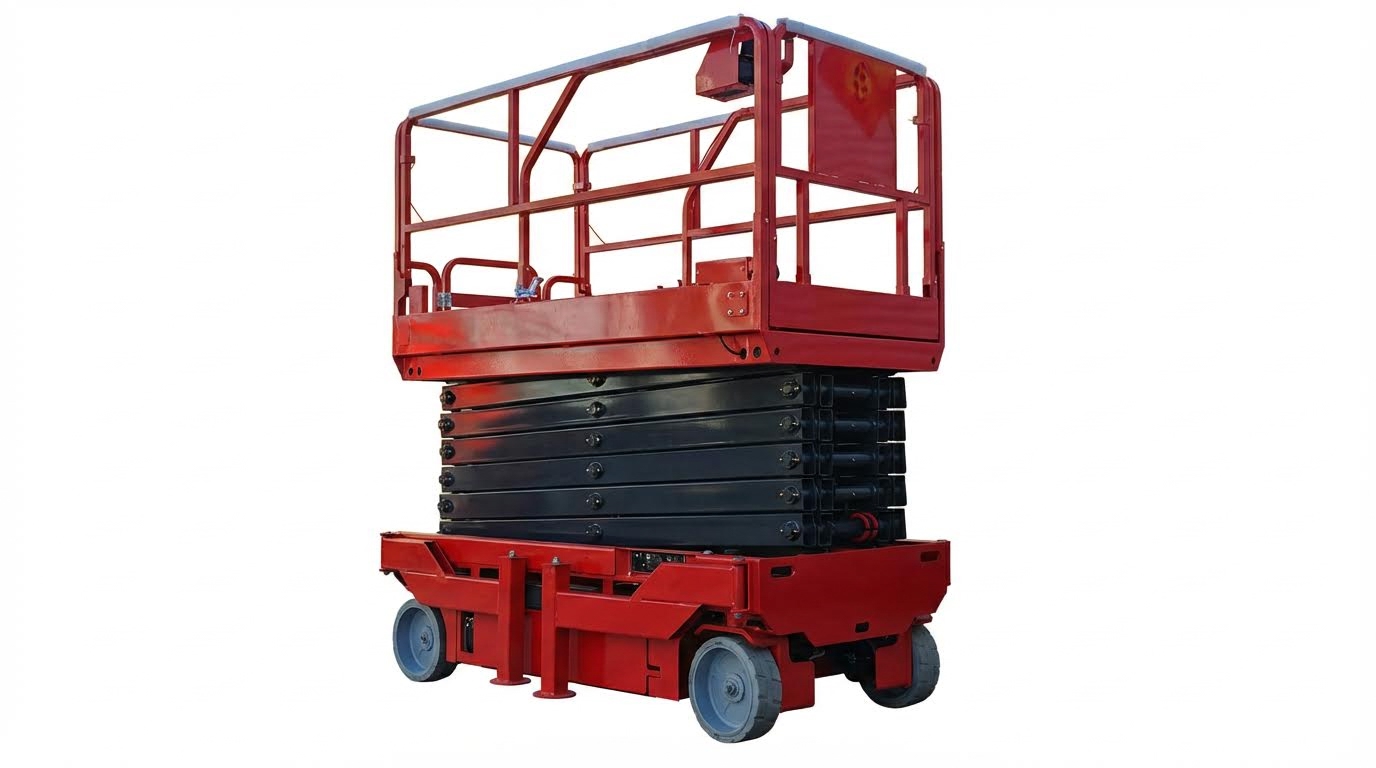
Engineering the installation and maintenance program means treating onboard extinguishers on scissor platform lifts as part of the machine system, with designed mounting, clear inspection routines, and digital tracking for compliance. This is where “does scissor platform lift require fire extinguishers” turns into a practical, auditable plan.
A good program answers three questions: Where and how is the extinguisher mounted, how is it inspected and tested, and how is all of this documented and enforced across the fleet.
Mounting Location, Brackets And Ergonomics
Mounting location, brackets, and ergonomics determine whether an onboard extinguisher is actually usable when a fire starts on or around an aerial platform. Poor mounting turns a compliant spec into a real-world failure.
For lifts that need onboard units, the design focus is visibility, reach from normal working positions, and resistance to vibration and weather while keeping within height and travel-distance rules.
| Design Aspect | Typical Engineering Target | Operational Impact On Electric Scissor Lifts |
|---|---|---|
| Handle height above platform floor | ≤1.5 m | Operator can grab the extinguisher without stretching or stepping on rails, improving response time and reducing fall risk per NFPA 10 guidance. |
| Mounting bracket strength | Withstand vibration and travel shocks | Prevents extinguisher dislodging when the lift drives over joints or rough slabs, avoiding falling-object hazards. |
| Release mechanism | One-hand, gloved operation | Operator can maintain three points of contact while removing the extinguisher, even with gloves on. |
| Primary location | Platform guardrail or mast column | Keeps the unit in the operator’s immediate reach if a fire starts at height and escape is at risk. |
| Secondary location (optional) | Chassis at ground level | Allows ground crew to attack small fires when the platform is elevated and cannot be lowered immediately. |
| Visibility | Unobstructed, labelled, contrasting color zone | Enables quick visual confirmation during pre-use checks and emergency response. |
- Platform mounting: Fix the extinguisher to a guardrail post or inside the platform at waist–chest height – ensures immediate access if a fire threatens the operator’s escape path.
- Chassis mounting: Use a rigid bracket on the scissor base frame or entry side – gives ground staff a safe attack position for engine-bay or battery fires.
- Bracket design: Use corrosion-resistant steel or coated brackets with positive latching – prevents loosening from vibration and outdoor exposure.
- Clearances: Keep clear of controls, emergency stop, gates, and decals – avoids accidental operation interference and maintains required safety markings.
- Travel distance logic: Mount onboard when fixed wall units would exceed 15–23 m travel distance – simplifies compliance with NFPA 10/OSHA spacing rules for indoor work zones.
How to choose platform vs chassis mounting
Choose platform mounting when the main concern is the operator trapped at height, such as indoor work near plastics, battery rooms, or hot work from the basket. Choose chassis mounting when the main concern is fires in batteries, chargers, or hydraulics while the platform is usually near ground level. Many high-risk sites use both to cover escape and ground firefighting options.
💡 Field Engineer’s Note: On rough concrete or outdoor sites, undersized brackets fatigue and crack within months. Always spec brackets tested on the actual lift model over a representative vibration profile, and re-check torque on mounting fasteners during the first scheduled service.
Inspection, Testing And Documentation Requirements
Inspection, testing, and documentation requirements turn the “does scissor platform lift require fire extinguishers” decision into a defensible safety system that stands up to OSHA or insurer audits. Once an extinguisher is on the lift, NFPA 10 and OSHA rules apply to that unit just like any wall-mounted device.
The core elements are structured visual checks, scheduled maintenance, pressure and shell integrity tests, and clear records tying each extinguisher to a specific lift.
| Activity | Minimum Frequency | Key Checks / Tasks | Operational Impact On Scissor Lift Fleets |
|---|---|---|---|
| Initial inspection after installation | Once, before first use | Correct type and rating, mounting security, visibility, pressure gauge in green, safety pin and seal intact per NFPA 10/OSHA 1910.157. | Prevents units going into service empty, damaged, or incorrectly mounted. |
| Operator pre-use check | Daily or at each shift start | Presence, access, gauge, damage, bracket tightness. | Catches damage from transport or previous shifts before the lift enters service. |
| Formal visual inspection | Monthly | Record ID, condition, pressure, seals, labeling, and location per OSHA 29 CFR 1910.157. | Creates traceable records and demonstrates active management to regulators and insurers. |
| Annual maintenance | Every 12 months | More detailed check by qualified person; clean, weigh or open as required, replace parts, update tag per NFPA 10. | Ensures extinguishing agent and mechanisms remain reliable despite vibration and temperature cycles on mobile equipment. |
| Internal examination (dry chemical) | Every 6 years | Open cylinder, check for caking, corrosion, replace agent if needed. | Prevents nozzle blockage or reduced discharge from compacted powder. |
| Hydrostatic test | Typically every 5–12 years, depending on cylinder type | Pressure test shell integrity as specified by NFPA 10. | Reduces risk of cylinder rupture during use or from over-pressurization. |
- Assign extinguisher IDs: Engrave or label each extinguisher with a unique ID – allows one-to-one mapping to a specific lift serial number.
- Link to lift records: Record extinguisher ID in the lift’s maintenance file – keeps fire protection history aligned with the equipment’s service history.
- Define responsibilities: Make operators responsible for pre-use checks and technicians for monthly/annual tasks – avoids gaps where “everyone” assumes “someone else” inspected the unit.
- Post-incident replacement: Any discharged or heat-exposed extinguisher must be replaced or fully serviced before the lift returns to work – prevents a “dead” unit from staying on the machine as a visual comfort only.
- Audit-ready logs: Keep at least 12–24 months of inspection records – supports defenses after an incident and demonstrates due diligence.
Interaction with aerial device inspection rules
Separate from extinguisher checks, many jurisdictions require annual and 5‑year inspections, including nondestructive testing, for the aerial device structure and components. These inspections should verify that extinguisher brackets and mounting points have not introduced cracks, distortion, or corrosion in guardrails, posts, or chassis weldments, and that access to controls and egress points remains clear.
💡 Field Engineer’s Note: The most common failure I see is “ghost” extinguishers—units removed for recharge and never refitted. Add a line item to every scheduled lift service: “Verify extinguisher present, correct ID, and in date,” and treat a missing unit as a red-tag condition on high-risk sites.
Using Telematics And Digital Tools For Compliance
Using telematics and digital tools makes extinguisher compliance on scissor platform lifts scalable, especially when multiple sites and dozens of units are involved. Manual spreadsheets usually fail once fleets grow beyond a handful of machines.
Digital systems tie extinguisher data to each lift, automate reminders, and create heatmaps that show where onboard extinguishers are most critical.
| Digital Tool / Feature | How It Works | Benefit For Onboard Extinguisher Programs |
|---|---|---|
| Asset management / telematics platform | Stores each lift’s serial number, location, and usage hours. | Links extinguisher ID and status to the actual machine, simplifying fleet-wide reporting. |
| Digital inspection checklists | Operators complete pre-use checks via app or terminal. | Forces a “Fire extinguisher OK?” step before the lift can be put into service. |
| Automatic reminders | Software schedules monthly and annual tasks. | Reduces missed NFPA 10/OSHA deadlines for inspections and maintenance. |
| QR codes / NFC tags on extinguishers | Technicians scan the unit to pull up history and log inspections. | Eliminates confusion when extinguishers are swapped between lifts. |
| Risk mapping / digital floor plans | Overlay lift work zones with fixed extinguisher locations. | Highlights areas where travel distance exceeds 15–23 m, justifying onboard units. |
| Exception reporting | Flags lifts with expired, missing, or failed extinguisher checks. | Lets managers intervene before a non-compliant lift is dispatched. |
- Configure work orders: Auto-generate work orders when inspection dates approach or when an operator flags an issue – keeps extinguishers from sitting “awaiting service” for weeks.
- Integrate with training records: Link extinguisher use and inspection training to operator IDs – ensures only trained staff sign off on checks.
- Use geofencing: For high-risk zones like paint booths or battery rooms, geofences can require an onboard extinguisher flag before the lift is authorized to enter – aligns real-time behavior with your written fire plan.
- Analyze incident data: Tag any fire, near miss, or battery failure to the lift and its extinguisher record – supports data-driven decisions on upsizing ratings or adding second units.
- Standardize across sites: Use templates so every facility applies the same rules on mounting, inspection intervals, and documentation – simplifies corporate governance and insurer discussions.
Practical rollout sequence for digital compliance
Start with a clean asset list and assign extinguisher IDs to each lift. Next, build a simple digital checklist that includes extinguisher presence, access, and gauge status. Then, add calendar-based reminders for monthly and annual tasks. Finally, integrate risk mapping to decide which lifts always carry onboard extinguishers and where fixed wall units are enough.
💡 Field Engineer’s Note: When you add extinguisher checks into existing telematics-driven pre-use inspections, compliance jumps dramatically. Operators already expect to complete a digital checklist before movement; adding three extinguisher questions costs 20 seconds but closes most of the real-world gaps in your fire protection plan.
Practical Guidance For Fleet Owners And Final Recommendations
Fleet owners should decide if scissor platform need onboard extinguishers by mapping fire risks, travel distances, and special regulations, then standardizing extinguisher type, mounting, and inspections across the fleet.
Below is a practical, decision-focused framework you can apply across sites and projects.
Quick Decision Framework: Does Electric Scissor Lifts Require Fire Extinguishers On Board?
This section gives a fast, defensible way to answer “does electric scissor lifts require fire extinguishers” for each site and task.
| Question | Typical Trigger | Recommended Action | Operational Impact |
|---|---|---|---|
| Is the lift used in mining or similar MSHA‑regulated work? | Self‑propelled unit, fire could block escape | Fit onboard extinguisher or manual suppression system to the lift | Meets 30 CFR 56.4230 / 57.4230 escape protection rules |
| Can a fire at the base trap people at height? | Narrow aisles, mezzanines, pits, congested plant | Install onboard ABC extinguisher with Class C rating | Operator has a tool to clear a path or control a small fire |
| Is any lift position >23 m from a wall extinguisher? | Large warehouses, yards, outdoor work | Either add fixed extinguishers or mount one on the lift | Keeps within NFPA 10 / OSHA travel distance limits |
| Is the lift used for hot work, paint, or near charging areas? | Hot work permits, spray booths, battery charging zones | Standardize onboard ABC extinguisher for those task types | Controls higher Class B and C risks at the point of work |
| Is the site under military / UFC‑style specs? | Projects referencing UFC or similar criteria | Provide at least one 9 kg ABC extinguisher per vehicle | Prevents project delays due to stricter client rules |
💡 Field Engineer’s Note: When in doubt, I treat any lift that regularly leaves “good extinguisher coverage” on the floor plan as a mobile hazard that should carry its own extinguisher. It is cheaper than redesigning the whole building layout.
Standardizing Extinguisher Selection Across The Fleet
The most efficient strategy is to standardize one or two extinguisher types and ratings for all scissor platform lift.
- Base Choice – ABC dry chemical: Select a multi‑purpose dry chemical with ABC rating – covers Class A debris, Class B liquids, and Class C electrics in one unit.
- Minimum rating – 2A:10B:C: Use at least 2A:10B:C where fire loads and escape paths are typical – aligns with common guidance for mixed hazards on small mobile equipment.
- Higher risk – 4A:40B:C: For mining, long travel paths, or limited egress, step up to 4A:40B:C – gives more agent and reach when help is far away.
- Corrosion resistance: Specify corrosion‑resistant cylinders and brackets in wash‑down, coastal, or chemical plants – prevents seized pins and failed inspections.
- Temperature band: Verify operating temperature range against your cold‑store or hot‑climate conditions – ensures the agent and pressure stay reliable.
How many extinguishers per lift?
Most fleets fit one extinguisher on the platform or chassis. High‑risk sites sometimes add a second unit at ground level, so ground staff can respond while the platform is elevated, improving coverage without overloading the guardrails.
Mounting, Location, And Operator Usability
Good mounting design ensures the extinguisher is reachable in seconds without creating new struck‑by or entanglement hazards.
- Height limit: Keep the handle at or below about 1.5 m above the standing surface – operators of different heights can grab it without overreaching.
- Primary location: Mount on the platform guardrail or entry post, not hidden on the chassis – the person at height usually needs it first.
- Clear access path: Avoid mounting near controls, gate latches, or emergency stop buttons – prevents accidental activation or blocked egress.
- Quick‑release hardware: Use a positive‑latching bracket that can be released with one gloved hand – speeds deployment during stress.
- Vibration resistance: Specify brackets and straps rated for off‑road vibration – stops pins walking out and cylinders falling or chafing.
- Ground‑level visibility: Ensure the cylinder label and gauge are visible from the ground – simplifies daily and monthly checks.
Platform vs chassis mounting
Platform mounting gives the operator immediate access but adds weight at height. Chassis mounting is better for large, heavy units (9 kg) or where platform space is tight. Many fleets choose a smaller unit on the platform and a larger one on the chassis only in high‑risk zones.
Building A Simple, Defensible Inspection And Maintenance Program
Your fire extinguisher program must match OSHA and NFPA 10 rules while staying simple enough that supervisors actually run it.
- Assign ownership: Make one role (e.g., lift maintenance supervisor) responsible for extinguisher compliance – avoids gaps between safety and maintenance teams.
- Pre‑use checks: Add a quick visual extinguisher check to the operator’s daily walk‑around – catches missing, discharged, or damaged units early.
- Monthly documented inspections: Have a competent person record monthly checks that the extinguisher is present, accessible, undamaged, and in the green zone – meets OSHA 29 CFR 1910.157 expectations.
- Annual maintenance: Use certified technicians annually to open, service, and tag units – verifies the agent, seals, and components as required by NFPA 10.
- 6‑year and hydrostatic intervals: Plan for 6‑year internal exams and 5–12‑year hydrostatic tests on dry chemical cylinders – prevents unexpected mass removals from service.
- Link to lift ID: Track each extinguisher against a specific lift serial number – gives a clean audit trail when investigators or clients ask for proof.
What to do after an incident or near miss
After any fire, tip‑over, or impact that could damage the extinguisher or mounting, remove the unit from service, test or replace it, and inspect the bracket and structure. Treat it like any other safety‑critical component before returning the lift to operation.
Integrating Digital Tools, Telematics, And Floor Plans
Digital tools make it easier to prove that each aerial platform has the right extinguisher, in the right place, at the right time.
- Digital asset records: Store extinguisher model, rating, and next due dates in the same system as the lift – keeps all compliance data in one place.
- Checklist prompts: Configure pre‑use and monthly digital checklists to include extinguisher questions – raises completion rates and creates time‑stamped records.
- Work order automation: Trigger maintenance work orders automatically when inspection dates or hydrostatic test intervals are nearing – prevents expired units staying on machines.
- Coverage mapping: Use digital floor plans to overlay lift routes and extinguisher locations – quickly shows where travel distances exceed 15–23 m limits.
- Risk heatmaps: Tag high‑hazard tasks (hot work, spray, charging) to specific lifts – ensures those units always carry appropriately rated onboard extinguishers.
Using telematics alerts
If your lifts have telematics, you can geo‑fence high‑risk zones and prompt operators with an on‑screen reminder to confirm extinguisher presence before entering. This connects your paper policy with real‑world behavior.
Final Recommendations For Fleet Owners
The best practice answer to “does electric scissor lifts require fire extinguishers” is: not always by law, but usually by risk and by contract.
- Start with law and standards: Check OSHA, MSHA, NFPA 10, and any client or military specs that apply to your sites – sets the hard minimum.
- Map travel distances: Use floor plans to confirm that every lift position is within required travel distances to a suitable extinguisher – shows where onboard units close the gap.
- Identify high‑risk tasks: Flag hot work, spray, battery charging, and high‑plastic storage areas – treat onboard ABC extinguishers as mandatory in these zones.
- Standardize hardware: Choose one or two ABC ratings (e.g., 2A:10B:C and 4A:40B:C) and a common bracket design – simplifies training, spares, and audits.
- Embed inspections into normal work: Make extinguisher checks part of daily, monthly, and annual lift routines – keeps units ready without adding a separate program.
- Leverage digital systems: Use telematics and CMMS to track extinguisher status like any other safety‑critical component – turns compliance into a manageable workflow.
If you apply these steps, most fleets will choose to fit onboard ABC extinguishers on at least a portion of their electric high lift pallet truck, not just to tick a box, but to keep operators from being trapped above a fire with no immediate way to act.
Practical Guidance For Fleet Owners And Final Recommendations
Electric scissor lifts sit in a grey zone where laws do not always demand onboard extinguishers, but real fire scenarios often do. Travel‑distance limits, blocked‑escape risks, and mixed A/B/C hazards turn the question from “Is it required?” into “Can we defend not having one when something goes wrong?” When you map routes and work positions, lifts frequently operate outside NFPA 10 and OSHA travel distances or above single escape paths. In those cases, an onboard ABC extinguisher effectively becomes a requirement, even if the code does not name lifts directly.
The most robust strategy is to standardize: choose one or two ABC ratings, engineer proper brackets and locations, and embed inspections into normal lift maintenance. Use telematics and digital checklists so every unit, from a compact Atomoving platform to larger site machines, carries a traceable, in‑date extinguisher. Treat the lift as a moving fire load and size the extinguisher for self‑rescue at the worst‑case position, not the average job.
For fleet owners, the defensible answer is clear. In mining, military, high‑hazard, or long‑travel applications, plan for onboard ABC extinguishers as standard equipment, then prove their readiness with a simple, auditable digital program.
Frequently Asked Questions
Do electric scissor lifts require fire extinguishers?
OSHA does not specifically require fire extinguishers on electric scissor lifts. However, if fire extinguishers are provided, they must comply with maintenance and inspection standards under 1910.157(e). This includes monthly visual inspections and annual maintenance checks. For more details, refer to Forklift Safety FAQs.
Where should fire extinguishers be located in the workplace?
Fire extinguishers should be placed throughout the workplace and easily accessible in case of an emergency. Common locations include hallways, meeting rooms, kitchens, mechanical/electrical rooms, and near exit doors. According to OSHA guidelines [29 CFR 1910.157(c)], proper placement ensures quick access during a fire. Learn more from the OSHA eTool.