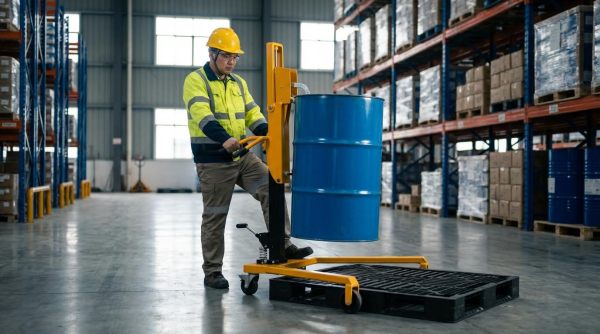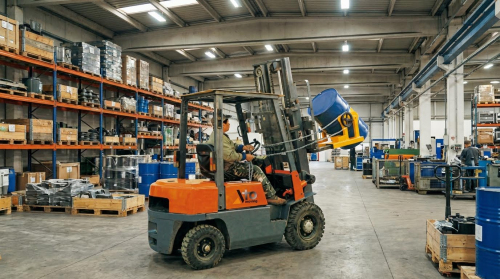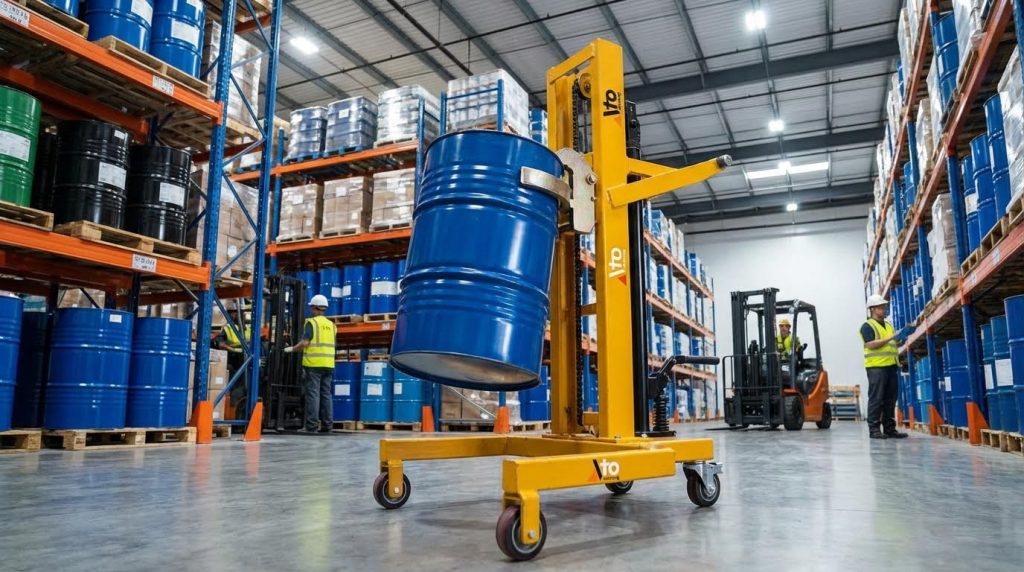
barrel lifter rack capacity for 55-gallon drums depends on drum weight, pallet pattern, rack beam ratings, and upright frame capacity, not just “how many fit.” This guide explains how many 55 gallon drums can a pallet rack hold safely, using real load paths, geometry, and manufacturer data instead of guesswork.
Fundamentals Of Pallet Racks And Drum Loads
This section explains how pallet rack components, load paths, and drum unit loads work together so you can answer “how many 55 gallon drums can a pallet rack hold” without guessing or exceeding safe capacity.
Key pallet rack components and load paths
Pallet rack capacity for 55-gallon drums starts with understanding how beams, uprights, and decking share and transfer the drum loads into the floor.
- Upright frames: Vertical columns and bracing carry all pallet and drum weight down to the floor – they set the total bay capacity.
- Beams: Horizontal members between uprights support each pallet level – they limit how much weight you can put on one rack level.
- Decking (wire or solid): Spans between beams and supports pallet boards – it spreads drum loads and reduces point loading.
- Bracing and connectors: Diagonals, footplates, and beam clips keep geometry rigid – they control sway and prevent beam dislodgement under impact.
Manufacturers publish load charts that link beam length, profile, and configuration to maximum uniformly distributed load (UDL) per level, and upright height to maximum bay capacity. These charts are the primary reference when sizing racks for drum storage according to rack manufacturers.
| Component | Main Function | Key Spec For Drums | Operational Impact |
|---|---|---|---|
| Upright frame | Transfers vertical load to floor | Frame height and column section set bay capacity | Limits total drums per bay and number of beam levels |
| Load beams | Support pallet levels | Length and profile set UDL rating | Limits drums per level; longer beams usually mean lower kg per level |
| Wire/solid decking | Spread pallet loads between beams | Deck load rating (UDL) | Helps handle concentrated drum footprints and damaged pallets |
| Anchors and base plates | Fix uprights to slab | Anchor pattern and slab quality | Critical for tall drum loads and impact from trucks |
Drum pallets often create semi-concentrated loads rather than perfect UDL, because drum weight sits over discrete pallet deck boards. Capacity calculations must consider whether the rack is rated for true UDL or for point loads at pallet positions as explained in pallet rack load guidance.
- Uniformly distributed load (UDL): Weight spread evenly along the beam – ideal case used in most beam ratings.
- Point or line loads: Weight concentrated at pallet stringers or drum cradles – increase local stress and deflection.
- Even vs uneven loading: One side of a beam loaded heavier than the other – can twist beams and overstress connectors.
💡 Field Engineer’s Note: When storing 55-gallon drums, treat each pallet position as a concentrated load. If you run close to the beam’s UDL rating with drum pallets, shorten beam spans or add higher-capacity beams instead of assuming “the decking will take it.”
How load paths answer “how many 55 gallon drums can a pallet rack hold”
First, calculate the mass of drums on each pallet and multiply by pallets per level. Then compare that to the beam UDL rating for the span, and finally to the upright frame capacity for the bay height and beam spacing. The lowest of these three governs the true safe drum count per level and per bay.
Drum weight, pallet patterns, and unit load geometry
The number of 55-gallon drums a pallet rack level can safely hold depends on drum mass, pallet pattern (how many drums per pallet), and the combined load height and footprint.
A typical 55-gallon (200 L) drum has a diameter around 572 mm and a height near 851 mm, with filled mass commonly in the 200–250 kg range depending on product density according to drum handling guidance. On a standard 1,219 × 1,016 mm pallet, engineers typically use a 2×2 pattern for four drums with tight but safe clearances as described in palletizing best practices.
| Parameter | Typical Value | Effect On Rack Capacity | Operational Impact |
|---|---|---|---|
| Single drum filled mass | 200–250 kg (approximate) | Sets pallet load in kg | Four drums can approach 800–1,000 kg per pallet |
| Drum diameter | ≈572 mm | Controls how many drums fit per pallet | 2×2 pattern on 1,219 × 1,016 mm pallets is typical |
| Drum height | ≈851 mm | Affects clearance to beams above | Two-high stacking reaches ≈1.7–1.8 m plus pallet |
| Standard pallet footprint | 1,219 × 1,016 mm | Defines load footprint on beams and decking | Determines pallet positions per beam level |
The combined load geometry (pallet thickness + drum height + dunnage) defines clear height needed between beam levels and inside any containment or enclosures. A two-high drum stack on a pallet can reach roughly 1.7–1.8 m, which quickly consumes vertical space and raises the center of gravity per drum stacking guidance.
- 2×2 pattern (4 drums): Most common, uses full pallet area – easy for forklifts and standard racking.
- Overhang control: Drums should sit inside pallet edges by several millimeters – prevents catching on beams or rack bracing.
- Spill-containment pallets: Add height and sometimes change footprint – reduce vertical clearance and may change rack beam spacing.
- Center-of-gravity (COG): Higher stacks raise COG – increases tipping risk during handling or seismic events.
Relating drum pallets to “how many 55 gallon drums can a pallet rack hold”
1) Determine drums per pallet (typically 4). 2) Multiply by pallets per beam level (often 2–3 pallets between uprights). 3) Multiply by number of beam levels. Then check that total mass per level does not exceed beam UDL rating and that total mass in the bay does not exceed upright frame capacity. The structural limit, not the physical space, answers how many 55 gallon drums a pallet rack can safely hold.
💡 Field Engineer’s Note: When you get close to 1,000 kg per pallet of drums, even small errors in product density or fill level matter. Always base rack capacity checks on worst-case filled mass, not average mass, and keep a written “max drums per level” rule posted at the rack.
Calculating Safe Drum Capacity Per Rack Level
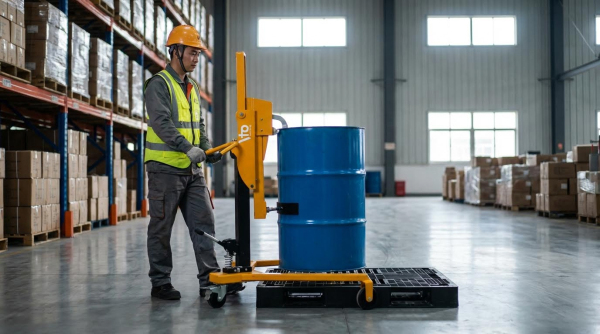
This section explains how many 55 gallon drums a pallet rack level can safely hold by tying beam ratings, upright capacity, spacing, and safety factors into one clear, step-by-step method.
For SEO and engineering clarity, remember that “how many 55 gallon drums can a pallet rack hold” is never a fixed number; it always depends on beam load ratings, frame capacity, and drum pallet weight.
Beam load ratings, span, and uniformly distributed loads
Beam ratings set the first hard limit on how many 55 gallon drums you can place on a single rack level because every drum pallet becomes a heavy, often point-loaded unit.
Manufacturers publish beam capacities by length, profile, and steel grade in load charts. These charts assume a uniformly distributed load (UDL) across the full beam span, not a few concentrated drum pallets. Manufacturer load charts define maximum weight per pair of beams at a given span.
| Design Element | Typical Range / Concept | Operational Impact For 55-Gallon Drums |
|---|---|---|
| Beam span | 2,400–2,700 mm between uprights | Controls how many drum pallets fit per level and the bending stress in beams. |
| Beam capacity basis | Rated as UDL across full length | Two drum pallets become quasi point loads; you must not exceed the UDL rating. |
| Drum mass (filled) | ≈200–250 kg per 200 L (55-gal) drum | Four drums on one pallet often weigh 800–1,000+ kg per pallet. |
| Pallet pattern | 2×2 drums on 1,200×1,000 mm or 1,219×1,016 mm pallet | Usually 4 drums per pallet; check overhang and fork entry geometry. |
| Number of pallets per level | Commonly 2–3 pallets between frames | Directly sets the possible drum count per level (e.g., 2 pallets × 4 drums = 8 drums). |
A standard 55-gallon drum has a diameter around 572 mm and height near 851 mm, so a 2×2 pattern on a 1,200×1,000 mm or 1,219×1,016 mm pallet is common for stable unit loads. Engineering guidance emphasizes tight but safe clearances and minimal overhang so drums do not catch on beams or wire deck during handling.
- Beam rating vs. drum pallet mass: Sum the mass of all drum pallets on that level – this total must be less than the beam pair’s rated UDL.
- Point load effect: Drums on pallets create concentrated reactions at pallet stringers – avoid narrow “skid” pallets that put all load near midspan.
- Wire deck role: Wire decking spreads load slightly but does not upgrade beam rating – never treat deck as a structural member.
Quick check: how many drum pallets per beam level?
1) Confirm beam span and UDL rating from the manufacturer chart. 2) Calculate one pallet mass (4 drums × 200–250 kg plus pallet). 3) Multiply by the number of pallet positions. 4) Ensure the total is comfortably under the beam rating with a safety margin.
💡 Field Engineer’s Note: When you push drum loads toward the limits of beam ratings, midspan deflection becomes visible and can trap pallets during put-away. In cold rooms or chemical stores where steel is stiffer but brittle, I keep beam utilization below roughly 80% of the published UDL for drum storage to avoid binding, damage to wire deck, and shock loads from hard forklift set-downs.
Upright frame capacity, bay height, and beam spacing
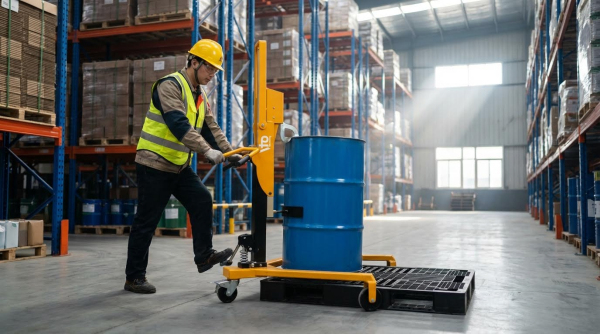
Upright frames limit how many heavy drum levels you can stack vertically because frame capacity drops as overall bay height and beam spacing increase.
Frame load capacity depends on column size, bracing pattern, steel grade, and the vertical distance between beam levels. Manufacturers publish frame load tables that show how total bay capacity decreases as rack height and beam spacing grow.
| Parameter | Effect On Drum Storage | Operational Impact |
|---|---|---|
| Frame height | Taller frames carry less load for a given column section | Very tall drum racks may need heavier-duty frames or fewer loaded levels. |
| Beam spacing | Greater vertical spacing reduces frame capacity | Extra-clearance for tall drum pallets reduces the allowable load per level. |
| Number of levels | More beam levels mean more total load on frames | Limits how many drum levels you can safely stack in one bay. |
| Total bay load | Sum of all level loads on one frame line | Defines the true upper bound for “how many 55 gallon drums can a pallet rack hold.” |
A typical 55-gallon drum height around 0.85 m means that a palletized single layer of drums often reaches roughly 1.0–1.1 m including pallet and dunnage. Two-high drum stacks on pallets can reach about 1.7–1.8 m. Guidance notes that higher stacks raise the center of gravity and tipping risk, so beam spacing must account for both height and stability, not just clearance.
- Check frame charts, not just beams: Beam levels might be strong enough, but frames can still be overloaded – always verify total bay load against frame ratings.
- Vertical spacing: Reducing beam spacing increases frame capacity – but do not compromise forklift clearance or drum handling safety.
- Drum load pattern per bay: Keep drum loads symmetric left-to-right – avoid heavily loading one side of a bay while leaving the other side empty.
Estimating total drums per bay, step-by-step
1) Decide how many beam levels you will use for drum pallets. 2) For each level, calculate drum count (pallets × 4 drums). 3) Convert to total mass per level. 4) Sum all levels for total bay load. 5) Compare to the frame capacity from the manufacturer chart at your exact frame height and beam spacing. 6) If you exceed capacity, reduce the number of drum levels or switch to heavier frames.
💡 Field Engineer’s Note: In real warehouses, I see frames overstressed more often than beams when clients switch from cartons to drums. They keep the old spacing and simply add heavier loads. Before adding a single drum pallet, I recalc total bay load and usually either reduce one level of storage or upgrade to a heavier frame section.
Safety factors, deflection limits, and inspection practices
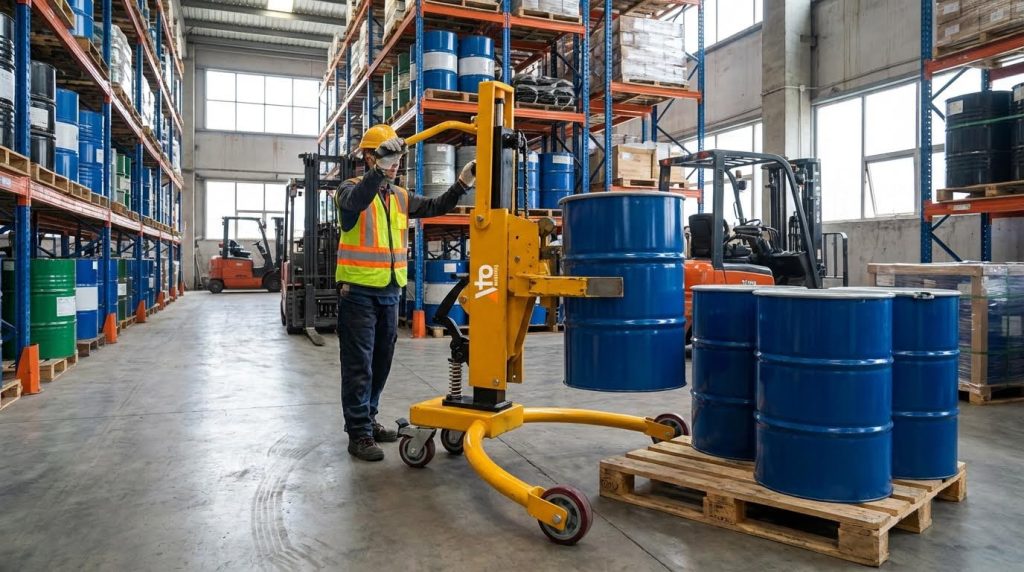
Safety factors, deflection limits, and inspections ensure that the theoretical answer to “how many 55 gallon drums can a pallet rack hold” remains safe under real-world abuse, impact, and wear.
Capacity calculations should include safety factors that account for dynamic forklift impacts, product weight variation, and load shifting. Industry practice is to use conservative load ratings, and guidance stresses that safety factors and regular inspections are essential to maintain system integrity.
| Safety Aspect | What To Check | Operational Impact For Drum Storage |
|---|---|---|
| Safety factor | Difference between calculated demand and rated capacity | Extra margin for shock loads when setting down 800–1,000 kg drum pallets. |
| Deflection limit | Maximum allowable beam sag under full load | Excessive sag can trap pallets and signal overstress. |
| Damage inspection | Bent beams, twisted frames, damaged connectors | Heavy drum impacts can permanently weaken components. |
| Load labeling | Clear signs showing max kg per level and per bay | Operators quickly see how many pallets or drums are allowed. |
- Apply conservative limits: Do not load to 100% of catalog capacity – keep a buffer for real-world impacts and weight variation between drums.
- Monitor beam deflection: Visible sag under drum loads is a red flag – measure midspan deflection and compare to manufacturer guidance.
- Inspect after impacts: Drum handling has higher collision energy than cartons – take any hit to uprights or beams seriously and inspect immediately.
- Maintain clear signage: Post maximum kg per level and total drums per level – operators should not need to “do the math” during busy shifts.
Translating capacity into “number of drums” for operators
1) Start with rated kg per beam level (after applying your chosen safety margin). 2) Divide by a conservative drum mass (e.g., 250 kg per drum including content variability). 3) Round down to a whole number of drums that still fits your pallet pattern (usually multiples of 4). 4) Put this as “Max X drums per level” on signage and SOPs.
💡 Field Engineer’s Note: In chemical and hazardous-goods stores, I usually size racks using the heaviest plausible drum mass and then label limits in “number of drums,” not kg. This avoids overloading when product density changes between batches or when operators mix heavy and light products on the same level.
Rack Layouts And System Choices For Drum Storage
Rack layout and system choice determine how many 55 gallon drums can a pallet rack hold safely, how fast you can access them, and how much floor space you consume. You must balance density, selectivity, and handling risk for your specific drum inventory.
For 55-gallon (200 L) drums, the critical layout questions are: how many pallets per bay, how many pallets deep, and what aisle width your handling equipment needs. Those three variables control both storage density and rack stability.
| Rack Type | Typical Drum Pallet Handling | Storage Density vs. Standard Selective | Inventory Rotation | Operational Impact For 55-Gallon Drums |
|---|---|---|---|---|
| Standard Selective Rack | 1 pallet deep, single position per beam level | Baseline; about 50% of floor area becomes aisles Reference | High selectivity (any pallet, any time) | Safest and simplest choice for mixed drum SKUs and spill pallets; easy inspection of every unit load. |
| Narrow Aisle Selective | 1 pallet deep, specialized turret/very-narrow-aisle trucks | Up to ~69% more capacity vs. standard selective aisles Reference | High selectivity | Good when you need more drum positions but must still access every pallet individually; requires very stable floors and trained operators. |
| Double Deep Rack | 2 pallets deep, reach truck with pantograph | Up to ~72% more capacity vs. standard selective aisles Reference | LIFO; store in pairs of like product | Useful for high-volume drum SKUs where you can live with reduced selectivity; higher risk if pallets or drums are not uniform. |
| Drive-In Rack | Forklift drives into lane; pallets rest on rails | Can increase density by ~60–80% vs. standard selective Reference | LIFO; low selectivity | Best for large batches of identical drums; higher collision risk and more demanding on rack strength and maintenance. |
| Pushback Rack | 2–6 pallets deep on carts over sloped rails | Up to ~75% higher density than selective Reference | LIFO; lanes should be run full to empty | High-density option for fast-moving drum SKUs; rolling carts add dynamic forces, so pallets and drums must be uniform and well secured. |
| Pallet Flow Rack | 2–30 pallets deep on gravity rollers | Very high density; deepest lanes of all common systems Reference | FIFO; ideal for date-sensitive product | Attractive for high-volume, date-controlled drum products; requires high-quality pallets and more maintenance of rollers and brakes. |
💡 Field Engineer’s Note: For heavy 200–250 kg drums, high-density systems like drive-in or pushback magnify impact loads from trucks and moving carts. If floor flatness, pallet quality, and operator discipline are not excellent, stay with selective or narrow-aisle to avoid chronic rack damage.
Selective vs. high-density rack for 55-gallon drums
Selective rack suits mixed drum SKUs and frequent access, while high-density rack suits large, homogeneous drum batches. The right choice depends on how many pallets per SKU you hold and how often you touch them.
- Selective rack (standard aisles): Full access to every drum pallet – Best when you have many SKUs, smaller batch sizes, or frequent sampling and partial picks.
- Narrow-aisle selective: Same selectivity with reduced aisle width – Increases positions for 55-gallon drums without changing your beam layout, but needs special trucks.
- Double deep: Two pallets of the same SKU stored front and back – Ideal when you usually hold at least 2 pallets of each drum SKU and can accept LIFO behavior.
- Drive-in: Multiple pallets deep in a single lane – Efficient when you store many pallets of the same drum product and ship full-lane quantities.
- Pushback: 2–6 pallets deep on carts – Good for high-throughput drum lines where you load and unload full lanes in sequence.
- Pallet flow: Deep FIFO lanes on rollers – Suited to date-sensitive liquids where drums must move in strict first-in-first-out order.
How many 55-gallon drum pallets per bay in typical layouts?
Most drum pallets use a 1,200 mm wide bay with one pallet per level. In selective and narrow-aisle systems, you normally place one 4-drum pallet per beam level per bay. In double deep, you can store 2 pallets per lane (front and back). In drive-in, pushback, or pallet flow, you might run 4–10 pallets deep per lane, but the safe number always depends on the rack manufacturer’s lane capacity and the mass of each loaded pallet.
In practice, selective rack makes it easy to answer how many 55 gallon drums can a pallet rack hold because each pallet position is discrete. With high-density systems, you must think in lanes and levels instead of simple “pallet positions,” and verify that every lane’s total drum mass stays within the rack’s rated capacity.
Aisle width, handling equipment, and stability risks
Aisle width and truck type directly limit which rack systems you can use for drum pallets and how safely you can maneuver 200–250 kg drums at height.
| Rack / Aisle Style | Typical Clear Aisle Width | Required Equipment | Stability & Risk Considerations For 55-Gallon Drums |
|---|---|---|---|
| Standard selective | About 2.7–3.7 m (9–12 ft) aisles Reference | Conventional counterbalance or reach trucks | Wider aisles give more margin to correct sway when handling tall drum loads; lower chance of striking uprights. |
| Narrow-aisle selective | About 1.5 m (60 in) aisles Reference | Turret/very-narrow-aisle trucks | Higher risk of mast sway with tall, heavy drum pallets; strict speed limits and very flat floors are essential. |
| Double deep | Similar to standard selective, sometimes slightly wider | Reach trucks with pantograph | Extended reach increases overturning moment when handling heavy drums; operators must avoid side-shift at full elevation. |
| Drive-in | Few main aisles; trucks enter lanes | Counterbalance trucks that can drive into rack lanes | High risk of upright and rail impact from mast and pallets; 55-gallon drum spill risk is higher if pallets are not square and secure. |
| Pushback | Similar to selective | Standard reach/counterbalance trucks | Moving carts create dynamic forces; sudden stops or misaligned pallets can shock-load drums and rack beams. |
| Pallet flow | Load and pick aisles separated | Standard trucks; good pallet quality required | Drums roll forward with the pallet; defective pallets can hang up or release suddenly, affecting load stability at the pick face. |
- Aisle too narrow: Truck cannot square to the rack – Fork tips strike pallet corners or drums, increasing leak and damage risk.
- Truck under-capacity: High drum loads exceed rated capacity at reach – Increases tip-over risk, especially with reach and double-deep trucks.
- Floor unevenness: Small slopes twist rack frames – Reduces the real safety margin of uprights supporting heavy drum pallets.
- Insufficient overhead clearance: Drums or bungs hit bracing or sprinklers – Creates impact loads and potential release of hazardous liquids.
How aisle width affects how many drum pallets you can store
Wider aisles reduce storage density but allow standard trucks and simpler training. Narrower aisles increase the number of pallet positions but require taller, more flexible masts and specialized trucks. For heavy 55-gallon drum pallets, the extra mast height and reduced maneuver space can limit how high you can safely store drums, which in turn caps how many 55 gallon drums can a pallet rack hold per bay.
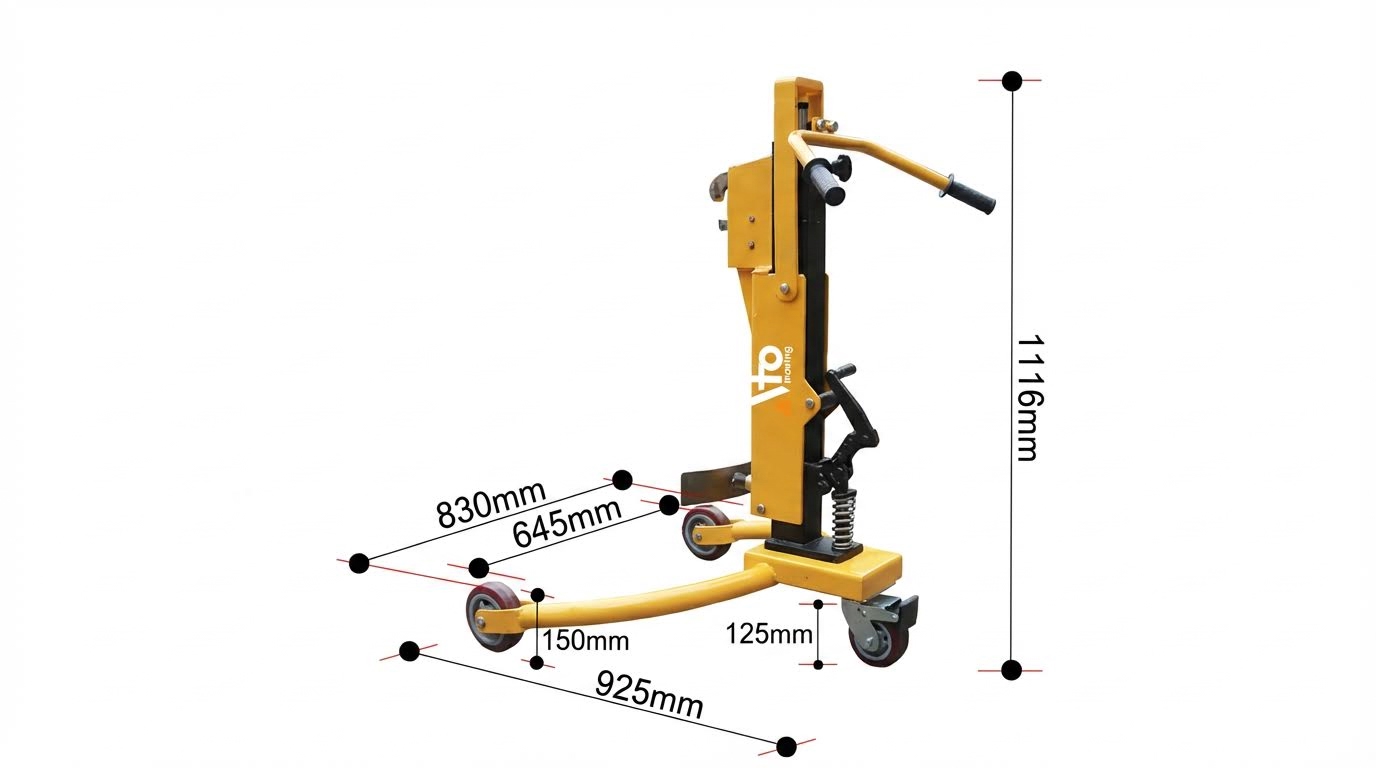
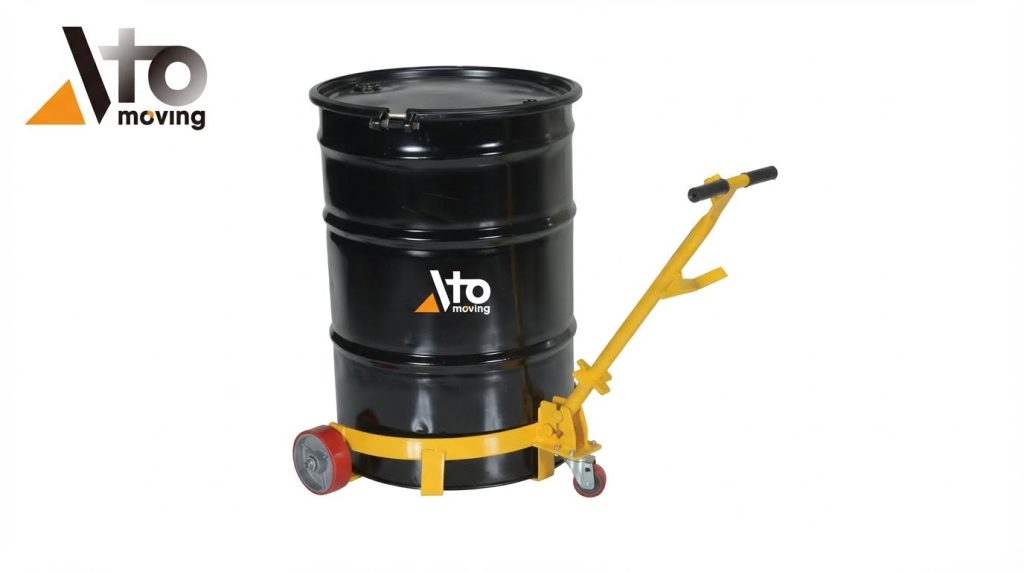
When handling 55-gallon drums, using proper equipment such as a drum cart or a barrel lifter ensures safer operations. Additionally, a hydraulic pallet truck can assist in transporting these heavy loads efficiently.
Final Considerations For Safe Drum Rack Design
The final answer to how many 55 gallon drums can a pallet rack hold is: only as many as the manufacturer’s rated capacity, adjusted for real drum weights, pallet patterns, and safety factors, will safely allow.
At this stage of design, you are validating that every earlier assumption about drum mass, pallet geometry, rack capacity, and handling method lines up with published data, regulations, and inspection practice. The goal is a system that remains safe after years of abuse, not just on day one.
- Always design to the rack, not the wish list: Check beam and upright charts – they define your hard limit for drum count per level.
- Lock in a standard drum pallet pattern: Typically a 2×2 pattern on 1,200×1,000 mm or 1,219×1,016 mm pallets – this makes capacity math repeatable.
- Use real filled drum weights, not “typical” values: Many products push drums toward 250 kg – this can overload beams faster than expected.
- Respect uniformly distributed load (UDL) assumptions: Rack ratings assume even loading across beams – concentrated point loads from drums reduce the effective capacity.
- Align rack type to your drum turnover: High-density systems suit bulk storage; selective racks suit mixed SKUs – this reduces rehandling and damage risk.
- Plan for spill containment and regulations: Integrate sumps and containment pallets into the geometry – this avoids illegal or unstable retrofits later.
- Engineer for the forklift you actually use: Aisle width, mast height, and truck capacity must match drum loads – this prevents tip-overs and rack strikes.
- Control stack height and center of gravity: Drum height near 850 mm makes two‑high stacks roughly 1,700–1,800 mm – higher stacks sharply increase tipping risk.
- Standardize dunnage and securing methods: Friction mats, cradles, blocking, strapping, and wrap patterns must be defined – this keeps loads stable in the rack and during handling.
- Build inspection and maintenance into operations: Regular checks for bent beams, damaged uprights, and loose anchors preserve rated capacity – this keeps your original design assumptions valid.
How to turn “drums per pallet” into “drums per rack level” safely
To move from marketing questions like “how many 55 gallon drums can a pallet rack hold” to an engineering-safe number, you tie three things together.
- Step 1: Confirm the drum unit load – Define the pallet size, 2×2 pattern, total mass, and overall height for one pallet of drums.
- Step 2: Match pallet count per beam level to beam UDL rating – Use manufacturer beam charts that relate length and profile to maximum uniformly distributed load per pair of beams.
- Step 3: Check upright frame capacity for full bay height and spacing – Use frame charts that show how total bay load drops as frame height and beam spacing increase.
- Step 4: Apply safety factors and deflection limits – Respect any recommended safety factor and maximum beam deflection (often span/180–span/240) from the manufacturer.
- Step 5: Verify with the manufacturer or a qualified engineer – Have them sign off on the exact configuration, including drum weights and pallet patterns.
Only after these steps can you state a safe maximum number of drum pallets per level and per bay.
Manufacturer data and configuration control sit at the center of safe drum rack design. Upright frames, beams, and any decking must be used within the capacities and configurations shown in load charts and technical documentation. These charts link beam length, profile, and spacing to maximum load, while frame charts link frame height and beam spacing to total bay capacity. Manufacturer load charts and capacity guidance make clear that changing beam spacing or frame height changes the rating.
For 55‑gallon drums, the load is heavy and often close to the beam limit, so you must treat the 2×2 drum pallet as a concentrated pattern of point loads, not a perfect UDL. If you run multiple drum pallets per level, check that the combined pallet mass stays comfortably below the beam pair rating and that the total per bay does not exceed the upright frame rating. Uneven loading, such as placing all full pallets on one side of a bay, can create structural imbalance and local overstress, even when theoretical totals look acceptable. Guidance on load distribution and UDL versus point loads stresses the importance of even loading.
💡 Field Engineer’s Note: When I validate a drum rack, I always check the “worst bay” – the tallest frame, the smallest beam spacing, and the heaviest product. If that bay passes with margin, the rest usually follow. If it fails, the rack often needs shorter frames, closer beam spacing, or a lower drum count per level.
System choice and layout are another final checkpoint. Selective racks offer maximum accessibility but lower storage density, with roughly half the footprint lost to aisles. Selective rack references describe typical aisle widths and trade‑offs. High‑density systems like drive‑in, double‑deep, pushback, and pallet flow racking increase storage density but demand more precise driving, higher structural robustness, and stricter pallet quality. For heavy 200–250 kg drums, the collision energy and impact loads in deep‑lane systems can be severe, so frames and rails must be specified conservatively, and operators must be trained specifically on drum handling.
Geometry from the drum and pallet side must also still work after you add containment and securing. A standard 55‑gallon drum diameter near 572 mm and height near 851 mm fits a 2×2 pattern on a 1,219×1,016 mm pallet with tight but workable clearances. Combined height for a single layer of drums on a pallet is already close to 1.0 m, and two‑high drum stacks on a pallet can reach 1.7–1.8 m once you include pallet and dunnage. Engineering guidance on drum and pallet geometry shows how stack height drives center‑of‑gravity and tipping risk.
Containment pallets, sumps, and cradles change the effective geometry and can raise the load height further. They may also alter how drum loads transfer into the pallet and then into the rack beams. Regulatory frameworks comparable to dangerous goods codes and spill‑containment rules such as 40 CFR 264.175 require adequate sump capacity and chemical resistance, which often means heavier, taller containment bases. Regulatory-aligned palletizing and containment practices highlight the need to design racks for these heavier, taller units from the start.
The last design layer is load securing and ergonomics. Heavy drums should not rely on friction alone. Friction mats, shaped cradles or V‑blocks, blocking dunnage, strapping, and stretch wrapping work together to keep drums from sliding or rolling on the pallet and to keep the unit stable when lifted or placed into the rack. Field-tested dunnage and securing methods show how to size straps and wrap patterns to drum mass and transport acceleration. In a rack, this reduces the chance that a small impact or a slightly mis‑leveled beam will start a slow shift that eventually pushes drums toward the beam edge.
Once the system is in service, only regular inspections keep the theoretical capacity true. Uprights can be dented by forklifts, beams can be bent by overloading or impacts, and anchors can loosen. These defects reduce the actual capacity below the nameplate rating. Inspection guidance for pallet rack systems emphasizes checking for damage, wear, and changes in load patterns. A conservative rule in drum warehouses is to remove any visibly damaged component from service and to re‑check capacity calculations whenever product density, drum type, or pallet patterns change.
When you put all these final considerations together, a safe design process emerges. You start with accurate drum and pallet data, select a rack type that fits turnover and aisle strategy, and then size beams and frames strictly to manufacturer charts. You integrate spill containment, securing methods, and forklift geometry into the layout. Finally, you lock in inspection and maintenance routines so that the answer to “how many 55 gallon drums can a pallet rack hold” stays valid for the life of the system, not just on the day it was installed.
For moving drums efficiently, consider using a drum cart or drum transporter. These tools simplify handling and reduce manual strain.

Final Considerations For Safe Drum Rack Design
Safe drum rack capacity comes from engineering, not guesswork. Geometry, load paths, and rack ratings must agree before you decide how many 55-gallon drums to store. Beams must carry each drum pallet as a concentrated load, not a perfect UDL. Upright frames must support the full bay load at the actual frame height and beam spacing. If either limit is low, you reduce drums per level or levels per bay.
Drum size, pallet pattern, and containment height set beam spacing and center of gravity. Two‑high drum stacks and sump pallets quickly raise load height and tipping risk. Choose selective or high‑density rack based on real turnover and operator skill, not just footprint. Deep‑lane systems need tighter control of pallets, floor flatness, and driver behavior.
Operations teams should convert catalog kg ratings into clear “maximum drums per level and per bay” and post these at the rack. They should use worst‑case filled drum weight, not typical values. They must also inspect beams, frames, and anchors often, and remove damaged parts from service. When in doubt, verify the exact configuration with the rack manufacturer or a qualified engineer.
If you follow this process and use purpose‑built handling tools from Atomoving, your drum storage will stay stable, compliant, and efficient over the long term.
Frequently Asked Questions
How many 55-gallon drums can a pallet rack hold?
The number of 55-gallon drums a pallet rack can hold depends on the weight capacity of the rack and the weight of each drum. A typical pallet rack compartment can support up to 4,000 pounds (1,814 kg) per pair of beams. Assuming a 55-gallon drum of liquid weighs approximately 460 pounds (209 kg), a single pallet rack level could hold about 8 to 9 drums, depending on their exact weight and distribution.
- Ensure drums are evenly distributed to avoid overloading one side.
- Check the manufacturer’s specifications for your specific pallet rack model.
What is the weight capacity of a typical pallet rack?
A standard pallet rack can hold around 4,000 pounds (1,814 kg) per beam level. This is equivalent to two pallets, each weighing 2,000 pounds (907 kg). Higher-end racks may support more, but always verify the load rating before use. For more details, refer to this Pallet Racking Guide.