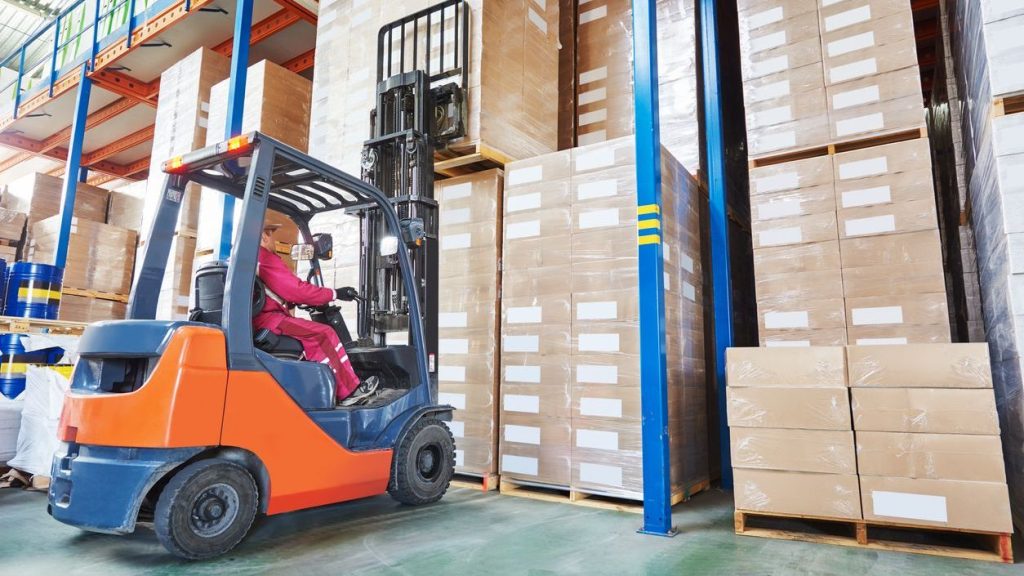
If you are asking “how much does a walkie stacker weight,” the realistic answer is usually 450–1,800 kg depending on whether it is manual or electric. That weight, plus the load, drives floor stresses, dock and trailer safety, and tipping risk. This guide explains typical walkie stacker weights, how options and batteries change them, and why engineers and safety managers must check floors, ramps, and trailer decks before driving a stacker into any building or vehicle.
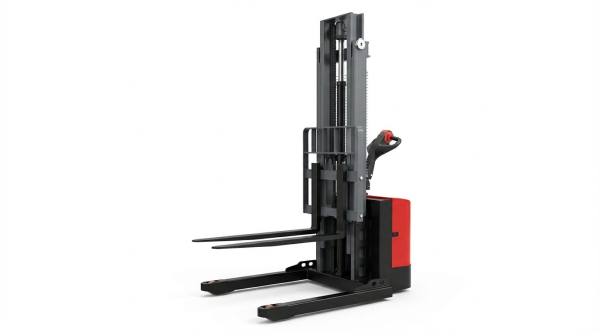
Typical Walkie Stacker Weights and Configurations
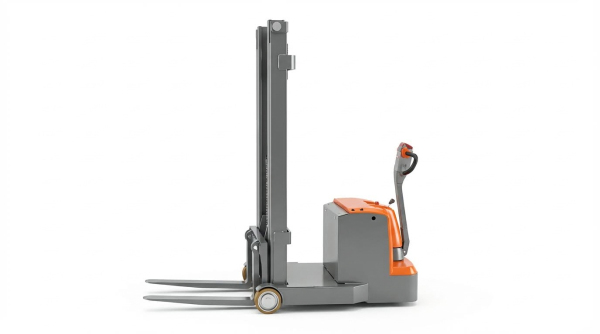
Typical walkie stackers weigh from about 450 kg to 1,800 kg, and understanding this range is key to answering “how much does a walkie stacker weight” for your floors, docks, and trailers. Service weight, battery choice, and mast type all drive where a specific truck lands in that band.
Most pedestrian stackers fall into a few predictable weight groups tied to whether they are manual or electric, and to their rated capacity of roughly 450–1,800 kg. Their configuration (straddle, counterbalance, reach) changes how that mass sits over the wheels and into your slab or trailer deck.
| Walkie stacker type | Typical service weight range | Typical rated capacity | Best for / Operational impact |
|---|---|---|---|
| Manual walkie stacker | ≈450–1,000 kg | ≈450–1,000 kg | Light-duty stacking where floor loading and budget are tight; easy to move in small rooms. |
| Compact electric pallet stacker | ≈450–610 kg | ≈1,000–1,200 kg rated under ideal conditions | Short shuttles in tight aisles; lower wheel loads for mezzanines and light slabs. |
| Standard electric walkie stacker | ≈900–1,800 kg | ≈1,000–1,800 kg with high masts and outreach | General warehouse stacking up to common pallet weights; main concern for dock plates and trailer floors. |
| Heavy-duty / reach-style pedestrian stacker | ≈1,400–1,800+ kg | ≈1,500–1,800 kg with high masts and outreach | Higher racking or deeper pallets; higher point loads and stricter floor and trailer checks. |
Within these ranges, remember that a truck rated to lift 1,000–1,800 kg does not always deliver full capacity if the load center grows or the mast is fully raised. As the load center increases beyond about 600 mm, effective capacity can drop roughly 20% or more, which is why spec sheets always tie capacity to a specific load center and height. Capacity falls as the load moves further from the mast, even though the truck’s own weight stays the same.
💡 Field Engineer’s Note: When checking if a floor or trailer can handle a walkie stacker, I first bracket it into one of the weight bands above, then add the maximum live load on the forks. That quick sum often exposes overloaded dock plates long before we open any design drawings.
Manual vs. electric walkie stacker weights
Manual walkie stackers usually weigh 450–1,000 kg, while electric walkie stackers typically weigh 900–1,800 kg once the battery and mast are installed. That extra electric mass improves lifting performance but sharply increases wheel loads into floors and trailers.
Manual units use a light chassis with a small hydraulic pump and no traction motor, so most of their mass sits in the steel frame and mast. Electric units add the drive motor, gearbox, power electronics, and, most importantly, a traction battery that can represent 20–30% of the total service weight. This is why a compact electric can already reach 450–610 kg even before you get into higher-capacity or reach-style designs.
- Manual stacker (≈450–1,000 kg): Simple frame, small mast, no battery – easier to push and friendlier to light mezzanine floors.
- Compact electric stacker (≈450–610 kg): Short wheelbase, smaller battery – good compromise for light trailers and tight elevators.
- Standard electric walkie (≈900–1,800 kg): Larger battery and mast – better stability and capacity but demands stronger slabs and dock gear.
Why electric stackers feel “heavier” in use
Electric walkie stackers not only weigh more but also concentrate more mass over a small drive tire and small load wheels. That creates higher contact pressures than a manual unit of similar capacity, which is why electric stackers are more likely to mark or damage weak floors and thin trailer decks if you do not verify ratings.
This weight difference becomes critical whenever you move from a ground-level warehouse into trailers, container floors, or suspended slabs. A manual stacker in the 450–700 kg range plus a 500–800 kg pallet is often still within many light-structure limits, while a 1,500 kg electric plus a 1,800 kg pallet can easily exceed typical dock plate or small-elevator ratings if you do not check.
Service weight, shipping weight, and rated capacity
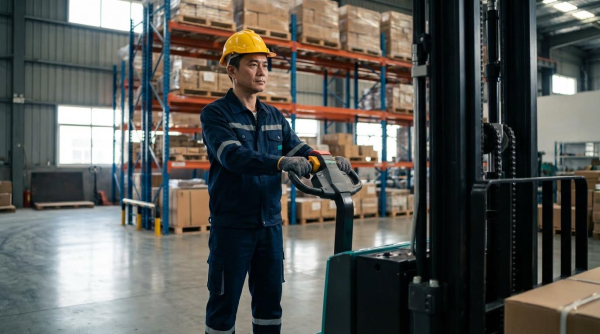
Service weight is the “real” in-use weight of a walkie stacker with battery, mast, fluids, and standard options installed, while shipping weight is lower because major components are removed or disassembled. Rated capacity is separate again: it is the maximum load, typically 1,000–1,800 kg, that the stacker may lift under ideal geometry and surface conditions.
For floor, dock, and trailer checks, you care about service weight plus whatever load you carry, not the lighter shipping figure. Electric walkie stackers commonly have service weights in the 900–1,800 kg range once you include the installed battery and full mast. Shipping weights can be several hundred kilograms lower if the battery ships separately or the mast ships laid down, which is why installation documents always list both numbers.
| Term | What it includes | Typical value range (electric walkie) | Operational impact |
|---|---|---|---|
| Service weight | Truck, mast, battery, fluids, standard options | ≈900–1,800 kg | Use for floor loading, dock plate, trailer, and elevator checks; governs wheel loads. |
| Shipping weight | Truck as shipped; often without battery or full mast | Several hundred kg less than service weight | Relevant for transport permits and crane lifts; unsafe to use for structural design in service. |
| Rated capacity | Maximum allowable load at specified load center and height | ≈450–1,800 kg under ideal conditions | Use for pallet and racking decisions; must be derated for larger load centers or high lift. |
Rated capacity is not a promise that the stacker can always lift that mass in real life. As soon as the load center increases or the mast is raised, capacity derates due to stability and mast deflection. For example, a stacker rated at 1,500 kg at a 600 mm (24 in) load center may only handle around 1,200 kg at a 760 mm (30 in) load center, roughly a 20% reduction, even though the truck’s own service weight is unchanged.
- Service weight: Drives wheel loads and structural checks – this answers the engineering side of “how much does a walkie stacker weight.”
- Shipping weight: Helps logistics plan cranes, trailers, and rigging – never use it for in-service floor checks.
- Rated capacity: Controls how much you may legally and safely lift – must be read together with load center and lift height charts.
How battery choice quietly changes service weight
Batteries can shift service weight by hundreds of kilograms. Traditional flooded lead-acid batteries often make up 20–30% of an electric walkie’s service weight. Newer lithium chemistries can cut that battery mass by roughly 15%, reducing overall truck weight and wheel loads, but also slightly lowering the stabilizing counterweight effect. Always confirm the manufacturer’s stated service weight for the exact battery type installed before signing off floor or trailer calculations.
💡 Field Engineer’s Note: When I audit a site, I ask for the data plate or manual to confirm service weight, then I add worst-case rated load to get a quick “maximum rolling load” for dock and slab checks. Using shipping weight or ignoring load derating is how trailers get bent and slabs crack around joints.
How Stacker Weight Affects Floors, Docks, and Trailers
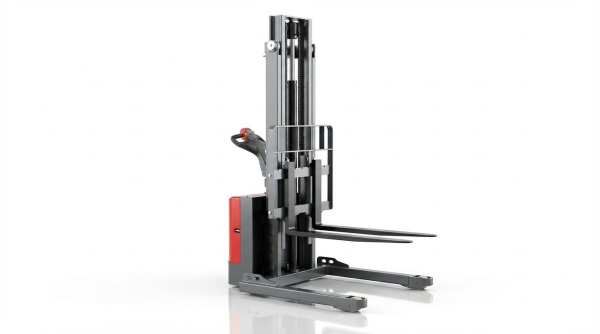
Stacker weight matters because it turns into very high wheel loads that can crack floors, overload dock gear, and damage trailer decks, especially when you also carry rated loads and work on slopes.
When people ask how much does a walkie stacker weight, the real engineering question is how that mass flows into the floor or trailer through a few small wheels. A typical electric walkie stacker weighs roughly 900–1,800 kg in service, and once you add a 1,000–1,800 kg payload, the combined reaction on floors, docks, and trailers can exceed what those structures safely carry over time.
- Key point: You never look at truck weight alone – you always check combined truck + load + operator against floor, dock, and trailer ratings.
- Key risk: Concentrated wheel loads and slopes can push a “safe on paper” stacker into slab cracking, dock failure, or tipping.
💡 Field Engineer’s Note: In older buildings, I always assume the floor is the weak link, not the stacker. We verify slab thickness, reinforcement, and any mezzanine or trailer ratings before allowing a 1.5-tonne walkie stacker with a full load to operate, especially near joints, pits, or dock edges.
Wheel loads, floor slabs, and trailer deck limits
Walkie stacker weight creates concentrated wheel loads that can overstress concrete slabs and light trailer floors if you ignore axle loads and wheel contact areas.
Typical electric walkie stackers have service weights between about 900 kg and 1,800 kg, with manual units from roughly 450–1,000 kg. Their mass sits on a small drive wheel and a pair (or two pairs) of tiny load wheels, so contact patches are small and local pressure is high. Engineers convert those wheel reactions into equivalent floor loads to check slab bending, punching shear, and trailer deck capacity.
| Parameter | Typical Range / Example | Engineering Meaning | Operational Impact |
|---|---|---|---|
| Service weight (electric walkie stacker) | 900–1,800 kg | Self-weight resting on floor via wheels | Even “light” units can exceed weak slab or mezzanine limits if misused |
| Manual walkie stacker weight | 450–1,000 kg | Lower mass but still concentrated at small wheels | Still risky on thin slabs, timber floors, or trailer decks |
| Rated capacity | 450–1,800 kg for many walkies under ideal conditions | Maximum safe load at specified load center | Combined truck + load can exceed 3,000 kg on the floor |
| Trailer floor design | For pallet loads, not point wheels in many cases | Assumes distributed load in kN/m² | Small wheels can crush boards or punch through thin steel decks |
| Floor loading check | Axle loads → kN/m² equivalent | Compare to slab and mezzanine ratings | Prevents cracking, spalling, and long-term structural damage |
Trailer floors in particular are risky because they are designed for pallets sitting on deck boards, not for a 1,200–1,800 kg walkie stacker plus a full pallet concentrated on a few wheels. Floor strength checks must compare calculated wheel contact pressures with trailer or mezzanine ratings expressed in kN/m² or kg/m². If you only ask “how much does a walkie stacker weight” and ignore contact pressure, you miss the real failure mode.
- Wheel load: Portion of total mass carried by each wheel – drives local floor stress and damage risk.
- Contact area: Wheel footprint on the floor – smaller area means higher pressure.
- Slab punching: Local cone-shaped failure under concentrated loads – critical near joints, pits, and thin toppings.
- Trailer board crushing: Timber or thin steel yielding under wheels – can cause sudden drop or stuck truck.
How engineers check a floor for walkie stacker use
Engineers typically: (1) estimate axle loads from truck + load, (2) divide by wheel contact area to get pressure, (3) convert to equivalent kN/m², and (4) compare with slab, mezzanine, or trailer ratings and reinforcement details. They also look at joints, trenches, dock pits, and any reduced-thickness areas as local weak spots.
Ramps, dock levelers, and slope restrictions
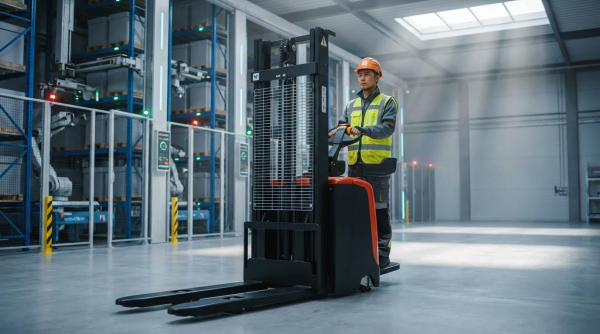
On ramps and dock levelers, stacker weight plus load multiplies reactions on hinges and lips, while slopes shift the center of gravity and raise tipping and traction risks.
Electric walkie stackers with service weights around 1,500 kg plus payloads up to about 2,000 kg place very high forces into dock levelers, hinges, and lip plates when crossing a dock or trailer transition. Codes and manufacturers typically limit loaded gradients to roughly 10% (about 5.7°) or less for safe operation, and some guidance treats slopes above about 7° as needing special rules such as directional travel and speed limits. Field guidance highlights that small walkie wheels are very sensitive to gaps, dock plates, and uneven surfaces.
| Element | Typical Condition / Limit | Risk Mechanism | Best For / Operational Guidance |
|---|---|---|---|
| Loaded ramp gradient | ≈10% or less for walkies | COG shift downhill, traction loss | Short, gentle dock approaches and internal ramps |
| “Special rule” slope band | Above ≈7° needs strict rules in practice | Faster COG movement during braking/turning | Drive uphill forward, downhill in reverse, no turning on slope |
| Dock leveler rating | Based on truck + load combination | Hinge, lip, and deck overstress | Confirm capacity before sending walkies into trailers |
| Transition at dock plate | Short slope + gap or step | Impact loads and dynamic wheel forces | Low approach speed, centered travel, anti-slip surfaces |
| Floor quality at ramps | High-friction, smooth, hard surface | Wheel spin or slide on smooth/dirty ramps | Regular cleaning and anti-slip surfacing |
- Ramp use: Follow manufacturer slope limits and traffic rules – prevents runaways and tipping.
- Dock levelers: Check rated capacity against truck + load – avoids hinge and lip failures.
- Transitions: Treat dock lips and trailer thresholds as hazards – slow down and keep wheels straight.
Practical ramp operating pattern for walkie stackers
For slopes near the upper allowed limit, operators should: (1) travel uphill with the load leading and forks low, (2) travel downhill in reverse with the load uphill, (3) avoid braking hard or turning on the slope, and (4) never stop and restart on a steep ramp with a full rated load.
Stability triangle, load moment, and tipping risk
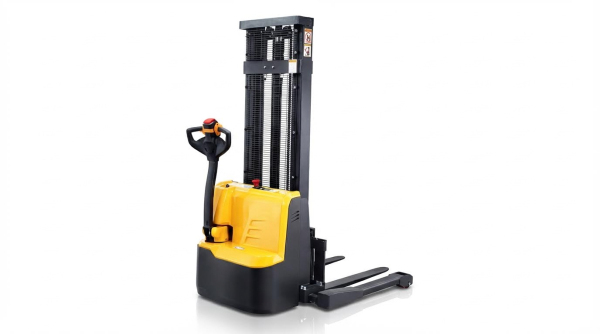
Stacker weight defines the stability triangle and counterweight, but load position, mast height, and slopes ultimately decide tipping risk on docks and trailers.
Walkie stackers have a relatively small stability triangle because of their narrow wheelbase and short length. When you drive onto a trailer or dock plate, any deflection, slope, or steering input shifts the combined center of gravity toward the triangle edges. High mast elevation, off-center pallets, or exceeding rated capacity at a larger load center all increase the overturning moment and reduce the safety margin. Capacity charts show how effective lifting capacity drops as load center and lift height increase, reflecting this stability reality.
| Concept | What It Means | Example Effect | Operational Impact |
|---|---|---|---|
| Stability triangle | Polygon connecting wheel contact points | Narrow base on walkie stackers | Small shift in COG on slopes can reach edge quickly |
| Load moment | Load × horizontal distance (Nm) | Higher load center or longer forks increase moment | Capacity must be reduced as load center grows |
| Lift height derating | Capacity reduction at high mast elevation | Triplex masts derate more at top height in many charts | Do not lift full rated load to maximum height without checking chart |
| Trailer slope and deflection | Deck flex and angle under load | COG moves as trailer sags or tilts in real use | Extra tipping risk at dock edges and inside flexible trailers |
| Battery and option weight | Part of counterweight system | Heavier battery can improve tip resistance but adds floor load | Always match battery spec to truck data plate |
- Travel low: Keep forks 300–400 mm above floor when moving in trailers – minimizes overturning moment.
- Respect charts: Never exceed rated capacity at given load center and height – charts already include stability margins.
- Avoid side loads: Do not push sideways on racks or trailer walls – side loading shrinks the effective stability triangle.
- Trailer-only risk: Inside trailers, visibility is poor and space is tight in many operations – run at very low speed with strict pedestrian exclusion.
Why “how much does a walkie stacker weight” is not enough for stability
Two walkie stackers can weigh the same, but the one with a higher mast, longer forks, or heavier options like sideshift has a very different stability profile. What matters is the full load chart: truck weight, wheelbase, mast type, load center, and maximum lift height, all combined with real operating conditions such as slopes, dock deflection, and floor quality.
Engineering Considerations When Selecting a Stacker
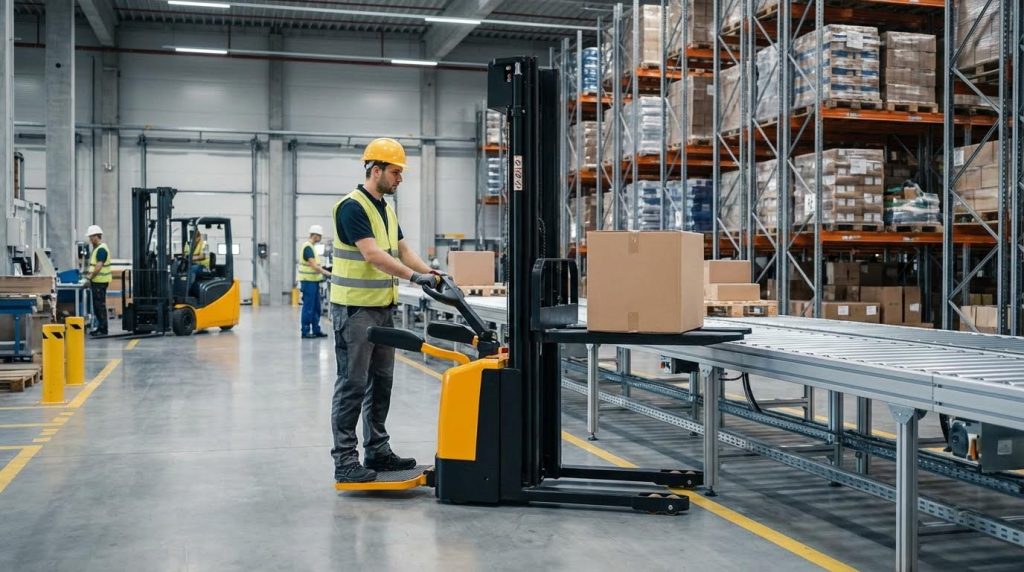
Engineering choices around batteries, mast design, and options determine how much a lift stacker weighs, how it handles loads, and how safely it works on your floors, docks, and trailers. When someone asks “how much does a walkie stacker weight,” the honest answer is that options and configuration can shift service weight by several hundred kilograms and change stability, floor loading, and lifecycle cost.
- Battery system: Chemistry and size drive 20–30% of service weight – directly affects stability and wheel loads.
- Mast design: Higher, multi‑stage masts add steel and cylinders – increases truck weight and raises the center of gravity.
- Attachments/options: Sideshift, fork positioners, guards – add up to ~20% weight and move the load forward.
- Duty cycle and terrain: Long runs, ramps, rough floors – favor robust, heavier frames and batteries.
- Building and trailer limits: Floor slabs, dock plates, elevators – must match stacker service weight plus payload.
Battery technology, mass, and weight distribution
Battery technology largely dictates stacker mass, weight distribution, and therefore stability and usable capacity. In most electric walkie stackers, the battery contributes roughly 20–30% of the service weight and acts as a key counterweight.
- Lead‑acid batteries: Traditional flooded or sealed lead‑acid batteries add “several hundred kilograms” and often make up 20–30% of total service weight – they give good counterweight but increase floor and wheel loading.
- Lithium‑ion batteries: Lithium iron phosphate packs typically reduce battery mass by about 15% for the same energy – they lighten the truck, reduce wheel pressures, and improve acceleration and energy efficiency.
- Service weight impact: A compact electric stacker might weigh 450–610 kg depending on battery size, while larger pedestrian units commonly reach 900–1,800 kg service weight with their installed batteries.
- Weight distribution: Battery position (within the chassis or behind the operator) shifts the combined center of gravity and therefore the stability triangle and tip resistance.
- Capacity sensitivity: Manufacturers note that the weight and condition of the battery can “significantly affect the truck’s stability and lifting performance,” changing effective capacity by a noticeable margin. Battery weight and stability
| Battery Type | Typical Mass Effect | Share of Service Weight | Operational Impact |
|---|---|---|---|
| Flooded lead‑acid | Baseline (heaviest common option) | ≈20–30% | Higher stability and counterweight, but higher wheel loads and floor wear. |
| Sealed lead‑acid (AGM/gel) | Slightly lighter than flooded | ≈20–25% | Lower maintenance, similar floor loading and handling feel. |
| Lithium iron phosphate | ≈15% lighter than equivalent lead‑acid | ≈15–25% | Lower stacker weight, better energy efficiency, but less “free” counterweight. |
- Energy use: Heavier trucks need more traction energy per meter, especially on rough floors or ramps – this raises kWh per shift.
- Tire and floor wear: Extra battery mass increases contact pressure on small load wheels – this accelerates tire wear and can damage thin dock plates or weak slabs.
- Maintenance profile: Lead‑acid requires watering and equalization; lithium‑ion cuts maintenance but raises capital cost – weight choice becomes a lifecycle cost decision, not just a spec sheet number.
How battery choice changes the “real” capacity
Published capacities assume the specified battery type and weight installed, on smooth, level, hard floors. Swapping to a lighter battery without the manufacturer’s approval can reduce the effective counterweight, shrinking the safety margin against forward tip when handling tall or off‑center pallets.
💡 Field Engineer’s Note: In cold storage below 0°C, high‑viscosity hydraulic oil and stiff tires already reduce handling margins. Pairing that with an under‑weight or partially discharged battery shifts the center of gravity forward faster than operators expect, so always size batteries and oil grades for the coldest operating zone, not the ambient dock.
Mast height, options, and their impact on truck weight
Mast height, number of stages, and add‑on options can change how much a battery-powered stacker weighs by up to 20% and strongly affect stability at height. Taller and more complex masts also require stricter capacity derating.
- Mast stages: Triplex masts (three stages) reach higher but use more steel and cylinders than simplex or duplex – this adds mass high above the chassis.
- Lift height vs capacity: As lift height increases, allowable load at the forks decreases due to stability and mast deflection limits. Higher masts need more aggressive derating at top heights. Lift height and derating
- Rated capacity band: Typical walkie stacker capacities run from about 450 to 1,800 kg under ideal conditions, but that rating only applies at the specified load center and at or below a given lift height. Capacity range and load center
- Options mass: Sideshift carriages, fork positioners, and extra guarding can increase total truck weight by up to about 20% compared with a bare configuration – and they often move the load center forward.
- Load center sensitivity: A stacker rated at 1,500 kg with a 600 mm load center may only handle about 1,200 kg at a 760 mm load center, a reduction of roughly 20%. Load center vs capacity
| Design Choice | Effect on Stacker Weight | Effect on Capacity & Stability | Operational Impact |
|---|---|---|---|
| Simplex/duplex low mast (≤3,000 mm) | Baseline, lighter mast | Less derating; lower center of gravity | Best for low racking, mezzanines, and tight trailers. |
| Triplex high mast (≥4,800 mm) | Heavier mast assembly | More derating at top height; higher COG | Needs stronger floors and careful training for high lifts. |
| Sideshift carriage | Extra steel and hydraulic block | COG moves forward, slightly reducing net capacity | Improves pallet alignment but increases wheel and floor loads. |
| Hydraulic fork positioner | Up to ~20% added weight vs base | Higher front‑axle load; more sensitivity to weak slabs | Faster handling of mixed pallet widths; check dock and elevator ratings. |
- Floor and dock checks: Heavier masts and front‑end options increase front axle and wheel loads, which can overstress thin slabs, dock levelers, or trailer floors if you only looked at “how much does a walkie stacker weight” in its base spec.
- Tip resistance: Extra mast and attachment weight above the drive axle shrinks the stability margin, especially with tall loads or when braking on a slope.
- Transport constraints: A stacker near 1,800 kg service weight plus payload can exceed smaller elevator or dock plate ratings, so always check truck weight including options against building and trailer data.
How to read a capacity plate for mast and option effects
The capacity plate lists rated load in kg, load center in mm, and maximum lift height. Many plates include a table or graph showing reduced capacities at higher lift heights or different load centers. When options like sideshift are installed, manufacturers issue updated plates; using the old rating with new, heavier attachments is unsafe and non‑compliant with common safety standards.
💡 Field Engineer’s Note: When you retrofit a walkie stacker with a heavier mast or a new attachment, treat it like a new truck from an engineering standpoint. Re‑check floor slab design loads, dock plate ratings, and trailer use plans; the extra 150–300 kg often shows up first as cracked dock plates or rutted warehouse joints long before anyone notices the change on the data plate.
Final Thoughts on Specifying Walkie Stackers by Weight
The key takeaway is that “how much does a walkie stacker weight” is a structural, safety, and lifecycle cost question, not just a spec line on a datasheet.
When you ask how much does a walkie stacker weight, you are really deciding what your floors, docks, trailers, and operators must safely handle every day. Service weights for typical electric units sit roughly between 900 kg and 1,800 kg, with manual pallet stacker versions often between 450 kg and 1,000 kg, and that mass concentrates into a few small wheels that your slabs and trailer decks must support under dynamic loading.
From an engineering standpoint, three checks should sit on every specification sheet: total service weight, rated capacity at the correct load center, and combined weight (truck plus load plus operator) on ramps, dock levelers, and trailer floors. Rated capacity already assumes ideal, level, hard floors and correct load centers; once you extend the load center or lift to higher mast stages, effective capacity can drop by around 20% or more, especially on tall triplex masts at maximum height. Capacity derating with height and load center makes it clear that you must design around worst realistic cases, not brochure numbers.
Weight choices also lock in stability behavior. A heavier chassis and battery increase tip resistance and allow higher rated capacities, but options like longer forks or sideshift move the center of gravity forward and eat into your stability triangle margin. On trailers and ramps, that small stability triangle and high combined mass interact with slopes, dock transitions, and trailer flex, increasing tipping and floor failure risk if you run close to limits. Guidance on trailer loading stresses that slopes above about 7° and concentrated wheel loads on thin trailer decks create real hazards that your risk assessment must address. Trailer floor, slope, and stability guidance shows how quickly conditions can move the center of gravity toward the edge of the stability triangle.
Finally, weight is a lifecycle cost lever. Extra mass increases traction energy per meter, accelerates tire and wheel wear, and punishes floors, dock plates, and trailer decks. Battery technology choices shift 15% or more of that mass, and with it your energy use, maintenance profile, and usable capacity over a shift. When you specify your next unit, treat “how much does a walkie stacker weight” as a design constraint that must align with floor design, dock equipment ratings, trailer construction, and your real pallet, height, and slope scenarios. If you cannot show those checks on paper, you are not done engineering the purchase.
Final Thoughts on Specifying Walkie Stackers by Weight
Walkie stacker weight is not a catalog detail. It is a structural and safety design input. Service weight, battery mass, and mast design set wheel loads, stability margins, and energy use on every shift.
Engineers must always work from service weight, not shipping weight, and then add the heaviest realistic pallet and the operator. That combined figure drives slab design checks, dock leveler selection, and trailer approval. Small drive and load wheels turn that mass into very high local pressures, so thin slabs, mezzanines, and trailer decks need special care.
Stability depends on the relationship between truck weight, load center, and mast height. Capacity charts and the stability triangle show that higher masts, longer forks, and options like sideshift reduce safe capacity, especially on slopes and flexible trailer decks. Ignoring derating is how trailers bend and trucks tip.
Best practice is clear. Define real pallets, lift heights, and slopes first. Confirm floor, dock, and trailer ratings. Then select a stacker, battery, and mast that fit those limits with margin. When in doubt, involve a structural engineer and your supplier, such as Atomoving, before the truck ever touches a dock plate.
Frequently Asked Questions
How heavy is a walkie stacker?
A walkie stacker’s weight can vary depending on the model and specifications. On average, a typical walkie stacker weighs around 1,542 kg (3,400 lbs). This weight often includes the battery. For more details, you can check specific models on warehouse equipment pages.
What factors influence the weight of a walkie stacker?
The weight of a walkie stacker is influenced by several factors:
- Battery Weight: Electric walkie stackers use heavy batteries for power.
- Material and Build: The frame and components are typically made from durable steel.
- Lifting Capacity: Higher lifting capacities often require stronger, heavier materials.
For more information on material handling equipment specifications, refer to material handling guides.