If you are asking “how much does a walkie stacker weight,” the practical answer is usually between 450 kg and 1,800 kg depending on design and power source. This article explains what drives that weight and why it matters for floor slabs, docks, and trailers. You will see how truck mass links directly to stability, wheel loads, and ramp safety, so you can choose a stacker that fits both your loads and your building. By the end, you will know what to check with your supplier and your structural engineer before signing off on a new truck or changing routes in your facility.
Typical Walkie Stacker Weights And What Drives Them
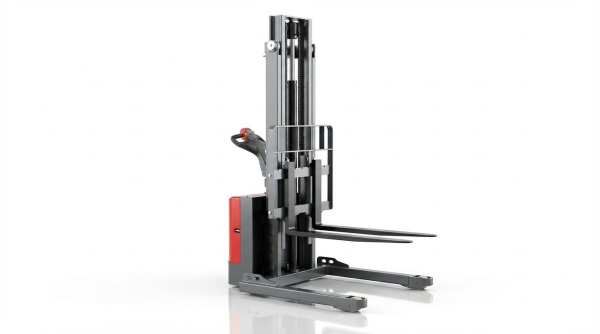
Typical walkie stackers weigh from about 450 kg to 1,800 kg, and the main drivers are power type, battery choice, mast design, and capacity rating. Understanding how much does a walkie stacker weight is critical for checking floor loads, ramps, and trailer limits. Typical walkie pallet truck (often classed with small walkie stackers) weigh roughly 91–181 kg, depending on drive and hydraulic options according to published ranges. Larger walkie stackers with masts and counterweight structures commonly sit between 900 kg and 1,800 kg in service weight, with some high‑capacity units above this band based on engineering guidance. For floors, docks, and trailers, engineers work with the full service weight, not just the rated load.
| Equipment type | Typical service weight range | Power / features | Operational impact |
|---|---|---|---|
| Small electric pallet truck (no mast) | ≈ 90–180 kg (200–400 lbs) | Electric drive, low lift | Low floor loading; often acceptable on light mezzanines and small elevators per typical data |
| Manual walkie stacker | ≈ 450–1,000 kg | Hand push, manual or simple hydraulic lift | Moderate floor loading; suitable where electric power is not available according to engineering ranges |
| Standard electric walkie stacker | ≈ 900–1,800 kg | Electric drive, mast up to ~4.5–5.5 m | High point loads at wheels; requires slab and dock capacity checks |
| High‑capacity / high‑lift walkie stacker | > 1,800 kg | Reinforced mast, larger battery, options | May exceed older slab or trailer ratings; needs detailed engineering review |
- Key takeaway: Service weight rises with capacity, lift height, and options – heavier trucks demand better slabs, ramps, and trailers.
- Safety implication: Underestimating truck weight leads to cracked slabs and overstressed dock levelers – a common but avoidable failure mode.
💡 Field Engineer’s Note: When I review damaged warehouse slabs, the root cause is often not overload from pallet racks but underestimated walkie stacker weight and wheel loads at dock approaches and construction joints.
Manual vs electric walkie stacker weight ranges
Manual walkie stackers are significantly lighter than electric walkie stackers, but electric units still dominate floor loading because they carry heavier batteries and masts. Knowing whether a truck is manual or electric is the first filter when someone asks how much does a manual platform stacker weight for their building.
| Type | Typical capacity class | Typical service weight | Why it weighs this much | Best for… |
|---|---|---|---|---|
| Manual walkie stacker | ≈ 500–1,000 kg rated load | ≈ 450–1,000 kg | Lighter frame, no drive motor, small hydraulic unit; operator supplies traction energy per typical ranges | Short distances, low‑throughput areas, mezzanines with limited floor rating |
| Electric pallet truck (no mast) | ≈ 1,500–2,000 kg rated load | ≈ 90–180 kg | Compact chassis, low lift height, small battery; no tall mast structure as reported | Horizontal transport, truck loading, tight aisles where racking is low |
| Standard electric walkie stacker | ≈ 1,000–2,000 kg rated load | ≈ 900–1,800 kg | Heavy battery, drive motor, reinforced mast and chassis to maintain stability according to engineering guidance | Stacking to 3–5 m, dock work, higher throughput warehouses |
- Manual stackers: Simpler and lighter – easier on floors but harder on operators over long distances.
- Electric stackers: Heavier due to battery and drive – better productivity but higher point loads at wheels.
- Design implication: For older slabs or suspended floors, manual or very light electric trucks often avoid costly strengthening – but you trade off speed and ergonomics.
How to quickly estimate if your slab can handle a stacker
As a rule of thumb, if your building was designed only for office loads (≈ 3–5 kN/m²), assume it is not suitable for a 900–1,800 kg walkie stacker without a structural check. Modern warehouse slabs are usually designed for much higher concentrated loads from material handling equipment, but you still need to verify wheel loads and joint detailing against the actual truck you plan to use.
How batteries and mast options change service weight
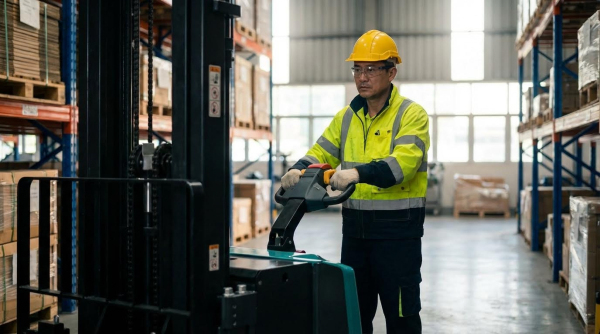
Batteries and mast options can change walkie stacker service weight by several hundred kilograms, which directly affects floor loading, ramp performance, and trailer selection. Two trucks with the same rated capacity can differ substantially in real mass if one uses a heavy lead‑acid pack and a tall, option‑loaded mast.
| Design element | Typical weight effect | Engineering note | Operational impact |
|---|---|---|---|
| Lead‑acid battery vs lighter chemistries | Lead‑acid can add several hundred kg; Li‑ion / LFP reduce pack weight by ≈10–15% | Battery is often the single heaviest removable component per guidance | Lighter packs reduce floor loads and improve acceleration but may reduce counterweight effect at high lift |
| Mast height increase (e.g., from 3.0 m to 5.5–6.0 m) | Can add a significant percentage to mast and chassis weight | Taller masts require stronger sections to control deflection and maintain stability at height as noted | Heavier front end increases wheel loads and may tighten turning in narrow aisles |
| Sideshift carriage | Up to ≈ 10–20% extra over base mast assembly | Adds steel mass and shifts the load center slightly forward per engineering commentary | Improves pallet handling accuracy but raises tip‑over risk if operators ignore load chart derating |
| Hydraulic fork positioner and extra hydraulics | Can push total truck weight ≈ 20% above base configuration | More steel, cylinders, and hoses mounted ahead of the mast pivot | Higher wheel loads at the front; may require stronger dock plates and ramps |
- Battery choice: Lead‑acid maximizes counterweight but stresses floors; Li‑ion / LFP lower mass – good for older slabs and energy use.
- Mast options: Every extra feature ahead of the mast pivot is a double penalty – more weight and a forward‑shifted center of gravity.
- Spec discipline: Always request the “service weight with options” value on the data plate – that is the number your structural engineer needs.
💡 Field Engineer’s Note: When you up-spec a walkie stacker with a taller mast and sideshift, assume the real service weight is near the top of the published range and recheck your dock levelers and trailer floors before the truck arrives on site.
Selecting The Right Stacker Weight For Your Application
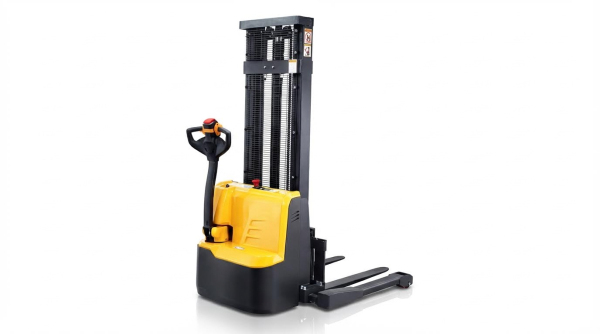
The right walkie stacker weight is the lightest truck that still safely carries your load at the required height on your actual floors. When people ask “how much does a walkie stacker weight,” the real answer is “it depends on your load, lift height, and building limits.” Typical electric walkie stackers weigh about 900–1,800 kg, with higher-capacity or high‑mast units going heavier. Service weight selection should always be tied to payload, lift height, and floor or trailer capacity.
- Start from the load: Define maximum pallet mass and dimensions – this sets minimum capacity and wheelbase.
- Add lift height: Confirm top lift level and racking – higher masts require heavier, stiffer trucks.
- Check building limits: Verify slabs, ramps, trailers, and elevators – these may cap allowable stacker weight.
- Consider duty cycle: Look at shifts, travel distance, and gradients – this influences battery type and energy use.
- Optimize, don’t oversize: Avoid unnecessary capacity and mast height – this reduces truck mass, cost, and floor wear.
💡 Field Engineer’s Note: When I size a walkie stacker for older warehouses, I often work backwards from slab and dock limits. A “safe” 2,000 kg high‑mast unit can easily overload thin floors or light dock plates if you ignore service weight plus payload.
Matching truck weight to load, height, and aisle layout
Matching stacker weight to load and lift height means choosing just enough truck mass and mast strength to keep the stability triangle intact in your aisles. Heavier is not always safer if your floors, joints, or trailers are marginal.
| Design Variable | Typical Engineering Range / Effect | Impact on Required Stacker Weight | Operational Impact |
|---|---|---|---|
| Rated load | Common walkie stackers: 1,000–2,000 kg payload | Higher payload → heavier chassis and counterweight mass | Heavier truck improves tip resistance but raises floor and trailer loading |
| Lift height | About 2.5–4.5 m typical; up to 5.5–6.0 m on some models (mast options) | Taller masts need heavier mast sections and base for stability | High-rack applications push you toward heavier trucks and stricter floor checks |
| Load center | Standard around 600–610 mm; 760 mm or more for long loads | Longer load center reduces capacity; sometimes drives selection of a heavier truck to keep margin (capacity derating) | Long pallets or overhanging loads may force a higher-capacity, heavier stacker |
| Aisle width | Common clear aisles: 2.2–2.7 m for walkie stackers | Narrower aisles favor compact, sometimes lighter designs | Very tight aisles may cap truck size and weight even if more capacity is desired |
| Truck service weight | Manual: ~450–1,000 kg; electric: ~900–1,800 kg typical (service weight ranges) | Higher weight boosts stability and traction but increases floor and ramp load | Crucial for answering “how much does a walkie stacker weight” for your specific job |
From an engineering standpoint, stacker weight is a direct response to overturning moments from the load at height. When you lift 2,000 kg to 5 m, the combined center of gravity of truck and load moves up and slightly forward, so designers add mass low in the chassis and strengthen the mast to keep the center of gravity inside the stability triangle. For example, stackers that lift around 2,000 kg to about 5 m typically operate with service weights at or above 1,000 kg.
- Short, low racks (≤2.5 m): You can usually select lighter trucks with modest masts – good for older floors and small trailers.
- Medium racks (3–4.5 m): Expect mid‑range service weights and stronger masts – most standard electric walkies fall here.
- High racks (4.8–6.0 m): Trucks become significantly heavier with more derating at the top – you must verify slab, dock, and trailer capacity.
How to quickly screen aisle layout vs stacker size
As a rule of thumb, take the overall truck length (including forks) plus about 300–400 mm clearance at each end of the turn. If your existing aisles are only 2.2–2.3 m, you may need a compact, lighter walkie stacker rather than a heavier, long‑wheelbase high‑capacity unit.
Balancing TCO, energy use, and battery technology
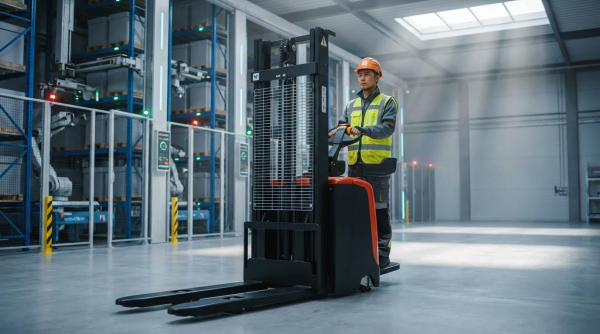
Balancing total cost of ownership (TCO), energy use, and battery technology means choosing a walkie stacker weight that minimizes lifetime energy and maintenance without compromising capacity or runtime. Battery choice is central because it changes both mass and operating cost.
| Battery / Design Choice | Effect on Stacker Weight | Energy & Maintenance Impact | Best For… |
|---|---|---|---|
| Lead-acid battery | Heavier; adds several hundred kg on many electric walkies (high mass) | Lower upfront cost; needs watering and equalization; higher energy per meter moved | Single‑shift work where extra mass aids traction and floors are robust |
| Lithium / LFP battery | Reduces truck weight by roughly 10–15% vs lead‑acid at same energy (lighter packs) | Higher upfront cost; lower maintenance; faster opportunity charging; better energy efficiency | Multi‑shift or high‑throughput sites, or buildings with sensitive floors or docks |
| Added mast options (sideshift, fork positioner) | Can increase total truck weight by up to ~20% vs base configuration (option mass) | More hydraulic circuits; slightly higher energy use and maintenance | Precision handling or mixed pallet sizes where productivity gain outweighs extra mass |
| Heavier vs lighter chassis | Heavier chassis improves stability and traction; lighter reduces floor loading | Heavier unit consumes more energy and wears tires and floors faster (lifecycle impact) | Heavier for steep ramps and heavy loads; lighter for flat, delicate floors and long travel |
Lifecycle cost is tightly linked to stacker mass. Every extra kilogram you push or pull along a 100 m aisle costs energy, accelerates tire wear, and increases abrasion on concrete or dock plates. Heavier walkie stackers also place higher loads on ramps and dock levelers, so engineers must check combined weight of truck, operator, and rated load when selecting dock equipment and trailers.
- Energy use: Heavier trucks require more traction energy per meter – this shows up in kWh per shift and charger size.
- Floor and dock wear: More mass means higher wheel loads – this speeds up joint spalling and dock plate fatigue.
- Maintenance: Lead‑acid packs add watering and corrosion checks; lithium reduces routine tasks – lower labor cost but higher capital.
Quick TCO checklist before you lock in stacker weight
Before issuing a purchase order, run through: 1) Maximum load and height today and in 5 years; 2) Floor slab thickness and joint condition; 3) Dock leveler and trailer ratings; 4) Number of shifts and charging windows; 5) Whether lithium’s lower weight and maintenance offset its higher upfront cost over the planned life of the truck.
Final Thoughts On Walkie Stacker Weight And Safety-Critical Design
Walkie stacker weight is not just a catalog number. It sets wheel loads, shapes stability, and decides whether your floors, docks, and trailers stay within safe limits. As capacity, lift height, and options increase, service weight rises and concentrates more force into a small contact patch at each wheel. That extra mass improves tip resistance but can crack thin slabs, damage joints, and overstress dock levelers and trailer floors if you skip checks.
Safe design links four things: payload, lift height, building capacity, and battery or mast choices. Engineers must work with real service weight, including options and a full battery, then compare wheel loads against slab design, ramp gradients, and trailer ratings. Operations teams should resist oversizing “just in case.” The right truck is the lightest configuration that still meets today’s and near‑future loads at height on known routes.
As a best practice, define your maximum pallet and top rack level, survey slabs and docks, then ask Atomoving for certified service weight and wheel load data for each candidate truck. Share that data with your structural engineer before purchase. This joined‑up approach keeps stability margins high, protects concrete and steelwork, and delivers safe, efficient handling over the full life of the stacker.
Frequently Asked Questions
How heavy is a walkie stacker?
A walkie stacker’s weight can vary depending on the model and specifications. On average, a typical walkie stacker weighs around 3400 lbs (1542 kg). This weight includes the battery and other components necessary for its operation. For more details, you can refer to specific product pages like Counterbalanced Walkie Stacker.
What factors influence the weight of a walkie stacker?
The weight of a walkie stacker is influenced by several factors:
- Battery Weight: The type and size of the battery significantly affect the overall weight.
- Material and Build: High-strength materials increase durability but also add to the weight.
- Lifting Capacity: Models designed to lift heavier loads often weigh more due to reinforced structures.
- Additional Features: Extra features such as extended masts or specialized attachments can add to the weight.
Does a walkie stacker count as a forklift?
Yes, a walkie stacker is considered a type of forklift. It is specifically designed for material handling tasks in warehouses and distribution centers. While it operates similarly to traditional forklifts, it is typically smaller and more maneuverable. For more information on classifications, you can check resources like Forklift Types Guide.