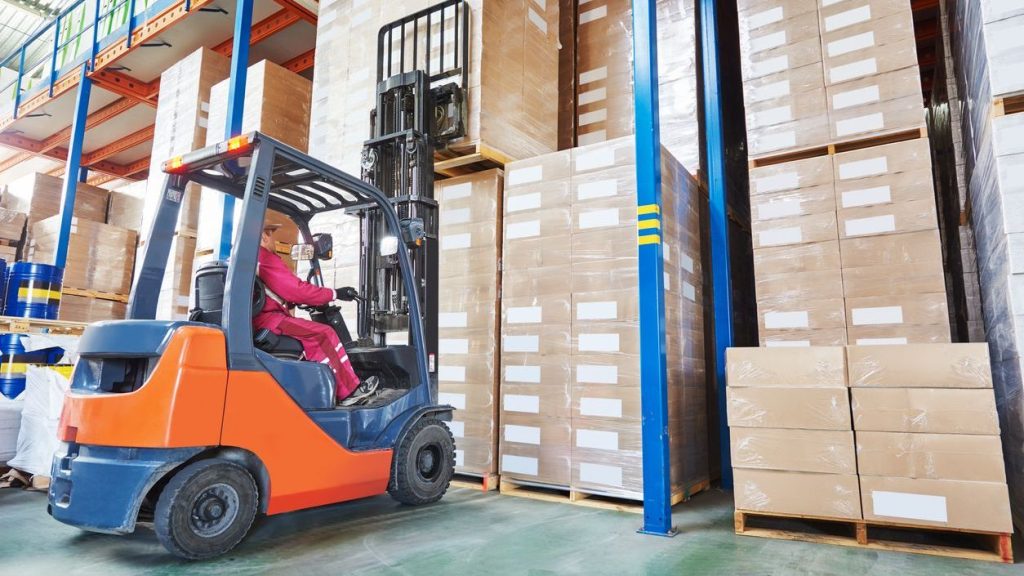
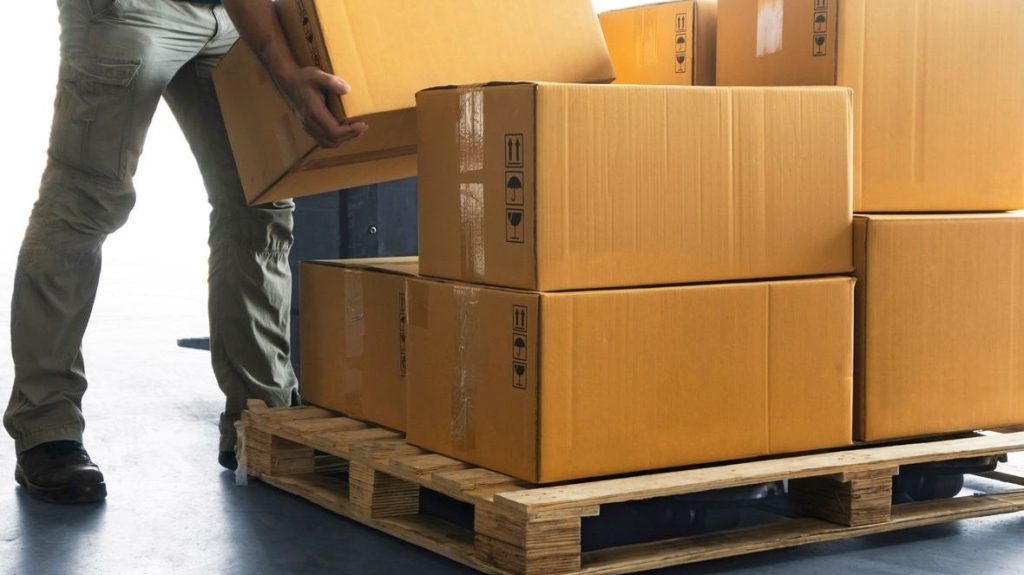
Walkie stackers typically lift between about 2,500 mm and 6,000 mm, with some specialized designs reaching around 7,000–8,000 mm, but safe height always depends on mast type, load center, and floor conditions. This guide explains how high a walkie stacker can lift in real warehouses, how mast design changes stability and capacity, and how to match lift height to your racking and safety standards so you do not overload a truck at the top beam.
Defining Walkie Stacker Lift Heights And Limits
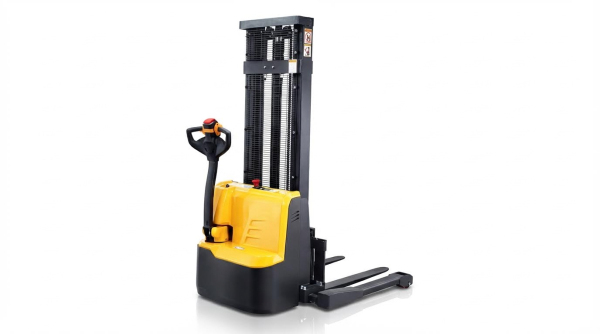
Walkie stackers typically lift between about 2,500 mm and 6,000 mm, with some specialized designs reaching 7,000–8,000 mm. The real answer to how high can a counterbalanced stacker lift depends on mast type, load center, and capacity derating at height.
Typical lift ranges and maximum heights
Walkie stackers cover low, medium, and high-reach ranges, from about 1,000 mm up to around 6,000 mm in common use. Some specialized high-bay models can reach about 7,000–8,000 mm, but these require tighter stability controls and application checks. This is the practical context behind the question “how high can a battery-powered stacker lift.”
| Category | Typical Lift Height Range | Representative Max Heights | Operational Impact / Best For… |
|---|---|---|---|
| Low-lift walkie stacker | Up to ~1,000 mm | ≈1,000 mm | Dock work, pallet transfer, feeding conveyors or low mezzanines. |
| Medium-reach walkie stacker | 2,000–4,000 mm | ≈4,000 mm | Standard pallet racking in small to mid-size warehouses. |
| High-reach walkie stacker | 4,000–5,400 mm | ≈5,400 mm typical | Higher rack beams in tight aisles; needs good floors and trained operators. |
| Special high-bay pedestrian stacker | 5,400–8,000 mm (specialized) | ≈7,000–8,000 mm in some designs | Special projects; must be engineered around floor flatness, load type, and strict procedures. |
| Typical catalog maximum for walkie stackers | 2,500–6,000 mm | Up to 6,000 mm with suitable mast | Common upper limit for standard warehouse applications. |
Why “maximum lift height” is not the only limit
The catalog maximum shows how high the forks can travel, not what you can safely store there. You must also check rated capacity at that height, load center, floor conditions, and any local safety rules before fixing rack beam elevations.
💡 Field Engineer’s Note: When planning new racking, I always cap working height 150–300 mm below the electric platform stacker’s absolute max. This keeps some margin for floor unevenness, mast deflection, and operator steering variation at full elevation.
How mast stages affect achievable height
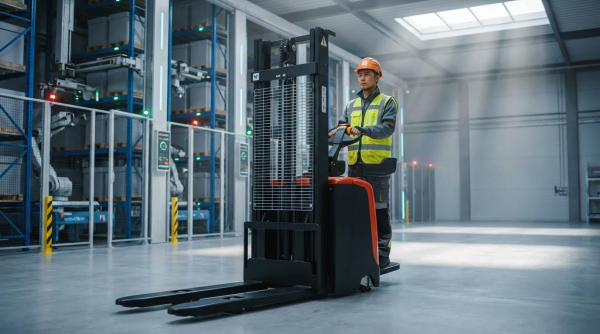
Mast configuration (simplex, duplex, triplex) is what really governs how high a walkie stacker can lift within a workable collapsed height. More mast stages allow higher reach but add complexity, deflection, and stricter stability requirements as you approach 6,000 mm and beyond.
| Mast Type | Typical Lift Range | Example Specs | Operational Impact / Best For… |
|---|---|---|---|
| Simplex (single stage) | Up to ~1,600–2,500 mm | Single mast around 1,600 mm with modest derating at height | Very rigid and stable; ideal for dock heights and low-level handling where maximum stiffness matters more than reach. |
| Duplex (2-stage) | ≈2,500–4,000 mm typical; up to about 6,000 mm in some designs | Dual masts commonly cover 2,500–4,000 mm; capacity derating increases at upper heights | Mainstream choice for standard pallet racking; balances collapsed height, reach, and stability. |
| Triplex (3-stage) | ≈4,500–6,000+ mm typical | Triplex mast can reach 6,000 mm with retracted mast height ≈2,500 mm | Enables high racks in buildings with low doors or mezzanines; requires good floors, careful setup, and trained operators. |
| Engineering trade‑off | Simplex: lowest; Triplex: highest | Simplex is stiffest; duplex moderate; triplex has most deflection and moving parts | More stages mean more reach but also more sway, higher maintenance, and sharper capacity derating at top lift. |
- Simplex mast rigidity: One solid section – Minimizes mast sway and capacity loss, ideal when vertical clearance is generous and you do not need high racks.
- Duplex mast versatility: Two sections with moderate free lift – Covers most 2,500–4,000 mm rack applications while keeping truck height reasonable when lowered.
- Triplex mast compact reach: Three sections with high free lift – Lets you clear 6,000 mm racks while still fitting under ~2,500 mm doors, but demands stricter inspection and operator discipline.
💡 Field Engineer’s Note: When clients ask how high can a manual platform stacker lift in an older building with low doors, I first check triplex mast retracted height against every doorway and mezzanine beam. A 6,000 mm reach is useless if you cannot even enter the aisle.
Rated capacity, load center, and height derating
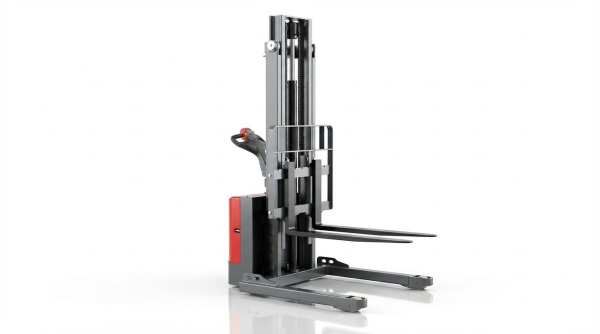
The higher you lift, the less weight a walkie stacker can safely handle at a given load center. Capacity derating with height is driven by leverage: as mast stages extend, the load’s center moves further from the truck, increasing overturning moment and cutting the allowable kg at height.
| Parameter | Typical Values | Effect on “How High Can a Walkie Stacker Lift” Safely |
|---|---|---|
| Base rated capacity at low height | ≈900–2,000 kg for most walkie stackers | This rating usually applies near floor level at the specified load center; it is not valid at maximum mast height without checking the capacity chart. |
| Load center distance (LC) | Commonly 600–910 mm | Longer pallets, overhanging loads, or attachments push LC out, increasing leverage and reducing safe capacity, especially at height. |
| Example capacity loss from LC change | 1,500 kg at 610 mm LC dropping to ≈1,200 kg at 762 mm LC | About 20% reduction just from a 152 mm shift in LC, even before considering extra derating at maximum lift height. |
| Height-related derating | Single mast: modest; dual/triple: stronger derating at top lift | At 4,000–6,000 mm the same truck may only handle a fraction of its base rating to keep within the stability triangle. |
| Typical overall lift height range | ≈2,500–6,000 mm for most walkie stackers | Safe use at the top of this range depends on matching load weight, LC, and floor quality to the manufacturer’s capacity chart. |
| Recommended safety margin on capacity | Engineer for 10–20% extra capacity over heaviest load | Ensures that real-world variations in load position, wear, and floor conditions do not push the truck beyond safe limits at height. |
- Capacity chart, not nameplate: The capacity plate gives base rating; the real limit at 4,000–6,000 mm is on the manufacturer’s capacity chart for that exact mast and load center.
- Load geometry matters: Long pallets, stacked totes, or offset loads increase effective load center – this can cut safe capacity by hundreds of kilograms at full lift.
- Height and sway: As mast height increases, forward bend and side sway grow – derating keeps overturning moment within the stability triangle defined in standards such as ISO 3691‑5.
💡 Field Engineer’s Note: When I size a walkie stacker, I start from the top rack and worst‑case pallet: rack height, pallet overhang, load center, and actual weight. Then I work backwards to a truck whose capacity chart still has at least 10–20% margin at that height.
Mast Types, Stability, And Performance Trade-Offs
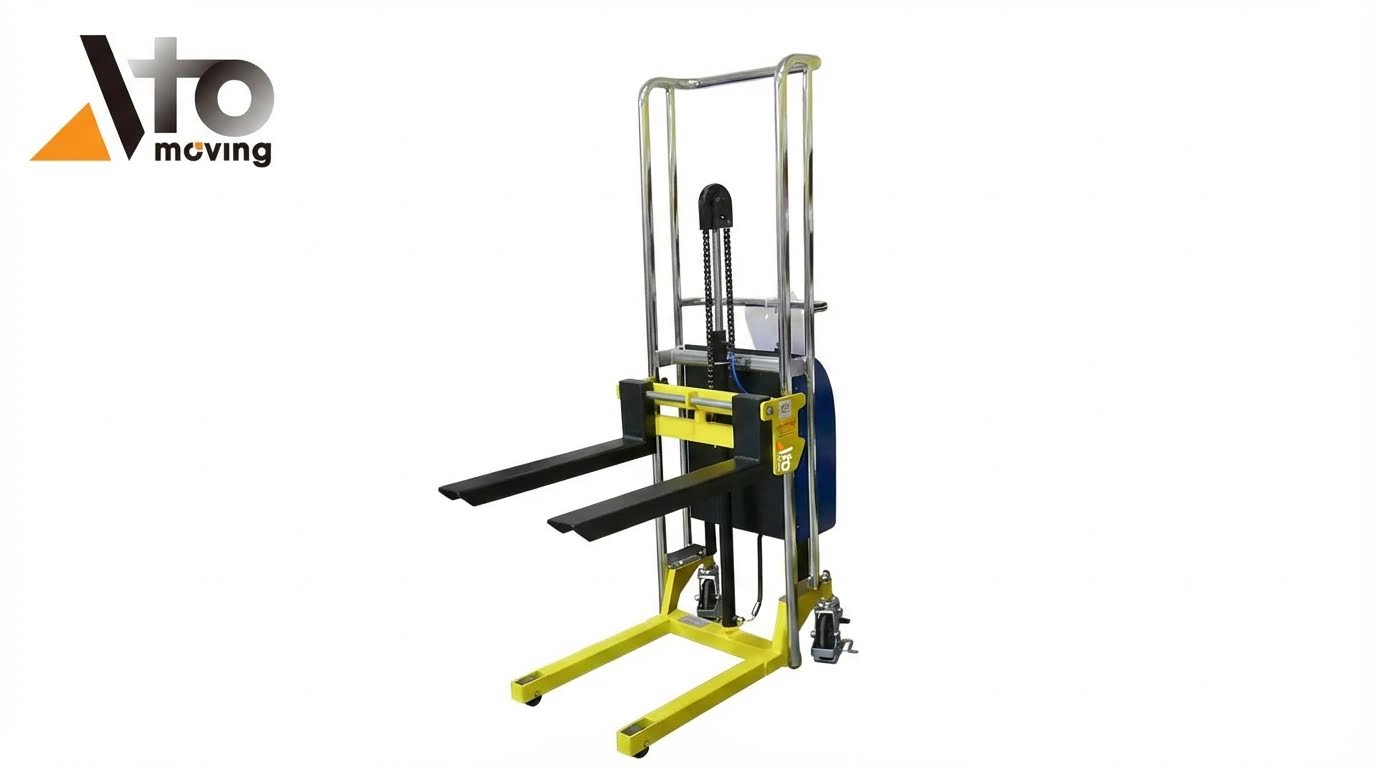
Mast design is the main engineering answer to how high can a counterbalanced stacker lift while still staying stable, efficient, and economical. Simplex, duplex, and triplex masts trade rigidity and capacity against maximum lift height, speed, and maintenance complexity. Choosing correctly means balancing reach requirements with real floor conditions, operator skill, and daily duty cycles.
Simplex, duplex, and triplex mast engineering
Simplex, duplex, and triplex masts are different ways of stacking steel channels and cylinders to reach more height, and each step up in stages increases achievable lift but adds weight, deflection, and parts to maintain. Simplex gives the stiffest feel at low heights, duplex covers most standard racking, and triplex is used when you must reach high-bay levels around 6,000 mm and above. These choices directly control how high can a battery-powered stacker lift in your building.
| Mast Type | Typical Lift Range | Retracted Mast Height (example) | Engineering Characteristics | Best For… |
|---|---|---|---|---|
| Simplex (single stage) | Up to ~1,600–2,500 mm low to medium lift capacity and height ranges | Often close to overall lift height (little free lift) | One solid mast channel, very rigid, minimal chains and rollers, lowest deflection at height. | Dock work, mezzanine feeds, low racks where rigidity and visibility matter more than maximum height. |
| Duplex (2-stage, ZT / ZZ) | About 2,500–4,000 mm, up to ~6,000 mm in many designs mid-height ranges | Moderate: can stay under common door heights while reaching standard racking | Outer fixed channel plus inner moving channel; more chains and rollers; good compromise of reach and stiffness. | Standard warehouse racking, most applications up to top beams around 4,000–5,000 mm. |
| Triplex (3-stage, DZ) | Commonly 4,000–6,000 mm, with some models up to ~7,000–8,000 mm high-reach territory high-reach ranges | Example: ~2,500 mm retracted to reach 6,000 mm lift triplex DZ example | Three nested channels, multiple chain runs and cylinders. Highest reach but more deflection, weight, and complexity. | High-bay storage where top beams exceed 5,000–6,000 mm and building height allows tall retracted masts. |
From an engineering view, each added mast stage increases the effective lever arm between the load and the truck’s support polygon, so capacity must be derated at height to keep within the stability triangle. Simplex masts tend to hold a higher percentage of base capacity at their modest maximum lift, while duplex and especially triplex masts see stronger derating at the top of stroke due to added deflection and higher combined center of gravity. Mast type and height derating must therefore be read from the manufacturer’s capacity chart, not guessed from the base rating plate.
- Simplex mast: Single, rigid section – Minimizes sway and maintenance, ideal when you do not need tall lift but want predictable handling.
- Duplex mast: Two-stage with good free lift – Balances reach and compactness, covering most “how high can a electric platform stacker lift” needs in standard warehouses.
- Triplex mast: Three-stage high-reach design – Enables 6,000 mm+ lift but demands stricter inspection, smoother floors, and disciplined operators.
Why duplex usually feels more “planted” than triplex at the same height
At, say, 4,000 mm, a duplex mast often uses less total steel height above the chassis than a triplex designed for 6,000 mm. That shorter lever arm means lower overturning moment and less deflection for the same load, so the truck feels more stable and responsive in mid-level racks.
💡 Field Engineer’s Note: If operators report “the pallets move a lot up top,” measure floor slope over a 3–5 m run with a straightedge and level. I have seen “only” 10–15 mm of height difference across an aisle be enough to make a triplex mast feel nervous at 5,000 mm.
Stability triangle, floor conditions, and mast deflection
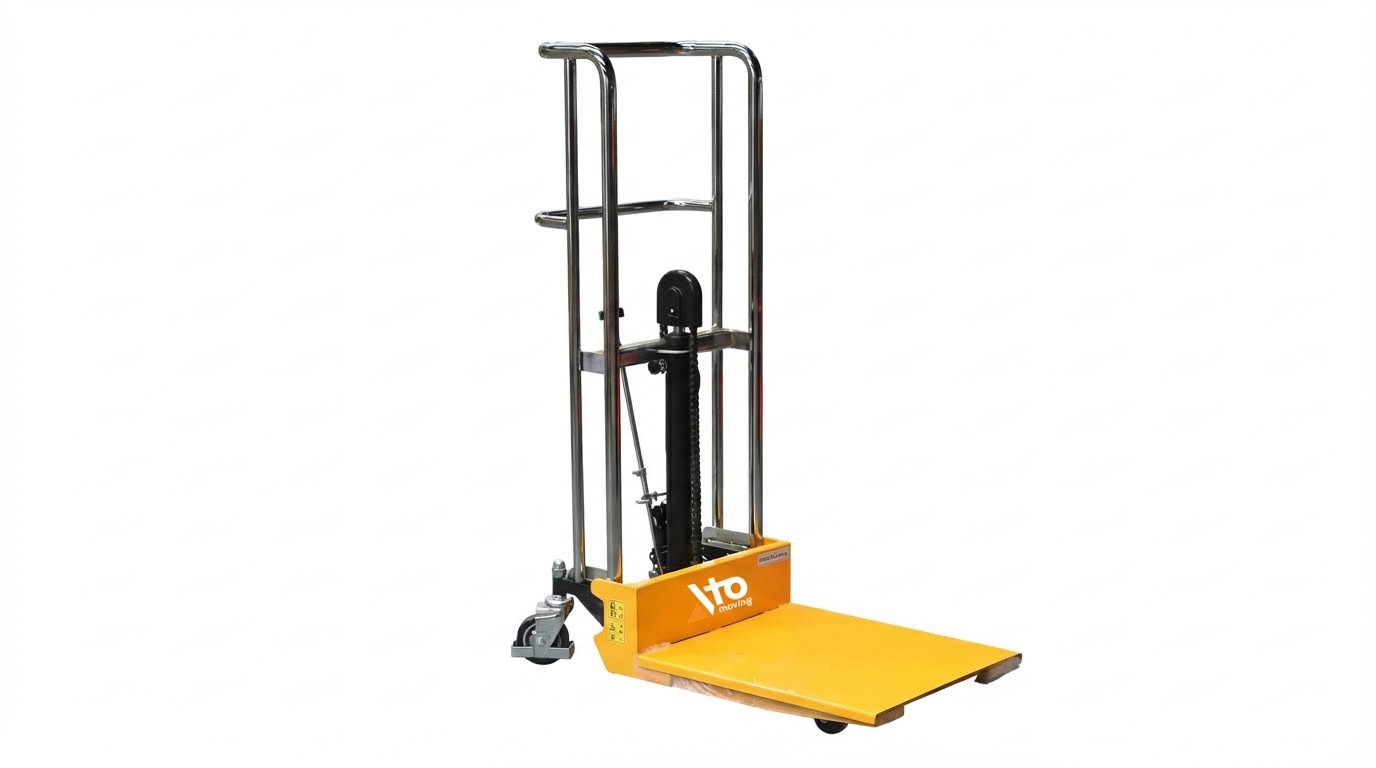
Walkie stacker stability at height depends on the stability triangle, floor quality, and mast deflection, and all three become more critical as you push how high can a manual pallet jack lift. Even a small tilt at floor level turns into a large horizontal shift at 4,000–6,000 mm, which is why capacity drops with height and why uneven floors are a hidden risk.
| Factor | Typical Engineering Reality | Operational Impact on High Lifts |
|---|---|---|
| Stability triangle | Defined by contact points between drive wheel and support legs; the combined center of gravity must stay inside this polygon with rated load at max height stability explanation | As mast extends, the load moves further from the triangle, increasing overturning moment and forcing capacity derating at height. |
| Floor conditions | Designed for flat, solid floors; typical gradeability around 5% loaded and 8% unloaded gradeability limits | Ridges, joints, or slopes tilt the truck. At 4,000–5,400 mm, a few millimeters of wheel rise can shift the load tens of millimeters sideways, cutting your real stability margin. |
| Mast deflection | All masts bend forward under load; duplex generally deflects less than triplex at the same height mast deflection notes | Deflection increases load sway and can cause pallets to contact rack beams. Operators must pause at height to let the mast “settle” before entry or withdrawal. |
| Load center | Typical design load centers 600–610 mm, sometimes up to ~910 mm depending on model load center ranges | Long or overhanging loads push the center of gravity forward, effectively shrinking the stability triangle and reducing safe lift height. |
| Off-center / damaged pallets | Real loads often sit skewed or have damaged boards | Side offset adds a lateral moment. At high lift, this can combine with floor slope to approach the edge of the stability triangle much faster than operators expect. |
- Flat, strong floor: Level, crack-free concrete – Preserves the designed stability margin so the truck can safely use its full rated lift height.
- Good housekeeping: Clear aisles, repaired joints – Prevents sudden wheel drops or climbs that can jerk a tall mast and start load sway.
- Controlled travel with raised loads: Low speed, forks just clear of floor – Reduces dynamic forces so the center of gravity stays well inside the stability triangle.
- Respect derated charts: Use capacity at actual rack height – Prevents overloading a high, extended mast where deflection and leverage are greatest.
How mast choice affects shift runtime
Every high lift cycle on a triplex mast moves more steel and oil than on a simplex or duplex system. Over a full shift with hundreds of lifts, that extra energy draw can noticeably reduce runtime from a 24 V/210 Ah battery compared to a 24 V/375 Ah pack in the same duty. High-bay users should size batteries and chargers for the real lift profile, not just travel distance.
💡 Field Engineer’s Note: When customers complain that “the truck is slow at height,” I check the maintenance history first. Dry chains and worn rollers add more speed loss than the factory’s safety limits. A 30-minute lubrication job often recovers more performance than any setting change.
Lift speed, energy use, and maintenance by mast type
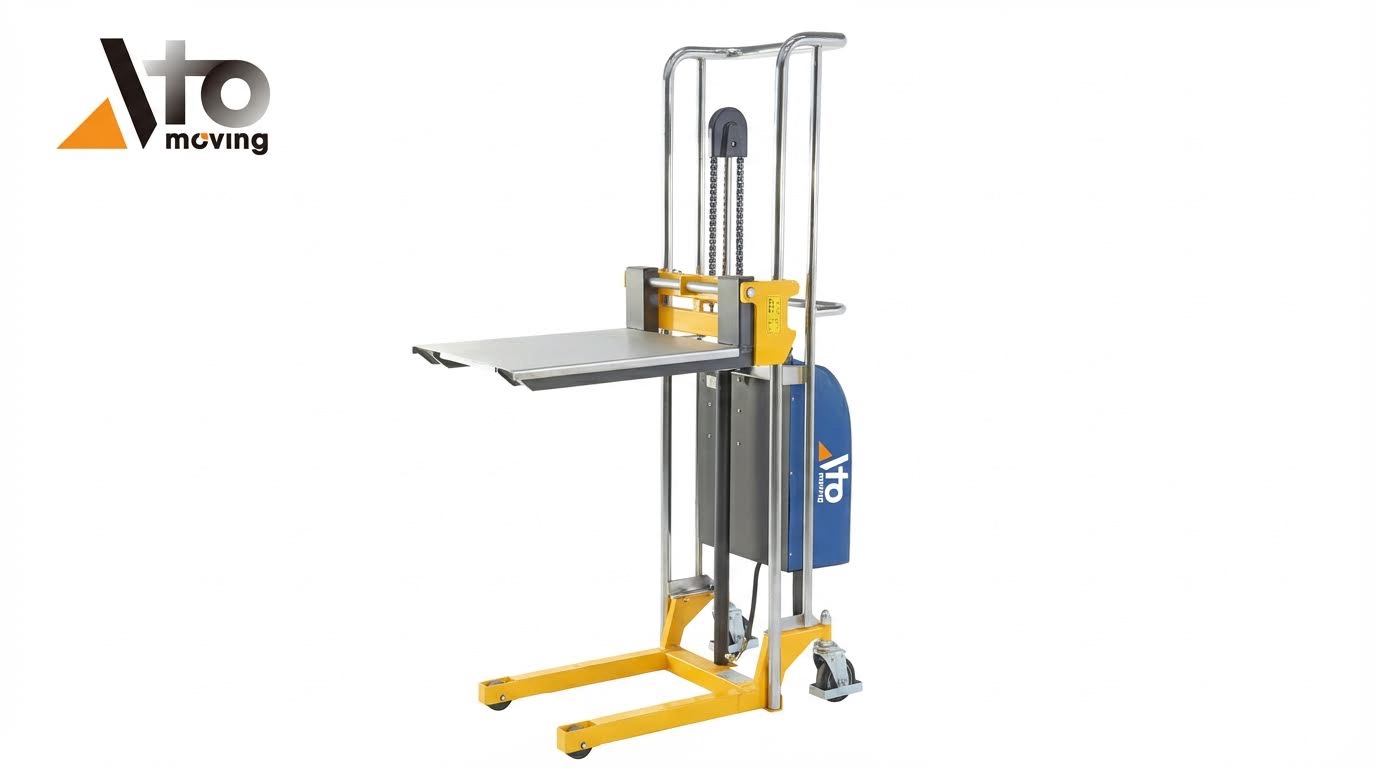
Mast type not only sets how high can a drum dolly lift, it also dictates lift speed, battery draw, and how much time you will spend on maintenance. Higher-stage masts typically lift slower, use more hydraulic energy, and contain more wear parts that need regular inspection and lubrication.
| Mast Type | Typical Lift / Lower Speeds | Energy Use | Maintenance Complexity | Operational Impact |
|---|---|---|---|---|
| Simplex | Representative lift speeds around 0.13 m/s loaded, 0.07 m/s unloaded; lowering about 0.07 m/s loaded, 0.11 m/s unloaded on typical electric stackers lift/lower speed example | Lowest hydraulic work per cycle; less oil flow and pressure peaks. | Fewest rollers, chains, and pivot points; quick inspection and lower parts cost. | Fastest cycles for low lifts, longest battery runtime, and simplest upkeep. |
| Duplex | Similar base speeds but often controlled to slow slightly near top of stroke to limit sway. | Moderate energy demand; more steel mass to move but still efficient for daily warehouse work. | Extra chain runs and rollers; needs regular lubrication and periodic chain stretch checks. | Good compromise: enough height for most racks without a big hit to runtime or service time. |
| Triplex | Often tuned slower at high stages to reduce dynamic loads and mast oscillation speed and mast trade-offs | Highest energy consumption per full-height lift; more hydraulic work and higher battery draw. | Most complex: multiple cylinders, chains, and rollers; sensitive to lubrication, alignment, and seal condition. | Essential for very tall racks but shortens runtime per charge and increases planned maintenance needs. |
- Hydraulic system sizing: Motor, pump, and valves must support peak flow and pressure – Undersized systems slow down under load and overheat oil, reducing component life.
- Battery capacity: Typical walkie stackers use 24 V packs from ~210–375 Ah battery range – High-reach, high-cycle applications should choose the upper end to avoid mid-shift voltage sag.
- Speed reduction at height: Many units automatically cut travel speed when forks are high safety features – This protects the mast from shock loads and keeps the center of gravity more stable.
- Preventive maintenance: Triplex masts need strict chain, roller, and cylinder checks – Skipping these inspections is one of the fastest ways to lose safe capacity at height due to uneven wear and misalignment.
Specifying The Right Lift Height For Your Operation
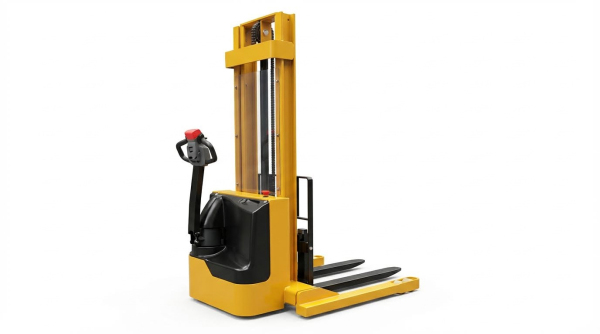
Specifying walkie stacker lift height starts from your rack and aisle geometry, then checks capacity at that height and floor conditions. This is how you turn “how high can a walkie stacker lift” into a safe, efficient spec.
| Key Design Question | Typical Value / Range | What To Check | Operational Impact |
|---|---|---|---|
| Maximum rack beam height | 2,000–6,000 mm common for walkies (medium–high reach ranges) | Measure top beam and pallet overhang | Sets minimum mast height requirement |
| Required mast lift height | Beam height + 150–300 mm clearance (typical engineering allowance) | Add clearance for fork tip and pallet extraction | Prevents hitting beams and fighting stuck pallets |
| Aisle width for right‑angle stacking | Approx. 1,400–1,955 mm + 152 mm safety margin (example spec) | Compare truck’s turning radius and pallet size | Determines if the truck can turn and square to rack |
| Lift height capability by mast type | Up to about 6,000 mm for duplex/triplex masts (example: 6,000 mm triplex) | Match mast family (simplex/duplex/triplex) to beam height | Balances reach versus stability and truck cost |
| Rated capacity at height | Approx. 900–2,000 kg, derated at upper levels (typical range) | Use manufacturer’s capacity chart at your rack height | Ensures the truck can safely lift your heaviest pallet |
| Safety margin on capacity | +10–20% above heaviest expected load (engineering best practice) | Include pallet, packaging, and attachments | Protects against overloads and real‑world variations |
| Floor slope and quality | Up to ~5% grade loaded, 8% unloaded for many designs (typical guidance) | Survey for slopes, joints, and damage | Limits practical safe height, especially with triplex masts |
💡 Field Engineer’s Note: When you push mast height in narrow aisles, tiny steering errors become big side loads at 5,000–6,000 mm. Treat “how high can a walkie stacker lift” as “how high can it stay stable on your actual floor.”
Matching mast height to rack design and aisle width
Matching mast height to rack and aisle layout means sizing the mast to your top beam plus clearance, then checking if the truck can actually turn and square up in the available aisle width.
| Design Element | Typical Numbers | How To Specify | Operational Impact |
|---|---|---|---|
| Rack beam levels | Medium: 2,000–4,000 mm; High: 4,000–5,400 mm+ (typical ranges) | Fix maximum beam height before choosing mast | Defines whether you need simplex, duplex, or triplex |
| Required fork tip height | Beam height + pallet height + 100–150 mm | Allow room to lift pallet cleanly off beams | Reduces rack strikes and jammed pallets |
| Final mast lift height | Beam height + ~150–300 mm clearance (common allowance) | Choose next mast size above this requirement | Ensures you can “float” pallets clear at full height |
| Mast family | Simplex: low; Duplex: up to ~6,000 mm; Triplex: >6,000 mm potential (engineering overview) | Pick the lowest mast type that still reaches | Shorter masts reduce sway and improve stability |
| Truck turning radius | As compact as about 1,812 mm in some models (example) | Compare against aisle width and pallet length | Determines if you can make a clean 90° approach |
| Right‑angle stacking aisle | Approx. 1,400–1,955 mm + 152 mm margin (example spec) | Use manufacturer’s “Ast” (right‑angle stack) value | Avoids shunting and truck damage in tight aisles |
| Building clear height / obstructions | Lights, sprinklers often at 6,000–8,000 mm | Compare lowered and extended mast to building services | Prevents collisions when mast is fully raised |
- Start from the rack, not the truck: Define maximum beam height, pallet height, and required clearances – this locks in the minimum fork height you must achieve.
- Add practical clearance: Add 150–300 mm above the top beam – this gives operators room to “breathe” instead of scraping beams every lift.
- Choose the shallowest mast that works: Prefer duplex over triplex if both reach your top level – stiffer masts sway less and feel more stable to operators.
- Check aisle width with a tape: Measure between upright frames, not column to column – this tells you if the theoretical right‑angle stacking number is realistic.
- Validate building clearances: Compare extended mast height to lights and sprinklers – avoids expensive overhead strikes when you finally use maximum lift.
How to quickly check if your aisles fit the truck
1) Note the truck’s right‑angle stacking aisle requirement (Ast) from the spec sheet. 2) Measure your narrowest working aisle between rack uprights. 3) If your aisle is not at least Ast plus a small safety margin, either reduce rack depth, widen aisles, or choose a more compact truck.
💡 Field Engineer’s Note: In practice, once aisles drop below about 1,800 mm, operators start “cheating” by traveling with the load higher than they should. If you must go that narrow, keep mast heights modest and enforce strict travel‑at‑low‑lift rules.
Safety margins, standards, and site constraints
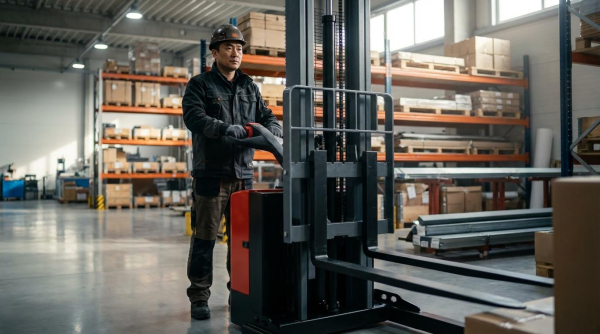
Building in safety margins means oversizing capacity and validating height against standards and floor conditions, so “how high can a walkie stacker lift” stays inside a stable, repeatable operating envelope.
| Safety / Constraint Factor | Typical Guidance / Data | What To Do When Specifying | Operational Impact |
|---|---|---|---|
| Capacity safety margin | Select 10–20% more than heaviest expected load (best practice) | Include pallet, packaging, and any attachments | Reduces overload risk and extends truck life |
| Capacity derating with height | Capacity drops as mast height increases (engineering principle) | Use manufacturer charts at your actual rack height | Prevents assuming floor‑level rating applies at 5,000 mm |
| Load center effects | Example: 1,500 kg at 610 mm may drop to ~1,200 kg at 762 mm (illustrative case) | Measure real pallet length and load overhang | Ensures long or uneven loads remain within safe limits |
| Floor slope and defects | Designed for flat floors; typical grades up to ~5% loaded (guidance) | Survey for ramps, drains, joints, and potholes | May force you to reduce working lift height in problem zones |
| Stability and safety standards | ISO 3691‑5:2014 covers pedestrian industrial trucks and stability checks (standard reference) | Confirm truck documentation lists rated height and limits | Supports compliance and operator training content |
| Truck safety systems | Auto speed reduction at high fork positions, overload detection, braking safeguards (modern features) | Prefer models with height‑dependent speed limiting | Makes high‑bay work more forgiving for operators |
| How high is “too high” for your site | Walkies often work best between 2,000–5,400 mm; up to ~6,000 mm with care (range overview) | Balance desired height against floor quality and aisle width | Avoids specifying height your site cannot safely support |
- Size capacity to your worst‑case pallet: Use the heaviest, longest, and most top‑heavy load as your design case – this prevents surprises when “that one product” goes into the top bay.
- Always verify capacity at height: Ask for the capacity chart at your required lift height and load center – never rely only on the headline kg rating.
- Respect load center limits: Long pallets or overhanging loads move the center forward – this can cut safe capacity by hundreds of kilograms.
- Derate for poor floors: If you have slopes, drains, or broken concrete, treat the theoretical maximum lift as a limit, not a target – run tall lifts only in the flattest zones.
- Leverage built‑in safety logic: Choose trucks with automatic speed reduction and height‑linked controls – these compensate for human error when working near maximum lift.
Final Thoughts On Selecting Walkie Stacker Lift Heights
The safe lift height of a walkie stacker is never just a catalog number. It comes from how mast type, capacity derating, load center, and floor quality interact in your building. Simplex, duplex, and triplex masts each trade rigidity, reach, and maintenance for different height bands. As height increases, leverage and mast deflection grow, so capacity must drop to keep the center of gravity inside the stability triangle.
For operations teams, the best approach is to design from the rack down. Fix your top beam height, add realistic clearance, then choose the lowest mast family that can reach it. Check the manufacturer’s capacity chart at that exact height and load center, and build in at least 10–20% capacity margin over your worst‑case pallet. Walk high loads only on the flattest floors, at low speed, with trained operators.
For engineering teams, treat high‑bay walkie work as an integrated system. Validate floor tolerances, aisle widths, building clear height, and maintenance plans before pushing beyond 5,000–6,000 mm. When in doubt, reduce working height or upgrade to a more suitable Atomoving stacker configuration rather than running at the edge of the charts every shift.
Frequently Asked Questions
How high can a walkie stacker lift?
A walkie stacker can typically lift loads to heights of up to 6100 mm (approximately 6.1 meters). This makes it ideal for storing loads at elevated positions in warehouses with minimal travel distances. For specific applications, certain models like the T-Series walkie reach stacker can handle stacking up to 5.5 meters high with a lift capacity of 1500 kg. Crown Stacker Details.
What is the lifting capacity of a walkie stacker?
The lifting capacity of a walkie stacker generally ranges from 1500 kg to 2500 kg, depending on the model and manufacturer. For instance, some models can lift up to 2500 lbs (approximately 1134 kg) with a maximum lift height of 143 inches (approximately 3.6 meters). Toyota Walkie Stacker Spec.