If you are asking how much can a pallet jack lift, this guide explains the real safe limits by design, load geometry, and floor conditions. You will see how capacity ratings translate into everyday decisions: which jack to buy, what weight to move, and when to say “no” for safety.
Understanding Pallet Jack Capacity Ratings
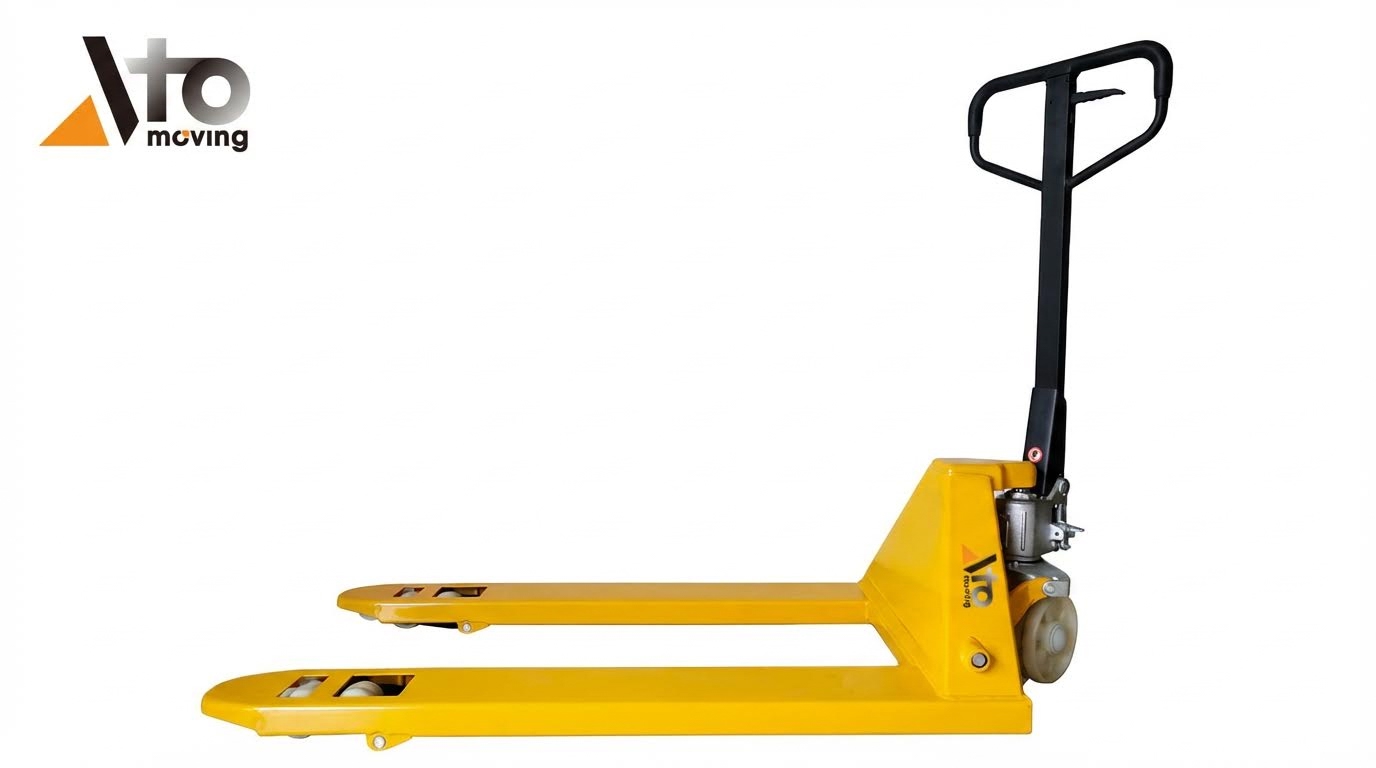
Pallet jack capacity ratings define the maximum safe load the truck can handle under specific geometry and floor conditions, and they are the only reliable answer to “how much can a pallet jack lift” in your facility.
When you ask how much can a pallet jack lift, the correct response is always its rated capacity from the manufacturer, never a guess or “rule of thumb.” Manual warehouse pallet jacks usually fall between 2,000 kg and 3,000 kg, with narrow or light-duty models closer to 1,400–2,000 kg. Electric pallet jacks often match or exceed these ratings, but their real-world safe capacity depends heavily on battery state, gradients, and travel speed, so operators must treat the published rating as an absolute ceiling, not a target. Industry guidance stresses that overloading accelerates wear and increases tipping risk.
💡 Field Engineer’s Note: In busy docks I always spec at least a 20–30% capacity buffer above the heaviest real load; this compensates for wet floors, slight slopes, and mis-stacked pallets that shift the center of gravity off the forks.
Typical capacity ranges by pallet jack type
Typical pallet jack capacity ranges vary by type, with manual models clustered around 2,000–3,000 kg and electric units extending higher for intensive duty cycles.
The table below converts common imperial ratings into metric and links them to practical use cases, so you can quickly map “how much can a pallet jack lift” to your own loads and aisles.
| Pallet Jack Type | Typical Rated Capacity (kg) | Typical Rated Capacity (lbs) | Operational Impact / Best For… |
|---|---|---|---|
| Standard manual pallet jack | 2,000–3,000 kg | ≈4,400–6,600 lbs (often sold as 4,500–5,500 lbs) | General warehouse pallets up to ~1.2 m × 1.0 m; suitable for most indoor freight moves. |
| Narrow / specialty manual jack | 1,400–2,000 kg | ≈3,000–4,400 lbs | Smaller pallets or tight aisles where fork width is limited; lighter mixed freight. |
| Electric walkie pallet jack (typical) | 2,000–3,600 kg | ≈4,500–8,000 lbs | Higher throughput, longer runs, and mild ramps; reduces operator fatigue in multi-shift work. Typical ranges |
| Heavy-duty electric pallet jack | Up to and above 3,600 kg | 8,000 lbs and higher | High-density loads, dock-to-truck shuttling, and continuous operation in large DCs. |
Manual pallet jacks in the 2,000–3,000 kg band cover the majority of standard palletized loads in retail and manufacturing warehouses. Special narrow units trade capacity for compact geometry, which is acceptable only if your heaviest pallets remain well below the lower rating.
Electric pallet jacks often advertise 4,500–8,000 lb (≈2,000–3,600 kg) ratings, but their effective safe capacity can drop when batteries are low, floors are uneven, or operators run on slopes at speed. Comparative data show that electrics are best used where duty cycle, not just peak weight, drives the specification.
How to use these ranges for quick sizing
List your heaviest pallet (kg), add at least 20% margin, then choose a jack family whose lower rating still exceeds that number. If your heaviest pallet is 1,200 kg, a 2,000 kg manual jack is acceptable; if it is 2,500 kg, move to a higher-capacity manual or an electric model.
Load center, fork length, and stability basics
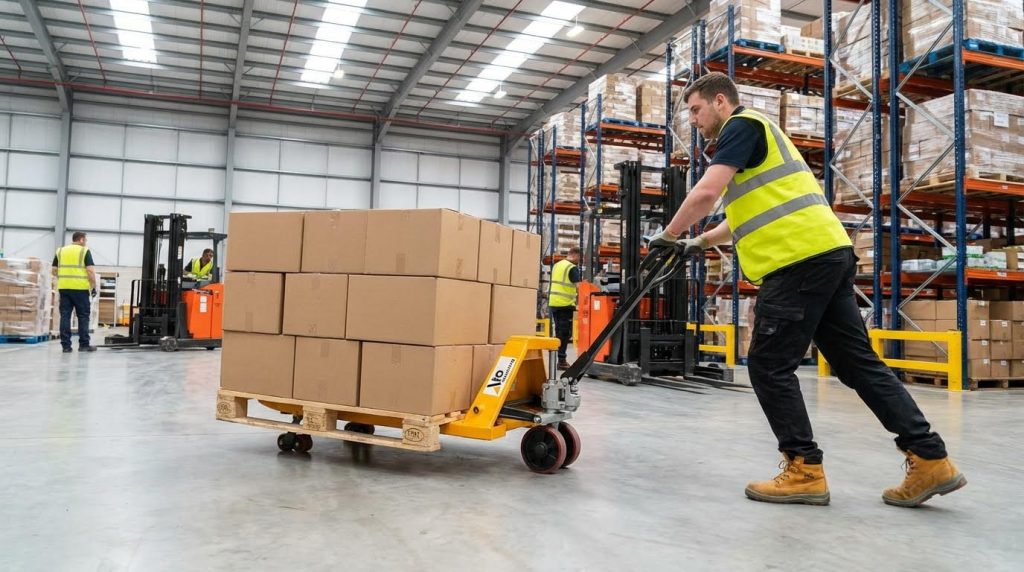
Load center, fork length, and stability define whether a pallet jack can safely carry its rated capacity, because they control where the combined center of gravity sits relative to the wheelbase.
Rated capacity assumes a specific load center, usually at the geometric center of a standard pallet resting fully on the forks. If the load is longer, poorly centered, or not fully supported, the real load center shifts forward or sideways. This moves the combined center of gravity closer to the support polygon edges defined by the wheels, shrinking the tipping margin during turns, braking, or travel over floor defects. Engineering guidance notes that stable, evenly distributed loads with the heaviest portion over the front wheels are essential.
- Load center distance: Half the pallet length measured from the fork heel – Controls leverage on forks and wheels.
- Fork length: Must fully support the pallet footprint – Short forks increase bending and pallet break risk.
- Support polygon: Triangle/rectangle formed by wheels – Center of gravity must stay well inside to avoid tipping.
- Lift height: About 25 mm for travel – Keeps center of gravity low while clearing floor irregularities.
- Load distribution: Even across both forks – Prevents twisting and uneven wheel loading.
Safe practice requires full fork insertion before lifting. Partial insertion increases fork bending stress and concentrates load on a small pallet area, which can cause sudden pallet failure. Best-practice recommendations also advise lifting only about 25 mm above the floor so any failure results in a short drop and the center of gravity stays as low as possible.
Operators should stack and wrap loads so the heaviest items sit low and near the fork tips, with tight stacking patterns and banding or stretch wrap to prevent shifting. If the load can move relative to the pallet during braking or turning, the effective center of gravity can jump suddenly toward the polygon edge, which is a common cause of near-miss tip events. Stability management guidance emphasizes keeping the combined center of gravity directly over the load wheels wherever possible.
What happens if you overload or mis-load?
Overloading increases stress on forks, axles, wheels, and hydraulics, leading to cracks, seal damage, or sudden loss of lift. From a stability angle, the heavier mass pushes the center of gravity toward the wheelbase edge, so a small bump, turn, or slope can trigger tipping. Documented effects of overloading show that even short-term overloads dramatically shorten component life.
Engineering Factors That Define Safe Load Limits
Safe pallet jack capacity is defined by engineering limits on structure, hydraulics, stability, and floor conditions, not just by “how much can a pallet jack lift” on the spec sheet.
Most buyers ask how much can a pallet jack lift, but engineers ask under what conditions that load stays safe. Capacity ratings assume specific load positions, floor quality, and equipment condition, and you must reduce them whenever those assumptions are not met.
| Factor | What It Controls | Typical Effect on Safe Capacity | Operational Impact |
|---|---|---|---|
| Nameplate rating | Absolute upper load limit on level, specified conditions | Manual: about 2,000–3,000 kg standard; specialty units lower | Defines the “never exceed” answer to how much can a pallet jack lift |
| Load center & fork length | Lever arm and tipping margin | Long or off‑center loads effectively reduce stability | Long pallets or overhangs can tip or overload forks at same weight |
| Hydraulic system | Lift force and holding ability | Overload accelerates seal wear and risk of sudden drop | Unit may refuse to lift or slowly sink under excessive weight |
| Forks & frame | Structural strength and deflection | Repeated overload leads to permanent bending or cracking | Reduced clearance, poor pallet entry, risk of fork fracture |
| Wheels & axles | Rolling resistance and point loading | Overload flattens wheels and stresses axles | Hard pushing, floor damage, and potential wheel failure |
| Floor & slopes | Traction and stability window | Ramps and rough floors require derating | Loads that feel “okay” on flat may be unsafe on even small slopes |
| Travel speed | Dynamic forces during braking/turning | Higher speed amplifies tipping and impact loads | Electric jacks at full speed need more safety margin than walking pace |
💡 Field Engineer’s Note: When a site “never has tipping issues,” I walk the ramps with a loaded jack. Anything above about a 2–3% slope with heavy loads quickly exposes marginal brakes, worn wheels, and overconfident capacity assumptions.
Nameplates, Manuals, and Conditional Derating
Nameplates and manuals give the only reliable answer to how much can a pallet jack lift safely in your conditions.
- Nameplate rating: The capacity label shows the maximum rated load, sometimes tied to a specific load center or fork length. Treat this as a hard ceiling, not a target weight. Source
- Manual clarification: The user manual explains conditional limits such as reduced capacity on slopes or with elevated forks. This is where derating rules and “do not use on ramps above X%” live. Reference
- Correct identification: The identification plate must match the actual unit configuration. Swapped handles, rebuilt pumps, or modified forks make old labels unreliable. Guidance
- Missing or illegible labels: When capacity labels are unreadable, best practice is to tag the jack out of service until proper documentation is restored. Operating “blind” on capacity removes your engineering safety margin. Safety guidance
How to use nameplate data in everyday planning
Start by treating the nameplate capacity as valid only on level, smooth floors, with fully inserted forks and a compact, evenly distributed load. Any deviation (ramps, long loads, damaged pallets, poor floors) should trigger a conservative derating. For example, if your standard manual jack is rated around 2,500–3,000 kg, keep real-world loads closer to 1,800–2,000 kg when running up short ramps or in congested areas where hard braking is common.
Overloading Effects on Hydraulics, Forks, and Wheels
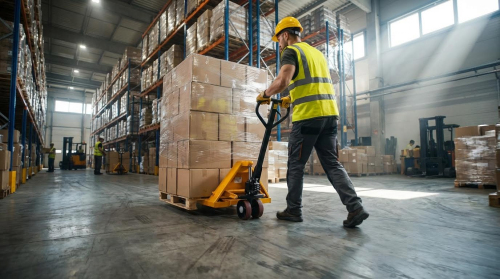
Overloading does not just exceed how much can a pallet jack lift; it accelerates hidden damage in hydraulics, forks, and wheels until a “sudden” failure appears.
- Hydraulic overload: Too much mass increases internal pressure, damaging seals and causing internal leakage or sudden loss of lift. Loads may creep down or fail to rise smoothly. Hydraulic risks
- Fork bending and fracture: Excess weight and poor fork insertion increase bending moment at the fork heel. Repeated overload leads to permanent sagging and, in extreme cases, cracking. Structural effects
- Wheel and axle stress: Overloading flattens polyurethane or nylon wheels and stresses axles and bearings. Operators feel this as high push force, vibration, and noisy travel before outright failure. Wheel care
- Center of gravity shift: Heavy, high, or uneven loads move the combined center of gravity toward the wheel triangle edges. This shrinks your margin against tipping when turning, braking, or crossing floor joints. Stability analysis
- Load planning: Best practice is to center the heaviest portion of the load over the front wheels, with weight evenly spread across both forks and the pallet. This maximizes stability and reduces bending stress. Planning guidance
- Fork insertion & travel height: Full fork insertion and lifting only about 25 mm above the floor for travel reduce bending and drop risk. Low travel height keeps the center of gravity low and limits impact if something fails. Fork usage
| Overload Symptom | Likely Root Cause | Risk if Ignored | Best Response |
|---|---|---|---|
| Jack slowly sinks under load | Hydraulic seal wear or internal leakage from repeated high loads | Unexpected drop during travel or loading | Tag out, inspect hydraulics, verify against rated capacity |
| Forks visibly “smile” (sag) under load | Chronic overloading or partial fork insertion | Pallet damage, reduced clearance, potential fork crack | Reduce load, inspect fork thickness and straightness |
| Flat spots on load wheels | Overweight loads parked in one spot, or impacts | Hard pushing, vibration, floor damage | Replace wheels, enforce load limits, avoid curbs/steps |
| Jack will not lift published capacity | Wear in pump, air in hydraulic system, or mis-set lowering valve | Operators “force” equipment or improvise unsafe methods | Service hydraulics, bleed air, check valve settings |
💡 Field Engineer’s Note: When operators complain “this jack is weak,” I weigh a typical pallet. In many plants, the problem is not the hydraulics; it is that real pallet weights quietly crept 15–25% above the original design assumption.
Floor Conditions, Slopes, and Travel Speed Constraints
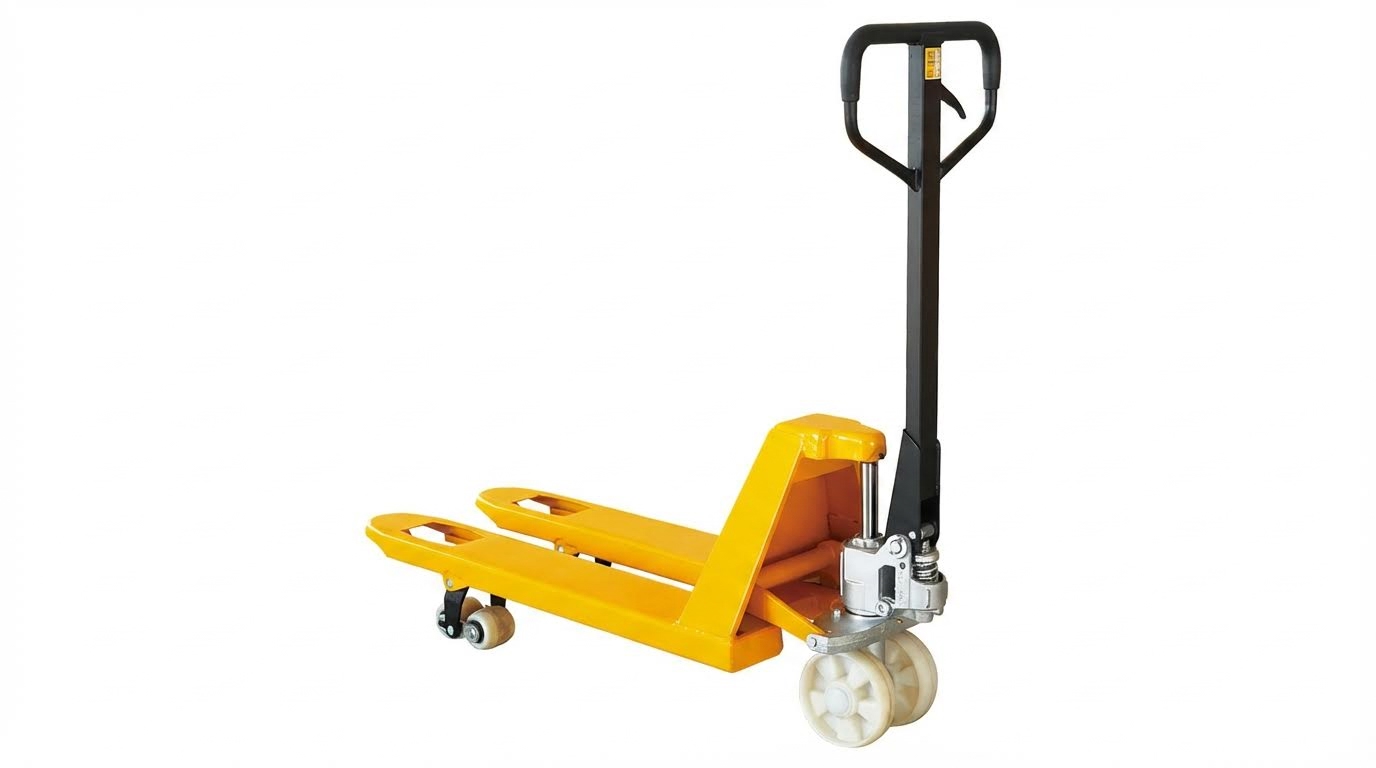
Floor quality, gradients, and speed determine whether the rated capacity is realistic or dangerously optimistic for how much a pallet jack can lift in motion.
- Floor flatness and friction: Rough or uneven floors introduce dynamic shocks and rocking that reduce stability. Each bump effectively multiplies the load on forks, wheels, and operator.
- Ramps and slopes: Manuals often specify reduced capacity or outright bans on certain gradients, especially for electric jacks. Gravity adds to the effective load on the hydraulic system and brakes. Slope limits
- Travel speed: Manual pallet jacks move at walking speed, but electric models run faster, which increases dynamic forces in braking and turning. Higher speed means you must keep a bigger buffer below rated capacity. Speed comparison
- Load security: Loose or poorly wrapped loads can shift when crossing thresholds or expansion joints. Even if total mass is within capacity, a sudden shift can push the center of gravity outside the wheelbase. Load securing
| Condition | Effect on Safe Capacity | Operational Impact |
|---|---|---|
| Smooth, level, indoor floor | Closest to full nameplate rating | Standard warehouse assumption for capacity labels |
| Short ramp or dock plate | Requires conservative derating | Heavier pallets may need powered jacks or forklifts |
| Cracked, uneven, or outdoor surfaces | Significantly reduced safe load and speed | Higher risk of wheel failure and tipping; consider different equipment |
| High-speed electric travel | Dynamic loads approach structural limits faster | Enforce lower load limits and speed in congested zones |
Practical rules of thumb for slopes and speed
On any noticeable slope, keep the heaviest loads for powered pallet jacks with good brakes and traction, and stay well below the published maximum capacity. Slow down before floor joints, dock plates, or doorway thresholds, especially with tall or shrink-wrapped loads. For electric pallet jacks, use lower-speed modes in tight aisles so dynamic forces do not erase the safety margin built into your capacity planning.
💡 Field Engineer’s Note: I treat every ramp and dock plate as a “multiplier” on real load. A 1,800 kg pallet on a steep, worn ramp can stress a pallet jack as much as a 2,200–2,400 kg load on a clean, level floor—and operators feel the difference in their shoulders and stopping distance.
Matching Pallet Jack Capacity To Your Application
This section explains how to choose manual pallet jack type and capacity for your workload, so “how much can a pallet jack lift” matches your real pallets, shifts, and floor conditions.
Before anything else, translate “how much can a pallet jack lift” into your own numbers: load weight range, pallets per hour, shift length, aisle width, and floor quality. Only then does the rated capacity on the nameplate make sense in your operation. Manual and electric pallet jacks can both handle typical warehouse loads, but they behave very differently across light, medium, and heavy duty cycles.
| Selection Factor | Typical Range / Option | Operational Impact |
|---|---|---|
| Typical load weight | Up to 1,400–3,000 kg | Defines minimum rated capacity; higher peaks may require electric units for safety margin. |
| Pallets moved per hour | 10–30 (manual), 30–70 (electric) | Higher throughput quickly favors powered jacks to reduce fatigue and injuries. |
| Daily operating hours | 1–3 hours (manual), 4–24 hours (electric with battery rotation) | Longer hours increase fatigue and justify electric drive. |
| Aisle width | ≈1.8 m (manual), ≈2.2 m (electric) | Very narrow aisles may still favor compact manual units. |
| Floor & ramps | Smooth, level vs. ramps/rough | Ramps and rough floors strongly favor powered traction. |
| Environment | Ambient, cold store, wet | Cold or wet conditions affect hydraulics and batteries; may need specialized electric options. |
💡 Field Engineer’s Note: When duty cycles grow, the practical limit is rarely “how much can a pallet jack lift” on paper; it is how much an operator can move per shift without fatigue, strain injuries, or unsafe shortcuts.
Manual vs. electric jacks for different duty cycles
Manual pallet jack fit low-volume, short-distance work, while electric pallet jacks dominate medium to heavy duty cycles where throughput and ergonomics matter most.
Both manual and electric models often advertise similar headline capacities, so “how much can a pallet jack lift” is not the only deciding factor. Manual pallet jacks commonly carry around 2,000–3,000 kg for standard models, with narrower or specialty units dropping into the 1,400–2,000 kg band according to capacity guidance. Powered pallet jacks typically match or exceed these numbers, but their effective safe capacity depends heavily on battery condition, floor gradients, and travel speed.
| Aspect | Manual Pallet Jack | Electric Pallet Jack | Best For… |
|---|---|---|---|
| Typical rated capacity | Approx. 2,000–3,000 kg (some 1,400–2,000 kg narrow units) capacity ranges | Comparable or higher; often 2,000–3,600+ kg depending on model load capacity comparison | Loads in the 1,000–2,000 kg band (manual) vs. repeated 2,000–3,000 kg loads (electric). |
| Operator effort | Human pushing, pulling, and pumping; fatigue rises quickly over distance or slopes. | Powered traction and lift; minimal physical strain. | Manual: short moves; Electric: long runs or heavy gradients. |
| Throughput | Roughly up to 30 pallets/hour in typical use productivity data | About 60–70 pallets/hour with trained operators productivity data | Manual: low-volume tasks; Electric: high-volume cross-docking or shipping. |
| Fatigue & injury risk | Higher; repetitive pulling and pushing increases strain and MSD risk ergonomic comparison | Lower; ergonomic controls can reduce injuries by up to 40% injury reduction data | Manual: occasional use; Electric: continuous multi-shift operations. |
| Aisle suitability | Maneuverable down to about 1.8 m aisles narrow aisle data | Optimized around 2.2 m aisles narrow aisle data | Manual: cramped retail backrooms; Electric: standard warehouse aisles. |
| Environment | Works well on smooth indoor floors and slight ramps; not ideal outdoors environmental adaptability | Handles more demanding conditions, ramps, and cold storage with suitable options environmental adaptability | Manual: small shops; Electric: distribution centers and docks. |
| Maintenance complexity | Low; mainly wheels, grease, and hydraulic oil checks maintenance comparison | Higher; includes battery, motors, and electrical systems maintenance comparison | Manual: sites with minimal technical support; Electric: sites with maintenance programs. |
- Light duty (occasional moves): Choose a manual pallet jack rated at or above your heaviest pallet – minimal capital cost and simple maintenance.
- Medium duty (regular daily moves): Consider a small electric jack where operators report fatigue – cuts strain while keeping capacity similar.
- Heavy duty (continuous flow): Use electric jacks with capacity headroom and strong batteries – supports high pallets/hour without overloading people or equipment.
How much can a pallet jack lift in real use vs. the nameplate?
The nameplate rating is an absolute upper limit under ideal conditions. In practice, slopes, rough floors, worn wheels, and tired operators reduce what you can safely move, especially with manual jacks. Treat the rated capacity as a ceiling, then apply your own derating for gradients and poor floors.
Battery technology, telematics, and TCO considerations
Battery type and telematics decide whether an electric pallet jack’s higher purchase price pays back through uptime, safety, and lower cost per pallet moved.
For electric units, the answer to “how much can a pallet jack lift” safely over a full shift depends on how well the battery supports traction and lift systems. Operators must verify state of charge, connector integrity, and cable condition before use, since low voltage reduces performance and may compromise safety systems daily battery checks guidance. Modern fleets choose between lead-acid and lithium-ion batteries, each with distinct charging and maintenance profiles.
| Battery / Technology | Key Characteristics | Operational Impact | Best For… |
|---|---|---|---|
| Lead-acid battery | Needs daily maintenance and 6–8 hour charge windows battery technology comparison | Requires planned charging breaks and watering; misuse shortens life and reduces effective capacity. | Single-shift or two-shift sites with existing charging rooms. |
| Lithium-ion battery | Higher efficiency, 3–4× life, 2–3 hour fast charging, no daily maintenance battery technology comparison | Supports opportunity charging and near-continuous operation; stable voltage keeps lift performance consistent. | High-throughput DCs and multi-shift operations. |
| Cold storage options | Electric jacks in cold rooms need rated enclosures and insulated batteries cold storage performance | Prevents condensation damage and voltage drops; keeps jacks lifting reliably below 0°C. | Freezers and chilled warehouses. |
| Telematics modules | Capture hours, travel distance, impacts, and overload events telematics and analytics | Highlight misuse and overloads that shorten jack life; support targeted training and maintenance. | Fleets with many trucks and multiple shifts. |
| Digital twins & analytics | Model wear based on loads, floor conditions, and operator behavior predictive analytics | Enable condition-based maintenance and early intervention before failures or safety incidents. | Large, data-driven operations optimizing lifecycle cost. |
- Battery care: Keep charge levels healthy and connectors clean – maintains lift speed and traction so the truck can safely handle its rated load.
- Charging strategy: Align charge windows with breaks and shift changes – prevents mid-shift power dips that tempt operators to overload remaining trucks.
- Telematics use: Monitor overload alarms and impact events – identifies where “how much can a pallet jack lift” is being exceeded in practice.
- Maintenance planning: Use logged hours and load profiles to schedule service – keeps hydraulics, wheels, and electrics within safe performance bands.
Total Cost of Ownership (TCO) is where electric pallet jacks often win despite higher purchase cost. Manual jacks have low upfront price and minimal ongoing spend, which suits small sites with low pallet counts TCO comparison. Electric jacks, however, can double pallet handling rate and cut injury risk, delivering estimated annual labor savings per operator and typical payback in around 5–8 months in high-frequency applications
Final Thoughts On Specifying Safe Pallet Jack Capacity
Safe pallet jack capacity is never just a number on the nameplate. It depends on load geometry, floor quality, equipment condition, and operator behavior working together. When you respect these limits, the jack, pallet, and floor act as one stable system.
Engineering rules about load center, fork length, and support polygon protect you from silent failure modes. If you stretch pallets past the forks, run on rough ramps, or ignore sinking hydraulics, you trade that safety margin for short-term convenience. Over time, seals, forks, and wheels record every overload and eventually fail without much warning.
Operations teams should start with measured pallet weights, real slopes, and true duty cycles, then select manual or electric jacks with at least 20–30% capacity headroom. Treat nameplate ratings as hard ceilings, then derate for ramps, poor floors, tall stacks, and tired batteries. Choose battery and telematics options that keep electric units within their safe performance window and flag misuse early.
The most reliable approach is simple: buy pallet jacks sized for your worst credible case, not your average load; train operators on geometry and floors, not just controls; and enforce tag-out rules when labels, hydraulics, or wheels look suspect. That is how Atomoving fleets keep capacity ratings aligned with real-world safety.
Frequently Asked Questions
How much weight can a pallet jack lift?
A standard pallet jack typically has a lifting capacity ranging from 5,000 to 5,500 pounds (approximately 2,268 to 2,495 kilograms). However, the exact capacity depends on the model and manufacturer. For more details, you can refer to this Pallet Jack Weight Guide.
Can a pallet jack lift a car?
Technically, a pallet jack can lift objects as heavy as a car if its weight is within the jack’s capacity. However, pallet jacks are not designed for such tasks and should not be used to lift cars due to safety risks and potential damage to both the jack and the vehicle. For more information, see this Forklift vs. Pallet Jack Guide.