Knowing how to load a truck with pallets safely is about balancing physics, regulations, and real‑world warehouse constraints. This guide walks through pallet patterns, truck limits, and forklift practices so you can maximize space without compromising worker safety or legal compliance.
Core Principles Of Safe Palletized Truck Loading
Core principles of safe palletized truck loading combine pallet selection, load layout, and truck limits so you can maximize space without breaching safety or legal requirements when deciding how to load a truck with pallets.
- Start with the load: Define mass per pallet, fragility, and stability – this sets your pallet type and stacking limits.
- Respect the truck: Know internal dimensions and axle limits – this prevents overloads and improves handling.
- Control movement: Use wrapping, blocking, and tie-downs – this keeps pallets from shifting under braking and cornering.
- Protect workers: Plan access, visibility, and equipment paths – this reduces forklift and manual handling incidents.
Why “principles” matter before patterns
Loading patterns, cube utilization, and routing software only work safely if you first respect pallet ratings, truck geometry, and worker limits. Skipping these basics often leads to broken product, damaged equipment, and regulatory problems.
💡 Field Engineer’s Note: When troubleshooting recurring damage, I start with three drawings: pallet footprint and stack, truck cross‑section, and side view with axle positions. Most issues reveal themselves before you ever touch a forklift.
Matching pallet design to load and route
Matching pallet design to load and route means choosing pallet type, size, and stacking approach that safely carries the mass and survives every handling step from warehouse to final delivery.
- Define load mass per pallet: Total product + packaging + pallet – this drives pallet strength and stacking height.
- Check product stiffness: Soft bags vs. rigid cartons – determines whether you can stack high or must keep to low tiers.
- Consider route roughness: Short urban trip vs. long mixed roads – rough routes need stiffer pallets and stronger wrapping.
- Count handling cycles: Direct full‑truck vs. multi‑stop LTL – more touch points demand more robust, square stacks.
Three main pallet materials dominate: wood, plastic, and metal, each with distinct behavior under load and during transport.
| Pallet Type | Typical Strength & Behavior | Best Use Cases | Operational Impact |
|---|---|---|---|
| Wood | High strength, variable stiffness, repairable | General freight, mixed warehouses | Cost‑effective; check for broken boards before loading to avoid collapse. |
| Plastic | Consistent stiffness, lighter mass, good hygiene | Food, pharma, closed loops | Reduces tare mass; may need friction aids when mixed with wood to prevent sliding. |
| Metal | Very high strength and durability | Heavy machinery, dense loads | Often used at bottom of stacks; higher center of gravity needs conservative stacking. |
Common pallet footprints worldwide
Common footprints include roughly 1,200 mm × 1,000 mm and 1,100 mm × 1,100 mm in many regions, and about 1,219 mm × 1,016 mm in North America. Always confirm your customer’s preferred size before designing standard patterns.
- Static vs. dynamic loading: Static is “sitting in the warehouse,” dynamic is “on a truck or forklift” – dynamic ratings are lower and govern how to load a truck with pallets safely.
- Stacking on pallets: Heavier cartons low and central – this keeps the center of gravity low and reduces tipping risk.
- Overhang control: Keep product within pallet edges – overhang is a major cause of corner crush and edge damage during transport.
- Wrapping as structure: Stretch wrap should tie the load to the pallet deck – this turns many boxes into one stable unit.
💡 Field Engineer’s Note: If you regularly see leaning stacks, check pallet stiffness and wrap pattern before blaming forklift drivers. A slightly stiffer pallet or one extra full‑height wrap pass often fixes the problem.
Understanding truck geometry and axle constraints

Understanding truck geometry and axle constraints means fitting pallets inside the usable box while keeping axle loads balanced and within legal limits for every trip.
For space planning, focus on three internal dimensions: usable length, width between restraints, and clear height under the roof or load bars.
- Internal length: Governs how many pallet positions you can fit in single or double rows – critical for full truckload optimization.
- Internal width: Determines if you can run “pinwheeled” or side‑by‑side pallets – impacts both capacity and stability.
- Clear height: Limits stack height and total load mass per pallet – prevents contact with roof bows and lights.
Typical pallet counts per truck (rule‑of‑thumb)
Small rigid trucks may carry around 6–8 pallets of about 1,100 mm × 1,100 mm, while full‑size trailers can carry roughly 20–30, depending on orientation and whether you double‑stack. Always verify with actual internal dimensions, not brochure numbers.
| Geometry / Limit | What It Controls | Operational Impact |
|---|---|---|
| Distance from kingpin to rear axle group | Axle load split front‑to‑rear | Heavy pallets too far back overload rear axles and reduce steering traction. |
| Axle group legal mass | Maximum allowable load per axle set | Requires placing heaviest pallets near trailer center, not at doors. |
| Door opening width/height | Max pallet and stack size that can enter | High stacks that fit inside may still hit the door frame when loading. |
| Floor rating | Point load and line load limits | Concentrated heavy pallets need spreader boards to avoid floor damage. |
Axle constraints are as important as total gross mass. A truck can be under its maximum gross weight but still illegal or unsafe if too much mass sits on one axle group.
- Balance front to rear: Keep dense pallets near the trailer’s longitudinal center – this improves steering and braking.
- Avoid tail‑heavy layouts: Loading heavy pallets at the rear doors increases swing and risk of jack‑knife under braking.
- Symmetry across width: Match left and right pallet masses – prevents roll instability and uneven tire wear.
Quick check before dispatch
Count pallets by row, estimate mass per pallet, and sketch their positions along the trailer length. If one axle group carries clearly more than the others, adjust by moving the heaviest pallets closer to the center before sealing the doors.
💡 Field Engineer’s Note: When drivers complain that a trailer “snakes” at speed, I almost always find a tail‑heavy load. Sliding the rear pallet row forward by 500–1,000 mm often calms the vehicle without changing total mass.
Engineering Safe, Space‑Efficient Loading Patterns
Engineering safe, space‑efficient loading patterns means arranging pallets so you fill the truck volume while keeping every pallet stable, accessible, and within axle and handling limits. This section turns “how to load a truck with pallets” into practical patterns you can repeat.
Good patterns respect three things at once: pallet and carton geometry, center of gravity behavior in motion, and how your securement system actually works in a real truck or trailer.
Common pallet patterns and orientation choices
Common pallet patterns and orientation choices are repeatable ways to position pallets so you maximize count per trip without creating handling or stability problems. The right pattern depends on trailer width/length, pallet size, and how the freight will be handled at each stop.
When you plan how to load a truck with pallets, start by standardizing 1–2 patterns per vehicle type and training operators to recognize when each one applies.
- Pattern: Straight (all pallets aligned) – Detail: Pallets all “square” to the trailer, same orientation – Practical Benefit: Fast to load, easy to count, ideal for uniform freight and full truckloads.
- Pattern: Turned (alternating 90°) – Detail: Every second pallet rotated 90° to interlock – Practical Benefit: Can gain 1–2 extra pallets in some trailers and improve side‑to‑side stability.
- Pattern: Pin‑wheeled at rear – Detail: First row at the doors uses rotated pallets to close gaps – Practical Benefit: Reduces voids at the rear, improving restraint under braking.
- Pattern: “Tight‑fit” wall‑to‑wall – Detail: Pallets placed with minimal side gaps to trailer walls – Practical Benefit: Uses friction and side contact to resist lateral shift in turns.
- Pattern: Mixed‑depth rows – Detail: Some rows 2‑deep, some 3‑deep, depending on pallet length – Practical Benefit: Helps use odd trailer lengths while keeping an even front‑to‑back weight spread.
- Orientation Choice: Long side to doors – Detail: Pallet stringers parallel to trailer length – Practical Benefit: Often allows more pallets per row, but can reduce fork entry options at delivery.
- Orientation Choice: Short side to doors – Detail: Pallet stringers perpendicular to trailer length – Practical Benefit: Better fork access at the dock and can lower tipping risk on narrow pallets.
How to pick a pattern for a new route
Measure internal trailer width and length in mm. Note pallet footprint and overhang limits. Sketch 2–3 options on paper, then test‑load with empty or light pallets to confirm turning space for forklifts and safe door closure.
💡 Field Engineer’s Note: When you change from straight to turned patterns to “squeeze in one more pallet,” always re‑check forklift aisle space at the dock. A pattern that looks efficient on paper can force unsafe tight turns or blind reversing at the doors.
Center of gravity, stacking, and stability limits
Center of gravity, stacking, and stability limits define how tall, heavy, and mixed your pallet stacks can be before they become unsafe in real road conditions. You control risk by keeping weight low, stacks straight, and avoiding weak “columns” in the load.
Thinking about center of gravity is essential to how to load a truck with pallets safely, especially on mixed or tall loads.
- Heaviest low and central: Detail: Place the heaviest pallets on the floor and as close to the trailer’s longitudinal center as possible – Practical Benefit: Reduces roll risk in cornering and pitching under braking.
- Limit stack height: Detail: Set a maximum palletized height based on product stiffness, pallet rating, and your carrier’s rules – Practical Benefit: Prevents toppling and carton crush during emergency maneuvers.
- Keep vertical “columns” straight: Detail: Align cartons so loads transfer vertically through the stack – Practical Benefit: Avoids leaning towers that can walk sideways over bumps.
- Avoid overhang: Detail: Keep product within the pallet footprint – Practical Benefit: Overhanging cartons are the first to snag, tear wrap, or get crushed against neighbors.
- Respect pallet ratings: Detail: Do not exceed the pallet’s rated load, especially when double‑stacking – Practical Benefit: Overloaded pallets can fail suddenly, dropping the center of gravity and collapsing stacks.
- Match stacks by stiffness: Detail: Avoid placing very rigid pallets next to flexible ones in the same row – Practical Benefit: Uneven deflection can make the flexible stack lean or shed cartons.
Quick field check for unstable stacks
Walk each row and push gently at shoulder height on suspect pallets. If the stack rocks easily or the base shifts on the deck, reduce height, re‑wrap, or re‑build the pallet before you close the doors.
💡 Field Engineer’s Note: On routes with rough roads or frequent roundabouts, treat your normal maximum stack height as a hard upper limit and reduce it by one carton layer for fragile or top‑heavy products. That small loss in cube often prevents full‑pallet failures mid‑route.
Load securement: wrap, blocking, and tie‑downs
Load securement using wrap, blocking, and tie‑downs turns individual pallets into a single, stable mass that can survive hard braking, cornering, and impacts. The goal is to prevent any pallet from gaining momentum relative to the truck.
Understanding securement is non‑negotiable when deciding how to load a truck with pallets, especially in mixed freight or partial loads where gaps are common.
- Stretch/shrink wrap as structural skin: Detail: Wrap from the pallet deck up, with several tight bands tying product to the pallet – Practical Benefit: Converts cartons and pallet into one unit that is harder to shear or tip.
- Corner posts and edge protectors: Detail: Add vertical posts or protectors on corners – Practical Benefit: Stiffens tall stacks and spreads wrap or strap forces to prevent carton damage.
- Blocking and bracing: Detail: Use dunnage, load bars, or blocking against bulkheads and walls – Practical Benefit: Removes free space so pallets cannot slide in sudden stops or lane changes.
- Positive fit over maximum friction: Detail: Prioritize filling gaps over relying only on friction between pallet and deck – Practical Benefit: Friction drops sharply if floors are dusty, wet, or painted.
- Tie‑downs on open decks: Detail: Use web straps or chains over or through pallets on flatbeds – Practical Benefit: Provides direct restraint in all directions, not just side contact.
- Symmetric securement: Detail: Place straps or blocks evenly around the load’s center of gravity – Practical Benefit: Prevents twisting and reduces the chance of one side loosening first.
- Regular checks en route: Detail: Inspect straps and wrap at the first stop and after severe maneuvers – Practical Benefit: Early detection of settling or loosening avoids progressive failure of the whole stack.
When to upgrade from wrap‑only to wrap + straps
Add straps or load bars when pallets are tall and narrow, contain high‑value or fragile goods, sit near the rear doors, or travel on routes with steep grades or frequent emergency braking risks.
💡 Field Engineer’s Note: On part‑loads, never leave a “free” last pallet at the rear doors with a gap in front of it. Either block it tightly, strap it back to the row ahead, or reposition it forward so the door is never the first line of defense.
Operational Practices And Equipment For Safe Loading

Safe operational practices and the right equipment are what turn a good load plan into a safe, efficient reality when deciding how to load a truck with pallets. This section focuses on powered equipment, manual handling, and day‑to‑day warehouse controls that prevent injuries and damage.
Forklift and pallet truck operating standards
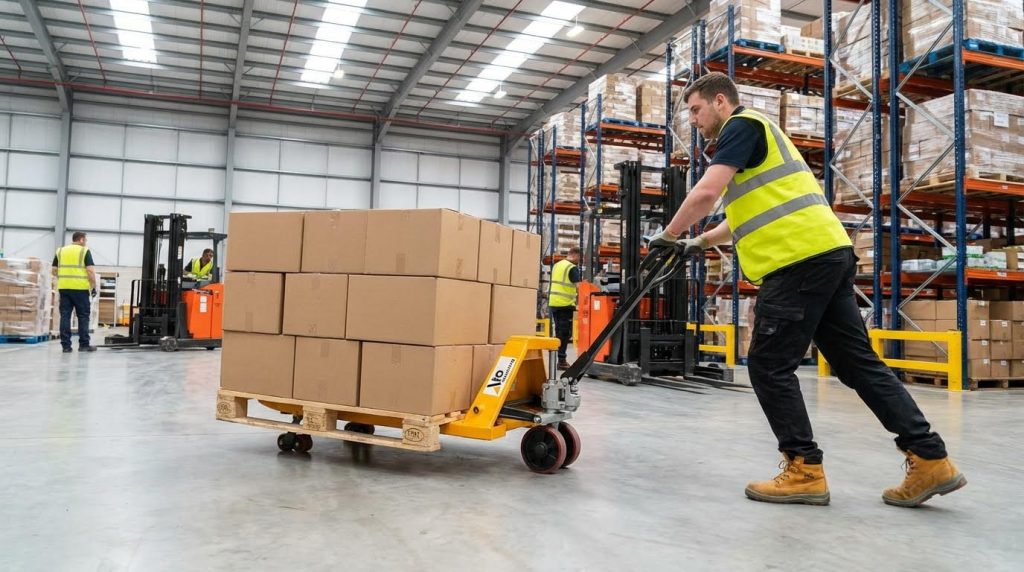
Forklift and pallet truck standards ensure that only trained people move pallet loads and that trucks operate within their limits to prevent tip‑overs, impacts, and dropped pallets during loading.
- Operator training and certification: Only trained and certified workers may operate powered industrial trucks – reduces collisions, dropped pallets, and dock edge incidents. OSHA requires PIT operator training and evaluation.
- Pre-use inspections: Operators must inspect forklifts and pallet trucks before each shift – catches brake, mast, tire, and hydraulic issues before you start loading a truck with pallets.
- Respect rated capacity: Never exceed the truck’s rated load or lift height chart – prevents forward tipping and loss of pallet stacks when raising to trailer bed level.
- Seatbelts and stability: Operators must wear seatbelts and stay within the protective frame – keeps the driver inside the “safety cell” if a truck tips on a dock or ramp.
- Speed and clearance control: Observe site speed limits and maintain safe clearance from pedestrians, racking, and trailer edges – reduces side-swipes and pallet puncture of trailer walls.
- Dock edge and reverse travel: Avoid reversing toward unprotected dock edges and use spotters where visibility is limited – prevents forklifts from going off the dock while loading deep into the trailer.
- Floor and surface condition: Maintain clean, even floors free of potholes, spills, and debris – reduces mast sway, pallet bounce, and loss of control, especially with tall pallet stacks.
- Routine maintenance: Keep PITs maintained per manufacturer instructions and remove unsafe trucks from service – limits vibration, steering play, and brake fade that can compromise precise pallet placement.
Battery charging and fuel handling during loading operations
Battery charging and fuel changes should occur in segregated, ventilated areas away from active loading lanes. Brakes must be applied, ignition switched off, and smoking or open flames banned. Operators should wear eye protection and gloves, and fire extinguishers must remain accessible and maintained. These controls prevent fires, explosions, and chemical burns in high‑traffic loading zones. OSHA outlines safe battery charging and fuel handling practices.
💡 Field Engineer’s Note: When loading tall pallet stacks into a trailer, keep travel speed very low and tilt the mast slightly back before crossing dock levelers. Sudden leveler movement or floor joints can create a forward pitching moment that snaps stretch wrap or pushes pallets off forks if the mast is too upright.
Ergonomics, manual handling, and worker safety
Ergonomic controls, good housekeeping, and clear emergency procedures protect workers who build, break down, and adjust pallets before and after truck loading.
- Limit manual case weight: Keep individual case weights at or below about 16 kg (35 lb) where possible – reduces back and shoulder strain when building pallets for truck loading. OSHA highlights 35 lb as a practical target for many case-picking tasks.
- Work between knees and mid-chest: Raise pallets for heavy items so lifting happens between knee and mid‑chest height – minimizes extreme bending and overhead reach when preparing pallets for the truck.
- Access to three sides of pallets: Provide space on at least three sides of each pallet at build stations – lets workers step and turn instead of twisting their spine while stacking.
- Stacking rules: Place heavier cases on lower layers and keep total height near shoulder level – improves both pallet stability in the truck and ergonomics during build.
- Anti-fatigue measures: Use anti‑fatigue mats or supportive footwear in high‑volume picking and loading areas – reduces leg fatigue and slips during long loading shifts.
- Secure storage and clear aisles: Stack materials securely on racks and keep aisles unobstructed – prevents falling items and allows forklifts to approach trailers cleanly.
- Fall protection at docks: Protect exposed dock edges over 1.2 m (4 ft) high with barriers or fall protection systems – prevents falls when staging pallets close to dock lines.
- Ladder use around trailers: Use ladders only on stable, level surfaces and maintain three points of contact – reduces falls when accessing higher pallet tiers or trailer interiors by hand.
- Hazard communication: Maintain Safety Data Sheets and train workers on any chemicals, such as cleaning agents or battery electrolytes, near loading zones – ensures safe response if spills occur during loading operations.
- Emergency and evacuation planning: Keep exit routes from docks and staging areas clear, signed, and lit – lets workers evacuate quickly if a fire, spill, or vehicle impact occurs during loading.
- Thermal environment controls: In hot warehouses, provide water, rest breaks, and shaded or cooled areas; in cold docks or reefers, provide insulated PPE and warm-up breaks – prevents heat or cold stress during long loading runs.
How ergonomics links to loading efficiency
Good ergonomics is not only about injury reduction. When workers lift lighter cases, work at better heights, and walk on clear, dry floors, they sustain higher picking and loading rates with fewer errors. This directly improves trailer turn times and makes how to load a truck with pallets both safer and more productive.
Final Considerations For Compliant, Efficient Pallet Loading
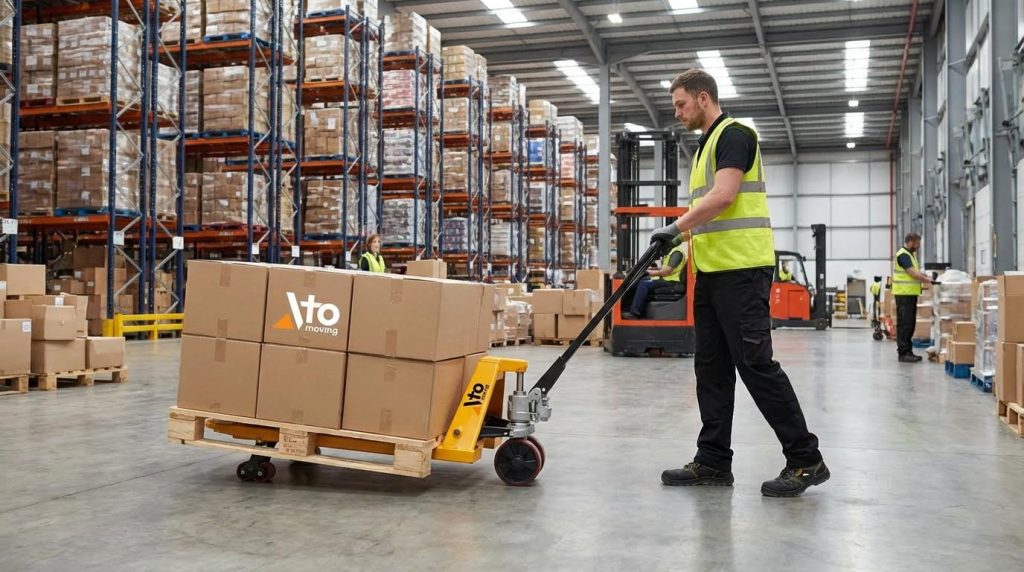
Final considerations for compliant, efficient pallet loading focus on aligning safety rules, ergonomics, and equipment practices so every truck leaves legal, stable, and damage‑free. This is where “how to load a truck with pallets” becomes a repeatable, auditable system.
- Define a loading standard: Document how to load a truck with pallets – Creates one clear method for all shifts and sites.
- Align with regulations: Map your procedures to applicable safety and transport rules – Reduces the risk of fines and load rejections.
- Design for people, not just pallets: Include ergonomic limits and handling rules – Cuts injuries and absenteeism.
- Control equipment condition: Tie loading rules to inspection and maintenance – Prevents incidents from mechanical failures.
- Audit and improve: Track damage, near-misses, and rework – Continuously tightens safety and space efficiency.
Compliance, Documentation, And Training
Compliance in pallet loading means your written procedures, training, and daily habits all reflect the same safety and legal requirements.
- Written SOPs: Create step‑by‑step instructions for how to load a truck with pallets – Makes training concrete and enforceable.
- Operator qualification: Ensure only trained, certified staff operate forklifts and manual pallet jacks. Powered industrial truck rules require formal training and evaluation – Reduces tip‑overs and struck‑by incidents.
- Pre‑shift checks: Require operators to inspect forklifts before loading – Catches brake, mast, or steering issues before they reach the dock.
- Load capacity awareness: Train operators to read data plates and never exceed rated capacities – Prevents mast failure and loss of load.
- Refresher training: Trigger retraining after incidents, near‑misses, or process changes – Keeps skills aligned with real risks.
What to include in a pallet loading SOP
Include: pallet acceptance criteria, maximum pallet mass, stack height rules, aisle and dock speed limits, truck bed inspection, sequence of loading, and sign‑off responsibilities.
💡 Field Engineer’s Note: During audits, the fastest way to spot trouble is to compare your written loading procedure with what actually happens at 16:00 on a busy Friday. Any “shortcuts” you see there are exactly where damage and injuries will appear later.
Ergonomics And Worker Protection At The Dock
Ergonomic design in loading operations keeps case handling within safe ranges and minimizes bending, twisting, and over‑reach.
- Limit case mass: Keep individual cases around 16 kg (35 lb) or less for manual handling. OSHA highlights higher risk above this level – Reduces back and shoulder strain.
- Raise work height: Use pallet stands or height‑adjustable tables so most lifting happens between knee and mid‑chest height – Minimizes deep bending and awkward postures.
- Access three sides: Arrange staging so pickers can reach at least three pallet faces – Reduces twisting and long reaches.
- Heavy low, light high: Place heavier cartons in lower layers and keep order heights at or below shoulder level – Improves pallet stability and reduces overhead lifting risk.
- Floor comfort: Provide anti‑fatigue mats or supportive footwear in high‑volume picking and loading zones – Cuts leg and lower‑back fatigue over long shifts.
How ergonomics ties into load quality
When workers can reach and place cartons easily, they build tighter, more uniform stacks. That directly improves pallet stability and reduces damage in transit.
Equipment, Maintenance, And Charging Areas
Safe pallet loading depends on forklifts and pallet trucks that are maintained, inspected, and operated correctly, including their charging areas.
- Remove unsafe trucks: Take any forklift with steering, brake, or mast issues out of service until repaired. OSHA requires defective PITs to be removed from service – Prevents catastrophic failures under load.
- Dock‑specific inspections: Pay extra attention to tires, brakes, and horn on trucks assigned to loading – Dock edges and tight trailer entries leave no margin for error.
- Battery charging controls: In charging areas, set brakes, use PPE (gloves, eye protection), and ensure ventilation – Limits exposure to acid and gas build‑up.
- No ignition sources: Prohibit smoking and open flames around charging stations – Reduces explosion and fire risk.
- Accessible extinguishers: Keep fire extinguishers near charging and staging points and inspect them regularly – Enables rapid response to small incidents.
💡 Field Engineer’s Note: A surprising number of dock accidents trace back to “minor” issues like low tire pressure or worn forks. Build a 2‑minute pre‑shift checklist, and you will usually halve near‑miss reports within a quarter.
Storage, Housekeeping, And Access Routes
Good housekeeping and storage discipline upstream of the dock make pallet loading faster, safer, and more predictable.
- Stable racking: Stack materials on racks and shelves so loads cannot slide or collapse. OSHA calls for secure stacking and interlocking where possible – Prevents spills while staging outbound loads.
- Heavier low, lighter high: Place heavier items on lower or middle shelves – Reduces rack overturning risk and manual lifting strain.
- Clear aisles: Keep aisles and passageways free of pallets, wrap, and debris – Improves forklift maneuvering and emergency egress.
- Good floor condition: Maintain smooth, clean floors – Reduces vibration, improves pallet jack control, and protects product.
- Marked routes: Clearly mark pedestrian and truck routes around docks – Separates foot traffic from forklift paths.
Why housekeeping matters for truck loading
Cluttered staging areas force tight turns and awkward approaches to the trailer. That increases fork impacts on pallets, trailer walls, and product, even when operators are skilled.
Fall Protection, Ladders, And Dock Edges
Fall protection and ladder safety rules prevent serious injuries around raised docks, trailer beds, and access points.
- Protect exposed edges: Where workers can fall 1.2 m (4 ft) or more, provide guardrails or other fall protection. OSHA requires fall protection at these heights – Prevents dock‑edge falls during loading.
- Safe ladder use: Use ladders only on stable, level surfaces and maintain three points of contact – Reduces falls when checking or securing tall stacks.
- No unstable bases: Never place portable ladders on pallets, boxes, or loose materials – Eliminates sudden ladder movement.
- Fixed ladder systems: Provide safety systems on fixed ladders above 7.3 m (24 ft) – Protects workers accessing upper levels.
- Clear exits: Keep exit routes unobstructed and well lit, and clearly mark non‑exit doors – Ensures fast evacuation if something goes wrong during loading.
💡 Field Engineer’s Note: Many teams climb on pallets inside trailers to “just adjust the last row.” Ban this. Use platforms, step‑workstands, or load‑levelers instead; ankle and back injuries from slips off pallets are far more common than roll‑overs.
Chemical, Heat, And Cold‑Storage Considerations
Chemical safety, heat stress control, and cold‑storage practices must be integrated into your pallet loading process, not treated as separate issues.
- Hazard communication: Maintain Safety Data Sheets and train workers on chemical hazards where chemicals are stored or loaded. OSHA requires a written hazard communication program – Prevents exposure during spills or handling.
- Protect chemical zones: Store chemicals away from forklift traffic and provide secondary containment – Reduces spill and impact risk while staging pallets.
- Emergency planning: Implement an emergency action plan with evacuation routes, accountability, and equipment locations – Ensures controlled response to fires, spills, or medical events.
- Heat stress controls: In hot docks or yards, provide water, rest breaks, shade, and acclimatization – Prevents heat exhaustion during peak loading periods.
- Cold‑storage protections: In freezers, provide insulated clothing, warm‑up breaks, and doors with inside release mechanisms – Prevents cold stress and entrapment while loading temperature‑controlled trucks.
Integrating environment into loading plans
For high‑heat or deep‑freeze operations, adjust shift length, staffing, and loading sequences so exposure times stay within safe limits while still meeting trailer departure windows.
💡 Field Engineer’s Note: In cold stores, condensation on dock plates and trailer floors can turn into invisible ice. Specify non‑slip surfaces and slower forklift speeds in your loading standard whenever trailer temperature is below 0°C.
When you bring all these elements together—clear SOPs, trained operators, ergonomic design, disciplined housekeeping, and environmental controls—you turn “how to load a truck with pallets” into a controlled engineering process. That is what consistently delivers safe people, compliant loads, and maximum usable space on every trip.
Final Considerations For Compliant, Efficient Pallet Loading
Safe pallet loading is an engineering problem as much as an operational one. Pallet strength, product stiffness, and stack geometry set hard limits on height and mass. Truck dimensions, axle ratings, and floor capacity then decide where those pallets can sit. Securement, from wrap to blocking and straps, must lock every pallet into the trailer so nothing gains momentum under braking or cornering.
Forklift standards, ergonomic rules, and housekeeping keep people in control of that engineered load. Trained operators, inspected trucks, and clear dock layouts reduce the chance that a good plan fails at execution. Environmental and chemical controls protect workers and product in hot yards, freezers, and mixed‑hazard warehouses.
Operations teams should treat “how to load a truck with pallets” as a documented, auditable process, not a driver‑by‑driver habit. Define standard patterns by vehicle, set stack and mass limits, and tie them to pre‑use checks and training. Review incidents, near‑misses, and damage data and update the standard often. When you do this, each trailer leaves as a stable structure, not a loose collection of pallets, and Atomoving can deliver maximum usable space without trading away safety or compliance.
Frequently Asked Questions
How should pallets be loaded on a truck for maximum stability?
Pallets should be loaded in straight rows, turned loading, or pinwheeled depending on pallet size, vehicle width, and stability requirements. Distribute weight evenly across the trailer to prevent shifting during transit. Trailer Loading Tips.
What are the best practices for loading a truck with pallets?
Follow these tips for safe and efficient loading:
- Know your weight limits before loading.
- Place approximately 60% of the cargo weight forward of the rear axle for better steering and traction.
- Secure the cargo to prevent movement during transit.
- Use proper material handling equipment for loading and unloading.
How do you ensure proper weight distribution when loading pallets onto a truck?
Avoid placing heavy loads too far forward as it may exceed the steer axle limit, and avoid placing them too far back as it could affect drive axle limits. Heavy items behind the rear axle can reduce steer axle mass, making steering unpredictable. Load Distribution Guide.