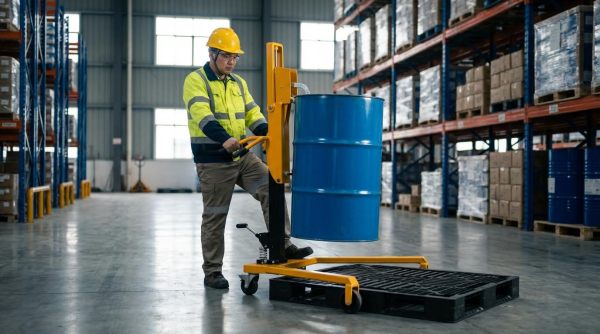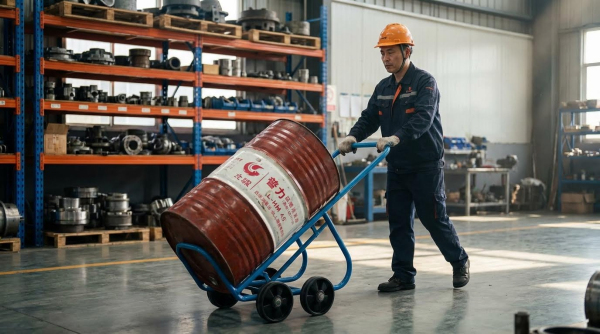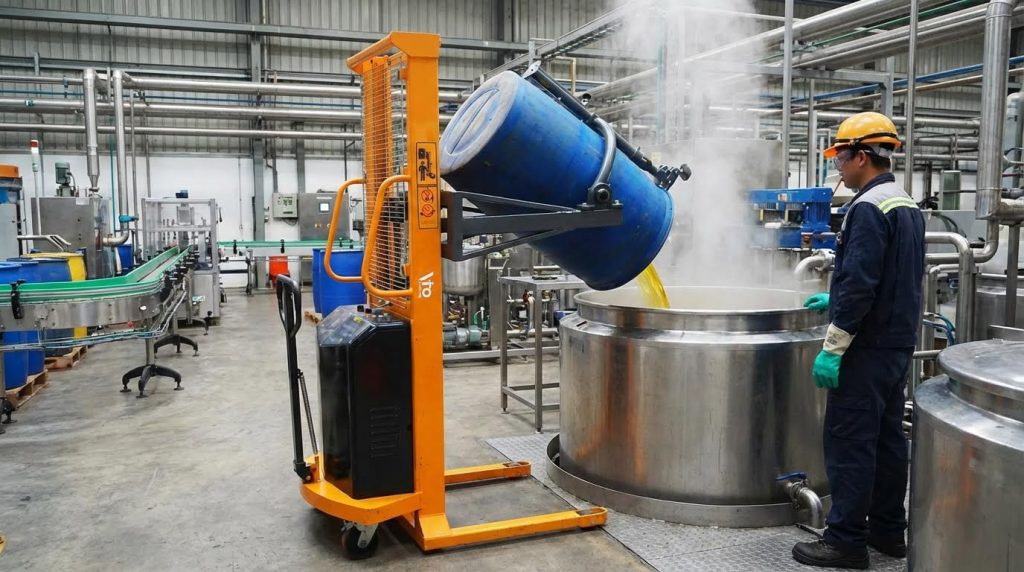
Safe handling of hazardous material drums means combining strict regulatory compliance with engineered equipment, correct PPE, and disciplined warehouse practices to control both chemical and mechanical risk. This guide explains how to handle hazardous material drums safely in real-world operations, from OSHA and HAZWOPER requirements to drum construction, storage design, and emergency response. You will see how dimensions, weights, and layouts translate into safer workflows, fewer spills, and better protection for your team. Use it as a practical roadmap to upgrade procedures, training, and manual pallet jack, drum dolly, drum palletizer, and forklift drum grabber double grips around every 200 L–450 L drum on your site.
Engineering Controls, PPE, And Handling Equipment
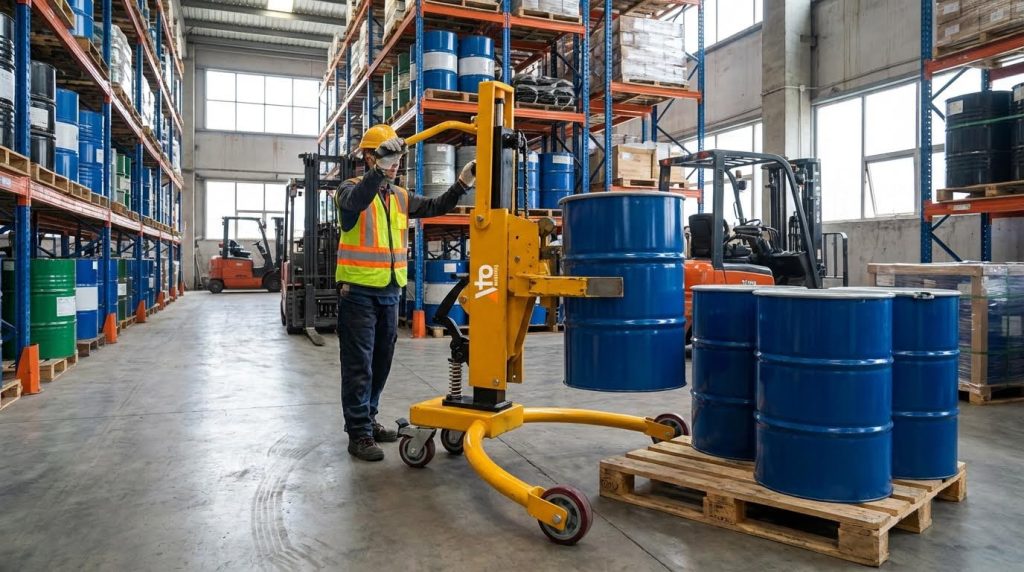
Engineering controls, PPE, and purpose-built handling equipment work together to define how to handle hazardous material drums safely without relying on human strength or luck. This section links drum design, protective clothing, and mechanical aids into one practical, compliant system.
Drum construction, capacity, and compatibility
Drum construction, capacity, and compatibility matter because the wrong shell thickness or lining can rupture or react under load, making how to handle hazardous material drums safely almost impossible. You must match drum design to liquid type, density, and handling method.
| Drum Type / Feature | Key Regulatory Specs | Typical Capacity Range | Operational Impact |
|---|---|---|---|
| General liquid drum >40 L | Body seams must be welded for liquids over 40 L | 40–450 L | Reduces seam failure risk when tipping or lifting with drum dolly. |
| Rolling hoops | Required for drums >60 L; hoops must not be spot‑welded | 60–450 L | Allows safe rolling and tipping; avoids hoop detachment when using hydraulic drum stacker. |
| Closures (bung / non‑removable head) | Openings must not exceed 70 mm; closures must be leakproof under normal transport | Up to 450 L | Prevents weeping during forklift movement or stacking; critical for toxic or flammable liquids. |
| Maximum drum capacity | Max 450 L and 400 kg net mass | Up to 450 L / 400 kg | Defines minimum truck/forklift capacity and pallet rating for safe handling. |
| Plywood drums | Min 2‑ply body, 3‑ply heads; max 250 L and 400 kg | Up to 250 L | Better for some solids; not ideal for wet, corrosive liquids or long outdoor storage. |
| Aluminum / other metal drums | Welded seams; rolling hoops >60 L; reinforced chime seams | 60–450 L | Lighter weight but must still be welded and reinforced to survive stacking and mechanical handling. |
| Internal coatings / linings | Required when base metal is incompatible with contents; coating must remain effective during transport | Typical 200–450 L | Prevents corrosion, hydrogen generation, and leaks when storing aggressive acids or alkalis. |
Density of the fill material directly changes handling risk. A 200 L (55‑gallon) drum of water weighs about 215 kg, but the same drum with concentrated sulfuric acid can exceed 390 kg.
- Check construction markings: Confirm UN type, material, and rating – Ensures the drum is engineered for the chemical and stacking height you plan to use.
- Verify closure integrity: Inspect bungs, gaskets, and torque – Prevents seepage when drums are tilted on trucks or clamped by handlers.
- Account for net mass, not just volume: Use SDS density to estimate kg – Protects workers and prevents overloading manual pallet jack and forklifts.
- Confirm compatibility: Match coating/lining to chemical – Reduces corrosion, gas evolution, and unplanned leaks during storage and movement.
How to estimate drum weight before you move it
Multiply drum volume in liters by liquid density (kg/L) from the SDS, then add 15–25 kg for the drum itself. For example, 200 L × 1.8 kg/L ≈ 360 kg plus drum mass.
💡 Field Engineer’s Note: When you see “heavy” acids or brines, assume the drum weight is near the 400 kg regulatory limit and verify equipment capacity before planning routes over mezzanines, dock plates, or old slab floors.
PPE selection, chemical clothing, and decontamination
PPE selection, chemical clothing, and decontamination matter because even perfect engineering controls can fail, and skin or respiratory exposure is the last barrier in how to handle hazardous material drums safely. PPE must match the specific hazard profile and be backed by a written decon plan.
Under HAZWOPER, employers must use engineering controls and work practices first, then supplement with PPE defined in a written safety and health program.
- Hazard-driven PPE selection: Base ensembles on toxicity, splash potential, and volatility – Ensures you do not under‑protect when opening or transferring drums.
- Chemical clothing specification: Define suit material, seams, and boot/ glove interfaces – Prevents wicking and pinhole leaks during prolonged drum handling.
- Fit testing and comfort: Verify respirators and clothing fit the worker and task – Reduces heat stress and maintains seal integrity during lifting and bending.
- Decontamination workflow: Plan stepwise decon for workers and tools – Stops cross‑contamination between staging areas, forklifts, and clean zones.
Decontamination procedures must be written, implemented, and communicated so workers know how to clean themselves and dispose of contaminated PPE and equipment.
- Step 1: Perform a preliminary hazard evaluation – Determines if splash, vapor, or both are credible during drum work.
- Step 2: Select PPE level and materials – Aligns suit, gloves, boots, and respirator with chemical compatibility and exposure duration.
- Step 3: Brief workers on donning, limits, and emergency doffing – Reduces panic and mistakes if a drum leaks or vents unexpectedly.
- Step 4: Establish a decon line at drum egress points – Ensures every worker and tool passes through decon before entering clean areas.
- Step 5: Inspect and retire damaged PPE – Prevents micro‑failures from repeating across multiple shifts.
What must your written PPE and decon plan include?
It should describe PPE selection criteria, maintenance, limitations, fit testing, decon steps, waste handling, and post‑emergency operations measures, as required under HAZWOPER for emergency response and drum handling activities.
💡 Field Engineer’s Note: For drum opening and sampling, plan PPE for worst‑case splash, not “typical” operations; pressure‑built drums and crystallized bungs can release contents far beyond the immediate work area.
Mechanical drum handling: trucks, forklifts, and AGVs
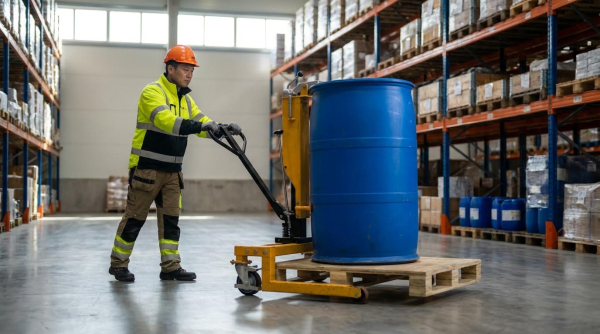
Mechanical drum handling using trucks, forklifts, and AGVs is essential because full drums routinely weigh 180–360 kg or more, far beyond safe manual limits, and mechanical aids are the only reliable way to handle hazardous material drums safely at scale.
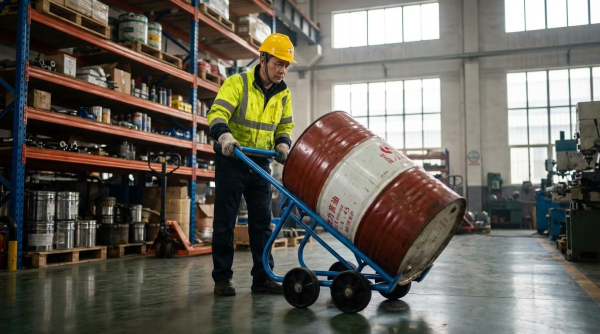
Training materials note that full drums can weigh between 180–360 kg and should not be manually lifted due to musculoskeletal injury risk. Guidance recommends drum trucks or powered equipment, with closures tightened and checked for leaks before moving. When forklifts are used, drums must be carried as low as possible and sudden turns avoided to keep the combined center of gravity inside the wheelbase.
| Equipment Type | Typical Use Case | Key Safety Requirements | Operational Impact |
|---|---|---|---|
| Manual drum truck | Short moves of single drums on flat floors | Use rolling hoops; secure drum; avoid gradients >2–3% | Reduces manual lifting; best for 200 L drums in small warehouses. |
| Powered drum lifter / stacker attachment | Vertical lifting, stacking one or two drums high | Verify rated capacity > drum mass; clamp correctly on rim or body | Improves reach and stacking while keeping operators clear of pinch points. |
| Forklift with drum grab or clamp | Moving multiple drums on pallets or individually | Keep load low; avoid sharp turns; ensure pallet integrity | Allows efficient movement of 2–4 drums through 2.7–3.0 m aisles. |
| AGV with drum fixture | Repetitive routes between filling, storage, and staging | Program speed, clearances, and emergency stops; maintain spill containment | Automates routine transfers while limiting worker exposure to leaks and vapors. |
- Match capacity to heaviest drum: Use worst‑case density, not water – Prevents overloading when handling high‑SG acids or brines.
- Use drum‑rated attachments: Avoid bare forks on single drums – Improves grip and reduces shell denting or puncture risk.
- Control speed and turning radius: Train operators on slow, deliberate movements – Keeps load stable and avoids sloshing or tipping.
- Integrate with containment: Route trucks through diked or curbed areas – Ensures any leak stays within spill control systems.
Why you should never pressurize drums to empty them
OSHA prohibits pressurizing drums or containers to remove contents because temporary pressurized systems can rupture and release hazardous substances. Relief valves and bypasses are mandatory when pressurized systems convey hazardous liquids or gases.
💡 Field Engineer’s Note: Treat every drum move like a rigging job: confirm weight, path, floor rating, and containment before lifting; the cost of a single dropped 300 kg drum with corrosive contents dwarfs any time saved by “quick moves.”

Final Considerations For Safe And Compliant Drum Operations
Safe hazardous drum handling depends on how well you connect regulations, engineering limits, PPE, and equipment into one system. Drum design rules fix shell strength, closures, and maximum mass, so you must size every truck, pallet, and floor rating to the heaviest credible fill, not just water. When you respect these limits, you cut the chance of ruptures, dropped loads, and unstable stacks.
PPE and decontamination planning then close the gap when engineering controls fail. If you base PPE on real splash and vapor hazards, train fit and emergency doffing, and enforce a clear decon line, you prevent small leaks from turning into site‑wide contamination.
Mechanical handling is the final link. When you use drum‑rated trucks, clamps, and Atomoving attachments, and you move slowly through routes designed with containment, you protect workers from both strain and chemical exposure.
The best practice is simple but strict: verify drum construction and weight, match equipment capacity with margin, plan PPE and decon for worst‑case events, and treat every drum move as a controlled lifting job. If you do this every time, you keep operations compliant and your people and site safe.
Frequently Asked Questions
How do you handle hazardous materials safely?
Handling hazardous materials requires strict adherence to safety protocols. Always wear proper personal protective equipment (PPE) like gloves, goggles, and masks. Ensure the area is well-ventilated and that containers are properly labeled and stored in appropriate conditions. 10 Safety Tips For Chemicals. Avoid mixing chemicals and dispose of hazardous substances according to regulations.
- Use PPE such as gloves and goggles.
- Ensure proper ventilation in the workspace.
- Label and store chemicals correctly.
- Avoid mixing different chemicals.
- Dispose of hazardous materials safely.
What is the primary hazard when handling drums containing hazardous materials?
The main risks when handling hazardous material drums include chemical exposure, fire or explosion, and physical injuries from moving heavy containers. Drums may also pose hazards if stacked improperly or if they deteriorate. Hazmat Handling Hazards.
- Exposure to harmful chemicals or radiation.
- Risk of fire or explosion.
- Injuries from moving or stacking heavy drums.
What must a hazardous waste drum have on it?
Hazardous waste drums must be clearly marked with the words “hazardous waste” and include details about the waste’s composition, physical state, and specific hazardous properties. Proper labeling ensures compliance with safety and shipping regulations. Hazardous Waste Label Guide.
- Label with “hazardous waste.”
- Include waste composition and physical state.
- State specific hazardous properties.