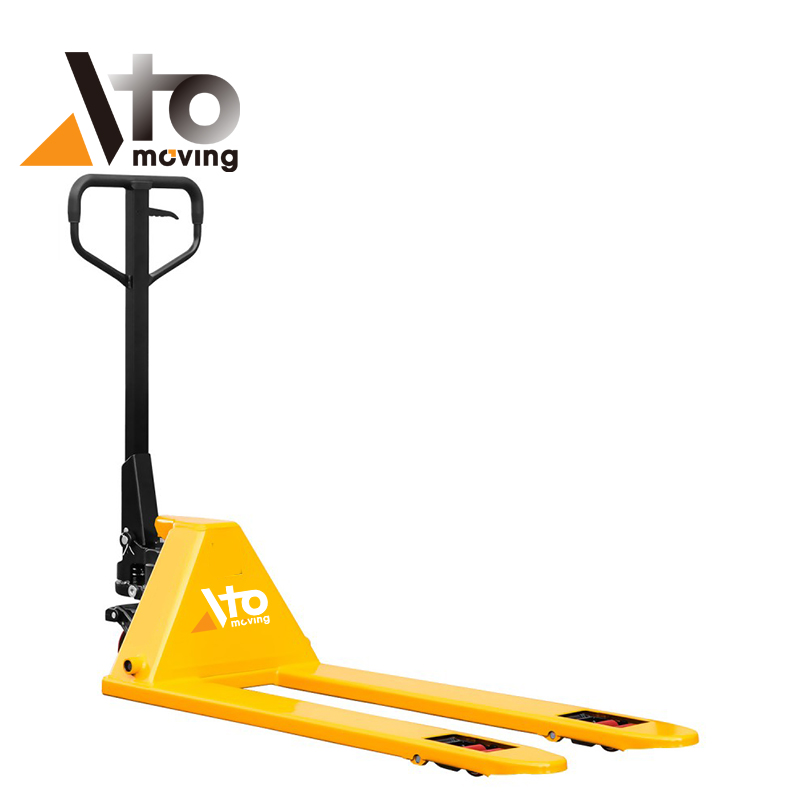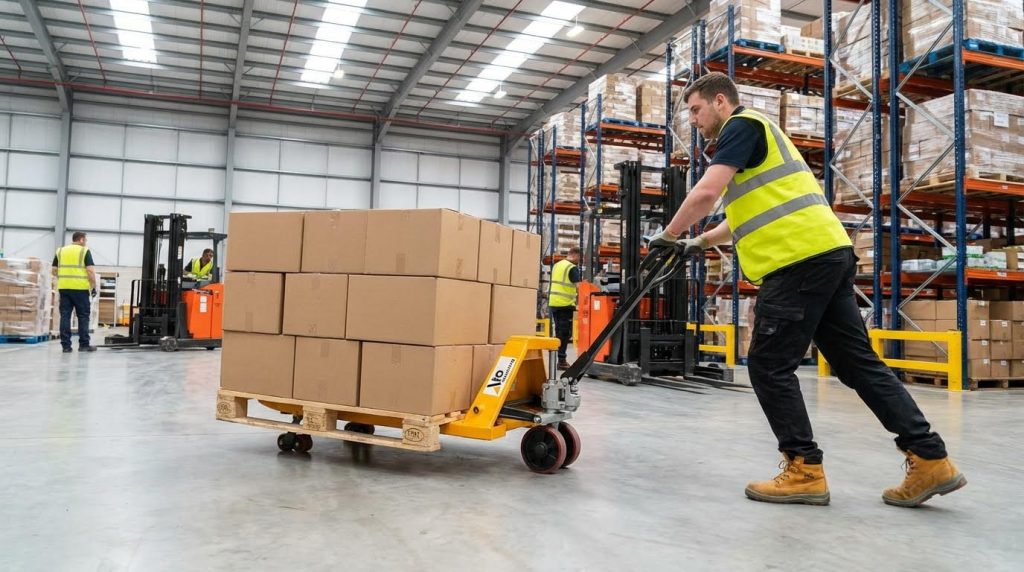
Pallet jack load ratings explain, in kilograms and millimetres, how much weight you can safely move without bending forks, bursting hydraulics, or tipping the truck. This guide breaks down what is the lifting capacity of the pallet jack in real warehouses, how to read capacity labels, and how factors like load center, height, and wear quietly reduce your true safe working load.
Core Concepts Of Pallet Jack Capacity Ratings
Pallet jack capacity ratings define the maximum safe load under specific test conditions, not a blanket “any load, any shape” promise. To really answer “what is the lifting capacity of the pallet jack,” you must pair the rated capacity with the correct load center and load geometry.
- Rated capacity: The maximum approved load under standard test conditions – your legal and engineering limit.
- Load center: The assumed distance of the load’s center of gravity from the fork heel – the lever arm that controls tipping risk.
- Capacity curve: How capacity falls as the load center moves out or the lift height increases – the real “usable” capacity.
- Labels/plates: The on-truck data plate that ties all these together – your first reference before lifting.
💡 Field Engineer’s Note: When a site asks “Can this jack lift 2,500 kg?”, I always answer “At what load center and on what floor?” Capacity is never a single number in isolation.
What “Rated Capacity” Really Means
Rated capacity is the maximum load a pallet jack can safely handle under standardized, controlled conditions, usually with a compact, evenly distributed pallet at a defined load center. It already assumes typical dynamic forces from normal travel on flat, level ground.
For manual pallet jacks, rated capacity commonly falls around 1,600–3,500 kg, and for powered pallet jacks up to about 5,000 kg, but the exact figure is printed on the capacity label or data plate. That printed number is the formal answer to “what is the lifting capacity of the pallet jack” for that specific unit, provided you stay within all the assumptions that went into the rating.
Static vs dynamic meaning of the rating
The structure and hydraulics can usually hold more than the rating in a static test, but the published rating is effectively a dynamic rating for normal travel. It already includes design safety factors to account for starting, stopping, and turning forces, so it must not be exceeded in daily work.
- Defined test case: Level floor, stable pallet, correct fork engagement – no ramps, no shock loading.
- Dynamic allowance: Includes allowance for normal travel forces – not for aggressive braking or impact.
- Legal boundary: Exceeding the rating means operating outside design and standards – higher liability and failure risk.
- Engineering margin: Structure may survive 2–3× in static tests – but that reserve is for safety, not for extra payload.
Overloading even by 10–20% accelerates fork bending, wheel and bearing damage, and hydraulic seal wear. Good engineering practice is to size jacks so day‑to‑day loads use only about 60–80% of the rated capacity to extend life and keep a buffer for occasional dynamic peaks.
💡 Field Engineer’s Note: If your “typical” pallet is already at 90–95% of the jack’s rating, you don’t have a safety factor—you have a near-miss waiting to happen every busy shift.
Load Center Distance And Its Effect On Capacity

Load center distance is the horizontal distance from the fork heel to the load’s center of gravity, and it directly controls how much of the rated capacity you can actually use. As the load center moves further out, the effective lifting capacity drops because the overturning moment increases.
Most pallet jack ratings assume a load center around 500–600 mm, often standardized at 600 mm for typical 1,000 × 1,200 mm pallets. Under these conditions, the data plate rating applies in full. When loads overhang, are longer than the forks, or are stacked irregularly, the center of gravity shifts forward, and the same weight creates a larger tipping moment.
| Parameter | Typical Value | Operational Impact |
|---|---|---|
| Standard rated load center | 600 mm | Full rated capacity applies for compact pallets that keep the center of gravity close to the fork heel. |
| Short, dense pallet | < 600 mm load center | Moment is lower; you stay comfortably within rating when weight is centered and stable. |
| Long or overhanging load | > 600 mm load center | Moment increases; usable capacity must be reduced to avoid tipping or fork overstress. |
| Typical manual jack rating | 2,000–2,500 kg @ 600 mm | Safe for standard pallets if the load is even and does not overhang significantly. |
Engineers often approximate the effect of a shifted load center with a simple proportional formula derived from the bending moment relationship:
New Safe Capacity = Rated Capacity × (Rated Load Center ÷ Actual Load Center)
Example: A jack rated 2,000 kg at a 600 mm load center handling a long load whose center of gravity is at 750 mm:
- Rated data: 2,000 kg @ 600 mm – design test condition.
- Actual condition: Load center 750 mm – further from the fork heel.
- Adjusted capacity: 2,000 × (600 ÷ 750) ≈ 1,600 kg – about 20% capacity loss.
How to estimate your own load center on site
Measure from the fork heel to the geometric middle of the load lengthwise. If the load is uneven, estimate where the bulk of the mass sits. The closer you can keep that point to the fork heel (without unsafe overhang the other way), the more of the rated capacity you preserve.
- Keep heavy product inboard: Place the densest items over the fork heels – reduces the load center and bending moment.
- Avoid large overhangs: Long loads or poorly stacked pallets push the center of gravity out – forces you to derate capacity.
- Watch tall stacks: Height raises and sometimes shifts the center of gravity – more risk in turns and on slopes.
- Respect the label: If the data plate shows a specific “kg @ mm” pair, treat the mm as strictly as the kg – both define your safe envelope.
💡 Field Engineer’s Note: In the field, most overloads I see are not “too heavy” pallets—they are “too far out” pallets. The moment from an 1,800 kg load at 800 mm can be more dangerous than 2,000 kg at 600 mm.
Technical Factors That Change Real-World Capacity
Technical factors like motion, slopes, load shape, attachments, and wear mean the real safe load is usually lower than the number stamped on the pallet jack. Anyone asking “what is the lifting capacity of the pallet jack” must account for these derating effects, not just the catalog rating.
- Key Point: Rated capacity assumes ideal conditions – real warehouses almost never match those conditions exactly.
- Result: Effective safe capacity can drop 10–40% – long loads, slopes, and wear are the usual culprits.
💡 Field Engineer’s Note: When I size pallet jacks for busy warehouses, I assume day‑to‑day loads should stay within 60–80% of the nameplate rating. This automatically covers slopes, bad floors, and the inevitable fork and wheel wear that creep in between services.
Static vs dynamic loading and slope effects
Static vs dynamic loading and slopes change how close you can safely run to the rated capacity, even if the weight on the pallet is the same.
- Static load: Jack parked, load not moving – forces equal the actual weight only.
- Dynamic load: Moving, turning, or braking – inertia adds extra force on forks, wheels, and chassis.
- Slopes and ramps: Gravity adds a component along the ramp – effective forces and stopping distances increase.
The published rating on a pallet jack is effectively a dynamic rating for level, straight travel with a stable load. Once you add turning, emergency braking, or a ramp, peak forces can exceed the static weight by a wide margin, especially with heavy or top‑heavy loads.
How slopes change effective load
On a 10% incline, the component of gravity acting down the slope is roughly 10% of the load weight. That extra force must be resisted by your arms (manual jack), the drive motor (electric jack), and the braking system. This is why many sites derate practical loads by around 10–15% on ramps to maintain similar safety margins to flat travel. Rough or broken floors add more shock loading and rolling resistance on top of this, further reducing what feels and behaves like a “safe” load.
- Rule of thumb – level floors: Keep typical loads within 70–80% of rated capacity – covers normal dynamic effects.
- Rule of thumb – frequent ramps/rough floors: Plan around 60–70% of rated capacity – protects operators, forks, and wheels.
- Operational impact: The practical answer to “what is the lifting capacity of the pallet jack on our ramp?” is usually 10–30% lower than the nameplate.
Ignoring these effects pushes stresses past design margins. Overloading by even 10% under dynamic conditions can start fork bending, wheel flat‑spotting, and hydraulic seal damage long before you see a dramatic failure.
💡 Field Engineer’s Note: If operators complain that a jack is “too heavy” to pull on a ramp even though the load is under the rating, treat it as a capacity problem, not a fitness problem. The combination of gradient, friction, and dynamic forces means you are effectively overloaded for that route.
Load height, irregular loads, and attachments
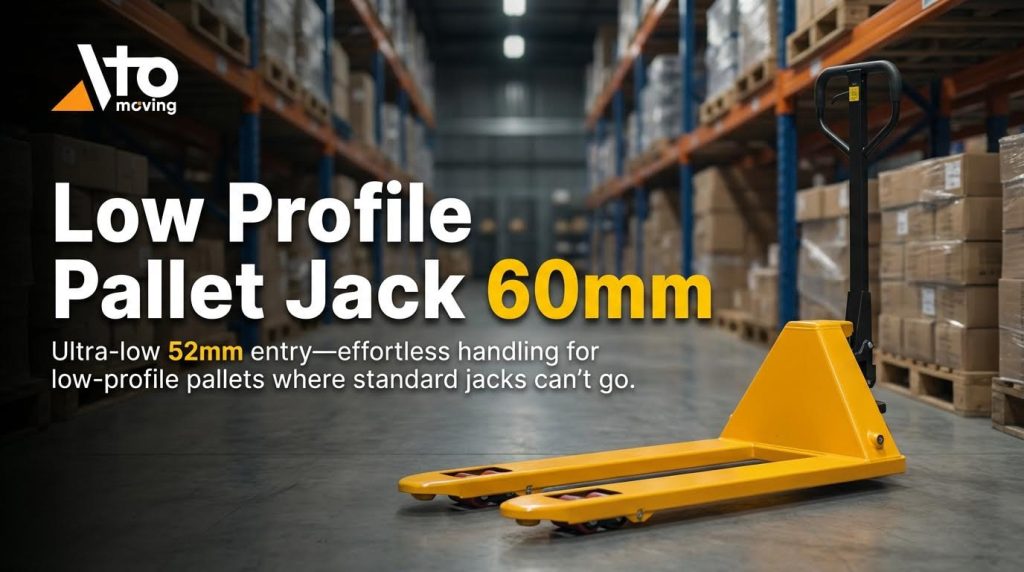
Load height, shape, and any attachments or fork extensions change the load center and stability, which directly reduces usable capacity versus the nameplate.
Rated capacity is normally defined at a standard load center, often 600 mm from the fork heel with a compact, evenly distributed load. When the center of gravity moves higher or further forward, overturning moments increase and safe capacity falls.
- Tall stacks: Raise the center of gravity – truck becomes more “tippy” when turning or braking.
- Overhanging loads: Move the center of gravity forward – effective load center exceeds 600 mm.
- Irregular loads: Center of gravity is not obvious – you must assume a worse (further out) load center.
How load center reduces capacity
For many pallet trucks, engineers use a simple proportional rule: New Safe Capacity = Rated Capacity × (Rated Load Center ÷ Actual Load Center). If a jack is rated 2,000 kg at 600 mm, but your long load shifts the center of gravity to 750 mm, the theoretical safe capacity becomes roughly 2,000 × (600 ÷ 750) ≈ 1,600 kg. This is before considering extra reduction for high lift or rough floors. This proportional approach is described in engineering guidance on pallet truck load capacity.
- Best practice for tall loads: Keep speed low, avoid sharp steering, and keep the heaviest layer closest to the forks – reduces tipping risk.
- Best practice for overhang: Re‑palletize so heavy items sit over the fork heels – pulls the center of gravity back towards the rated 600 mm.
Attachments and fork extensions add another layer. They increase dead weight on the truck and push the effective load center forward, both of which erode the original rating.
- Attachments: Clamp heads, platforms, or special cradles – add weight and sometimes height, cutting into structural margin.
- Fork extensions: Make forks longer – almost always push the load center past the original rating point.
- Label requirement: Any attachment that changes load handling must have updated capacity information – to stay compliant with standards and avoid guesswork.
For powered pallet trucks and stackers, increasing lift height compounds these effects. As the mast rises, the load center of gravity moves up and can shift slightly forward due to mast deflection and geometry. This increases overturning moment and reduces safe capacity at height, which is why data plates often show lower capacities at maximum lift. Technical guidance on pallet trucks explains this derating with height.
- Manual low‑lift jacks: Fork rise is only about 150–200 mm – height has minimal effect on capacity; load shape matters more.
- High‑lift / stackers: Capacity can drop significantly near max height – you must read the height‑specific rating on the plate.
💡 Field Engineer’s Note: Any time I see fork extensions in use, I assume the original rating is no longer valid until I see a revised capacity label. Extensions are one of the fastest ways to turn a “2,000 kg jack” into a 1,200–1,500 kg jack in real life.
Wear, inspections, and predictive capacity monitoring
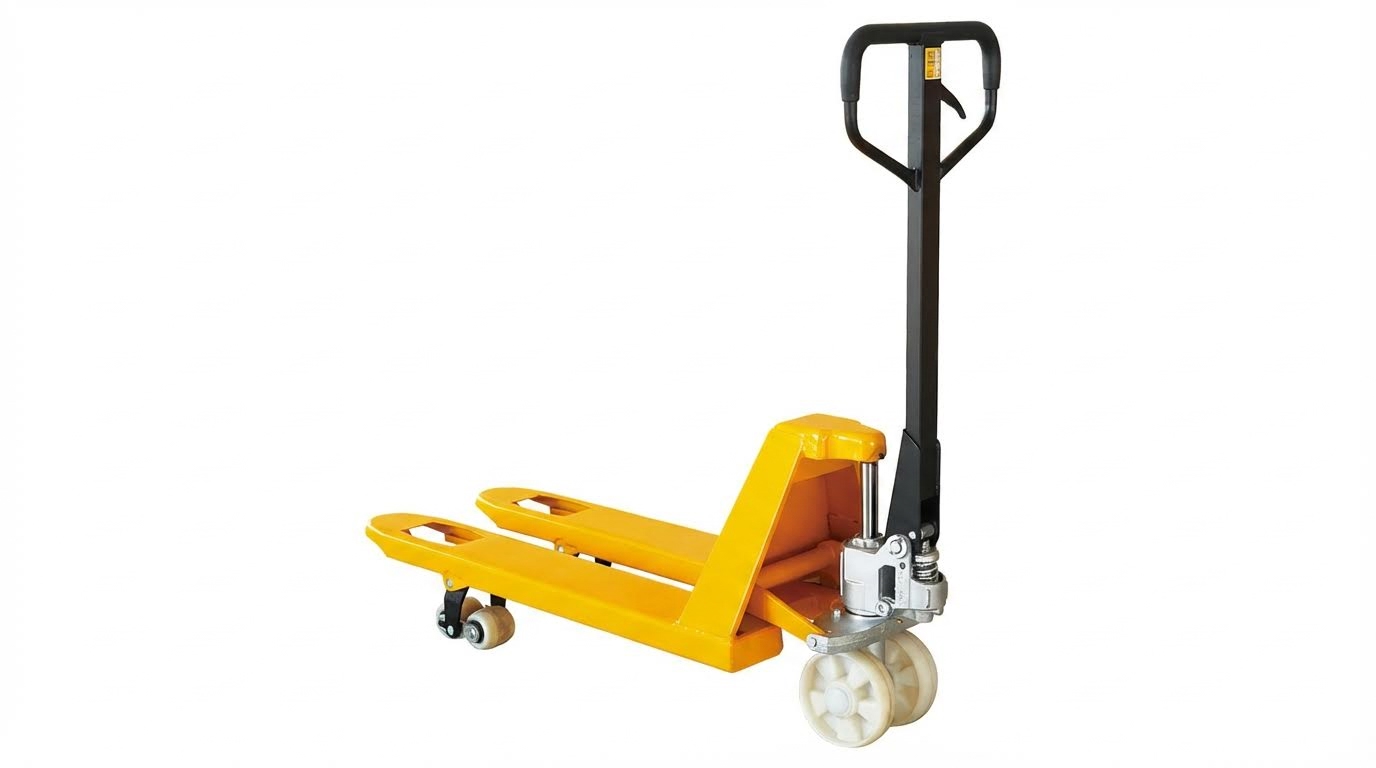
Wear, inspections, and modern predictive tools determine how close your real pallet jack capacity stays to the original rating over its life.
Structurally, new pallet jacks are designed with safety factors; static tests may use 2–3 times the rated load. But as forks wear thinner, wheels flatten, and hydraulics leak, those safety margins shrink. The “what is the lifting capacity of the pallet jack” question must then be answered as “what is the lifting capacity of this specific, used pallet jack today?”
- Fork wear: A 10% loss in fork thickness can cut fork capacity by roughly 20% – forks should be removed from service at defined wear limits.
- Fork damage: Cracks at the heel or visible bending – stress concentrates here and can cause sudden failure.
- Wheel condition: Worn, chunked, or under‑sized wheels – increase point loads, rolling resistance, and tipping risk.
Daily and periodic inspections are the main tools to keep real capacity close to the rating. Typical checklists include fork thickness, straightness, wheel condition, hydraulic leaks, handle function, and the legibility of the capacity label. Industry guidance highlights how fork wear alone can significantly reduce safe capacity.
- Operator checks (daily): Quick visual and functional check before use – catches obvious capacity‑reducing defects early.
- Maintenance checks (scheduled): Measure fork thickness, inspect welds, check hydraulics and wheels – decides when to derate or scrap equipment.
- Label verification: Ensure the capacity plate is present, readable, and matches any attachments – prevents “mystery ratings.”
How predictive systems help
Modern pallet truck fleets increasingly use IoT sensors and fleet management software. Load sensors estimate real‑time load weight and sometimes load moment. The system compares this to the rated capacity and warns operators as they approach unsafe levels. Data logging tracks overload events, harsh impacts, and duty cycles, allowing maintenance teams to identify units that are being pushed hardest and may have lower remaining safe capacity. Predictive models then adjust service intervals and recommend component replacements before failures occur, keeping the effective working capacity closer to design values for longer.
- Benefit of digital monitoring: Turns capacity from a static number into a live, monitored limit – reduces overload frequency.
- Benefit for management: Overload and impact data highlight training gaps – targeted coaching improves both safety and equipment life.
💡 Field Engineer’s Note: In fleets where we installed load and impact monitoring, overload events dropped sharply within months. Once operators saw live warnings, the old habit of “just one more heavy pallet” faded fast, and fork and wheel failures decreased noticeably.
Applying Capacity Data To Selection And Operations
This section explains how to turn capacity labels and load-center data into real decisions: which pallet jack to buy, what is the lifting capacity of the pallet jack you already own, and how much safety margin to keep in daily use.
In practice, you combine three things every time you pick a truck: rated capacity, load center, and lift height. Then you derate for slopes, irregular loads, and wear so real-world loads stay inside a safe envelope.
💡 Field Engineer’s Note: When I size pallet jacks for busy warehouses, I design so typical loads use only 60–80% of the rating. This absorbs the extra forces from slopes, hard braking, and occasional poor stacking without living on the edge of the data plate.
Matching capacity, load center, and lift height to use
To match capacity, load center, and lift height, you first understand the rating on the nameplate, then adjust it for your actual load geometry and any required lift height.
The core question behind “what is the lifting capacity of the pallet jack” is not just the number on the label, but the number you can safely use with your pallets, your aisles, and your ramps.
| Parameter | Typical Value / Rule | How It Affects Safe Capacity | Operational Impact |
|---|---|---|---|
| Rated capacity | ≈ 1,600–3,500 kg manual, up to ≈ 5,000 kg powered | Maximum tested load under standard conditions | Choose a rating so normal loads use only 60–80% of this figure. |
| Rated load center | Usually 600 mm from fork heel | Basis for the published capacity rating | Standard 1,200 mm pallets fit this; long loads may exceed it. Reference |
| Actual load center | Measured to the load’s center of gravity | If greater than rated load center, usable capacity drops | Overhanging or long loads must be derated before lifting. |
| Lift height | Manual: ≈ 150–200 mm fork rise | Low-lift jacks see little capacity change with height | Just clear the floor by 25–40 mm to keep stability margins. |
| Lift height (high-lift / stacker) | Up to several meters | Higher mast position reduces safe capacity | Always check the data plate column for the planned lift height. Reference |
The key engineering relationship is that when the load center moves outward, the safe capacity falls in roughly the same ratio. A widely used formula is: New Safe Capacity = Rated Capacity × (Rated Load Center ÷ Actual Load Center). Reference
Worked example: long load on a standard pallet jack
Assume your pallet jack is rated 2,000 kg at a 600 mm load center. You need to move a long crate where the center of gravity sits 750 mm from the fork heel.
Using the formula: New Safe Capacity = 2,000 kg × (600 mm ÷ 750 mm) = 2,000 × 0.8 = 1,600 kg. So even though the label says 2,000 kg, you must treat this combination as limited to 1,600 kg. Any more and you are eating into the design margin for stability and fork strength.
- Measure the real load center: From fork heel to the estimated center of gravity – This tells you if you are beyond the 600 mm reference.
- Apply the derating formula: New Capacity = Rated Capacity × (Rated LC ÷ Actual LC) – Prevents overload when handling long or overhanging loads.
- Check lift height requirements: Compare your required lift to the data plate – High-lift work often has a lower capacity line than floor-level travel.
- Account for dynamic use: Add extra margin for ramps, frequent braking, or tight turns – Dynamic forces can exceed the static weight by a wide margin.
For low-lift manual pallet jacks, forks typically rise only about 150–200 mm, so capacity is almost independent of height; stability problems come more from poor stacking than from lift height itself. For high-lift electric pallet jacks or stackers, the center of gravity rises and moves slightly away from the chassis as you lift, increasing overturning moments and reducing safe capacity at the top of the stroke. Reference
Reading labels and setting safe working margins
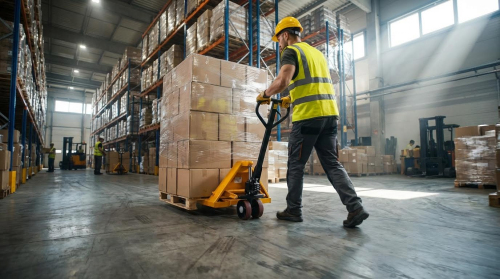
To read capacity labels correctly and set safe working margins, you treat the plate as the legal and engineering limit, then step back by 20–40% for everyday operation.
Labels answer “what is the lifting capacity of the pallet jack” under test conditions; your job is to interpret that number under your floor, your pallets, and your operators.
| Label Element | What It Shows | How To Use It | Real-World Safety Margin |
|---|---|---|---|
| Rated capacity (kg) | Maximum approved load at standard load center | Never plan routine work right at this figure | Target 60–80% of this for typical loads to extend life. |
| Load center (mm) | Distance from fork heel to rated center of gravity | Compare with your actual pallet and load geometry | Derate if your load center exceeds the printed value. |
| Lift height / capacity chart | Capacity at several mast heights (for high-lift) | Match your maximum stacking height to the chart | Use the lowest capacity number that covers your height. Reference |
| Truck weight | Unladen weight of the pallet jack | Important for floor loading and lift gates | Check mezzanine and elevator ratings against jack + load. |
| Attachment notes | Revised capacity with specific attachments | Use only the attachment-adjusted rating | Never assume original rating still applies with extensions. Reference |
- Keep labels readable: Replace any plate that is worn, painted over, or missing – Operators cannot respect limits they cannot see.
- Update labels after modifications: New forks or extensions require updated capacity data – Prevents accidental overload from outdated information.
- Train operators on label meaning: Explain capacity, load center, and height columns – Turns the plate from “decoration” into a daily decision tool.
- Set internal working limits: Use SOPs that cap loads below the printed rating – Builds in a buffer for slopes, poor floors, and wear.
How to turn a label into a site-specific working limit
1. Note the rated capacity and load center on the plate (for example, 2,500 kg @ 600 mm). 2. Measure your heaviest realistic pallet plus load and its load center. 3. If the actual load center is larger than 600 mm, calculate the derated capacity using the standard formula from capacity guidance. Reference 4. Apply an additional 20–40% reduction for dynamic effects such as slopes, braking, and uneven floors. 5. Document this lower figure as the “site working limit” in your operating procedures and training.
When you combine correct label reading with conservative working margins, you greatly reduce the chances of fork bending, wheel failure, or tip-over, especially on slopes and rough floors. Over time, this approach also supports predictive maintenance: by avoiding overloads, you keep forks, hydraulics, and wheels operating closer to their original design capacity for longer.
Final Thoughts On Safe Pallet Jack Load Capacity
Pallet jack safety depends on more than the kilogram figure stamped on the plate. Rated capacity, load center, height, motion, and wear all interact. Together they decide whether a move stays inside the design envelope or edges toward failure.
Engineers and supervisors must treat the data plate as a starting point, then adjust for real pallets, real floors, and real operators. Long or tall loads push the center of gravity out and up. Ramps and rough concrete add dynamic forces. Fork wear quietly eats into structural margin. Each factor cuts true safe capacity, even when the load looks “under the rating.”
Best practice is simple. Choose pallet jacks so routine loads sit in the 60–80% band of the nameplate figure. Measure or estimate actual load centers and derate using the moment-based formula. Set lower limits for ramps and poor floors. Keep forks, wheels, hydraulics, and labels under tight inspection, and use digital monitoring where the fleet justifies it.
When teams follow these rules, they turn capacity from a guess into a controlled parameter. That protects operators, stock, and floors, and keeps Atomoving pallet jacks working safely and efficiently through their full service life.
Frequently Asked Questions
What is the maximum weight a pallet jack can lift?
A pallet jack’s lifting capacity typically ranges from 2,000 to 6,000 pounds (907 to 2,721 kilograms). Manual pallet jacks usually support between 4,500 and 5,500 pounds (2,041 to 2,495 kilograms), while heavy-duty models can handle up to 10,000 pounds (4,536 kilograms) Pallet Jack Weight Guide.
Can a pallet jack lift a car?
Technically, a pallet jack can lift a car if its weight is within the jack’s capacity. However, this is not recommended as pallet jacks are not designed for such tasks and could lead to damage or safety risks. For automotive lifting, specialized equipment is preferred Forklift vs Pallet Jack Guide.
How much weight can a standard pallet hold?
Standard wooden pallets (48 x 40 inches) can hold approximately 2,500 pounds (1,134 kilograms). Plastic pallets have a higher range, supporting between 3,500 to 17,600 pounds (1,588 to 7,983 kilograms), depending on their design and material quality Pallet Load Capacity Guide.
What factors determine the lifting capacity of a pallet jack?
- Type of pallet jack: Manual or heavy-duty models have different capacities.
- Material and build quality: Steel construction generally supports heavier loads.
- Hydraulic system efficiency: Determines how much force can be applied to lift loads.
Always check the manufacturer’s specifications before using a pallet jack for heavy loads.