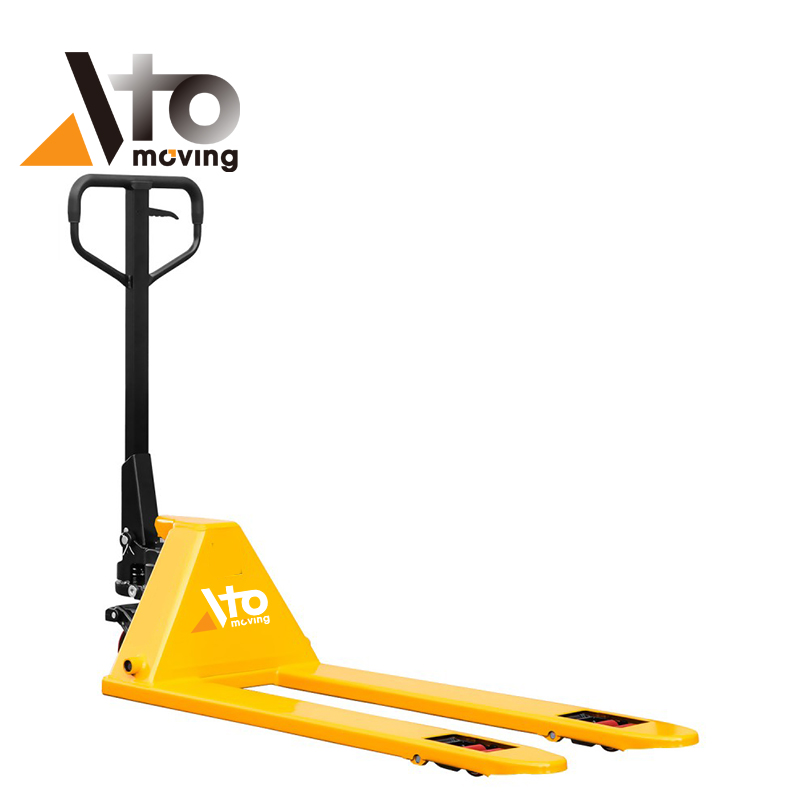
Electric pallet jacks are low-lift powered trucks designed to move palletized loads efficiently over short to medium distances. This guide explains how high an electric pallet jack will lift, how far it can run per charge, and how to match its specs to real industrial applications for safe, efficient handling.
Key Specs Of Electric Pallet Jacks Explained
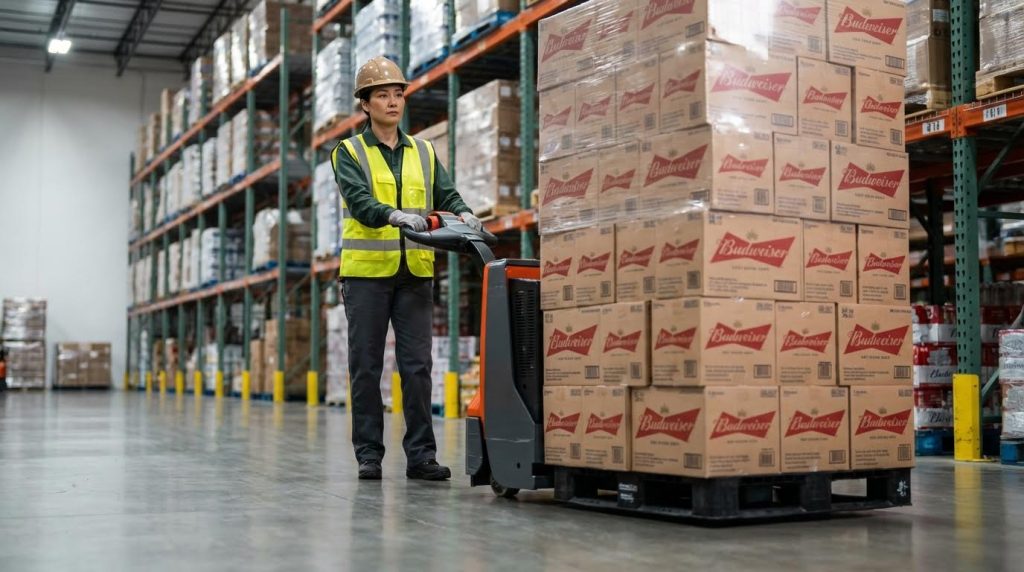
Electric pallet jacks are low-lift trucks designed to raise pallet loads just high enough for safe transport, using compact batteries and electric motors sized for multi-hour warehouse shifts. This section explains lift height, fork geometry, and power specs so you can match a jack to real aisle, pallet, and runtime constraints.
💡 Field Engineer’s Note: When comparing spec sheets, always cross-check three numbers together: fork length, lowered height, and turning radius. That trio tells you if the jack will actually clear your dock plates and still turn inside your narrowest aisle without chewing up pallets or racking.
Typical lift heights and fork geometry
For “how high will an electric lift pallet jack lift,” most standard models raise loads about 100–210 mm, with fork geometry optimized for 1,150 mm pallets and low-clearance entry. They are built to move pallets, not to stack like a forklift.
| Spec | Typical Value / Range | Operational Impact |
|---|---|---|
| Lowered fork height | ≈ 75–85 mm | Slides under most 1200 x 1000 mm and 1200 x 800 mm pallets without dragging boards. |
| Maximum lift height (service range) | ≈ 0–210 mm (0–8.2 in) for some models | Raises pallet just clear of floor, dock plates, and minor floor defects; not for stacking. |
| Standard fork length | ≈ 1,150 mm for most standard pallets | Matches common EUR and AU/US pallet footprints; keeps turning radius manageable in 2.4–2.7 m aisles. |
| Overall fork width (across both forks) | ≈ 520–685 mm (typical industry range) | Must fit between pallet entry openings without rubbing stringers. |
| Single fork width | ≈ 160–180 mm | Concentrates load on deck boards yet still fits between bottom deck gaps. |
| Capacity range | ≈ 1,500–3,500 kg for typical electric jacks | Determines fork section thickness and reinforcement needed to limit deflection. |
- Lift range vs. use: 100–210 mm lift is ideal for dock work and internal transport – you clear the ground without raising the load’s center of gravity too high.
- Fork length: ≈ 1,150 mm suits standard pallets – longer forks help with double-pallet moves but increase turning radius.
- Fork width match: Width must match pallet entry – too wide and you split boards; too narrow and the pallet rocks.
- Capacity class: Higher capacity means heavier, stiffer forks – better for dense loads but harder to maneuver in tight spaces.
How to check “will it lift high enough” for your site?
1) Measure your roughest floor high spot to low spot over 3–4 m. 2) Add dock plate crown (often 20–40 mm). 3) Add 20–30 mm safety margin. Your pallet underside must clear that sum when the forks are at max height.
Battery, motors, and duty-cycle ranges
Electric pallet jacks use compact DC drive and lift motors powered by 24 V battery packs sized for 3–8 hours of typical warehouse use per charge, depending on capacity and duty cycle.
| Component / Spec | Example Value | Best For… / Operational Impact |
|---|---|---|
| Battery configuration – 3,000 lb (≈1,360 kg) class | Two 12 V, 95 Ah batteries (24 V, 95 Ah) in one common design | Lighter truck; suitable for lighter loads and shorter or intermittent shifts. |
| Battery configuration – 4,500 lb (≈2,040 kg) class | Four 6 V, 200 Ah batteries (24 V, 200 Ah) in one common design | Higher energy reserve; better for dense loads and longer routes. |
| Drive motor – lower capacity class | ≈ 0.7 kW DC motor on some 3,000 lb units | Efficient for flat floors and moderate gradients; limits top speed and gradeability. |
| Drive motor – higher capacity class | ≈ 1.2 kW DC motor on some 4,500 lb units | More tractive effort for ramps and heavy loads; draws more current at peak. |
| Lift motor – lower capacity class | ≈ 1.3 kW lift motor on some 3,000 lb units | Quick enough for light to medium pallets; slows under near-rated loads. |
| Lift motor – higher capacity class | ≈ 2.0 kW lift motor on some 4,500 lb units | Maintains lift speed with heavy pallets; more comfortable for high-throughput docks. |
| Typical runtime – 3,000 lb class | ≈ 3–4 h continuous, up to ≈ 8 h intermittent for some models | Suited to partial shifts or low-intensity multi-shift use with breaks for charging. |
| Typical runtime – 4,500 lb class | ≈ 6–7 h continuous, up to ≈ 8 h intermittent for some models | Covers most single-shift operations without battery change. |
| Truck weight (unladen) | ≈ 247–608 kg (544–1,340 lb) in one product family | Heavier units track better on rough floors but increase point loading on weak slabs. |
- Higher Ah battery: More amp-hours extend runtime – critical for long routes or heavy slopes.
- Drive motor size: Larger kW improves acceleration and ramp performance – but drains the battery faster at full load.
- Lift motor size: Bigger motor keeps lift times short – important at busy docks where seconds per pallet add up.
- Truck weight: Extra mass improves traction – but can damage weak mezzanine floors or old tiles.
Choosing batteries and options for your duty cycle
For light, intermittent picking, a smaller 24 V, ~95 Ah pack can comfortably cover a shift with opportunity charging. For dense, continuous loading, step up to ~200 Ah and consider AGM or gel options where available to reduce maintenance and improve performance in cold or sensitive environments.
💡 Field Engineer’s Note: When operators complain that “the jack dies before lunch,” it is often not a bad battery but a mismatch between battery Ah and real duty cycle. Time your actual travel and lift minutes over a shift; if you exceed 60–70% of the rated continuous runtime, you either need a higher-capacity pack, a second battery, or to enforce opportunity charging during every break.
Engineering Factors Affecting Lift And Travel
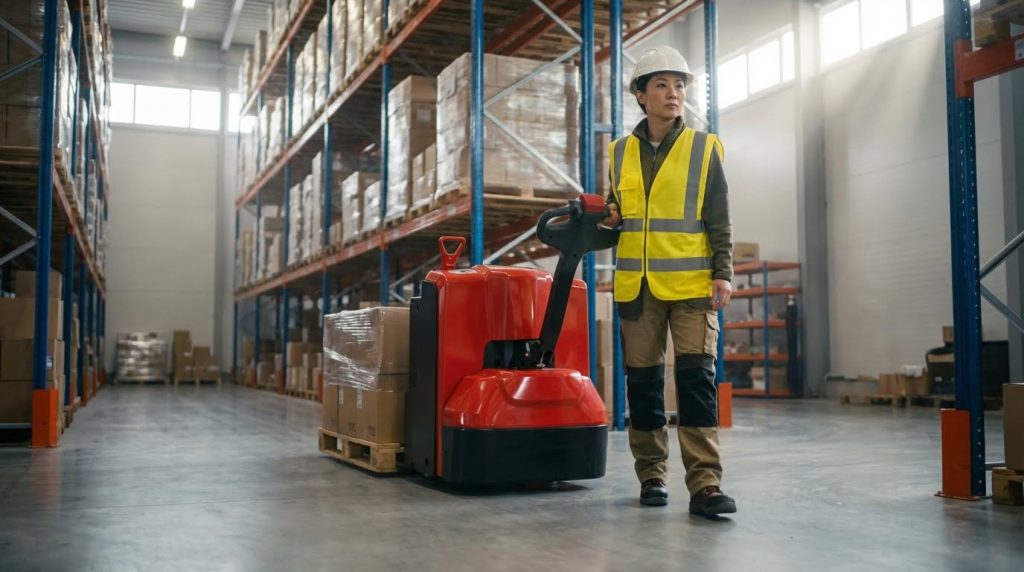
Engineering factors like capacity class, frame stiffness, battery system, and braking design directly control how high an electric lift pallet jack will lift and how far it can safely travel in a shift. Understanding these constraints lets you specify a jack that matches both vertical lift needs and horizontal travel demands without overloading components or draining batteries prematurely.
Capacity classes and structural design
Capacity class and structural design determine the safe lift height, fork deflection, and how the truck behaves when moving a fully loaded pallet. When you ask how high will an electric lift pallet jack lift, the real answer starts with its rated capacity and frame geometry, not just the hydraulic cylinder.
- Rated capacity band: Typical electric pallet jacks handle about 1,500–3,500 kg – this range sets how much load you can lift without overstressing steel and welds. Capacity guidance
- Fork length and section: Standard fork length is about 1,150 mm, with the fork thickness and height tuned to limit bending – this controls tip deflection at full load and reduces pallet damage. Fork dimensions
- Lift range of low-lift jacks: Many electric pallet jacks only raise from floor level to roughly 0–210 mm (0–8.2 in) – enough to clear pallet bottom boards and dock plates, not for stacking. Typical 0–8.2″ range
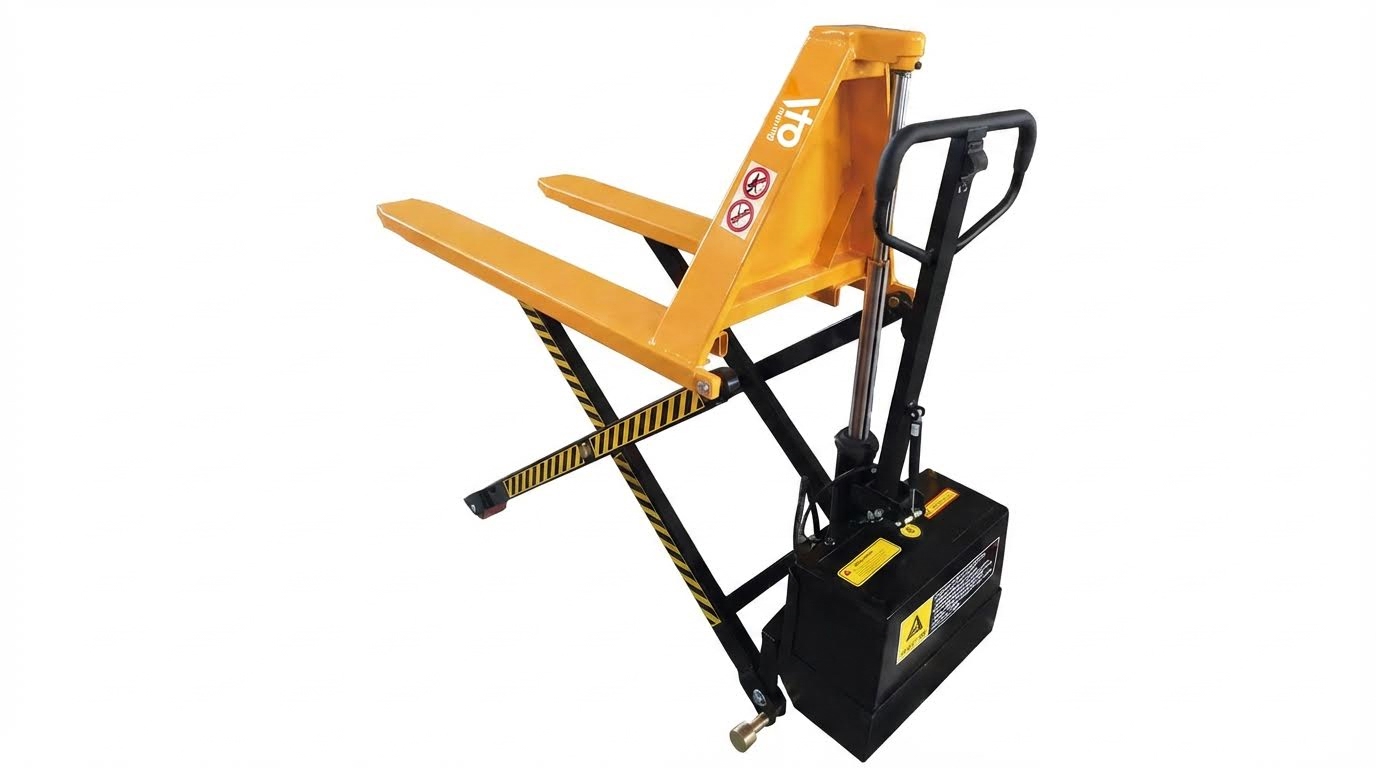
- High-lift variants: High-lift pallet trucks use reinforced masts or scissor mechanisms – they trade travel speed and capacity for extra lift height for work positioning or light stacking. High-lift discussion
- Chassis and tiller mounting: The frame around the drive wheel and the tiller pivot must resist torsion – this keeps steering predictable when turning with a raised, offset load.
- Load wheel layout: Tandem or single load wheels, and their spacing, affect point loading – this influences floor damage, ramp behavior, and fork stability at full lift.
| Design Aspect | Typical Range / Feature | Impact on Lift | Operational Impact |
|---|---|---|---|
| Rated capacity | 1,500–3,500 kg | Higher capacity usually means thicker forks and heavier chassis | Handles denser loads but increases truck weight and turning effort |
| Fork length | ≈1,150 mm standard | Longer forks increase bending at full lift | Suited to standard pallets; oversize pallets need longer forks and more space |
| Low-lift height | 0–≈210 mm (0–8.2 in) | Just clears pallet and dock transitions | Not for stacking; ideal for ground-level transport and loading docks |
| High-lift design | Mast or scissor support | Supports higher center of gravity | Best for workstations and light stacking, not long-distance travel |
How structural design limits “maximum” lift height
Theoretical hydraulic stroke could lift higher, but designers cap lift to keep the load’s center of gravity inside a stable wheelbase. Steel section sizes, welds, and load wheel spacing are all chosen so that, at rated capacity and maximum lift, stresses stay within fatigue limits and the truck still meets stability requirements in standards like ISO 3691 and EN/ANSI B56 series.
💡 Field Engineer’s Note: When a customer insists on “a bit more lift” to reach a higher conveyor, I check fork deflection with their heaviest pallet. If the fork tips sag more than a few millimeters at full height, operators start dragging into conveyor edges and racks, which quickly turns into bent forks and cracked welds.
Powertrain, batteries, and energy management
Powertrain and battery choices dictate how far and how long an electric pallet jack can travel at a given capacity, and how often it can cycle through its full lift range in a shift. For operations asking how high will an electric lift pallet jack lift and still last a full shift, the hidden constraint is usually battery amp-hours and motor sizing, not just the lift cylinder.
- Battery configuration: Smaller jacks may use two 12 V, 95 Ah batteries, while heavier-duty units use four 6 V, 200 Ah batteries – larger packs support longer run time and more lift cycles. Battery specs
- Drive motor power: Drive motors around 0.7–1.2 kW move the jack – higher power improves acceleration and gradeability but draws more current. Drive motor data
- Lift motor power: Lift motors around 1.3–2.0 kW handle vertical movement – stronger motors shorten lift time but increase peak load on the battery. Lift motor data
- Duty cycle and run time: A 1,360 kg (3,000 lb) model may run 3–4 hours at full duty or up to 8 hours intermittent; a 2,040 kg (4,500 lb) model may reach 6–7 hours continuous or 8 hours intermittent – planning shifts around these numbers prevents mid-shift failures. Duty-cycle data
- Energy per lift vs. travel: Lifting a full pallet by 100–200 mm uses a short, high-power burst, while long travel uses lower but continuous power – intensive lifting near capacity can drain smaller packs faster than long, light moves.
- Battery chemistry options: AGM and gel batteries are often available – they reduce maintenance and can perform better in specific environments, but need correct chargers and temperature management. AGM/gel options
| Model Type | Battery Pack | Motor Ratings | Typical Run Time | Best For… |
|---|---|---|---|---|
| ≈1,360 kg class | 2 × 12 V, 95 Ah | 0.7 kW drive, 1.3 kW lift | 3–4 h heavy / up to 8 h light | Short routes, moderate lift frequency, single-shift use |
| ≈2,040 kg class | 4 × 6 V, 200 Ah | 1.2 kW drive, 2.0 kW lift | 6–7 h heavy / up to 8 h light | Longer runs, heavier loads, high-throughput docks |
How to match battery and motor to your lift pattern
Start by counting lifts per hour at near full load and the average travel distance per pallet. High-lift, short-shuttle applications (e.g., feeding a packaging line) are lift-energy heavy. Long-haul, low-lift moves (e.g., cross-dock transfers) are travel-energy heavy. Choose higher Ah and a stronger lift motor for the first case, and prioritize drive motor power and speed control for the second.
💡 Field Engineer’s Note: In cold rooms around 0–4°C, I derate effective battery capacity by 20–30%. Without that margin, jacks that look fine on paper slow to a crawl in the last hour of the shift, and operators start “riding” the lift button to compensate, which only accelerates the drain.
Safety, braking, and compliance considerations
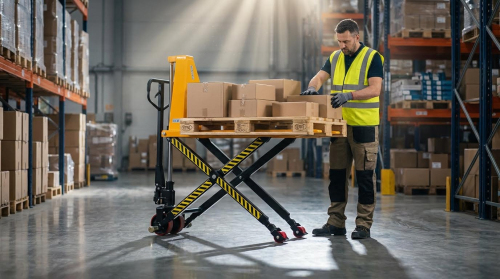
Safety systems and braking design set hard limits on speed, lift height use, and maneuvering, especially in tight aisles and around pedestrians. Even if the hydraulics could lift higher, compliant electric pallet jacks restrict lift and travel behavior to stay within stability and stopping-distance requirements.
- Emergency stop and reverse features: Many units include an emergency stop and a belly switch that reverses direction and moves the jack away from the operator, then disables it after activation – this mitigates crush hazards during close-quarters maneuvering. Belly switch feature
- Automatic braking: Electric pallet jacks often integrate automatic braking and speed control – these systems keep stopping distances predictable under varying loads. Safety feature summary
- Anti-roll-back and gradient control: Anti-roll-back functions hold the truck on slight slopes – this is critical when loading ramps or dock levelers where uncontrolled movement can tip a pallet. Anti-roll-back mention
- Speed reduction with raised forks: Many control systems limit travel speed when forks are raised – this reduces the risk of overturning when the load’s center of gravity is higher.
- Stability envelope and standards: Design must comply with industrial truck standards (e.g., ISO/EN, ANSI B56) – these specify stability tests with rated loads and maximum lift, effectively defining safe answers to how high will an electric lift pallet jack lift in real use.
- Environment-specific safety: In cold stores or wet areas, braking and traction tuning change – tires, speed curves, and braking ramps are adjusted to avoid skidding and loss of control.
| Safety / Control Feature | Function | Effect on Lift & Travel | Operational Impact |
|---|---|---|---|
| Emergency belly switch | Reverses and then disables truck | Limits travel in crush zones | Protects operator when pinned between truck and obstacle |
| Automatic braking | Applies brake when handle released or limits speed | Controls stopping distance at various loads | Makes behavior predictable in mixed pedestrian traffic |
| Anti-roll-back | Prevents uncontrolled rolling on slopes | Restricts movement on steep ramps | Safer loading at docks and into trailers |
| Speed reduction at height | Reduces speed with raised forks | Discourages fast travel with high center of gravity | Helps prevent tip-overs and dropped pallets |
Why safety systems limit “usable” lift height
Even if the hydraulic system could raise the forks higher, stability and braking requirements force manufacturers to cap travel speed or even prevent truck movement above a certain fork height. In practice, this means the safe, productive lift range is often lower than the mechanical maximum, especially in tight aisles or near pedestrians.
💡 Field Engineer’s Note: When I investigate pallet spills, the pattern is familiar: forks raised to maximum, operator driving fast to “save time,” then an emergency stop. The combination of high center of gravity and abrupt braking snaps the pallet forward. Programming speed limits with raised forks has solved more of these incidents than any amount of extra training alone.
Matching Jack Performance To Applications
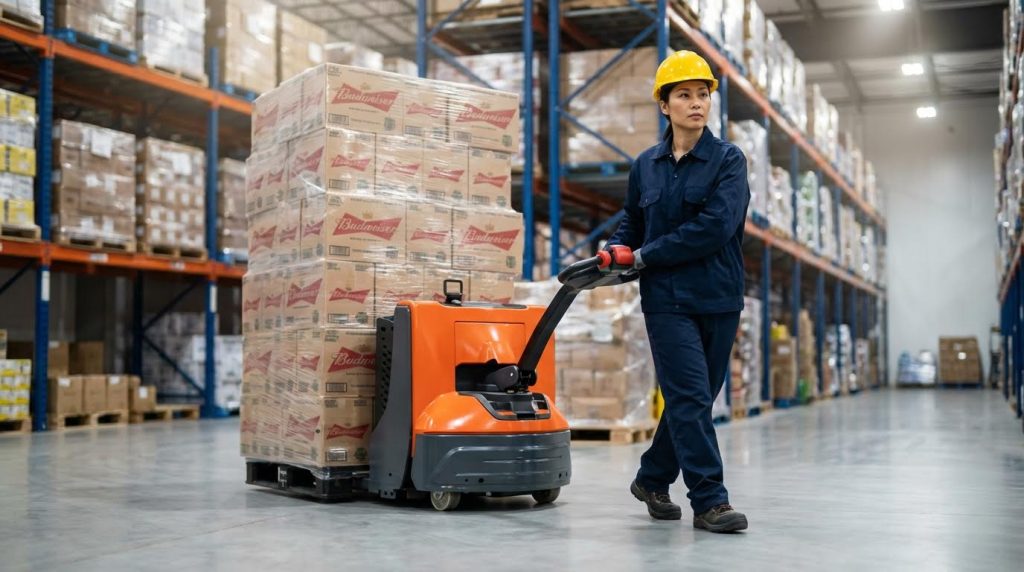
Matching an electric pallet jack to your application means balancing lift height, aisle width, floor quality, and shift length so the truck works safely and efficiently instead of fighting your building and loads.
In this section we translate numbers like “how high will an electric lift pallet jack lift” and “turning radius” into clear rules for docks, racking, production lines, and loading areas.
Lift height and aisle constraints by use case
Lift height and aisle constraints define where an electric pallet jack can actually work, from dock plates and trucks to racking and production cells.
Most electric pallet jacks are built to move palletised loads at low level, not to replace a stacker or reach truck, so you need to match the lift range and geometry to the task.
| Typical Use Case | Required Lift Height (approx.) | Recommended Jack Type | Aisle / Space Constraint | Operational Impact |
|---|---|---|---|---|
| Dock-to-rack floor transport (no stacking) | Up to 200 mm (pallet just clear of floor) | Standard electric pallet jack | Aisles ≥ 2,000–2,400 mm | Fast horizontal moves; no need for high lift |
| Truck loading/unloading at docks | 0–200 mm, plus dock plate thickness | Standard electric pallet jack | Truck interior width; tight turning at doors | Must clear dock plate lips and trailer floors |
| Feeding production lines / workstations | 100–800 mm depending on conveyor/table height | High-lift pallet jack or scissor-lift type | Short approaches, tight spaces at machines | Ergonomic height to reduce bending and strain |
| Low-level order picking (ground-level pallets) | Up to 200 mm | Electric pallet jack or low-level order picker | Narrow aisles, frequent turning | Low lift keeps centre of gravity stable while picking |
| Stacking 1–2 high in racking | 1,000–3,000 mm | Not suitable for standard pallet jack | Requires stacker or reach truck aisle widths | Use dedicated stacker; pallet jacks are for ground work |
Electric pallet jacks typically lift from ground level to a modest working range mainly intended to clear the pallet and floor surface. One manufacturer lists a service range from 0 mm to about 210 mm (8.2 in) for standard models, which is enough for moving but not stacking pallets. Typical electric pallet jack lift range data
High-lift or scissor-type pallet jacks extend this range significantly and can raise loads closer to bench or conveyor height, but they trade off travel speed and sometimes rated capacity at maximum height. Guidance from one technical article stresses that high-lift options are necessary for stacking or working from raised surfaces, and that you must consider both the maximum height and stability at that height when selecting a model. High-lift pallet jack selection considerations
How high will an electric lift pallet jack lift in real sites?
In most warehouses, a standard electric pallet jack only needs to lift high enough to: clear the pallet base (usually 80–100 mm), bridge small floor irregularities, and pass over dock plates or thresholds. This usually means a practical range of roughly 100–200 mm. If you need to reach 700–800 mm to match a conveyor or workbench, you are in high-lift territory and should specify a high-lift pallet jack or a dedicated lift table instead of a standard low-lift unit.
- Rule 1 – Measure the highest interface: Dock, conveyor, or table height – This tells you whether a low-lift or high-lift jack is required.
- Rule 2 – Check pallet type: Standard 1,150 mm forks suit most pallets – Wrong fork length or width causes hang-ups and damaged decks.
- Rule 3 – Confirm turning envelope: Map the tightest corner or aisle – Prevents jamming trucks in blind aisles and truck bodies.
- Rule 4 – Separate lifting from stacking: Use stackers for vertical storage – Keeps pallet jacks in their safe low-lift role.
💡 Field Engineer’s Note: When customers ask “how high will an electric lift pallet jack lift,” I first ask where the load starts and ends. If both points are on the floor, extra lift height adds cost and instability without improving throughput.
Environment, floor quality, and shift patterns
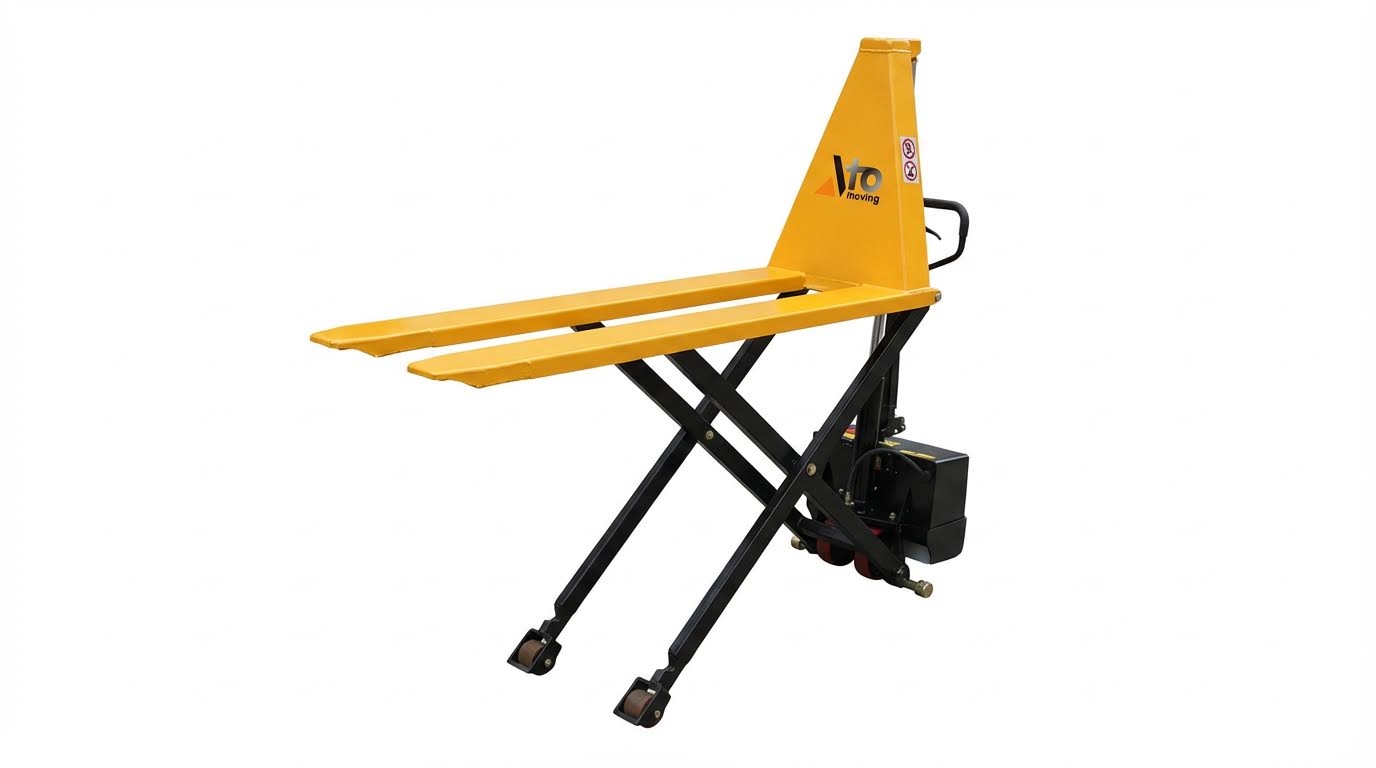
Environment, floor quality, and shift patterns determine how hard an electric pallet jack’s powertrain, wheels, and batteries must work to deliver safe, reliable performance.
Two jacks with identical capacities behave very differently on smooth indoor concrete versus broken outdoor aprons or in cold storage, so you must specify around your worst-case conditions.
| Factor | Key Consideration | Engineering Impact | Best For… |
|---|---|---|---|
| Floor smoothness | Rough vs smooth concrete | Higher rolling resistance and vibration on rough floors | Spec higher-traction tyres and robust forks for harsh floors |
| Floor flatness / level | Uneven slabs, ramps, thresholds | More lift needed to clear high spots; risk of tip or pallet strike | Use jacks with adequate lift range and good ground clearance |
| Environment temperature | Ambient vs cold storage | Battery capacity and oil viscosity change in low temps | Cold-rated batteries and seals for refrigerated areas |
| Shift pattern | Single vs multi-shift, continuous vs intermittent | Determines Ah capacity and charging strategy | High-Ah packs or opportunity charging for multi-shift work |
| Travel distance per move | Short in-aisle vs long cross-dock runs | Longer runs drain batteries and heat motors | Higher kW drive motors and larger batteries for long hauls |
Technical guidance notes that smooth concrete floors are ideal for operating electric pallet jacks, while rough warehouse floors may require models with enhanced traction features. Flooring and environment compatibility for pallet jacks
In cold storage, low temperatures reduce battery performance and can affect hydraulic oil behaviour, so it is essential to use pallet jacks specifically designed for low-temperature conditions with suitable materials and battery chemistry. The same source also highlights that manoeuvrability depends on a compact chassis and appropriate turning radius for the workspace, which is critical in narrow aisles and congested areas. Manoeuvrability and safety features in pallet jacks
Battery range vs shift pattern
One electric pallet jack specification shows that a 1,360 kg (3,000 lb) capacity unit with two 12 V, 95 Ah batteries can operate 3–4 hours at full usage, or up to 8 hours intermittently. A 2,040 kg (4,500 lb) capacity version with four 6 V, 200 Ah batteries can reach 6–7 hours at full use, or roughly a shift at intermittent duty. Electric pallet jack battery and duty-cycle data Match these ranges to your actual driving time, not just clock time on shift.
- Environment: Specify cold-storage-ready jacks below 0°C – Prevents sluggish hydraulics and early battery failure.
- Floor quality: Audit expansion joints, potholes, and slopes – Ensures forks can lift high enough to clear hazards safely.
- Shift length: Compare true driving hours to battery Ah – Avoids mid-shift brownouts and overheated motors.
- Traffic pattern: Map long runs vs short shuttles – Helps choose between walkie-only and rider-capable models.
💡 Field Engineer’s Note: On rough or sloped floors, operators instinctively lift pallets higher “just in case.” If your jack barely clears at full lift, they will run at max height all day, which increases instability and fork damage. Build in 20–30 mm clearance over the worst spot you can find.
Final Considerations For Specifying Electric Pallet Jacks
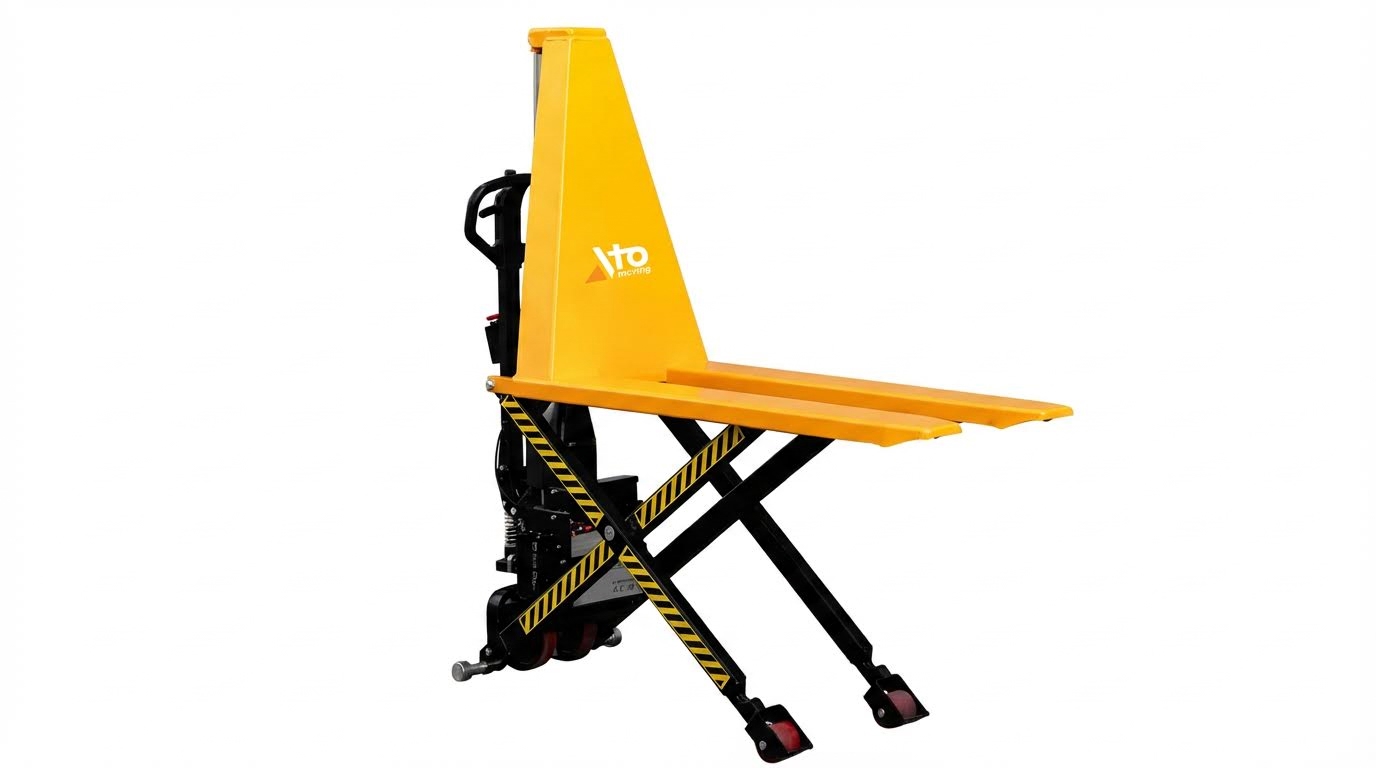
The final choice of an electric pallet jack comes down to matching lift height, capacity, and environment to your real working constraints, not just catalogue specs. This is where questions like “how high will an electric lift pallet jack lift” must be tied directly to doors, docks, racking, and shift length.
- Clarify the true lift height you need: For simple transport, a low-lift electric pallet jack that raises forks only about 100–210 mm is usually enough to clear floor irregularities and dock plates. This minimizes cost while still protecting forks and loads.
- Decide if you really need high-lift capability: If you must stack or feed conveyors, choose a high-lift or scissor-type pallet jack with greater elevation, instead of overworking a low-lift unit at its limits. This improves stability and reduces tip-over risk.
- Match capacity with a safety margin: Typical electric pallet jacks handle about 1,500–3,500 kg, and it is recommended to choose a model slightly above your maximum daily load. This preserves frame life and keeps braking distances predictable. Reference – capacity selection guidance
- Check fork geometry against your pallets: A common fork length is about 1,150 mm, which suits most standard pallets, but special or oversize pallets may need longer forks or different widths. Correct fork size avoids broken boards and jammed entry. Reference – fork dimensions
- Relate lift height to floor and dock interfaces: Typical electric pallet jacks offer a service lift range from roughly 0 mm to about 200 mm (0–8.2 in), which is enough to clear most dock plates and thresholds. Knowing this range lets you answer “how high will an electric lift pallet jack lift” in the context of your ramps and truck beds. Reference – typical lift range
- Size the battery and duty cycle to your shifts: For light to medium use, 3,000 lb (≈1,360 kg) units can run 3–4 hours at full duty or up to about 8 hours intermittently, while 4,500 lb (≈2,040 kg) units typically offer 6–7 hours at full duty and up to 8 hours with intermittent use. This prevents mid-shift failures and supports planned charging windows. Reference – runtime and battery data
- Align truck weight with your floors and docks: Electric pallet jacks can weigh from about 250–600 kg (544–1,340 lb) empty. Heavier units ride better over rough floors but may overload weak mezzanines or dock plates. Reference – weight range
- Evaluate your flooring and environment honestly: Smooth concrete is ideal, while rough floors or outdoor transitions call for higher-quality wheels and more robust traction. Cold storage or wet areas require models specifically designed for low temperatures and corrosion resistance. This prevents traction loss and premature component failure. Reference – environment guidance
- Check manoeuvrability against your tightest aisles: Compact chassis and ergonomic tillers reduce the turning radius, which is critical in aisles under about 2.5 m wide. This keeps operators from dragging loads or striking racking uprights. Reference – manoeuvrability
- Prioritize safety systems, not just speed: Look for emergency stop, automatic braking, anti-roll-back, and speed control. Some models also include a “belly” reverse switch that backs the truck away and then disables it if pressed for more than about 1.5 seconds. These features directly reduce crush and run-over incidents. Reference – safety feature example
- Consider optional platforms and battery types: Rider platforms and AGM/gel batteries add cost but can extend operator comfort and reduce maintenance. These options pay off in multi-shift or long-travel operations. Reference – optional equipment
How to turn “how high will an electric lift pallet jack lift” into a spec
To convert the question “how high will an electric lift pallet jack lift” into a proper specification, start from the interfaces, not the brochure. Measure the highest obstacle you must clear (dock plate, threshold, ramp crest) and add at least 30–50 mm safety margin to account for floor wear and pallet sag. Then measure the lowest and highest transfer points (e.g., conveyor beds, mezzanine edges) if you are not just floor-transporting. If all your work is floor-to-floor, a low-lift range of roughly 0–200 mm is usually sufficient. If you must stack or feed higher equipment, you likely need a high-lift pallet jack or a different class of truck altogether, such as a stacker or reach truck, instead of forcing a low-lift jack to do the wrong job.
💡 Field Engineer’s Note: When you are close to the limits on both lift height and capacity, always test with your worst-case pallet: heaviest load, softest timber, and roughest floor section. Many near-misses I investigated came from jacks that “could just barely lift it” on paper but lost stability when the pallet deflected or when one wheel hit a shallow depression mid-travel. A 20–30 mm extra lift margin and 10–15% capacity headroom are cheap insurance compared with a dropped load or a damaged dock edge.
Final Considerations For Specifying Electric Pallet Jacks
Electric pallet jack performance comes from a tight link between geometry, structure, power, and safety controls. Fork height and length set how the truck clears docks and floor defects without raising the center of gravity too far. Structural capacity and fork stiffness then keep deflection low so pallets stay stable at full load. Battery size and motor power define how far and how fast you can move that load through a shift without brownouts or overheating.
Safety systems close the loop. Speed limits with raised forks, automatic braking, and anti-roll-back functions keep the truck inside a stable envelope, even when operators push hard. On rough or cold floors, these limits often decide the real usable lift and speed, not the brochure maximums.
For operations and engineering teams, the best practice is clear. Start from your worst pallet, tightest aisle, highest interface, and longest shift. Then select lift range, capacity, and battery to give at least 10–15% headroom and 20–30 mm extra clearance. Use high-lift or stacker trucks for vertical work, and keep low-lift pallet jacks in their ground-handling role. When in doubt, test on-site with an Atomoving unit before standardizing your fleet.
Frequently Asked Questions
How high can an electric pallet jack lift?
An electric pallet jack can typically lift loads to heights ranging from 6 inches to over 20 inches. These machines are designed for environments where frequent lifting and lowering are necessary, such as warehouses and distribution centers. Pallet Jack Lift Guide.
What is the minimum and maximum height range for electric pallet jacks?
The minimum height for most electric pallet jacks is around 3 to 4 inches, while the maximum height usually ranges between 12 to 15 inches. Some models may offer higher lifting capabilities depending on their design and intended use. Car Jack Size Guide.