This guide explains how to use a drum dolly safely, from loading and securing drums to moving and unloading them with minimal risk. You will learn practical limits, inspection routines, and route-planning methods that reduce injuries, spills, and equipment damage.
We focus on real-world material handling: typical drum masses, center-of-gravity control, push forces, and floor conditions. Use this as a step-by-step reference to standardize drum dolly operation in warehouses, plants, and maintenance shops.

Drum Dolly Basics and Core Safety Principles
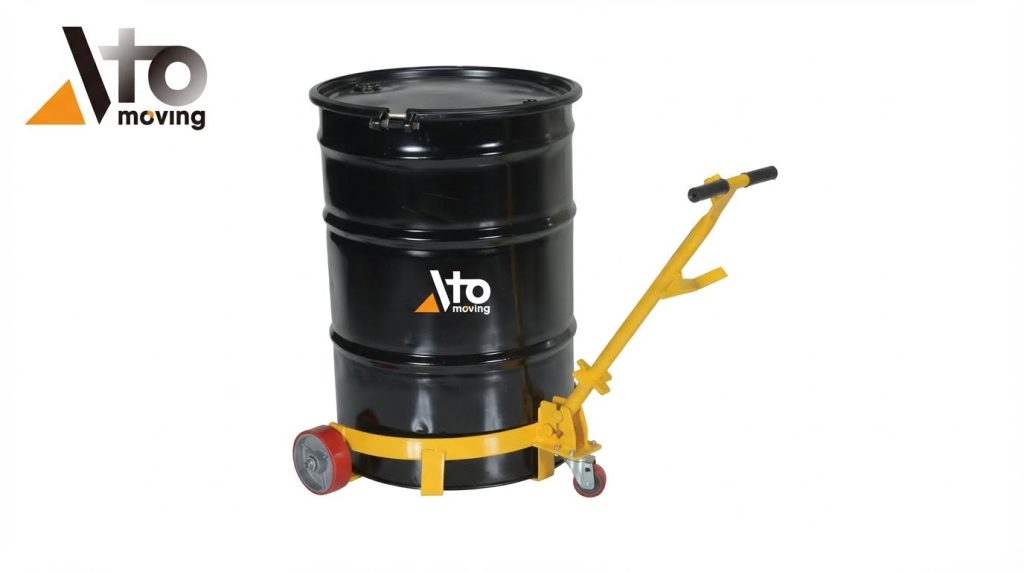
Drum dolly basics and safety principles explain how to use a drum dolly without tipping, overloading, or injuring operators, by matching the right dolly type, load rating, and PPE to each drum handling task.
This section builds the foundation for how to use a drum dolly safely in real plants and warehouses. We start with dolly types and capacities, then move into stability physics and finish with standards, PPE, and training.
Drum dolly types and typical load capacities
Drum dolly types and capacities matter because each design supports different drum sizes, floor conditions, and risk levels, and choosing the wrong type is a common root cause of spills and tip-overs.
Most drum dollies are designed around common 200 L (55-gallon) steel or plastic drums and typical gross masses up to roughly 300–500 kg, including drum plus contents. Capacity always refers to the total drum weight, not just the liquid.
| Dolly Type | Typical Drum Size | Typical Capacity Range (kg) | Key Features | Best For… |
|---|---|---|---|---|
| Round ring / cradle dolly | 200 L (55-gallon) steel or plastic | 250–500 kg | Circular ring, 3–4 casters, low height | General warehouse moves on smooth concrete |
| Heavy-duty cross-frame dolly | 120–200 L drums | 300–500 kg | Cross frame, reinforced corners, larger wheels | Frequent moves, mixed floor joints and small thresholds |
| Multi-drum platform dolly | 2–4 × 200 L drums | 500–1,000+ kg | Rectangular platform, multiple drums | Batch moves in production areas; needs wide aisles |
| Specialty spill-containment dolly | Hazardous 200 L drums | 250–450 kg | Integrated sump or tray | Chemicals, oils, and environmental compliance |
Manufacturers rate drum dollies so the load rating exceeds the maximum drum mass, including liquid, sludge, or solids. Overloading a dolly increases tipping risk and can breach safety rules. Guidance on load ratings and stability emphasizes staying within the rated capacity.
- Match capacity to worst-case drum mass: Use density of the heaviest liquid – avoids hidden overloads.
- Use low-profile dollies where possible: Lower deck height lowers the combined center of gravity – improves stability on bumps.
- Select wheel material for the floor: Harder wheels roll easier; softer wheels grip better – reduces push force and skidding.
💡 Field Engineer’s Note: When in doubt between two drum dolly sizes, choose the higher-capacity model and treat 70–80% of rated load as your practical limit. This margin absorbs unknowns like heavier liquids, scale errors, and dynamic loads over floor joints.
Load ratings, stability, and center of gravity control
Load ratings, stability, and center of gravity (COG) control are the physics core of how to use a drum dolly safely, because every tip-over starts with the COG moving outside the wheelbase.
Drum dollies are typically rated to carry loads up to about 500 kg per drum, depending on design. Stability depends on keeping the drum’s COG vertically above the dolly’s support polygon (the wheelbase footprint), especially when the dolly hits a bump, turns, or runs on a slope. Misalignment or overload significantly increases tipping risk.
| Stability Factor | What It Means | Unsafe Condition | Operational Impact |
|---|---|---|---|
| Load rating | Maximum allowed drum mass (kg) | Drum mass > rating | Higher stress on frame and wheels; more violent tip if it fails |
| Wheelbase width | Distance between outer wheels | Narrow base with tall drum | Small sideways push can move COG outside footprint |
| COG position | Drum centerline vs dolly centerline | Off-center drum | Dolly tends to twist or roll toward heavy side |
| Dynamic effects | Acceleration, braking, bumps | Sudden starts/stops, floor defects | Temporary COG shift causes rocking or tip-over |
Safe drum dolly use keeps the drum vertical and centered on the dolly, with its axis aligned to the dolly centerline. Guidance on drum positioning stresses vertical, centered placement and firm restraints, while safe operating techniques emphasize aligning the vertical axis with the dolly centerline.
- Keep drum vertical: Avoid leaning drums on the ring or frame – prevents side loading and roll-off.
- Center the drum: Equal clearance around the drum – keeps weight shared across all casters.
- Use restraints where fitted: Straps, clamps, or rings snug, not loose – limits rocking during stops and turns.
- Control speed and turns: No sudden pivots or hard braking – reduces dynamic COG shifts.
How to estimate if a drum is within rating
1) Identify the drum volume (e.g., 200 L). 2) Use the heaviest likely liquid density (e.g., 1.2 kg/L for many chemicals). 3) Multiply to get liquid mass (200 × 1.2 = 240 kg). 4) Add drum tare mass (say 20 kg) to get 260 kg. 5) Compare to dolly rating and stay comfortably below it.
💡 Field Engineer’s Note: The most overlooked stability issue is small floor level changes: a 10–15 mm lip at a doorway can jolt a fully loaded drum enough to rock it. Approach lips straight on and slow, and never pull a loaded dolly backward over a threshold.
Applicable standards, PPE, and operator training
Applicable standards, PPE, and operator training turn good equipment into a safe system, because even a perfectly designed drum dolly becomes dangerous in untrained hands without the right protection.
While drum dollies are simple devices, their safe use sits under general material handling and occupational safety rules. Facilities typically align with national regulations on manual handling, hazard communication, and workplace transport, and they document inspection and maintenance to prove compliance. Structured inspection, cleaning, and lubrication schedules support compliance and extend equipment life.
- Core PPE for drum dolly work: Safety shoes with toe protection, gloves, and eye protection – mitigates crush, cut, and splash risk.
- Additional PPE for chemicals: Chemical-resistant gloves, aprons, and face shields – protects against hazardous contents during leaks or spills.
- Manual handling training: Push instead of pull, keep hands at about elbow height, and use body weight – reduces back and shoulder strain.
- Route and traffic awareness: Know designated drum lanes and crossings – prevents collisions with pedestrians and vehicles.
Safety best practices highlight PPE like steel-toe boots and gloves, strict adherence to weight limits, and correct body mechanics, while manual handling guidance recommends pushing, limiting initial push force to about 25 kgf, and avoiding sudden movements.
- Step 1: Train operators on drum hazards and routes – links equipment use to site-specific risks.
- Step 2: Demonstrate pre-use checks and proper loading – builds habit of rejecting unsafe dollies.
- Step 3: Practice controlled starts, turns, and stops with empty then full drums – lets operators feel inertia safely.
- Step 4: Refresh training after incidents or layout changes – keeps procedures aligned with reality.
Where “how to use a drum dolly” fits into a safety program
Written “how to use a drum dolly” instructions should sit inside your manual handling or drum handling SOP. They should cover equipment selection, inspections, loading, travel rules, parking, and emergency response, and they should tie back to your risk assessment and training records.
💡 Field Engineer’s Note: The fastest safety win I see is adding a short, photo-based “how to use a drum dolly” SOP at the storage area, plus a 5-minute toolbox talk. Most near-misses disappear once operators clearly see what “centered,” “secured,” and “within rating” actually look like.
Engineering Controls for Safe Loading and Unloading
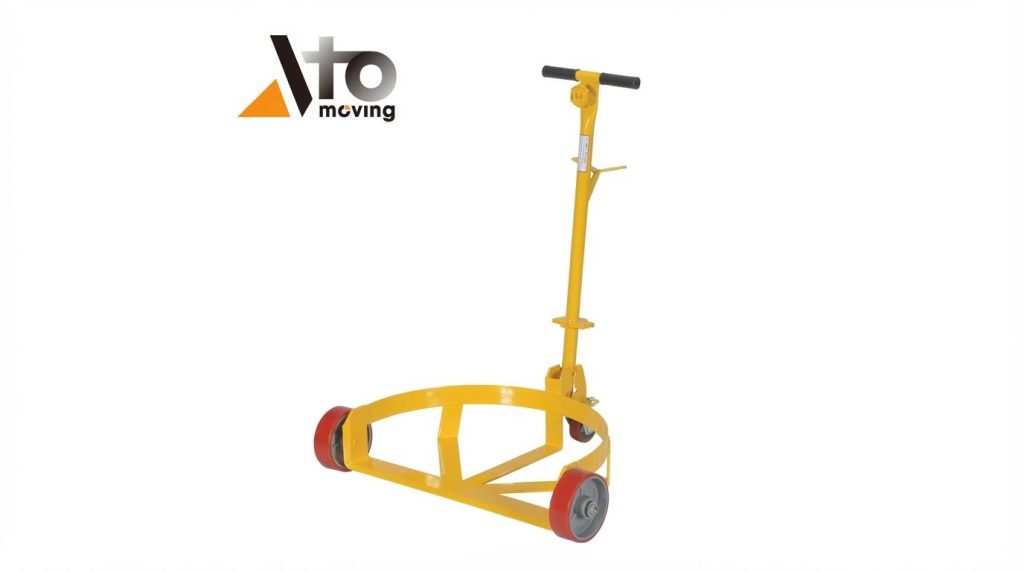
Engineering controls for safe drum dolly loading and unloading focus on stable positioning, restraint integrity, functional brakes, and controlled lifting so the drum’s center of gravity stays inside the dolly footprint at all times. If you want to know how to use a drum dolly safely, this is the critical phase where most crush, tip, and spill incidents either happen or are prevented.
- Goal: Keep the drum stable and restrained – Prevents tipping, roll-off, and sudden movement during transfer.
- Method: Use mechanical aids and brakes, not body strength – Reduces musculoskeletal strain and uncontrolled motion.
- Control: Standardize checks and steps – Makes safe operation repeatable across all shifts.
💡 Field Engineer’s Note: Treat every loading and unloading point like a “mini loading dock”: level floor, enough clearance for turning, and no slopes within at least 1 m of the transfer point. Most near-misses I have seen came from tiny floor irregularities right under the dolly wheels.
Pre-use inspection of frame, wheels, and restraints
Pre-use inspection is the first engineering control that determines whether a drum dolly is mechanically safe to load before you even touch a drum. A quick, consistent checklist prevents you from putting a 200 L drum on a dolly with hidden defects.
- Frame and welds: Check for cracks, bent sections, or corrosion – Compromised frames can buckle under dynamic loads.
- Handles and cradles: Ensure no looseness or deformation – Loose interfaces cause sudden shifts when you start or stop.
- Wheels and casters: Spin each wheel; look for flat spots, wobble, or debris – Damaged wheels increase push force and can stop suddenly.
- Bearings and rotation: Confirm smooth, low-resistance rolling – High resistance tempts operators to overexert and jerk the load.
- Brakes and locks: Engage on level ground and try to push – If you can move it, you cannot safely load it.
- Restraints (straps, rings, clamps): Inspect for cuts, fraying, corrosion, or missing hardware – Weak restraints fail exactly when you hit a bump.
- Noise and tracking test: Roll the empty dolly 3–5 m – Grinding sounds or side-drift indicate bearing or alignment issues during daily checks.
Suggested quick pre-use checklist (laminate and hang at issue point)
- Step 1: Visual scan of frame and welds – Reject if any crack or severe rust is visible.
- Step 2: Spin all wheels and casters – Reject if they bind, wobble, or feel rough.
- Step 3: Test brakes on level floor – Reject if the dolly moves with moderate push.
- Step 4: Inspect straps/clamps – Reject if cuts, broken stitches, or bent hooks appear.
- Step 5: Short empty test roll – Reject if it veers sideways or makes grinding noises.
Daily mechanical checks should be logged, not just “eyeballed”, so you can remove problem dollies from service before a 300 kg drum is on top of them. Facilities that formalized daily wheel, frame, and restraint inspections significantly reduced unplanned downtime and near-miss events. Daily inspection guidance aligns with common preventive maintenance practice.
Positioning drums, securing restraints, and brake use
Correct drum positioning, tight restraints, and positive brake engagement are what physically keep the drum’s center of gravity inside the dolly wheelbase while you load and unload. This is the “hands-on” part of how to use a drum dolly without tipping or losing the load.
- Step 1: Park on level, clean floor – Uneven or sloped floors shift the center of gravity during loading.
- Step 2: Apply brakes or wheel chocks – Prevents the dolly from rolling as the drum contacts it.
- Step 3: Align drum and dolly centerlines – Vertical drum axis should sit over the dolly’s geometric center.
- Step 4: Keep drum vertical during placement – Tilting raises the effective center of gravity and reduces stability.
- Step 5: Seat drum fully in cradle or ring – No gaps that allow rocking or rolling.
- Step 6: Tighten straps, clamps, or rings – Remove slack so the drum cannot shift during acceleration or braking as recommended for stable drum handling.
- Step 7: Reconfirm brakes before first move – Only release brakes once the drum is fully secured.
Drums should be positioned vertically and centered on the dolly to maintain stability, with restraints applied firmly but not so tight that they dent thin-walled drums. Excessive clearance between the drum and restraints allows rocking, which increases tipping risk when you hit floor joints or drains. Guidance on drum positioning and restraint use emphasizes this point.
| Setup Factor | Good Practice | Risk if Ignored | Operational Impact |
|---|---|---|---|
| Drum orientation | Vertical, axis aligned with dolly centerline | Offset center of gravity, higher tip risk | Allows safe turning within narrow aisles |
| Restraint slack | No visible slack; drum does not rock by hand | Shifts on bumps; can walk off the cradle | Stable over floor joints and small thresholds |
| Brake engagement | Set before loading/unloading | Dolly rolls as drum contacts it | Prevents crush incidents at operator’s feet |
| Floor slope | ≈0% at transfer point | Runaway dolly during placement | Predictable, low push forces |
💡 Field Engineer’s Note: If you can rock the drum by hand more than a few millimeters at the rim, it is not secured enough for real-world floors. Tighten restraints or re-seat the drum before moving, especially if you will cross door thresholds or expansion joints.
Common positioning mistakes to eliminate in training
- Half-on cradles: Drum only partly seated on the support ring – Creates a lever arm that magnifies tipping forces.
- Side loading on a slope: Loading from the downhill side – Dolly tends to roll under the drum.
- Loose straps “for short moves”: Assuming a 5 m move is “safe enough” – Most spills occur on short, rushed transfers.
Hoists, lifters, and controlled transfer to and from dollies
Using hoists or drum lifters for transfer to and from dollies allows you to handle full drums with controlled, predictable forces instead of manual tilting or rolling. The key is to grip only approved drum areas and coordinate lift, swing, and set-down with the dolly’s brakes and position.
- Step 1: Position the empty dolly under the planned landing point – Center of the cradle under the drum’s vertical axis.
- Step 2: Apply dolly brakes and verify floor is level – Prevents dolly drift during lowering.
- Step 3: Attach hoist or lifter to approved drum features – Avoid bungs, fittings, or thin sections that can tear as recommended for safe gripping points.
- Step 4: Lift just high enough to clear obstructions – Minimizes swing radius and kinetic energy.
- Step 5: Guide the drum slowly over the dolly with tag lines if needed – Controls rotation and prevents side impact.
- Step 6: Lower at a controlled speed until the drum is fully seated – Avoids impact loads on the frame and wheels.
- Step 7: Release hoist only after the drum is stable and restraints are applied – Prevents the drum from tipping as load transfers.
Loading and unloading should always occur with the dolly parked on level ground and brakes applied, with hoists or lifters gripping only approved drum areas and using controlled lifting speeds. These controls reduce the chance of sudden drum swing or drop, which can overload the dolly structure or push the center of gravity outside the wheelbase. Recommended loading and unloading procedures stress brake use and controlled motion for this reason.
| Transfer Method | Typical Use Case | Main Control | Best For… |
|---|---|---|---|
| Chain or strap drum lifter | Vertical lift from pallet to dolly | Evenly loaded around drum rim | Steel 200 L drums with strong chimes |
| Mechanical drum clamp | Repeat transfers in production lines | Positive locking before lift | High-throughput, consistent drum sizes |
| Overhead hoist with sling | Irregular or damaged drums | Balanced sling angles | Recovery or rework areas |
💡 Field Engineer’s Note: Never “chase” a swinging drum with the dolly. Stop, park the dolly with brakes on, let the drum settle, then reposition. Chasing the swing is how dollies get knocked over and operators get pulled off balance.
Integrating hoists and dollies into a standard work instruction
- Define landing zones: Mark floor rectangles where dollies must sit during hoist operations – Ensures repeatable alignment.
- Set lift speed limits: Use hoist controls or SOPs to cap lowering speed – Prevents impact loading.
- Tag line requirement: For any lift over 1 m, require tag lines – Gives the operator leverage to control swing.
When all three elements—pre-use inspection, precise positioning with restraints, and controlled hoist transfer—are combined, you create a robust engineering control system for how to use a drum dolly safely. This system reduces reliance on operator strength and reflexes and instead builds safety into the equipment, layout, and standard steps.
Safe Movement, Ergonomics, and Maintenance Programs
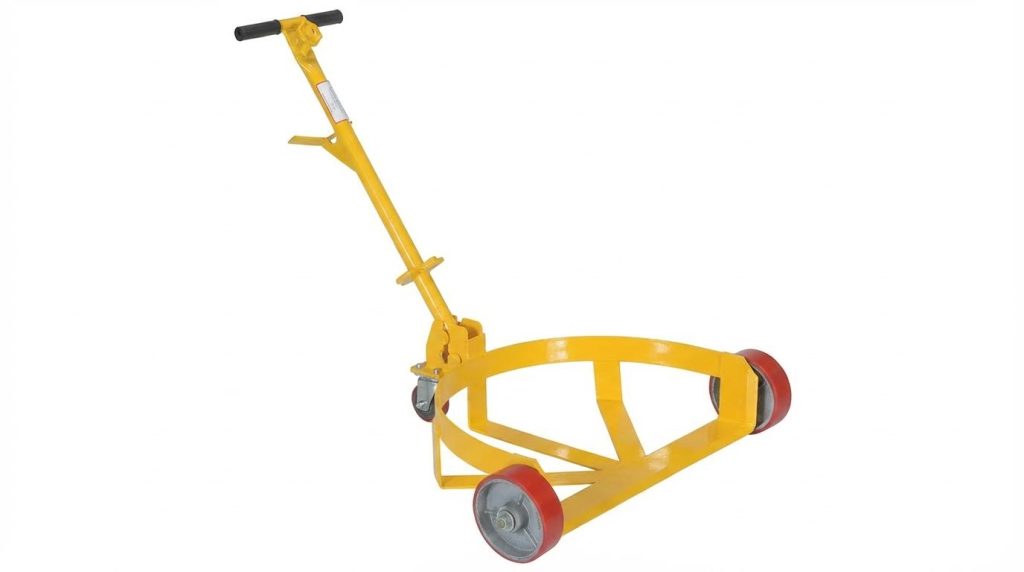
This section explains how to use a drum dolly safely by controlling push forces, floor conditions, traffic, and maintenance so drums up to several hundred kilograms move with minimal strain and maximum stability.
- Goal: Integrate ergonomics, route design, and preventive maintenance – to cut injury risk, near-misses, and unplanned downtime.
- Scope: Manual forces, floor and route standards, and structured inspection programs – the core of any drum dolly safety system.
Manual handling limits, push forces, and ergonomics
Manual push forces, body posture, and drum positioning determine whether drum dolly use stays within safe ergonomic limits or creates back and shoulder injuries.
- Push, don’t pull: Operators should push drum dollies instead of pulling – this uses body weight, improves visibility, and reduces back strain.
- Hand height: Keep hands roughly at elbow height on the handle or drum – this keeps shoulders neutral and reduces fatigue.
- Initial push force: Initial push force should stay below about 25 kilogram‑force (≈250 N) for most workers on level floors – to keep within common ergonomic guidelines.
- Lower limits on slopes: Reduce allowable push force significantly on ramps or slopes – gravity adds load, so control becomes harder and stopping distance longer.
- Push point: Apply force low on the drum or frame, not high near the top – this reduces tipping moment and improves stability on irregular floors.
- Smooth driving: Avoid sudden starts, stops, and sharp pivots – jerks can shift the drum’s center of gravity outside the wheelbase and cause a tip.
- Single-operator control: One operator should control the dolly whenever possible – multiple people pushing or pulling can create conflicting forces and instability.
- Load alignment: Align the drum’s vertical axis with the dolly centerline – this keeps the mass centered and reduces side loading on casters.
- Stability during motion: Adjustable cradles or straps must be tight enough to prevent rocking – this keeps the drum stable under acceleration and braking.
- Training focus: Training should cover safe forces, body positioning, and recognizing unstable loads – so operators know when to stop and re-secure the drum.
| Parameter | Typical Guidance | Operational Impact When Using a Drum Dolly |
|---|---|---|
| Initial push force on level floor | ≤ 25 kgf (≈250 N) | Keeps most operators within ergonomic limits for repeated moves. |
| Push vs pull | Always push where possible | Improves visibility and reduces lumbar loading during drum movement. |
| Hand height | Approx. 900–1,100 mm from floor (elbow height for many adults) | Minimizes shoulder and wrist strain during long pushes. |
| Load alignment | Drum axis on dolly centerline | Prevents side-dragging and uneven caster wear; improves tracking. |
| Motion style | Smooth, no jerks | Reduces risk of drum rocking, slipping, or tipping. |
How ergonomic limits tie into how to use a drum dolly safely
When planning how to use a drum dolly in a plant, match drum mass, route length, and slope to realistic push-force limits. If push forces exceed about 25 kgf on level, consider team handling, powered equipment, or route changes.
💡 Field Engineer’s Note: If operators complain that “the dolly suddenly gets heavy” halfway through a route, measure the force at that point. You will often find a slight un-noticed ramp or floor defect that spikes push force beyond ergonomic limits.
Floor conditions, route planning, and traffic management

Floor quality, route design, and traffic controls decide whether a drum dolly tracks straight and stable or fights the operator with every meter of travel.
- Clean, defect-free paths: Travel paths must be clean and free of debris, pallet splinters, and wrapping – these increase rolling resistance and can jam casters.
- Level surfaces: Favor level floors with minimal slopes for routine drum routes – this keeps push forces low and stability high.
- Ramp use: On ramps, keep the dolly aligned straight up or down, avoiding diagonal travel – diagonal movement increases lateral tipping risk.
- Avoid floor hazards: Avoid gaps, drains, expansion joints, and sudden level changes – these can stop a caster and throw the drum off balance.
- Defined drum lanes: Mark dedicated “drum lanes” with paint – this separates dollies from forklifts and general pedestrians.
- Blind corners: Use convex mirrors and floor markings at blind corners – this improves visibility and reduces collision risk.
- Traffic separation: Provide separate pedestrian walkways and dolly routes – this minimizes interaction between people and moving drums.
- Speed control on slopes: Control speed manually on inclines and avoid running starts – momentum of a 200 L drum can quickly overpower one operator.
- Lighting and sight lines: Ensure operators can see several meters ahead along the route – early hazard detection prevents emergency stops with a high center of gravity load.
- Emergency planning: Place spill response and containment equipment along drum routes where hazardous contents are moved – this allows rapid control if a drum leaks or tips.
| Route Design Element | Good Practice | Operational Impact When Moving Drums |
|---|---|---|
| Floor flatness | Level, smooth, minimal cracks | Reduces push force and tipping risk; improves caster life. |
| Slopes/ramps | Short, straight, with controlled speed | Prevents runaway dollies and side-tipping on diagonal travel. |
| Debris control | Daily sweeping and inspection | Prevents wheel jamming and sudden stops under full load. |
| Traffic layout | Separate drum lanes and walkways | Cuts collision risk with forklifts and pedestrians. |
| Visibility | Mirrors, markings, good lighting | Allows early reaction to obstacles and crossing traffic. |
Integrating route planning into how to use a drum dolly
Before teaching operators how to use a drum dolly, map standard drum routes on a floor plan. Remove unnecessary ramps, tighten turning radii, and add markings so the “default” path is also the safest and most ergonomic.
💡 Field Engineer’s Note: Many tipping incidents happened at small floor transitions, like a 10–15 mm lip at a doorway. Grinding or ramping these edges often reduced near-misses more than any amount of extra operator training.
Inspection, cleaning, lubrication, and predictive maintenance
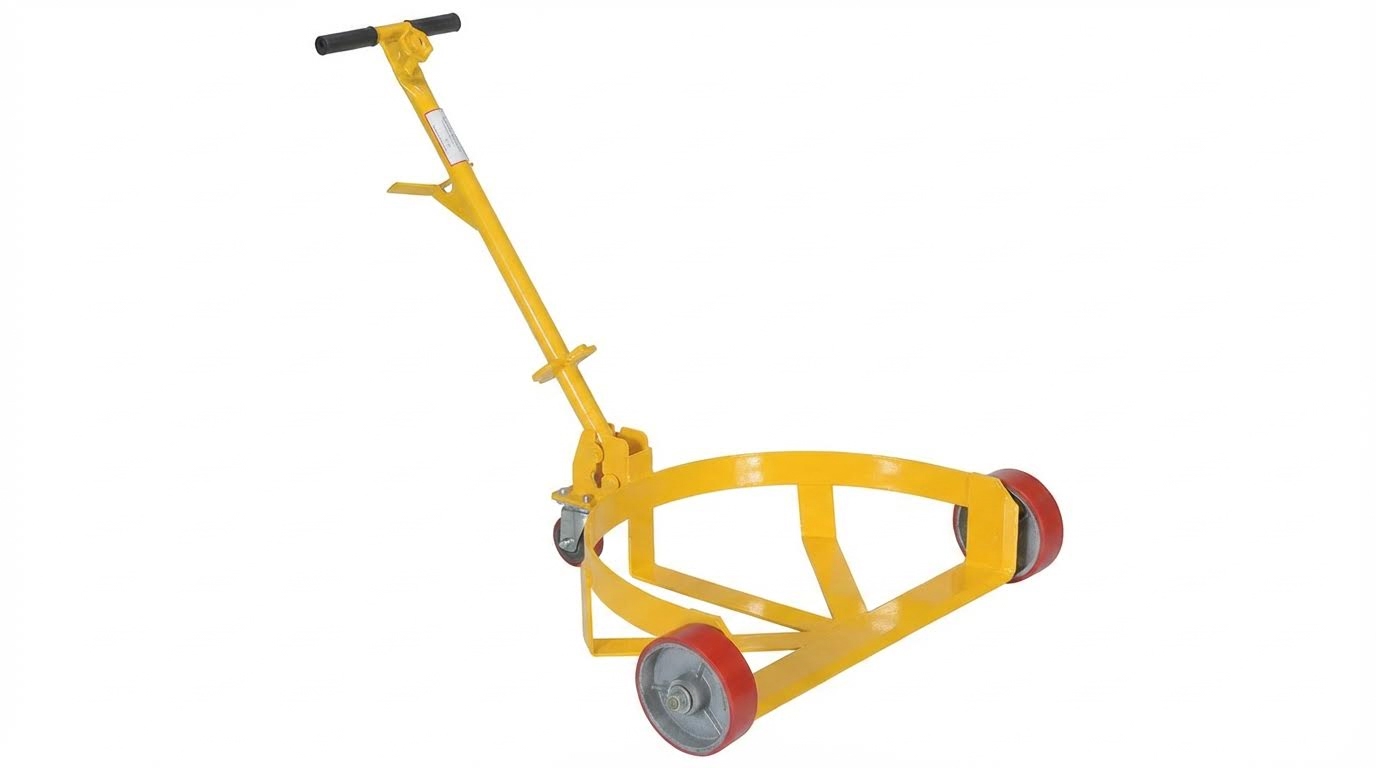
Structured inspection, cleaning, lubrication, and digital tracking programs keep drum dollies rolling easily so operators use safe forces and avoid sudden mechanical failures.
- Daily checks: Operators should inspect wheels and casters daily for free rotation, debris, and obvious wear – stiff or jammed wheels sharply increase push force.
- Frame and fasteners: Check frames, handles, welds, and fasteners regularly – cracks or loose joints can fail under dynamic drum loads.
- Brakes and locks: Test brakes or wheel locks daily on level ground – they must hold the loaded dolly during loading, unloading, and parking.
- Weekly inspections: Inspect welds, joints, and control mechanisms weekly for fatigue or corrosion – this catches early damage before a structural failure.
- Monthly maintenance: Monthly tasks should confirm bolt torque, verify load capacity markings, and assess wheel wear – this maintains rated performance.
- Annual overhaul: Annual maintenance may include professional inspections and replacement of worn wheels, bearings, and straps – this resets the equipment’s safety margin.
- Cleaning practices: Clean wheels, axles, and frames with mild, material-compatible detergents – this removes dirt that increases rolling resistance and corrosion risk.
- Drying and corrosion control: Dry metal parts thoroughly after washing and inspect protective coatings – standing moisture accelerates rust and weakens frames.
- Lubrication points: Lubricate wheel bearings, pivot points, and brake linkages with suitable grease or oil – proper lubrication keeps push forces low and movement predictable.
- Digital tracking: Use maintenance software, barcodes, or RFID tags to log inspections and repairs – trend analysis reveals misuse patterns and high-risk areas.
| Task | Typical Frequency | Operational Impact on Drum Dolly Use |
|---|---|---|
| Wheel and brake check | Daily | Ensures the dolly rolls straight and stops reliably under load. |
| Debris removal from wheels | Daily | Reduces rolling resistance and prevents sudden jams. |
| Weld and joint inspection | Weekly | Detects cracks before structural failure with heavy drums. |
| Bolt torque and capacity verification | Monthly | Maintains rated load performance up to typical 500 kg ranges. |
| Component replacement (wheels, bearings, straps) | Annually or as needed | Restores smooth operation and full safety factors. |
| Cleaning and drying | Planned, at least monthly or by environment | Prevents corrosion and keeps wheels free-rolling. |
| Lubrication of moving parts | Per manufacturer guidance | Maintains low push forces and consistent brake function. |
| Digital maintenance logging | Ongoing | Supports predictive maintenance and compliance documentation. |
How maintenance supports safe techniques for how to use a drum dolly
Even perfect technique for how to use a drum dolly fails if wheels are seized or brakes do not hold. A documented inspection and lubrication schedule keeps the equipment predictable so ergonomic training and route planning actually work in the field.
💡 Field Engineer’s Note: When operators start avoiding certain dollies because they are “hard to push,” treat that as a red flag. A quick force test often shows push forces double the ergonomic target due to dry bearings or flat-spotted wheels.

Final Thoughts on Implementing Drum Dolly Safety Systems
Safe drum dolly operation depends on one integrated system, not a single rule or checklist. Engineering limits, operator behavior, and maintenance all work together to keep the drum’s center of gravity inside the wheelbase and push forces within human limits. When you respect load ratings, keep drums vertical and centered, and always secure restraints, you turn unstable, high-mass drums into predictable loads.
Engineering controls at loading and unloading points remove surprise movement. Level floors, working brakes, and controlled hoist transfers stop tip-overs before they start. Good ergonomics and route design then keep operators in a safe force range while they push, turn, and stop. Clean, flat, well-marked paths reduce shocks into the drum and cut collision risk with people and vehicles.
Planned inspection, cleaning, lubrication, and digital tracking keep every dolly close to “as new” performance. That means lower push forces, fewer sudden failures, and clear evidence for audits. The best practice is simple: choose the right Atomoving drum dolly for the load, enforce standard steps for loading, movement, and unloading, and support those steps with a living maintenance and training program. When these elements align, drum handling becomes both safer and more efficient shift after shift.
Frequently Asked Questions
How do you use a drum dolly?
To use a drum dolly, push the dolly up to the drum and position its feet at the base of the drum. Tip the dolly forward slightly to engage the dolly-drum lock securely. Pull the dolly backward until it rests on its wheels, allowing you to move the drum safely and efficiently. For more details, refer to this Drum Dolly Safety Guide.
What are the benefits of using a drum dolly?
A drum dolly provides an ergonomic solution for moving heavy drums, barrels, or kegs. It reduces physical strain and minimizes the risk of injury by handling the weight of the drum. Available in manual or electronic configurations, drum dollies can transport steel, plastic, fiber, and cardboard containers with ease. Learn more about their advantages in this Drum Dolly Product Overview.