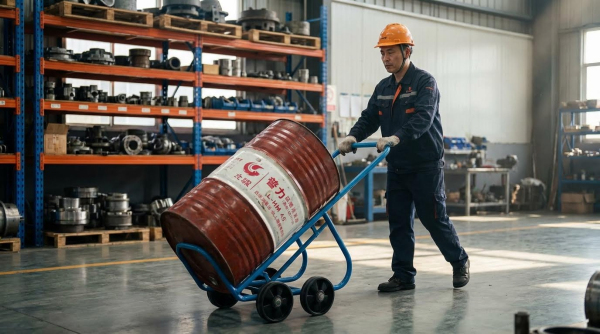
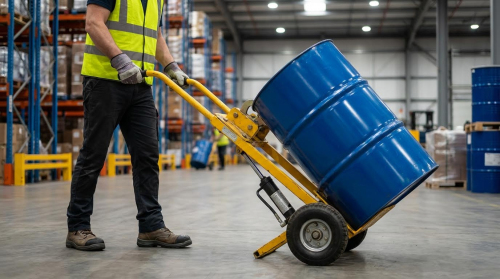
Electric forklifts can typically lift between about 3 m and 12 m depending on mast design, truck type, and load center, but safe height is always limited by stability and de‑rating. This guide explains how mast stages, capacity charts, and warehouse geometry control how high an electric forklift can lift in real operations.
You will learn the real-world lift ranges by truck and mast type, how capacity falls as height and load center increase, and how to specify the right mast height for your racking and building. We will also cover safety concepts like the stability triangle, mast deflection, and the impact of attachments and hydraulic pallet truck so you can push height safely without compromising stability or uptime.
How High Electric Forklifts Really Lift
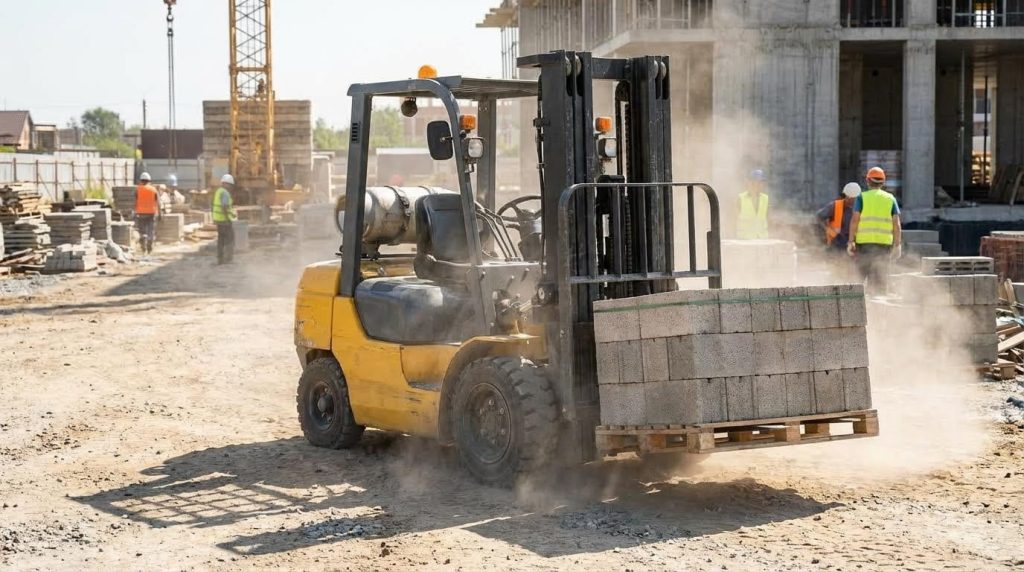
Electric forklifts typically lift between about 3 m and 12 m, depending on truck type and mast design, which directly answers how high can an electric forklift lift for most warehouse operations. This section breaks down real-world lift ranges by truck category and explains the mast height terms engineers must use when specifying equipment.
Typical lift heights by truck category
Electric forklifts in normal warehouses usually lift 3–10.5 m, while specialized very narrow aisle trucks can exceed 12 m, so “how high can an electric forklift lift” depends strongly on truck type and mast configuration.
| Electric truck type | Typical lift height range (m) | Typical mast types used | Best for… / Operational impact |
|---|---|---|---|
| counterbalanced stacker / electric platform stacker | 3.0–6.5 reference | Simplex, duplex | Low to mid-level racks; small warehouses with rack beams up to about 6 m. |
| Electric counterbalance forklift | Up to ≈7.5 m reference | Simplex, duplex, triplex | General warehouse work; standard pallet racking around 3–7 m; dock work and yard loading. |
| Electric reach truck | ≈8.5–10.5 m reference | Triplex, quad | Narrow aisle racking; high-bay storage above 8 m with good visibility into racks. |
| Very narrow aisle (VNA) / turret truck | ≥12 m reference | High triplex, quad | High-density, very narrow aisles; high-bay warehouses where top beams are 11–12 m or higher. |
| Special high-lift electric forklifts | Up to ≈12.2 m or more with quad masts reference | Quad | Specialized high-bay applications where maximum storage height is critical. |
These height bands are only safe at the rated load and load center shown on the data plate; capacity always drops as you lift higher or push the load center out. For example, electric forklifts with triplex masts commonly reach 4.6–9.1 m, while quad masts can reach 6.1–12.2 m or more. reference
- Rule of thumb – counterbalance: 3–7.5 m – Matches most standard pallet racking.
- Rule of thumb – reach/VNA: 8.5–12 m – Used where vertical storage is maximized.
- Above ≈10 m: Expect reduced capacity and more mast sway – Plan lighter loads on top beams.
💡 Field Engineer’s Note: When you ask how high can an electric forklift lift, also check how narrow your aisles are. A 10 m reach truck that cannot turn or stabilize in a 2.6 m aisle is a wasted investment; always pair lift height with aisle width and floor flatness.
How to quickly estimate the lift height you actually need
Take your top rack beam height, add 150–200 mm for fork clearance, and another 100–150 mm for pallet overhang. That sum is your minimum required Maximum Fork Height (MFH) for safe operation.
Key mast height terms engineers must know
Forklift spec sheets use four height terms—Overall Lowered Height, Overall Raised Height, Maximum Fork Height, and Free Fork Height—that control how high an electric forklift can lift in your building without hitting doors, ceilings, or sprinklers.
- Overall Lowered Height (OALH): Mast height when fully lowered – Checks if the truck fits under doors and into trailers.
- Overall Raised Height (OARH): Mast height fully extended – Ensures you clear lights, sprinklers, and roof trusses.
- Maximum Fork Height (MFH): Vertical distance from floor to fork top at full lift – Must exceed top rack beam by 150–200 mm for safe entry/exit.
- Free Fork Height (FFH): How high forks can rise before the mast stages start extending – Critical in low-ceiling zones, containers, and mezzanines.
Engineers used OALH to confirm the truck can pass under typical 2,400 mm trailer or door openings, and OARH to avoid collisions with overhead fixtures. MFH must exceed the top rack by about 150–200 mm to let the forks lift cleanly above the beam and pallet. reference
Free lift and mast stages in simple language
Free lift means the carriage and forks can rise while the outer mast stays at the same height. Small free lift is about 100 mm; large free lift allows much more carriage travel before the mast extends, which is vital in containers or low rooms. Duplex and triplex masts often offer large free lift to combine low OALH with high MFH. reference
- Simplex / single-stage mast: Low MFH, minimal free lift – Good for low racks and open ceilings.
- Duplex mast: Moderate to high MFH with small or large free lift – Useful where door height is tight but racks are higher.
- Triplex mast: High MFH, often up to ≈6–9 m with large free lift – Standard choice for high-bay warehouses.
- Quad mast: Very high MFH, ≈6.1–12.2 m – Used where vertical space is maximized but aisle width is limited.
Simplex masts typically cover about 3–4.9 m, duplex around 3–6.1 m, triplex from about 4.6–9.1 m, and quad 6.1–12.2 m or more in electric forklifts. reference Mono and triplex masts with large free lift are especially useful where you must stack high in a hall with low doors or beams. reference
💡 Field Engineer’s Note: When you size masts, never aim for “just enough” MFH. Add at least 200 mm over your top beam plus pallet overhang; otherwise, operators will tilt back aggressively to clear beams, which eats into your stability margin at height.
Quick checklist before choosing mast height
1) Measure highest rack beam and any future planned extensions. 2) Measure lowest overhead obstruction along the travel path. 3) Confirm door and dock opening heights. 4) Add 150–200 mm clearance for MFH. 5) Re-check the data plate for capacity at that height, not just at ground level.
Mast Types, Load Centers, and Stability Limits
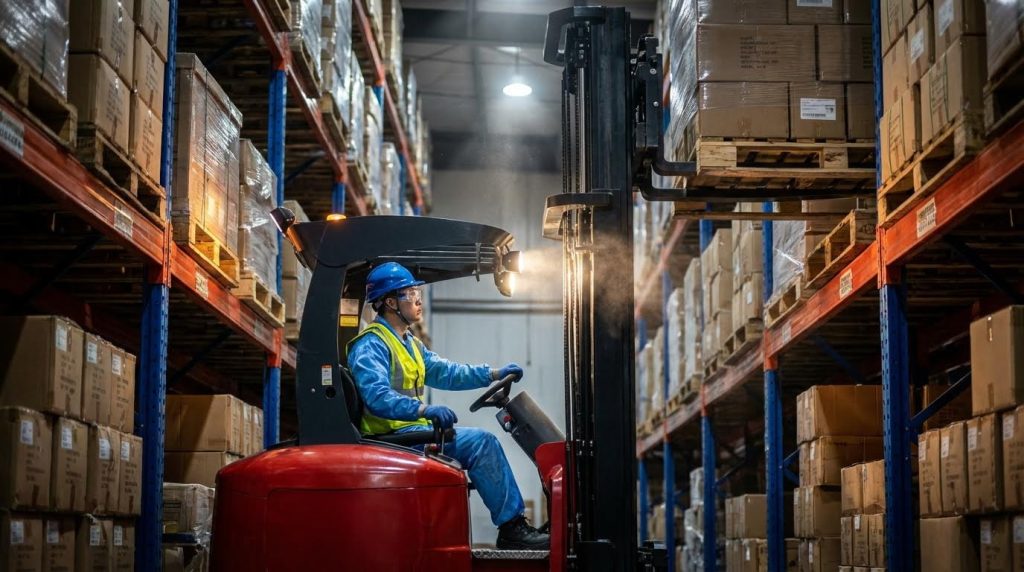
This section explains how mast design, load center, and stability limits ultimately control how high an semi electric order picker can lift safely, not just the headline maximum height on the brochure.
When engineers ask how high can an electric forklift lift, the real answer depends on mast stages, load center, and how much capacity you are willing to lose at height.
Single, duplex, triplex, and quad mast ranges
Mast type is the main mechanical factor that sets how high an warehouse order picker can lift before hitting stability, deflection, or building clearance limits.
The more stages in the mast, the higher the Maximum Fork Height (MFH) you can reach for a given Overall Lowered Height (OALH), but with increased complexity and sway at full extension. Typical working ranges are shown below.
| Mast type | Typical MFH range (m) | Free lift capability | Common applications | Operational impact |
|---|---|---|---|---|
| Single / simplex | ≈3.0–4.9 m (10–16 ft) | Minimal free lift | Low stacking, ground-level loading | Best where headroom is generous and racks are ≤4 m. |
| Duplex (2‑stage) | ≈3.0–6.1 m (10–20 ft) | Small or large free lift options up to ≈100 mm and beyond (free lift) | General warehouse, low‑ceiling docks | Good for 3–5 m racks where trailers and doors limit OALH. |
| Triplex (3‑stage) | ≈4.6–9.1 m (15–30 ft); up to ≈6 m common in standard masts (triplex) | Large free lift | High‑bay warehouses, low doorways | Ideal when you need ≈8–9 m racks but must pass 2.3–2.4 m doors. |
| Quad (4‑stage) | ≈6.1–12.2 m or more (20–40+ ft) | Large free lift, complex staging | Very high‑bay storage, special applications | Used when racks ≥10 m but building or doors restrict OALH. |
| Reach truck masts | ≈6.0–13.7 m typical (8.5–10.5 m common, up to ≈12+ m) | High free lift, deep reach | Narrow‑aisle, high‑density storage | Lets you work in aisles ≈2.5–3.0 m with racks ≥10 m. |
- Single/simplex mast: One fixed outer channel with a single moving inner section – robust and simple but limited height and free lift.
- Duplex mast: Two stages with inner rails telescoping – good compromise between height and low OALH.
- Triplex mast: Three stages with large free lift – best for “dock‑to‑high‑bay” operations under low ceilings.
- Quad mast: Four stages – maximizes MFH but increases weight, complexity, and deflection.
What does “free lift” really change in daily operation?
Free lift lets you raise the forks (and the load) by roughly 100 mm or more without the mast extending above its lowered height. This is critical when loading inside containers, trailers, or mezzanines where ceiling height is around 2.3–2.5 m but you still need to clear pallet bases and dock edges.
💡 Field Engineer’s Note: On quad and tall triplex masts, operators often complain about “whip” at full height. That is mast deflection plus clearance in the stages. If your top beam is above ≈9 m, budget for stiffer masts and train operators to pause and stabilize at height before fine positioning.
Load center, de‑rating, and capacity at height
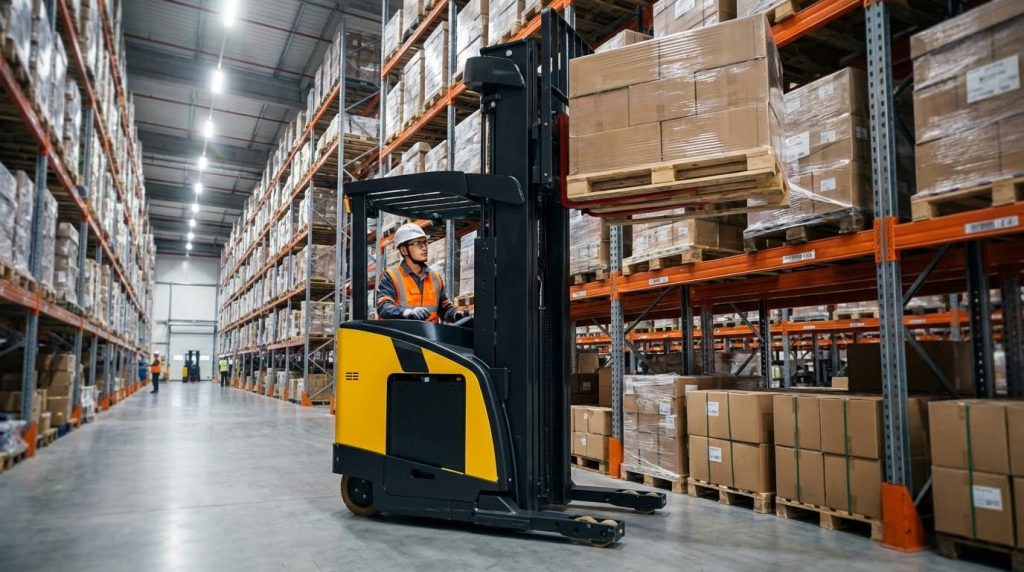
Load center and lift height together decide how much weight an order picking machines can safely handle, so the same truck lifts far less at 6 m than at 3 m.
Manufacturers rate capacity at a standard load center, then de‑rate that capacity as the load center increases or as you lift higher, because the overturning moment grows.
| Example truck | Rated load center | Rated capacity | Changed condition | New safe capacity | Operational impact |
|---|---|---|---|---|---|
| Counterbalance truck | 610 mm (24 in) (standard) | ≈1,815 kg (4,000 lb) | Load center increases to 915 mm (36 in) | ≈1,210 kg (2,666 lb) (example) | Long pallets or overhanging loads sharply cut capacity, especially at height. |
| Counterbalance truck | 610 mm (24 in) | ≈1,360 kg (3,000 lb) | Load center increases to 760 mm (30 in) | ≈1,090 kg (2,400 lb) (example) | Even modest load overhang can drop legal capacity by ≈20%. |
| Electric reach truck | 500 mm | ≈1,500 kg | Load center increases to 700 mm | Significantly less than 1,500 kg (illustrative) | Deep pallets or attachments can push you out of rated envelope at upper beams. |
- Load center: Distance from fork face to the load’s center of gravity – longer loads act like a longer lever.
- Rated capacity point: Typically at 500–610 mm load center – this is the “headline” capacity on the data plate.
- De‑rating: Automatic reduction in allowable load as height or load center increases – prevents tipping by limiting overturning moment.
Attachments and battery selection also change how high an electric forklift can lift a given load because they alter both weight and geometry.
- Attachments: Clamps, rotators, and side‑shifters add dead weight and move the load forward – they reduce the net capacity and may lower allowable height for the same load. Attachment impact
- Battery weight: In electric forklifts the battery is part of the counterweight – lighter, non‑approved batteries reduce stability and capacity, especially at height. Battery effect
How to read the capacity plate for height and load center
The data plate usually lists rated capacity at a base height and load center, then shows a table or graph of reduced capacities at higher lift heights and longer load centers. To answer “how high can an electric forklift lift this 1,000 kg pallet,” you must match three things on the chart: the load center of your pallet, the planned lift height, and whether an attachment is fitted. If your required weight is above the curve, you must reduce load, lower height, or change truck.
💡 Field Engineer’s Note: When we troubleshoot “mysterious” tip‑overs, we often find long pallets or stacked loads pushing the load center 100–200 mm beyond the rating. At 7–8 m that extra moment easily overcomes the counterweight, even if the nominal kg value looks legal.
Stability triangle, mast deflection, and safety systems
The stability triangle, mast deflection, and modern safety systems together determine the real stability envelope at height, beyond the simple mast height number.
Even if the mast can mechanically reach 10 m, the combined center of gravity must stay inside the stability triangle while the mast bends and the truck moves.
- Stability triangle: The triangle between the tyre contact points – the combined center of gravity of truck plus load must stay inside this area to avoid tipping. Stability triangle
- Center of gravity shift: As you raise the load, the center of gravity moves up and forward – this shrinks your stability margin.
- Dynamic effects: Braking, turning, or tilting with a high load displaces the center of gravity further – this is why standards and OSHA guidance tell operators not to travel with elevated loads.
Mast deflection and structural limits are the other side of the answer to how high can an electric forklift lift in real warehouses.
- Mast deflection: Tall, multi‑stage masts bend under load – the forks can be several tens of millimeters out of line at 10–12 m. Deflection factors
- More stages, more play: Each extra mast stage adds joints and clearances – this increases sway and requires slower, smoother operation at full height.
- Attachments and reach mechanisms: Side‑shift and reach pantographs increase overhang and deflection – this further limits safe speed and usable capacity at top beams.
Modern electric forklifts use safety systems to maintain stability at height and to enforce the de‑rated envelope.
- Electronic stability systems: Sensors can limit travel speed, tilt, or lift speed when the mast is raised – this reduces dynamic instability. Safety systems
- Interlocks and alarms: Some trucks restrict lift above certain heights if load weight appears excessive – this prevents operators from exceeding the de‑rated chart.
- Inspection and maintenance: Regular checks of mast rails, chains, and hydraulics are mandatory – wear increases play and deflection, which eats into your stability margin at 8–12 m. Inspection guidance
Why traveling with elevated loads is so risky
When the load is high, the combined center of
Specifying Lift Height for Your Warehouse
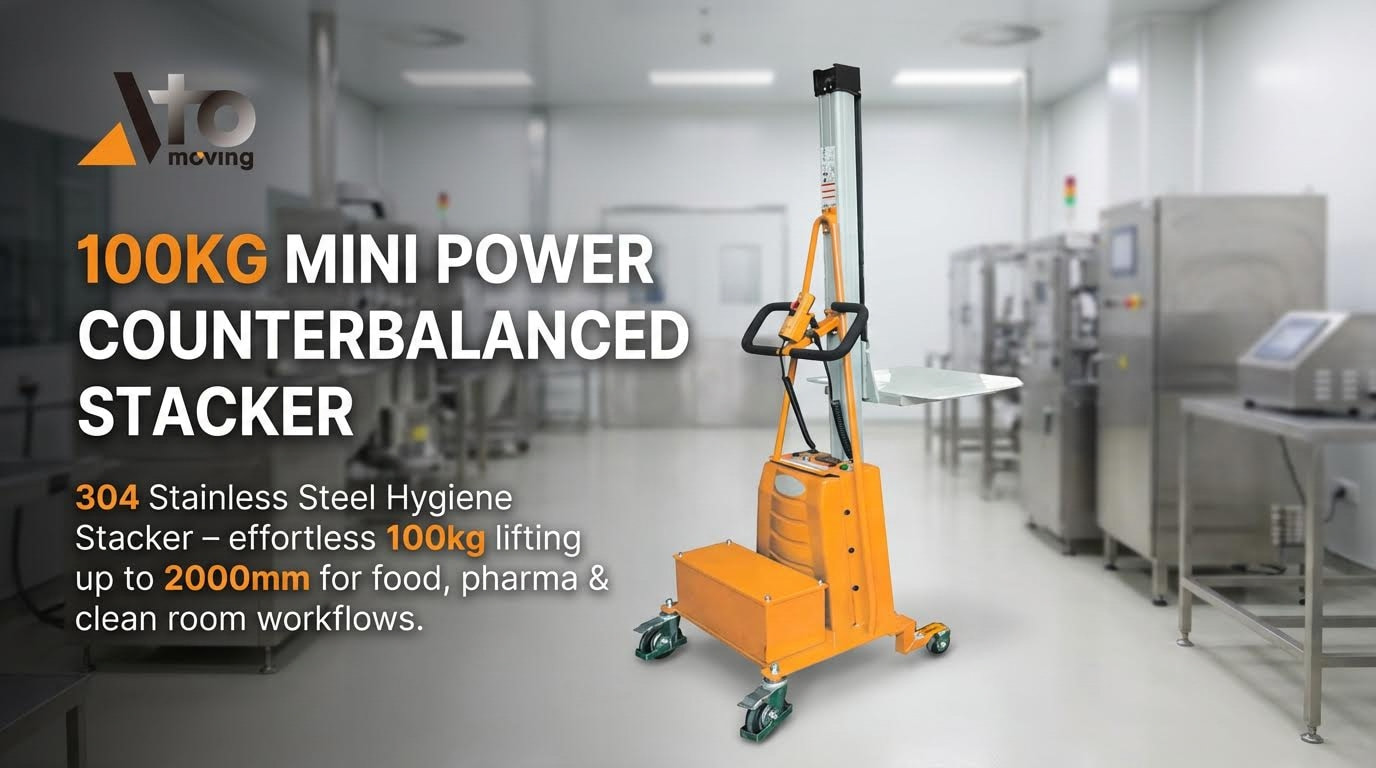
Specifying lift height for your warehouse means matching mast, truck type, and capacity to rack geometry, clearances, and real loads so the answer to “how high can an electric forklift lift” is safe, not just theoretical.
- Start from the load, not the truck: Define pallet size, weight, and load center – this controls real capacity at height.
- Work from top rack down: Set required Maximum Fork Height (MFH) and safety clearances – this drives mast stage selection.
- Check building and aisle limits: Compare Overall Lowered Height (OALH) and Overall Raised Height (OARH) to doors, sprinklers, and lights – prevents collisions.
- Factor attachments and batteries: Recalculate de‑rated capacity and stability – avoids overloading at full lift.
- Choose truck type by height band: Counterbalance vs reach vs VNA – optimizes cost and throughput.
💡 Field Engineer’s Note: When customers ask how high can an electric forklift lift, I always walk the aisles with a tape measure first; 10 minutes of measuring often saves years of living with the wrong mast height.
Matching mast height to rack and building geometry
Matching mast height to rack and building geometry means sizing MFH, OALH, and OARH to your rack beams, doors, and overhead services with clear safety margins.
| Key Height Term | What It Means | Typical Value / Rule of Thumb | Operational Impact |
|---|---|---|---|
| Maximum Fork Height (MFH) | Highest fork level with mast fully extended | Top beam height + 150–200 mm clearance | Ensures forks can enter top pallets without hitting beams. |
| Overall Raised Height (OARH) | Highest point of mast/backrest fully raised | MFH plus backrest/headguard, often +600–1,000 mm | Must clear sprinklers, lighting, HVAC, and roof bracing. |
| Overall Lowered Height (OALH) | Mast height fully lowered | Must be < door or trailer height, often <2,400 mm for docks | Determines if truck can enter containers, trailers, or low doors. |
| Free Fork Height (FFH) | Fork lift before mast stages extend | From about 100 mm (small free lift) to large free lift options | Allows lifting inside containers or under low ceilings without hitting the roof. |
To answer how high can an electric forklift lift in your building, you must overlay these mast dimensions on your actual rack layout and structure.
- Step 1: Measure rack geometry – Record floor-to-top-beam height for every level, especially the highest pallet position.
- Step 2: Add working clearance – Add 150–200 mm above the top beam to set required MFH for safe entry and exit of pallets.
- Step 3: Check OARH against the roof – Compare MFH plus backrest to lowest sprinkler, light, or truss to avoid strikes.
- Step 4: Verify OALH at doors and docks – Ensure the mast passes under all door headers and trailer roofs.
- Step 5: Choose mast stages to fit – Use duplex/triplex to combine high MFH with acceptable OALH and sufficient free lift.
Typical truck type vs rack height bands
| Rack Top Beam Height | Typical Electric Truck Choice | Indicative Lift Range | Best For… |
|---|---|---|---|
| Up to 3–4 m | Electric pallet stacker or small counterbalance | ≈3–4.9 m simplex/duplex | Low-bay storage, back-of-store areas. |
| 3–6 m | Electric counterbalance, duplex mast | ≈3–6.1 m | General warehouse pallet racking. |
| 6–9 m | Triplex counterbalance or reach truck | ≈4.6–9.1 m triplex; 8.5–10.5 m reach | High-bay but still conventional aisles. |
| ≥10–12 m | Reach truck or very narrow aisle (VNA) truck | ≈10.5–≥12 m | High-density, narrow-aisle storage. |
💡 Field Engineer’s Note: Always model the worst bay: the one under the lowest roof brace or sprinkler. That bay usually sets your maximum safe OARH, even if other aisles are higher.
Attachments, batteries, and TCO at high lift
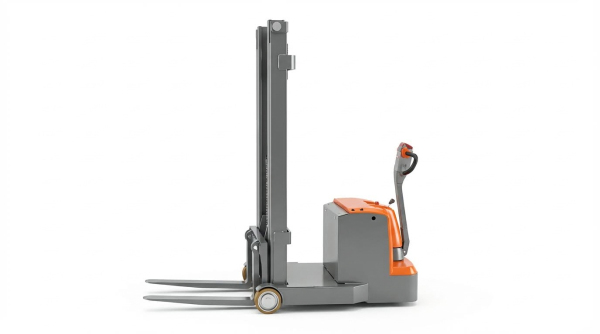
Attachments, batteries, and total cost of ownership (TCO) at high lift are about how extra weight, shifted load centers, and energy use quietly reduce how high an electric forklift can safely lift in daily operation.
| Factor | Engineering Effect | Typical Impact on High-Lift Operation | Operational Impact / TCO Angle |
|---|---|---|---|
| Fork attachments (clamps, rotators, side-shifters) | Add dead weight and move load center forward | De‑rates capacity at height; may require taller-capacity truck for same load. | Higher truck class and energy use; more expensive mast and components. |
| Updated data plate | Shows new rated capacity vs height and load center with attachment | Makes clear how high you can lift a given load legally and safely. | Prevents hidden de‑rating that forces slow, partial pallet handling. |
| Battery weight | Acts as part of counterweight; affects stability | Lighter, non-approved batteries reduce capacity; heavy approved units maintain design rating. | Wrong battery can force lower stacking heights or derated loads. |
| Battery chemistry and duty cycle | Voltage sag under heavy, repeated lifts | Less lift speed and acceleration at end of shift, especially at high mast heights. | May require extra batteries, fast charging, or larger capacity pack. |
| Mast and truck selection margin | Extra capacity above nominal pallet weight | Absorbs attachment weight and future load growth without changing how high you stack. | Higher capex but lower retrofit and downtime costs later. |
- Attachment planning: Specify all current and likely future attachments during selection – manufacturers then provide correct de‑rated capacity and mast options.
- Load center verification: Measure real load depth; a 1,000 mm deep pallet gives a 500 mm load center, but clamps or overhanging loads can push it to 600–700 mm – this sharply reduces safe capacity at height as shown in typical reach truck ratings.
- Battery as a design parameter: Treat battery weight and chemistry as part of the truck spec, not an afterthought – changing to a lighter pack later can invalidate the original capacity rating and reduce how high you can lift safely.
- Energy and cycle cost at height: High lifts use more hydraulic energy and time; frequent 8–10 m lifts need stronger cooling and charging strategy – this affects TCO more than many buyers expect.
- Future-proofing: If you plan to add a rack level later, specify mast height and capacity now – retrofitting masts or trucks is far more expensive than a small initial overspec.
How high can an electric forklift lift once everything is de‑rated?
In practice, an electric forklift with a nominal 9 m triplex mast might only be allowed to lift your heaviest, clamp-handled loads to 7.5–8 m once you apply attachment weight, larger load centers, and stability limits from the data plate. Always design your top rack level based on that de‑rated, real-world height, not the marketing headline.
💡 Field Engineer’s Note: When budgets are tight, I prefer specifying a slightly taller, higher-capacity mast and a robust battery once, rather than running trucks at their limit; it cuts damage, downtime, and surprise “we can’t reach that shelf” moments over the truck’s life.
“”
Final Thoughts on Safe High-Lift Electric Forklifts
Safe high-lift electric forklift operation depends on treating mast height, capacity, and warehouse geometry as one linked system. Mast type and stages set the theoretical lift height, but load center, attachments, and battery weight decide how much of that height you can actually use with a real pallet. As height increases, the stability triangle shrinks, mast deflection grows, and dynamic moves become far less forgiving.
Engineering and operations teams must start from the load and rack design, then work back to MFH, OARH, OALH, and free lift. They should always size masts with extra clearance and capacity, not to the bare minimum. Teams must also read the data plate at the planned height and load center, not just the headline rating.
The best practice is clear. Measure the building carefully, include every attachment and future change, and select trucks with enough margin that operators rarely work at the edge of the chart. When you do this, electric forklifts can run at 8–12 m with stable handling, lower damage, and predictable uptime across the fleet, whether you buy from Atomoving or expand an existing operation.
Frequently Asked Questions
How high can an electric forklift lift?
An electric forklift’s maximum lift height depends on its design and intended use. Standard electric warehouse forklifts with quad masts can reach heights of up to 20 feet (6 meters). For higher-reaching needs, specialized models like electric reach trucks can extend to approximately 45 feet (13.7 meters).
- General warehouse forklifts: Up to 20 ft (6 m).
- Specialized reach trucks: Up to 45 ft (13.7 m) Toyota Reach Truck Specs.
What factors determine the lift height of an electric forklift?
The lift height of an electric forklift is influenced by its mast configuration, design purpose, and stability features. Forklifts built for indoor warehouse use typically have lower lift heights compared to those designed for heavy-duty or specialized applications.
- Mast type (single, double, triple, or quad).
- Application (warehouse vs. industrial).
- Stability and counterweight design.