This guide explains how a pallet truck works from the inside out, so you can connect real hydraulic and mechanical design to daily warehouse use. You will see how handle force becomes lift, how the frame carries 1600–5000 kg loads, and how good maintenance keeps lifecycle costs under control. By the end, “how does a pallet truck work” will be a concrete, engineering-based answer, not a guess.
Core Mechanics Of Manual Pallet Truck Operation

Manual pallet truck core mechanics combine mechanical leverage and a compact hydraulic circuit to lift 1600–3000 kg loads with human-scale forces. Understanding these internals is the real answer to “how does a pallet truck work” in everyday warehouses.
In simple terms, the operator’s handle force drives a small hydraulic pump, which pressurizes oil and extends a lift cylinder that raises the forks through link arms. Once you see how the force path and pressure multiplication work, load ratings, ergonomics, and failure modes all make sense.
Force Transmission From Handle To Hydraulic Pump
The force path in a hydraulic pallet truck turns a small hand input at the tow handle into high pressure in the hydraulic cylinder. The design uses lever ratios and a positive-displacement pump so the operator can lift heavy pallets without excessive effort.
- Handle as primary lever: The long drawbar handle works as a first-class or compound lever – it multiplies the operator’s 150–300 N push–pull into a higher force at the pump piston.
- Mechanical linkage to pump: Pins and link arms at the handle base drive the small pump plunger – each pump stroke moves a fixed oil volume into the circuit.
- Positive displacement pump: The integrated pump is a positive-displacement unit, so each stroke delivers nearly the same oil volume regardless of load – lift speed mainly depends on how fast the operator pumps, not on load, until the relief valve opens (hydraulic circuit description).
- Check valve-controlled flow: As the handle moves down, an outlet check valve opens and sends oil to the lift cylinder; on the return stroke an inlet check opens to refill the pump from the reservoir – this one-way logic prevents the load from pushing oil back through the pump (check valves and relief valves).
- Control lever interface: The handle head includes a small three-position control (lift / neutral / lower) that reconfigures internal ports – it decides whether pump strokes raise the load, hold it, or allow it to descend (lift, hold, and lower positions).
Step-by-step: What happens when you pump the handle?
- Step 1: You pull the handle down – linkage pushes the pump plunger, compressing oil in the pump chamber.
- Step 2: Outlet check valve opens – pressurized oil flows into the lift cylinder because pump pressure exceeds cylinder pressure.
- Step 3: Cylinder pressure rises – the piston starts extending, beginning fork lift.
- Step 4: You let the handle return – spring return pulls the plunger back, outlet check closes, inlet check opens, and the chamber refills from the reservoir.
- Step 5: You repeat strokes – each cycle adds oil volume under the piston, increasing lift height until transport height is reached (about 100–200 mm fork clearance) (lift, transport, and lowering cycle).
Because the pump is positive displacement with tight internal clearances, designers rely on oil viscosity (often ISO VG 32) to limit internal leakage and keep volumetric efficiency high at realistic handle speeds (hydraulic circuit and oil viscosity).
💡 Field Engineer’s Note: In cold rooms below about 0°C, oil thickens and handle return slows. If operators complain that “the pallet truck is heavy” first thing in the morning, check oil grade and temperature before blaming the pump or seals.
Hydraulic Pressure, Cylinder Sizing, And Lift Force
The hydraulic section of a pallet truck converts pressure in a small-diameter cylinder into several thousand kilograms of lifting capacity. This is where the core physics behind “how does a pallet truck work” shows up as p = F/A and F = p × A.
- Pressure generation: Handle force, amplified by the lever ratio, acts on the pump piston to create oil pressure according to p = F/A – smaller pump piston area gives higher pressure for the same hand force (pressure formula p = F/A).
- Cylinder sizing: Designers then choose a lift cylinder piston area A so that F = p × A is enough to raise typical rated loads of 1600–3000 kg while keeping required handle forces ergonomic for repeated cycles (piston motion and load balancing).
- Linkage to forks: As the cylinder extends, its rod pulls or pushes link arms at the fork heels, converting the piston’s linear stroke into roughly 85–200 mm of fork lift – enough for 100–200 mm transport clearance (link arms and fork travel).
- Holding the load: When pumping stops and the control lever is in neutral, the valve block closes all ports to the cylinder – trapped oil holds the piston position and keeps the load suspended (neutral or hold position).
- Controlled lowering: In the lower position, a metered path opens from cylinder back to reservoir – oil bleeds out at a controlled rate so the forks descend smoothly under gravity, even at maximum rated capacity (controlled-lowering valves).
- Overload protection: A pressure relief valve opens slightly above nominal rating, typically around 105–110% of rated load – it diverts oil back to the reservoir so pressure cannot climb high enough to bend forks or burst seals (overload protection).
| Design Aspect | Typical Engineering Choice | Operational Impact |
|---|---|---|
| Rated load range | 1600–3000 kg for manual pallet trucks (manual pallet trucks) | Covers most EUR/ISO pallet loads in warehouses without needing powered trucks. |
| Fork lift range | About 85 mm minimum height to roughly 200 mm maximum height (fork travel) | Provides 100–200 mm ground clearance for safe transport over typical floor joints. |
| Entrance height | About 75–93 mm fork entrance height for manual models (entrance height range) | Allows access to low-profile pallets while keeping enough steel section for strength. |
| Hydraulic oil grade | ISO VG 32 low-temperature hydraulic oil (oil viscosity recommendation) | Balances easy pumping in cold conditions with wear protection and low internal leakage. |
| Relief valve setting | Approximately 105–110% of nominal rated load (overload protection) | Prevents structural over-stressing and seal blowout if operators try to lift overloads. |
Real-world behaviour also depends on oil condition and air content. Air bubbles are compressible, so they act like springs in the circuit and make lifting spongy or delayed; bleeding cycles remove this air and restore a firm, predictable handle feel (air in oil and bleeding).
How lift, hold, and lower modes share the same hydraulics
- Lift mode: Pump outlet connects to cylinder, return path closed – each stroke adds oil volume and increases height.
- Hold (neutral) mode: Cylinder ports closed – pressure and height stay constant unless there is internal leakage.
- Lower mode: Return path opens through a restriction – oil drains back to reservoir, forks descend at a controlled speed.
💡 Field Engineer’s Note: If a truck “won’t hold” a load and the forks slowly sink, the physics tells you one thing: oil is escaping from under the piston. In practice that means a leaking seal, a misadjusted lowering valve, or micro-leakage through contaminated valve seats, not a “weak spring” or “tired cylinder.”
Structural Design, Stability, And Component Engineering
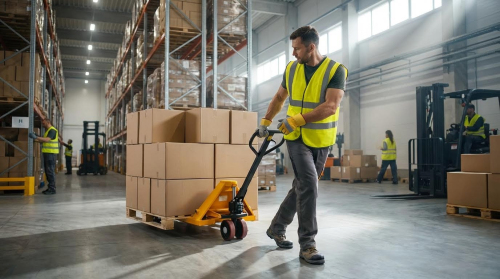
Structural design, wheel selection, and safety logic determine how does a pallet truck work safely under rated loads on real warehouse floors. This section links geometry and components to stability, fatigue life, and operator effort.
Fork Geometry, Deflection Limits, And Load Ratings
Fork geometry and deflection limits define how does a pallet jack work without bending, cracking, or losing stability at its rated capacity. In practice, fork dimensions, steel grade, and lift height all interact with the stability triangle.
| Parameter | Typical Value / Range | Engineering Role | Operational Impact |
|---|---|---|---|
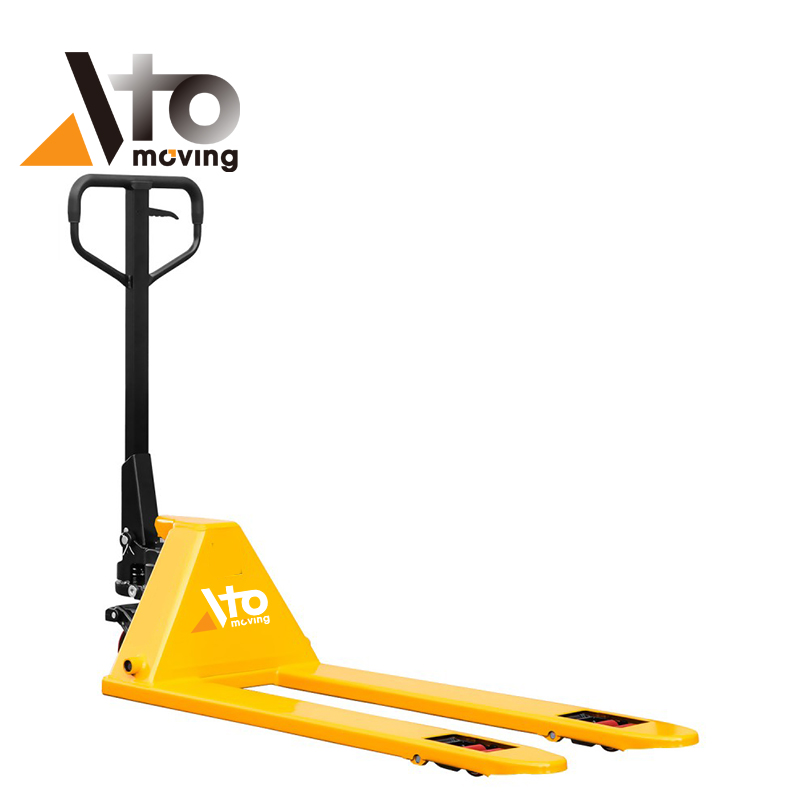
| Standard fork length | ≈1150 mm | Matches EUR / ISO pallet footprint for full fork support | Full entry under 1200×800 mm pallets; reduces tip-over from overhanging loads. |
| Overall fork width | ≈520–685 mm | Adapts to narrow and wide pallets while keeping wheels inside fork envelope | Improves compatibility with mixed pallet pools and reduces heel collision with boards. |
| Fork thickness / section | Sized for 1600–5000 kg | High‑tensile steel resists bending and fatigue under repeated load cycles | Limits permanent fork spread and tip sag, keeping pallets level during transport. |
| Entrance / minimum fork height | ≈75–93 mm (often ≈85 mm) | Low profile engages low pallets while preserving structural depth | Allows entry under low‑deck or damaged pallets without scraping boards. |
| Lift range | ≈85 mm to ≈200 mm | Vertical travel from lowered to transport height via linkage and cylinder | Provides floor clearance over joints and minor ramps while keeping centre of gravity low. |
| Rated capacity (manual trucks) | ≈1600–3000 kg | Defined by fork section modulus, chassis strength, and hydraulic relief setting | Ensures elastic deflection only; overload would cause permanent bending or structural failure. |
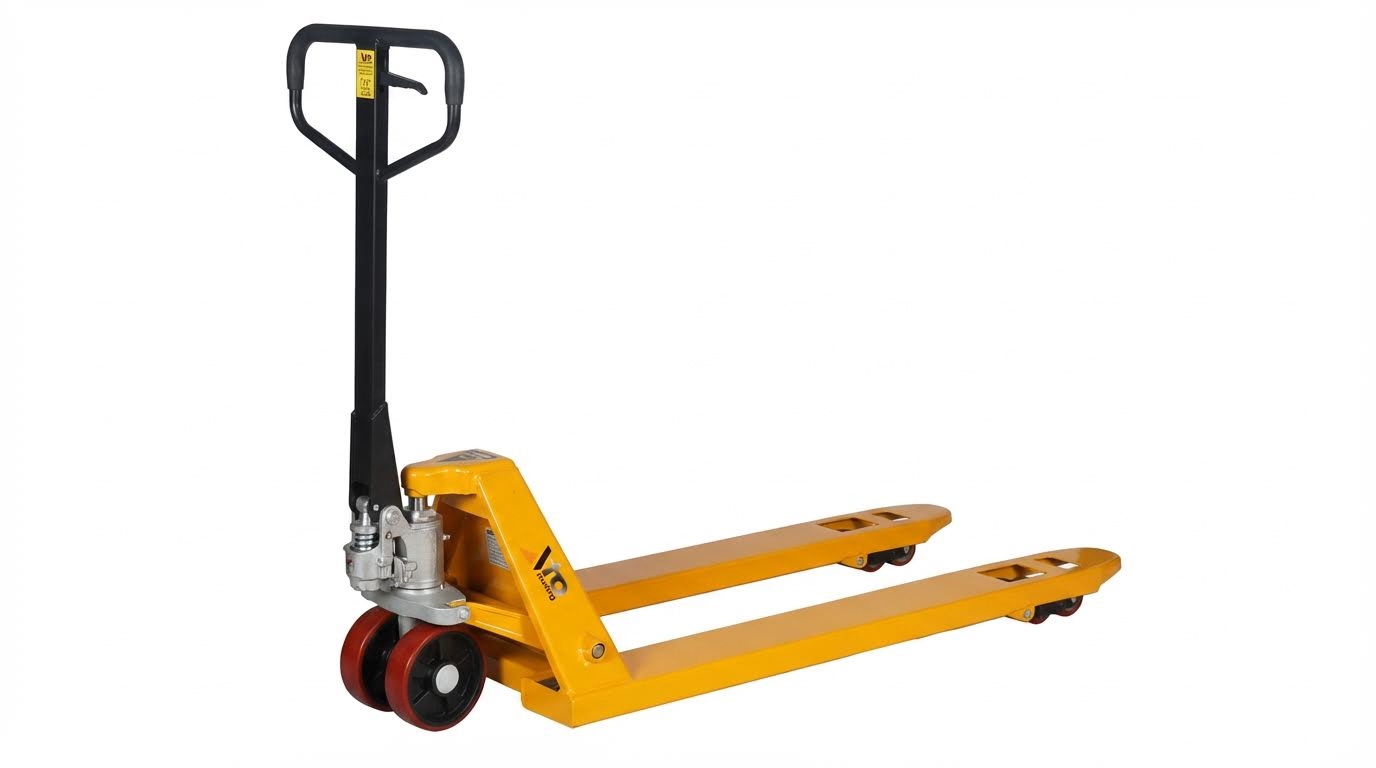
The welded chassis carries the pump unit, steering axle, and fork pivots, with reinforcement plates around high‑stress zones to avoid crack initiation. Link arms transfer cylinder motion into fork lift, giving roughly 85–200 mm of vertical travel while keeping the hydraulic cylinder compact near the drawbar end.
- Rounded, tapered tips: Reduce impact and insertion force – less pallet damage and easier entry for misaligned approaches.
- Controlled elastic deflection: Forks are allowed only small millimetre‑level sag at full load – keeps load stable and prevents scraping the floor.
- High‑tensile steel: Increases yield strength – supports 2000–5000 kg capacities without excessive weight.
- Reinforced heels and radii: Spread bending stresses – avoids heel cracking, the classic failure point on abused trucks.
How fork geometry links to “how does a pallet truck work” in daily use
Fork length and thickness determine how close the combined centre of gravity stays to the steering axle. Longer forks shift the load further forward, increasing bending moment and reducing stability margins, especially on slopes or when pulling instead of pushing. Correct geometry ensures that, when you pump the handle and lift, the forks rise uniformly, the frame stays straight, and the stability triangle remains intact.
💡 Field Engineer’s Note: When you see forks that sit 5–10 mm lower at the tips even with no load, treat that truck as structurally compromised. That “small” permanent bend sharply reduces safety margin on slopes and during sudden stops, even if the hydraulic unit still lifts fine.
Wheel, Roller, And Bearing Design For Floor Conditions
Wheel, roller, and bearing choices control how does a drum dolly work over different floors, directly affecting push–pull force, noise, and floor damage. Correct wheel material and diameter often matter more than rated capacity in real operations.
| Component | Typical Spec | Best For… | Operational Impact |
|---|---|---|---|
| Steer wheels (tow end) | ≈200 mm diameter | General warehouse concrete floors | Larger diameter rolls over joints and small debris with lower starting effort. |
| Load rollers under forks | ≈80 mm diameter | Standard pallets and dock plates | Carry most of the vertical load; small diameter keeps entrance height low. |
| Polyurethane tread | On steer wheels / rollers | Smooth indoor concrete, mixed‑use floors | Low rolling resistance, reduced noise, and good floor protection. |
| Nylon rollers | Hard, solid tread | Very flat, hard, dry floors | Very low friction but harsher impact and more noise; can mark softer floors. |
| Tandem load rollers | Two rollers per fork tip | Rougher floors and dock transitions | Spreads load, reduces point loading, and improves ride over gaps. |
| Bearings | Precision ball or sealed units | Medium–high utilisation sites | Lower push–pull effort and extended wheel life with minimal maintenance. |
Load wheels under the fork tips carry most of the vertical load, while the larger steer wheels provide directional control and absorb steering forces. Bushings or bearings at all pivot points minimise friction so that even near‑rated loads remain movable by a single operator on flat floors.
- Correct wheel material: Matches friction and wear to floor hardness – prevents floor spalling and keeps human push forces within ergonomic limits.
- Sealed bearings: Keep out dust and moisture – reduce seizure risk in wet or chemically aggressive areas.
- Regular roller inspection: Finds flat spots and cracks early – avoids sudden steering jerk or pallet drop when a roller fails at a dock edge.
- Axle and spacer integrity: Maintains wheel alignment – prevents the truck “crabbing” sideways under load.
How wheel design fits into how a pallet truck actually works
Hydraulics only get the load off the floor. Once lifted, the real work is horizontal. Wheel diameter, bearing quality, and tread material determine how much of the operator’s input force is lost to rolling resistance and floor deformation. On rough or damaged floors, upgrading wheel sets can improve effective capacity more than increasing the nominal kg rating on the nameplate.
💡 Field Engineer’s Note: On floors with expansion joints or dock plates, I often specify larger steer wheels and tandem polyurethane rollers before considering an electric upgrade. This alone can cut starting effort by 20–30% and dramatically reduce complaints about “hard‑to‑push” pallet trucks.
Safety Valves, Control Lever Logic, And Stability Triangle
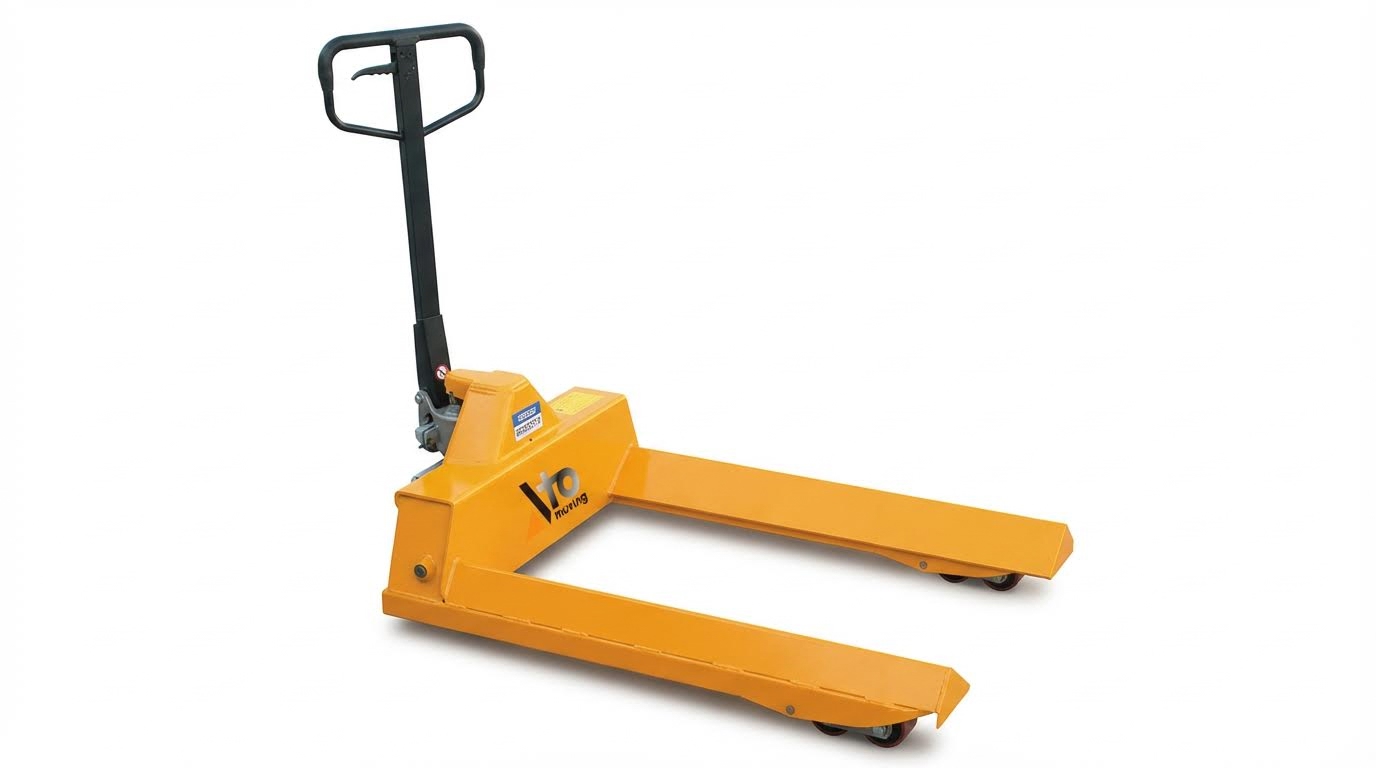
Safety valves, control lever logic, and the stability triangle ensure how does a drum stacker work without sudden drops or tipping when operators overload or mis‑position pallets. These features quietly enforce physics limits that operators cannot see.
- Overload pressure relief valve: Opens slightly above rated capacity (≈105–110%) – prevents structural over‑stress by bypassing oil instead of lifting an unsafe load.
- Controlled‑lowering valve: Meters oil back to the reservoir – avoids sudden fork drops that could shatter pallets or injure feet.
- Multi‑position control lever: Lift / Neutral / Lower – lets the operator switch between pumping, travel lock, and controlled descent with one hand.
- High‑quality seals: Limit internal leakage in neutral – prevent slow, unnoticed sinking of raised loads during picking or staging.
Rated load for pallet trucks typically falls between 1600 kg and 4000 kg depending on design, with the hydraulic relief valve and chassis stiffness both sized to this envelope. The stability triangle is defined by the contact points of the steer wheels and the effective support line between the load rollers; as long as the combined centre of gravity of truck and load stays inside this triangle, the system remains stable.
Understanding the stability triangle in simple terms
Imagine a triangle drawn between the two load rollers and the midpoint of the steer axle. When you lift a pallet, its weight shifts onto this tripod. If you overload, use a non‑standard pallet, or brake hard on a slope, the centre of gravity can move outside the triangle, causing tipping or sudden pivoting. Structural design, fork length, and valve settings are all tuned so that, within the rated kg, the centre of gravity stays well inside that triangle on level floors.
- Correct lever use: Neutral during travel – locks fork height and prevents accidental lowering if the handle is bumped.
- Progressive lowering: Some designs allow fine modulation – lets operators place fragile loads gently on racking beams or scales.
- Pre‑use checks: Look for leaks, bent forks, damaged wheels – any defect shr
Application Choices, Maintenance, And Lifecycle Costs
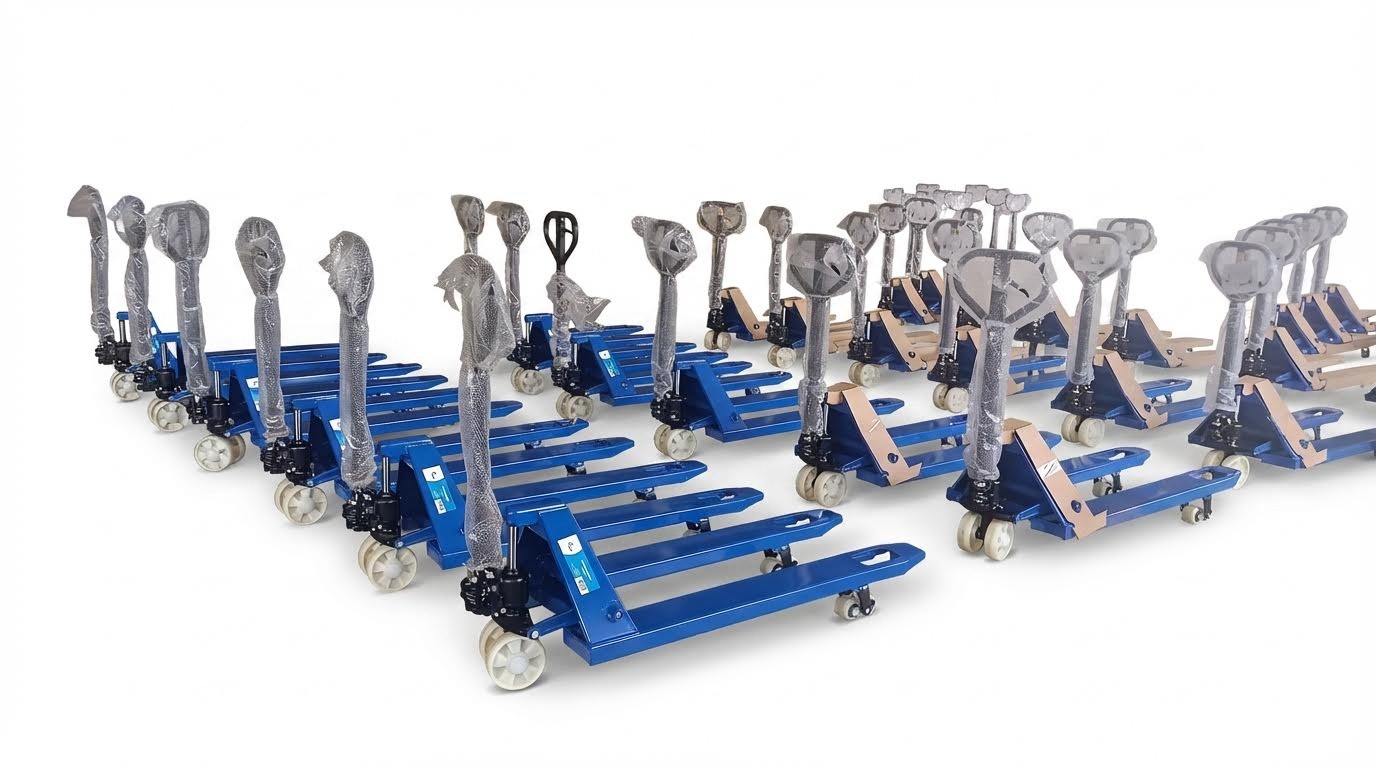
This section explains how different pallet truck types, maintenance strategies, and lifecycle costs interact so you can match equipment to duty cycle, floors, and budget while understanding how does a pallet truck work over years of service.
Once you understand how does a hydraulic pallet truck work mechanically and hydraulically, the next decision is which drive concept to use and how aggressively to maintain it. The right choice can cut total cost per moved pallet by 20–40% while reducing strain injuries.
Selecting Manual Vs Electric Vs IC Pallet Trucks
Selecting between manual, electric, and IC pallet trucks depends on load, distance, slope, and cycle frequency, not just purchase price.
Truck Type Typical Capacity Range Typical Performance Best For… (Operational Impact) Manual pallet truck 1600–3000 kg capacity range Human-powered, short shuttle moves only; ergonomically limiting at high cycles Short distances on smooth floors, low-throughput docks, backup truck in small warehouses Electric pallet truck (walk/ride-on) ≈1800–4000 kg capacity range ≈5.0 km/h laden, 6.0 km/h unladen; lift cycle ≈5.5 s Medium–high throughput, longer runs (30–80 m), ramps, and multi-shift operations Diesel / IC pallet truck (with mast) ≈3000–3500 kg, lift height up to 3000 mm specs Travel ≈18–19 km/h; gradeability up to 20% unladen Outdoor yards, loading ramps, rough surfaces, high-capacity loading where emissions/noise are acceptable - Manual trucks: Simple hydraulics and no batteries – lowest purchase and maintenance cost, but operator fatigue rises sharply with distance and slopes.
- Electric trucks: Powered traction and lift – reduce push–pull forces and time per move, ideal when “how does a pallet truck work” must align with ergonomic policies.
- IC / diesel trucks: Engine-driven hydraulics and drive – handle heavy loads and steep ramps where electric or manual units stall or overheat.
Quick selection rules by application
Rule 1: If average push distance is under 15–20 m on flat, smooth floors and daily cycles are low, a manual hydraulic pallet truck is usually sufficient.
Rule 2: If operators regularly push 25–80 m, cross docks, or ramps, an electric pallet truck typically pays back via productivity and fewer strain injuries.
Rule 3: For outdoor yards, gravel, or slopes approaching 20%, IC pallet trucks or forklifts become necessary to maintain rated capacity and stability.
💡 Field Engineer’s Note: When you size equipment, walk the actual route with a loaded manual pallet truck. If you see operators “surfing” the handle or avoiding certain aisles, that’s a red flag that you needed electric assistance yesterday.
Preventive And Predictive Maintenance For Uptime
Preventive and predictive maintenance keep pallet trucks lifting at rated capacity, minimize unplanned downtime, and flatten lifecycle cost peaks.
- Daily checks: 5–7 minute visual and functional inspection – catches leaks, bent forks, and wheel damage before a failure stops a shift.
- Weekly lubrication: Lube pivots, wheel axles, and center joints – reduces friction and push force, especially on high-cycle manual units maintenance routine.
- Monthly deep inspection: Clean hidden areas, check for rust, fork bending, and oil condition – prevents long-term structural damage and hydraulic failure.
- Annual FEM-style inspection: Structured check of structure, hydraulics, and capacity – extends life beyond 5 years in typical warehouses and keeps compliance documentation ready FEM 4.004 reference.
Maintenance Layer Typical Actions Impact on “How Does a Pallet Truck Work” Over Time Preventive – manual trucks Oil level checks, bleeding air, roller and wheel replacement, rust control Keeps hydraulic lift smooth and preserves full 1600–3000 kg rating without spongy lifting or sinking Preventive – electric trucks Battery charge discipline, cable checks, hydraulic oil checks Maintains travel speed (≈5–6 km/h) and lift cycle times, avoids mid-shift battery failures Predictive – advanced fleets Sensors for vibration, speed, battery cycles, temperature Allows condition-based servicing before bearing, wheel, or battery failure disrupts production Key failure modes to monitor
Hydraulic issues: Slow or jerky lifting usually means air in the circuit or low oil. Bleeding and topping up with ISO VG 32 oil typically restore performance. Persistent sinking indicates internal leakage or a faulty lowering valve that needs repair or seal replacement. Troubleshooting guidance.
Wheel and roller wear: Flat spots, cracked tread, or seized bearings show up as heavy steering and floor damage and should trigger pairwise replacement to keep tracking symmetrical.
Lifecycle cost analysis shows that disciplined daily, weekly, and monthly routines plus annual inspections prevent over 90% of failures and push service life well beyond five years in typical use, even for basic manual hydraulic trucks lifecycle data. Compared with electric pallet trucks, manual units have almost no energy or electronics cost, but poor maintenance quickly shows up as high operator effort and lower throughput, which is often more expensive than oil and rollers.
💡 Field Engineer’s Note: If you see operators “cherry-picking” the newest trucks and parking the old ones, your lifecycle cost problem has already started. Rotating units and enforcing simple daily checks keeps the fleet uniform and avoids a few “hero trucks” carrying all the abuse.
“”
Final Thoughts On Pallet Truck Design And Future Trends
Pallet truck performance is never about one component. Hydraulics, fork geometry, wheel sets, and safety valves work together as one system. Handle leverage and cylinder sizing turn modest human force into controlled lift, while forks and chassis keep stresses below yield so steel always springs back, not bends.
Wheel and roller choices then decide if that rated capacity is usable on your floors. Correct diameters, tread materials, and bearings cut rolling resistance and protect concrete, which directly lowers operator strain and cycle times. Safety valves, control logic, and the stability triangle quietly enforce non‑negotiable physics limits, so overloads and bad pallets do not turn into sudden drops or tip events.
For operations and engineering teams, the best practice is clear. Size truck type to distance, slope, and cycle rate, not just load. Match wheel packages to real floor conditions. Lock in daily checks plus structured annual inspections to keep hydraulics tight and structures straight. When you apply these engineering principles, a manual pallet truck from Atomoving stays safe, predictable, and cost‑effective across its full service life, and future upgrades to electric or IC units become a strategic choice, not an emergency fix.
Frequently Asked Questions
How does a pallet truck work?
A pallet truck works by using a hydraulic pump system to lift and lower the forks. The operator slides the forks underneath a pallet, then pumps the handle to raise the pallet off the ground. Once elevated, the user can push or pull the load to its desired location. Hand Pallet Guide.
How does an electric pallet truck work?
An electric pallet truck operates using a hydraulic pump to lift and lower the forks. The handle is attached to the hydraulic pump and is used to control these movements. Electric models are relatively easy to operate and are ideal for moving heavy loads efficiently. Power Pallet Truck Info.
Do you need training to use a pallet truck?
Yes, proper training is essential to operate a pallet truck safely. Training typically covers practical skills, equipment knowledge, risk awareness, and safe usage techniques. Certification may be required depending on workplace regulations. Pallet Truck Training Guide.