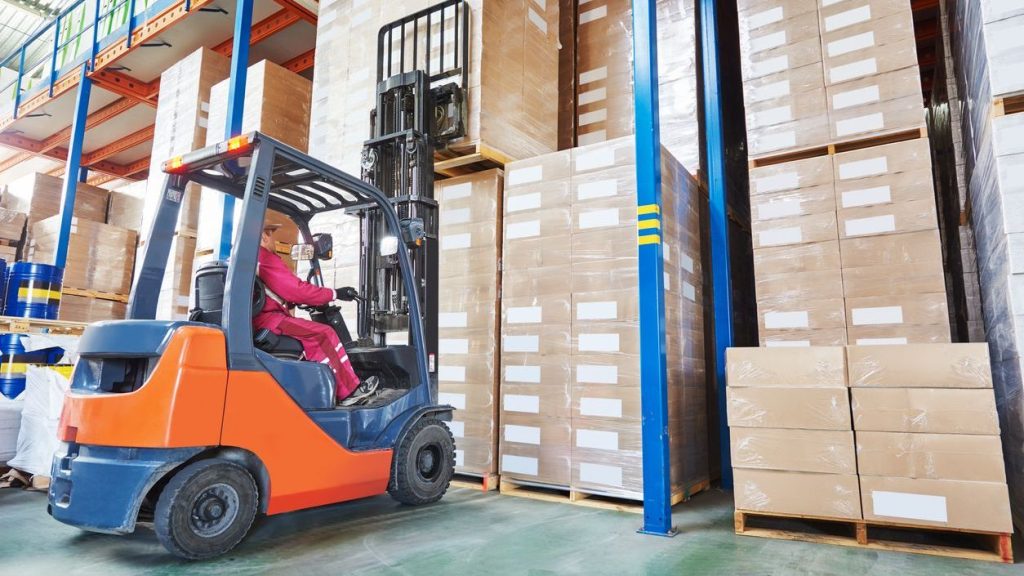
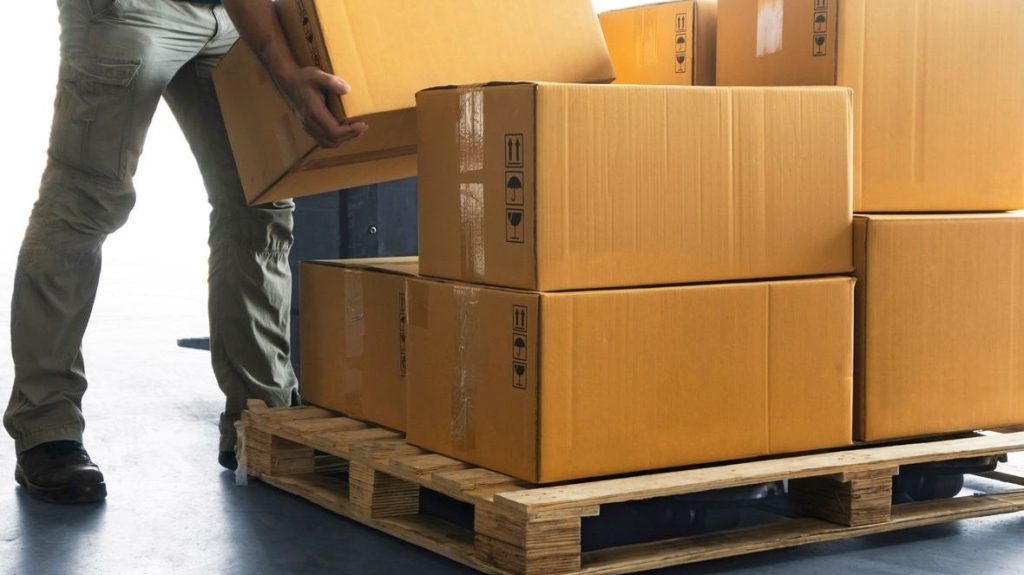
Walkie stacker capacity is the maximum load, in kg, that the truck can safely lift at a specified load center and height under ideal conditions. This guide explains how much can a walkie stacker hold in the real world, what derates that capacity, and how to match ratings to your actual pallets, floors, and duty cycles.
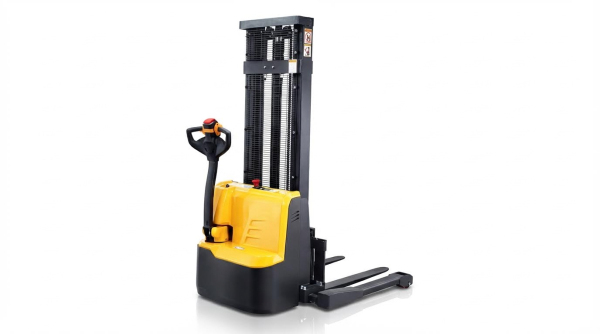
Understanding Walkie Stacker Rated Capacity
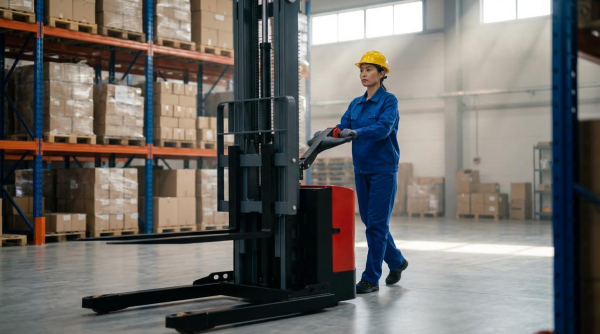
Walkie stacker rated capacity answers “how much can a counterbalanced stacker hold” under ideal, controlled test conditions, not in messy warehouse reality. You need to understand both the typical rating and how quickly it derates once conditions change.
Typical capacity ranges and load centers
Typical walkie stackers hold about 1,000–2,000 kg, but only at a defined load center and lift height. This is the starting point for deciding if a machine matches your pallets, racking, and floors.
| Parameter | Typical Value / Range | What It Assumes | Operational Impact (Real-World Meaning) |
|---|---|---|---|
| Rated capacity range | 1,000–2,000 kg (approx. 2,200–4,400 lb) | Standard pallet, uniform load, ideal floor | Defines the maximum “catalog” load; real safe load is often lower in daily use. |
| Standard load center | 600–610 mm from fork face | Load mass centered within pallet footprint according to capacity definitions | Works well for typical 1,000 mm × 1,200 mm pallets; long or overhanging loads break this assumption and reduce capacity. |
| Example rating | 1,500 kg @ 610 mm load center | Uniform cube load, specified mast height | Safe only if your actual load center is near 610 mm and lift height is within the rated chart. |
| Effect of larger load center | 1,500 kg @ 610 mm → ≈1,200 kg @ 760 mm | Same truck, longer or more overhanging load per example derating | Long pallets, bulky equipment, or offset loads can cost you roughly 20–25% of the nameplate capacity. |
| Typical lift height range | ≈2,500–5,500 mm | Within manufacturer’s stability envelope using mast load charts | Higher racking means more derating at top levels; you cannot always lift the full rated load to maximum height. |
From an engineering standpoint, “how much can a manual pallet jack hold” is always expressed as: capacity (kg) at a given load center (mm) and a given lift height (m). If you change any of those three, you change the safe capacity.
- Rated capacity: Maximum load in kg – Valid only at the specified load center and height.
- Load center: Horizontal distance from fork face to load’s center of gravity – Controls overturning moment.
- Rated lift height: Maximum fork elevation in mm – Higher height = higher center of gravity = lower safe load.
How to estimate your actual load center
Measure pallet length (front to back along forks). If the load is evenly distributed, the load center is roughly half that length from the fork face. For example, a 1,200 mm pallet gives a ~600 mm load center. If the load overhangs or is top-heavy, the true center of gravity can shift further out, effectively increasing the load center and reducing safe capacity.
💡 Field Engineer’s Note: When I audit sites, the fastest way to spot under-rated stackers is to look for long pallets (over 1,200 mm) or loads that stick out past the fork tips. Even with a 2,000 kg nameplate, those trucks often should not be handling more than about 1,200–1,400 kg at full height once you account for the longer load center and real floors.
Rated vs usable capacity in real conditions
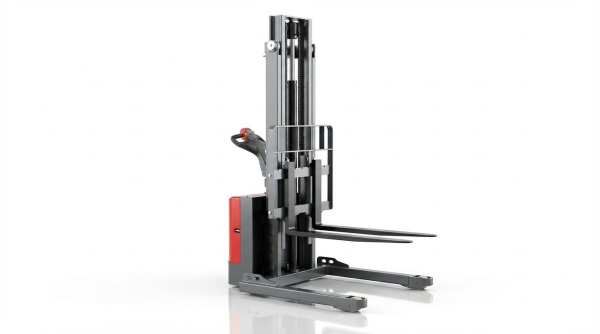
Rated capacity is the lab number on the nameplate; usable capacity is what you can safely lift in your building, on your floors, with your pallets and operators.
| Aspect | Rated Capacity (Nameplate) | Usable Capacity (Real World) | Typical Operational Impact |
|---|---|---|---|
| Definition | 1,000–2,000 kg at specified load center and height under ideal test conditions | What you can lift and move repeatedly without instability or performance issues | Real usable figure is usually 10–30% below the nameplate, depending on conditions. |
| Load geometry | Uniform, compact load | Uneven, offset, or tall loads | Top-heavy or offset loads force you to derate further, especially at high lift. |
| Floor and grades | Flat, smooth, clean floor; minimal slope | Joints, dips, rough patches; 5% grades loaded, 8% empty as typical limits | Dynamic shocks and reduced friction mean you should run under rated capacity, especially near edges or racking. |
| Lift height | Tested at specific height from load chart | Frequent high-level stacking at 4–5.5 m | Residual capacity at full height can be significantly lower than the base rating. |
| Component condition | New truck, perfect hydraulics and mast | Wear in chains, rollers, hydraulics, tires | Worn components reduce effective lifting force and stability, cutting practical capacity. |
| Battery and thermal state | Fully charged battery, cool motors | Partially discharged battery, hot motors and oil causing derating | Near the end of a shift, lift speed drops and the truck may struggle or refuse to lift heavier loads to full height. |
In practice, many engineers treat the rated capacity as a hard upper bound, then apply an operational margin of around 10–20% below that for normal use. Manufacturers already built in structural safety factors of roughly 15–25%, which you should not “spend” in daily operation according to design practice.
- On good floors, short pallets: Usable capacity may be close to rated (within ~10%). – Best-case scenario.
- On mixed floors, longer pallets: Expect 15–30% derating from rated. – Common in older warehouses.
- On poor floors or ramps: Treat nameplate as a theoretical limit only. – Plan for aggressive derating and strict procedures.
Quick rule of thumb for sizing a walkie stacker
1) Take your heaviest realistic pallet (kg). 2) Add 10–20% as an operational safety margin. 3) Check the manufacturer’s capacity chart at your actual load center (mm) and top lift height (m). If the charted capacity there is not at least equal to step 2, move up to the next higher truck size.
💡 Field Engineer’s Note: When someone asks me “how much can a drum dolly hold,” I ignore the nameplate at first and look at their worst pallet, highest rack, and roughest aisle. The safe answer is whatever the capacity chart says at that exact combination, minus another 10–20% for real-world chaos—never the bare number painted on the truck.
Engineering Factors That Derate Real-World Capacity
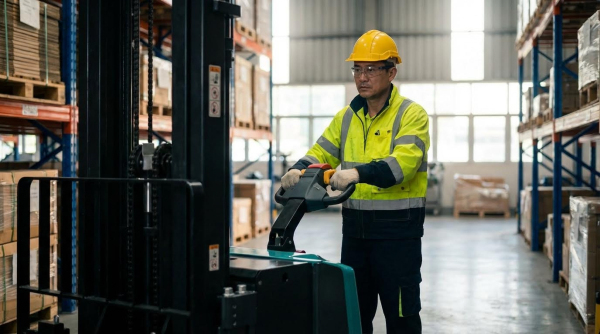
Engineering factors like load center, lift height, floor quality, and battery state all reduce how much a counterbalanced stacker can safely hold versus its nameplate rating. Understanding these is essential when asking how much can a walkie stacker hold in your building, not just in the brochure.
Under ideal test conditions a walkie stacker might be rated 1,000–2,000 kg at about a 600–610 mm load center and a defined lift height, but real usable capacity is lower once you change pallets, raise the mast, drive on slopes, or run on a low battery. Each subsection below explains where that “missing” capacity goes and how to plan for it.
Load center, pallet size, and load geometry
Load center, pallet length, and load shape directly control how much can a battery-powered stacker hold before it reaches its stability limit. As the load center moves out, capacity drops fast.
Rated capacity is defined at a specific load center, typically around 600–610 mm from fork face to load center of gravity. In real warehouses, long pallets, overhang, or unbalanced loads push that center out, increasing the overturning moment. That is why a stacker that is “1,500 kg” on paper may not safely lift 1,500 kg of long product.
| Parameter | Typical Value | Effect on Capacity | Operational Impact |
|---|---|---|---|
| Rated load center | 600–610 mm | Full nameplate capacity available at this point | Use for standard 1,200 mm pallets with compact loads |
| Increased load center | ≈760–762 mm | 1,500 kg rating can drop to ≈1,200 kg (≈20% loss) Documented example | Long pallets or overhang need lower load weights |
| Uneven / top‑heavy load | COG shifts forward or high | Reduces lateral and longitudinal stability | Greater tip‑over risk when turning or braking |
- Long pallets or overhang: Push the center of gravity beyond the rated load center – This derates capacity even if the weight is unchanged.
- Unstable or “loose” loads: Shift during travel or braking – Can swing the effective load center forward suddenly.
- High, narrow stacks: Raise the combined center of gravity – Reduce side‑to‑side stability in turns.
How to estimate your actual load center
Measure from the fork face to the geometric center of the load. For a 1,200 mm deep pallet with no overhang, the center is at roughly 600 mm. Add any front overhang or uneven product distribution to that distance. Compare this real value to the capacity chart, not just the nameplate rating.
💡 Field Engineer’s Note: When I audit sites, the fastest way to explain derating is this: every extra 100–150 mm of load center past the chart value costs you a big chunk of capacity. If you routinely carry long pallets, choose a higher-capacity truck than the math suggests, or you will run out of stability margin long before you hit the “rated” weight.
Lift height, mast design, and stability envelope
Lift height and mast type strongly reduce how much can a electric platform stacker hold at the top of the mast compared with ground level. The higher you go, the less you can safely lift.
As mast height increases, the combined center of gravity of truck plus load rises, shrinking the stability triangle. Manufacturers account for this with capacity charts that show a lower allowable load at maximum lift, especially on duplex and triplex masts.
| Mast / Height | Typical Lift Range | Capacity Behavior | Best For… |
|---|---|---|---|
| Short / single mast | ≈1,600–2,500 mm Example ranges | Modest derating across stroke | Low racks, dock work where full rating is often usable |
| Standard duplex mast | ≈2,500–4,500 mm | Noticeable derating near full height | Typical warehouse racking up to second/third level |
| Triplex / high‑lift mast | ≈5,500–6,000 mm | Strongest derating at top elevation | Very high racking where residual capacity is critical |
- Rated capacity point: Usually defined at a specific height (often near ground or a mid‑height) – Do not assume that value holds at 5.5 m.
- Deflection and sway: More mast sections mean more bending and side sway – Manufacturers reduce allowable load to keep sway within safe limits.
- Residual capacity: The safe load at a given height and load center – This is the real answer to “how much can a walkie stacker hold” on your top rack.
Using capacity charts instead of the nameplate
Always read the capacity chart: find your lift height on one axis and your actual load center on the other. The intersection gives residual capacity. If your worst‑case pallet weight is within 80–90% of that value, you are in a safe planning zone with a reasonable margin.
💡 Field Engineer’s Note: Many incidents I investigated involved loads that were “technically under the rating” but lifted to the very top of a triplex mast. At full height, that same truck often had 20–30% less residual capacity than the sticker suggested, especially with non‑standard pallets.
Floor conditions, grades, and dynamic effects
Floor flatness, surface friction, and slopes can sharply reduce how much can a manual pallet jack hold safely, even if the static weight is below the rating. Dynamic shocks and grades amplify the effective load.
Walkie stackers are designed for flat, hard floors with limited gradeability. Typical maximum grades are about 5% loaded and 8% empty under ideal conditions. Real slabs often have joints, dips, and debris that introduce impact loads and reduce tire grip.
| Condition | Typical Spec / Situation | Capacity Effect | Operational Impact |
|---|---|---|---|
| Floor flatness | Real slabs may vary ±3–5 mm per meter | Causes rocking and momentary overloads | Reduce load weight and speed near joints and slopes |
| Ground clearance | ≈30 mm with small load wheels Typical figure | Debris impacts can jar tall loads | Keep routes clean; avoid potholes and dock plates with gaps |
| Grade (loaded) | ≈5% recommended maximum | Gravity adds to effective load and braking demand | Derate load weight on ramps and keep forks low |
| Surface friction | μ ≈0.4–0.6 for polyurethane on dry concrete | Low μ (oil, dust, water) increases stopping distance | Clean spills promptly; restrict heavy loads on slick areas |
- Braking and turning: Sudden stops or sharp turns with raised loads generate lateral and longitudinal forces – These can exceed static capacity even below the rating.
- Ramps and dock plates: Add vertical and rotational shocks – Plan lower weights when crossing transitions with high or fragile loads.
- Travel height: Loads should travel around 300–400 mm above floor – Minimizes center‑of‑gravity height and improves stability.
Practical derating on poor floors
On cracked, jointed, or sloped floors, many safety managers enforce an additional 10–20% derating versus capacity charts. That means if the chart says 1,200 kg at your height and load center, you cap operations at about 960–1,080 kg to account for dynamic effects.
💡 Field Engineer’s Note: If I see a stacker with tiny polyurethane wheels running near full rating on a rough or sloped floor, I assume the real safety margin is already gone. The combination of low ground clearance and impact loads is what tips trucks, not the static weight number on the paperwork.
Batteries, hydraulics, and thermal derating
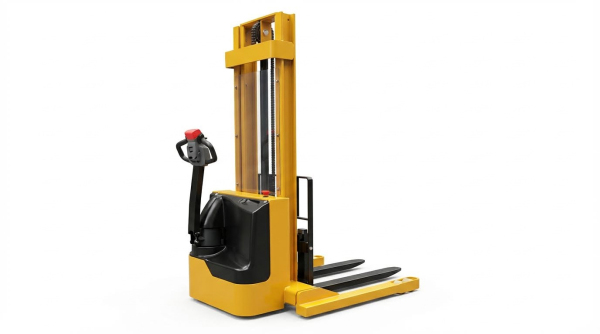
Battery discharge, motor heating, and hydraulic condition all reduce how much can a drum dolly hold in practice by limiting lift force and control, especially late in the shift. The nameplate assumes healthy systems at normal temperature.
Electric walkie stackers commonly run 24 V batteries around 180–280 Ah. As the battery discharges, voltage sag limits motor current, slowing lift and sometimes preventing full‑height lifting of rated loads under heavy duty cycles. At the same time, drive and lift motors heat up, and thermal protection cuts current to protect components.
| Subsystem | Typical Spec / Issue | Capacity Impact | Operational Impact |
|---|---|---|---|
| Battery system | 24 V, ≈180–280 Ah; voltage sag when discharged | Reduces motor torque and lift speed | Near end of shift, truck may fail to lift heavier pallets to full height |
| Motor thermal limits | Drive 1.2–2.2 kW, lift 2.2–3.0 kW generating heat | Thermal protection reduces allowable current | Effective capacity drops during intense, continuous stacking |
| Hydraulic oil temperature | Hot oil becomes low‑viscosity; cold oil stiff | Hot: internal leakage and loss of force; cold: pressure spikes | Derated performance in very hot or cold environments |
| Hydraulic maintenance | Leaks, low oil, worn seals and chains | Cannot sustain rated pressure and stable lift | Slow, uneven lifting and reduced safe working limit |
- Poor maintenance: Worn pumps, cylinders, chains, and rollers add friction and leakage – Real safe capacity can fall well below the original rating.
- Relief valve settings: If set too low, the truck will stall below nameplate load – If set too high, components risk failure under stress.
- Battery care: Proper charging and avoiding deep discharge – Keeps actual lift performance close to the rated value across the shift.
Simple on-site checks to protect real capacity
Monitor lift speed with a known test load at the start and end of a shift. A noticeable slowdown under the same weight usually points to battery or hydraulic issues that are already eating into your safe capacity margin, even if the truck still “technically works.”
💡 Field Engineer’s Note: In high‑throughput sites, I routinely assume a 10–15% functional derating late in the shift unless battery health and hydraulic maintenance are proven. If your worst‑case pallet is already close to the chart value, that extra hidden derating is where problems start.
Matching Walkie Stacker Capacity To Your Application
To match walkie stacker capacity to your application, you define real loads and duty cycles, then apply capacity charts and safety margins so “how much can a walkie stacker hold” stays safely below its limits in daily use.
Defining true load cases and duty cycles
Defining true load cases and duty cycles means describing what you actually lift, how often, and in what conditions, not just reading the nameplate rating.
- Load weight range: List minimum, typical, and worst-case pallet weights in kg – This anchors how much can a walkie stacker hold for your reality, not theory.
- Load geometry: Record pallet length, width, and overhang in mm – Longer loads shift the load center and cut usable capacity.
- Load type: Note if loads are rigid, shrink-wrapped, stacked boxes, drums, or IBCs – Unstable loads need extra safety margin.
- Lift height: List the highest rack beam or platform in mm – Capacity always drops as lift height increases.
- Travel path: Map slopes, dock plates, thresholds, and rough patches – Grades and shocks derate safe capacity.
- Cycle frequency: Estimate lifts per hour and operating hours per shift – High duty cycles trigger thermal and battery derating.
- Environment: Note temperature range, cold rooms, dust, or moisture – Cold or hot conditions affect hydraulics and batteries.
How to capture real load data in one day
Pick a busy shift, weigh 10–20 representative pallets, and measure pallet length and any overhang with a tape (mm). Photograph the worst, tallest, and ugliest loads. This quick survey usually reveals that a few “problem pallets” control your stacker sizing.
From this, define at least three design load cases:
- Typical case: E.g., 900 kg pallet on 1,200 mm pallet, lifted to 2,500 mm – Represents 70–80% of work.
- Heavy/high case: E.g., 1,300 kg pallet, 1,200 × 1,200 mm, to top rack at 4,500 mm – Controls required capacity and mast type.
- Abuse case: E.g., slightly overhanging, unstable, or damaged pallets – Drives extra safety margin and training.
💡 Field Engineer’s Note: When I audit sites, the “true” limiting case is usually a handful of tall, mixed-load pallets going to the top rack on a slightly sloped or jointed floor. If you size only for average pallets on perfect floors, operators will quietly overload the truck to keep production moving.
Using capacity charts, safety margins, and inspections
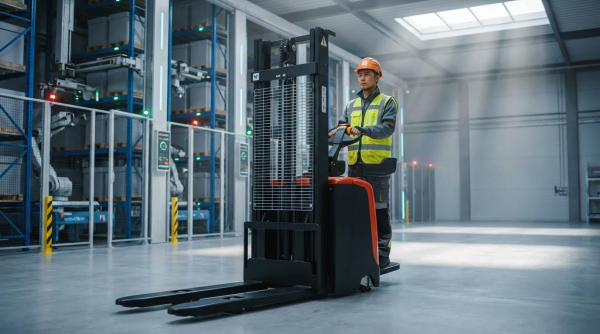
Using capacity charts, safety margins, and inspections turns your load cases into a safe, practical answer to “how much can a walkie stacker hold” over the life of the truck.
Start with the rated capacity range and load center assumptions. Typical walkie stackers are rated about 1,000–2,000 kg at a 600–610 mm load center and a specified lift height under ideal conditions. Source for typical ratings and conditions
| Specification | Typical Value | Operational Impact |
|---|---|---|
| Rated capacity (ideal) | 1,000–2,000 kg @ 600–610 mm load center | Maximum weight at standard pallet depth and specified height in perfect conditions. |
| Standard load center | 600–610 mm | Assumes ~1,200 mm pallet with load centered; longer loads reduce capacity. |
| Example derating | 1,500 kg → ~1,200 kg when load center grows to ~760 mm | Extra 150 mm of load center can cut usable capacity by ~20%. Load center impact example |
| Typical lift heights | 2,500–5,500 mm | Higher masts have more derating at maximum height; check the chart at your top rack. |
| Typical grades | ≈5% loaded, 8% empty | On ramps or rough floors you should run below rated capacity to keep stability. Grade and floor guidance |
Then, walk through the manufacturer’s capacity chart for each of your design load cases:
- Step 1: Find the correct mast height – Use your highest lift point (mm) to select the right chart row or graph.
- Step 2: Calculate actual load center – Half of pallet length plus any overhang becomes your real load center.
- Step 3: Read residual capacity – This is how much the walkie stacker can safely hold at that height and load center.
- Step 4: Compare to worst-case load – Residual capacity must exceed your heaviest design load, not just the typical one.
Next, apply operational safety margins on top of the chart values. Manufacturers already build in about 15–25% structural safety margin that you should not plan to use. Source for typical safety factors For operations, it is good practice to keep an extra 10–20% margin above your worst-case load.
- Example 1: Worst-case pallet = 1,000 kg at your top rack – Select a stacker with ≥1,200 kg residual capacity at that height and load center.
- Example 2: Worst-case pallet = 1,300 kg with long pallets – Target ≥1,500–1,600 kg residual capacity at that geometry.
What this means for “how much can a walkie stacker hold”
If the nameplate says 1,500 kg at 600 mm, but your real load center is closer to 760 mm and you lift to a high rack, the usable safe capacity may only be around 1,200 kg. After adding a 10–20% operational margin, you should plan routine loads around 1,000–1,050 kg in that configuration, not at the 1,500 kg headline figure.
Finally, keep your real-world capacity close to the calculated value with inspections and maintenance. Poor maintenance (worn hydraulics, low oil, damaged chains, tired batteries) reduces practical lifting ability and stability even though the nameplate does not change. Maintenance impact on capacity
- Daily checks: Operators inspect forks, mast, wheels, brakes, and hydraulics before use – Catches damage that silently reduces safe capacity.
- Scheduled service: Technicians service hydraulics, chains, bearings, and batteries – Maintains lift speed and stability at rated loads.
- Battery care: Keep 24 V batteries healthy and charged – Reduces voltage sag and thermal derating on heavy cycles.
- Floor monitoring: Repair bad joints, potholes, and steep spots – Preserves the stability envelope assumed in the capacity chart.
💡 Field Engineer’s Note: If you want a fast field check, watch a fully loaded lift to top height near the end of a shift. If the mast slows dramatically, struggles, or the truck alarms on every cycle, your battery, hydraulics, or chosen capacity are too close to the edge—even if the numbers look fine on paper.
Final Thoughts On Selecting Safe Stacker Capacity
Walkie stacker capacity is never just the big number on the nameplate. Real safety depends on how load center, lift height, floor conditions, and equipment health interact in your building. When you extend the load center, raise the mast, drive over joints, or run on a tired battery, you shrink the stability envelope and lose usable capacity, even though the plate stays the same.
Engineering teams should start with hard data on real pallets, worst lift heights, and actual routes. Then they must size trucks using capacity charts at those exact load centers and heights, not at catalog conditions. Operations should plan routine loads at least 10–20% below charted residual capacity to cover dynamic effects, wear, and thermal derating.
Daily inspections, disciplined battery care, and timely hydraulic and mast maintenance keep real capacity close to design. Floor repairs and clear travel paths protect the narrow stability margins at high lift. The safest strategy is simple: buy enough capacity for your worst case, then run it conservatively. Used this way, an Atomoving walkie stacker will handle its rated work with stable performance and low incident risk over its full service life.
Frequently Asked Questions
What is the weight capacity of a walkie stacker?
A walkie stacker’s weight capacity varies depending on the model and manufacturer, but typically ranges between 1,000 kg to 2,000 kg. The exact capacity should be checked on the equipment’s data plate or in the manufacturer’s specifications. For more details, refer to Forklift Types Guide.
How high can a walkie stacker lift materials?
Walkie stackers are designed to lift materials to varying heights, usually up to 6,100 mm. This makes them suitable for stacking loads on high shelves in warehouses. For more information, check out this Stacker Guide.
Does a walkie stacker count as a forklift?
Yes, a walkie stacker is considered a type of forklift. It falls under the category of powered industrial trucks and requires proper certification for operation. Learn more about walkie stackers in this Safety Guide.