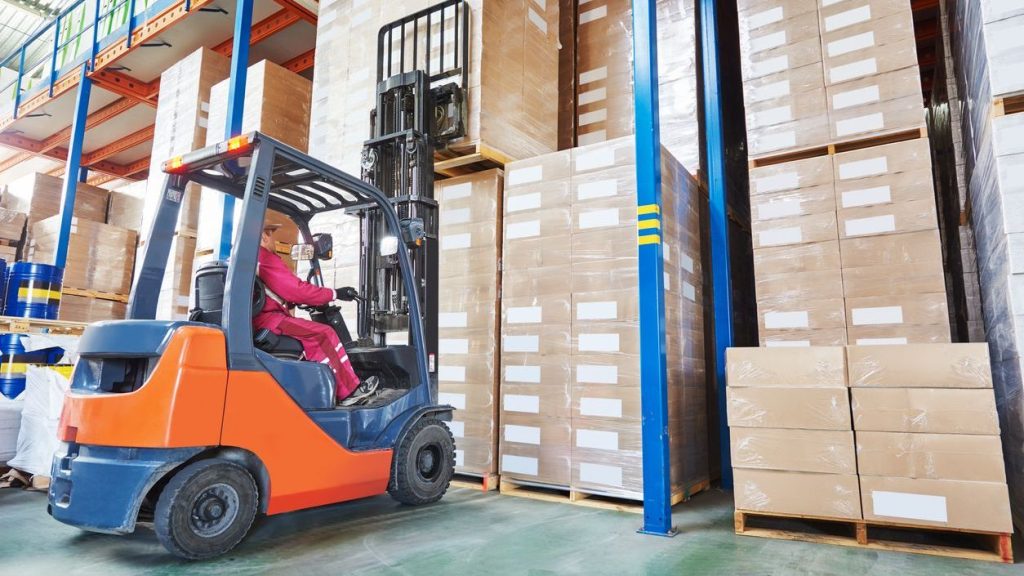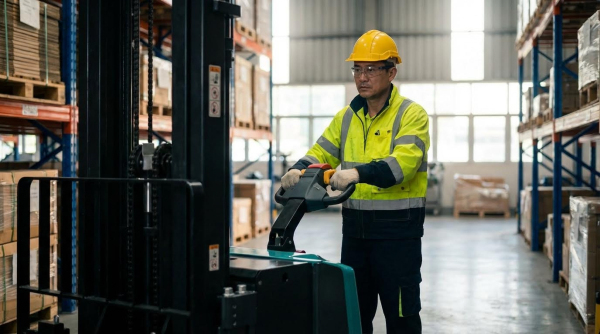
Walkie stackers typically lift between about 3,000 mm and 5,400 mm, with some specialized designs reaching 7,000–8,000 mm when stability allows. This guide explains how high a walkie stacker can lift in real facilities, and how mast design, capacity derating, and stability limits should shape your equipment choice.
You will see how mast types, load centers, and safety standards interact so you can match stacker lift height to your rack beams and aisles without flirting with tip‑over risks. By the end, you will know which specs matter, what “safe at height” really means, and how to talk confidently about walkie stacker lift heights with your supplier or safety team.
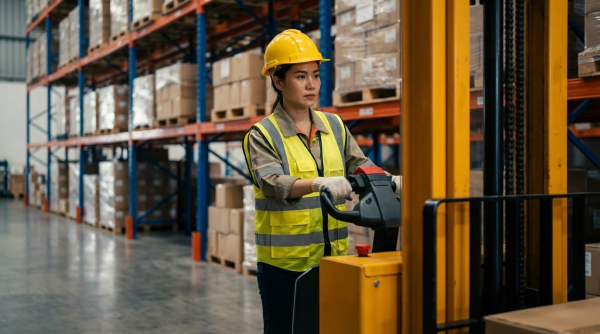
Defining Walkie Stacker Lift Heights And Limits
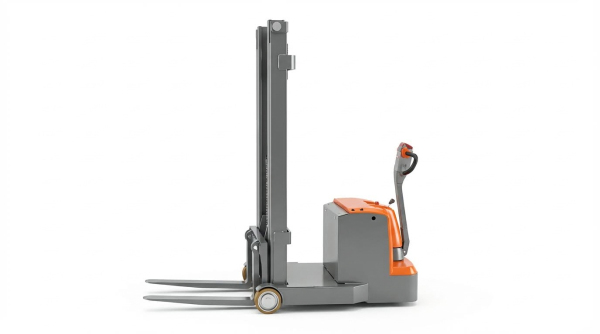
Walkie stackers typically lift between 3,000 mm and 5,400 mm, with specialized units reaching 7,000–8,000 mm, but the safe answer to “how high can a walkie stacker lift” always depends on mast design and stability limits. This section explains realistic height ranges, how mast type changes those limits, and how the stability triangle and load center control tip-over risk.
Typical lift height ranges by stacker design
Walkie stackers usually lift from about 1,000 mm for low-lift work up to 5,400 mm for standard high-reach, with some specialist designs approaching 8,000 mm under tightly controlled conditions.
| Stacker / Application Type | Typical Max Lift Height (mm) | Usual Capacity Range at Low Lift (kg) | Best For… |
|---|---|---|---|
| Low-lift walkie stacker | Up to ~1,000 mm | 900–2,000 kg | Dock work, truck loading, low mezzanine feeds where only small elevation is needed (height ranges) |
| Medium-reach walkie stacker | 2,000–4,000 mm | 900–2,000 kg | Standard pallet racking up to roughly 4.0 m clear beam height in small warehouses (medium reach) |
| High-reach walkie stacker | 4,000–5,400 mm | 900–2,000 kg at ground level, de‑rated at height | Higher racking in typical warehouses, answering most “how high can a walkie stacker lift” needs up to about 5.4 m (5,400 mm high‑reach) |
| Pedestrian reach stacker | Up to ~6,000 mm | Typically toward lower end of 900–2,000 kg band at height | Pedestrian-operated reach into deeper or higher racking up to ~6.0 m (pedestrian reach heights) |
| Special high-bay walkie stacker | 7,000–8,000 mm | Strongly de‑rated vs. ground capacity | Special projects in high-bay storage; only with careful stability checks and strict operating rules (7,000–8,000 mm) |
Across these types, nameplate capacities around 900–2,000 kg apply at or near floor level and at the rated load center. As lift height increases, manufacturers de‑rate capacity to keep the overturning moment within the stability triangle, so a truck rated 2,000 kg at low lift may safely handle only a fraction of that near 5,000 mm. (capacity vs. height)
💡 Field Engineer’s Note: When someone asks “how high can a walkie stacker lift,” I first look at the rack beam height and then the data plate, not the brochure. The real limit is the height where the unit still has enough rated capacity for your heaviest pallet, not the absolute mast maximum.
How mast type changes maximum lift height
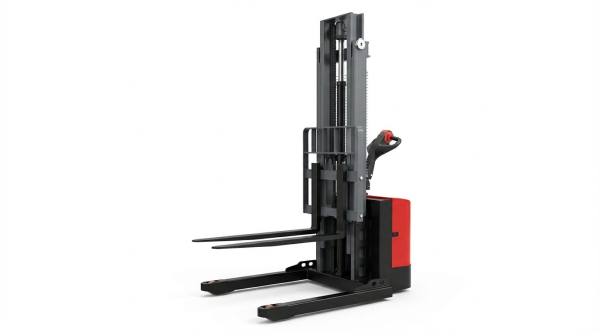
Mast type directly controls how high a walkie stacker can lift, as well as whether it will physically clear doors, mezzanines, and low ceilings in your building.
| Mast Type | Construction | Typical Lift Height Range (mm) | Key Characteristics | Operational Impact |
|---|---|---|---|---|
| Simplex (single-stage) | Single fixed frame; carriage runs centrally | Generally low-lift, below typical headroom levels | Overall mast height does not change much as forks rise; very rigid but limited reach (simplex masts) | Best for dock heights and low mezzanine feeds where you do not need racking above ~1.0–2.0 m. |
| Duplex (two-stage) | Two telescopic sections | Medium lift, often up to about 4,000–6,000 mm depending on model | Provides some free lift so forks can rise without increasing overall mast height, ideal for low ceilings (duplex features) | Common on walkie stackers serving standard racking up to roughly 4.0–5.0 m where doorway heights are tight. |
| Triplex (three-stage) | Three telescopic sections | High lift, typically above 6,000 mm with compact collapsed height | Delivers high reach with lower closed height than duplex; more moving parts and lubrication points (triplex masts) | Used when racking exceeds ~6.0 m or when you must pass through low doors then lift high in the aisle. |
Concrete mast data from a typical walkie stacker shows how this plays out. A two-stage limited free-lift mast can offer a maximum fork height of about 3,556 mm, with overall extended height around 4,877 mm. A three-stage full free-lift mast on the same truck can reach about 4,724 mm fork height while keeping the lowered height down near 2,108 mm and extending to roughly 6,045 mm at full lift. (mast dimensions)
What “free lift” really means for your building
Free lift is the vertical distance the forks can travel before the mast height starts to increase. Limited free-lift on duplex masts (for example around 152 mm in some designs) lets you pick a pallet off the floor inside a trailer or under a mezzanine without the mast striking the roof. Full free-lift triplex masts extend this concept so you can raise loads significantly while still staying below door headers or low beams until you are positioned in the main aisle. (free-lift data)
💡 Field Engineer’s Note: For older buildings with 2.4–2.7 m door headers feeding 5.0–6.0 m racks, I almost always specify a triplex mast. You trade some maintenance complexity for the ability to clear doors safely, then answer “how high can a walkie stacker lift” with enough margin to hit your top beam plus 200–300 mm clearance.
Stability triangle, load center, and tip‑over risk
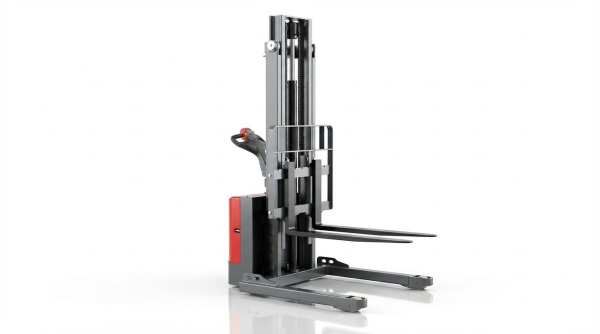
The stability triangle, load center, and lift height together define the real safety limit on how high a walkie stacker can lift a given load without risking tip-over.
- Stability triangle: The truck’s wheels form a triangle that defines its base of support – keeping the combined center of gravity inside this triangle prevents overturning.
- Load center distance: Typically around 600 mm for palletized loads – increasing this distance increases the overturning moment and forces capacity derating at height. (600 mm load center)
- Height effect: As the mast raises, the combined center of gravity moves up and can shift toward the front axle – this shrinks your stability margin, especially with braking or mast tilt.
- Capacity derating: Many walkie stackers keep close to 100% of nameplate capacity near the floor, but effective capacity can drop to 50–70% near maximum mast height – this is how manufacturers keep the center of gravity inside the triangle. (derating ranges)
- Dynamic effects: Mast tilt, braking, turning, or operating on slopes change the combined center of gravity – this can push it outside the stability triangle even if the static capacity chart says the load is acceptable. (stability training)
ISO 3691‑5 requires that walkie stackers prove stability with their rated load at maximum lift height, and that braking performance remains fail-safe, including on slopes above 1,000 mm lift. (ISO safety requirements) In practice, operators must still check the capacity plate for the actual load center and height combination they intend to use, then keep loads as low as possible while travelling and avoid side slopes or tight-radius turns with elevated pallets. (safe driving rules)
💡 Field Engineer’s Note: When I validate an installation, I do not just ask “how high can a walkie stacker lift”; I ask “how high can it lift your heaviest 1,200 mm deep pallet at a 600 mm load center and still stay inside the stability triangle during an emergency stop on a 2% slope.” That is the real engineering limit you should design around.
Engineering Factors That Govern Maximum Lift Height
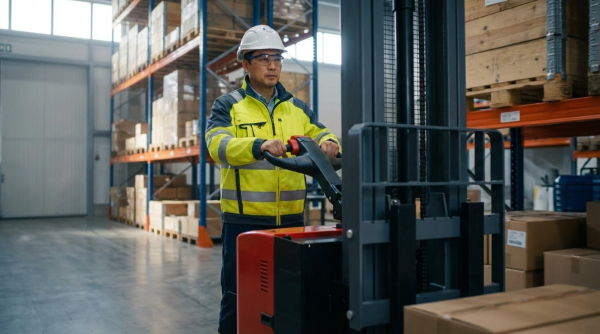
Engineering factors like capacity derating, mast design, and chassis geometry ultimately decide how high can a counterbalanced stacker lift safely at your site. Understanding these limits prevents tip‑overs, bent masts, and broken pallets.
At ground level many battery-powered stacker handle 900–2,000 kg, but usable capacity often falls to 50–70% near maximum mast height to keep the truck inside its stability triangle. Mast construction, free‑lift, battery weight, and wheelbase length all interact with load center to define the real working height in your aisles.
💡 Field Engineer’s Note: When you push a electric platform stacker close to its top beam, the limiting factor is almost never “how high can a walkie stacker lift” on paper; it is whether your floor, pallets, and operators can tolerate the extra sway and reduced capacity at that height.
Capacity derating curves versus mast height
Capacity derating curves show how the rated load drops as mast height and load center increase, directly limiting how high can a lift stacker lift with a given pallet. They translate pure physics (overturning moment) into a simple, readable chart.
Near the floor, most units can use 100% of the nameplate capacity. As you raise the load, the overturning moment increases, so allowed capacity must fall to keep the combined center of gravity inside the stability triangle. Typical guidance shows a 10–25% reduction at around half mast height and only 50–70% of base rating near maximum lift, especially with long or unbalanced loads. Reference data and manufacturer curves confirm this trend.
| Lift Height (relative) | Typical Allowable Capacity | Engineering Reason | Operational Impact |
|---|---|---|---|
| Near floor (0–500 mm) | ≈100% of nameplate (e.g. 2,000 kg) | Short lever arm, low overturning moment | Best for transport; keep loads low while travelling |
| Mid‑height (~½ mast) | ≈75–90% of nameplate | Higher center of gravity increases tipping risk | OK for mid‑rack work; avoid extra attachments |
| High level (80–100% of max height) | ≈50–70% of nameplate | Maximum overturning moment and mast deflection | Use lighter pallets; verify against derating chart |
Walkie stackers with ground‑level capacities of 900–2,000 kg may therefore only be permitted to lift a fraction of that at 5,000–5,400 mm. Manufacturer specifications emphasize this de‑rating to keep the truck within ISO 3691‑5 stability requirements.
- Check the data plate: Always read capacity at the required height and load center – prevents invisible overloads at top beams.
- Account for attachments: Side‑shifters or clamps move the load center out – further reduces safe capacity at height.
- Respect mid‑height limits: Do not assume full capacity until you reach the very top – derating starts much earlier.
How to read a derating chart in practice
Find your mast type and maximum height on the chart, trace vertically to your target height, then horizontally to the permitted mass at your load center (commonly 600 mm). Compare this to your heaviest pallet plus packaging.
Mast construction, free‑lift, and deflection control
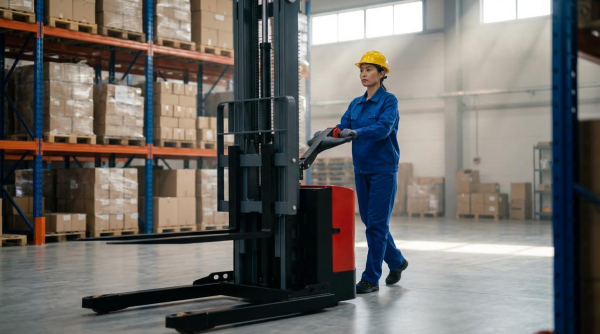
Mast construction, free‑lift, and deflection control determine how high can a manual platform stacker lift without excessive sway, binding, or hitting the roof. Stronger sections and better bearings allow higher, stiffer masts.
Simplex, duplex, and triplex masts use different numbers of telescoping channels and lift cylinders, which directly affects maximum height, collapsed height, and rigidity. Simplex designs offer the best stiffness but limited lift; duplex and triplex add stages to reach 4,000–6,000 mm and beyond, at the cost of more moving parts and potential deflection. Two‑stage limited free‑lift masts can reach about 3,556 mm fork height with 4,877 mm extended mast height, while three‑stage full free‑lift options reach around 4,724 mm fork height with 6,045 mm extended height. Detailed mast tables illustrate these dimensions.
| Mast Type | Typical Max Fork Height | Free‑Lift Behavior | Best For… |
|---|---|---|---|
| Simplex (1‑stage) | Low lift; often <3,000 mm | Minimal or no free‑lift | Dock work, low mezzanines, maximum rigidity |
| Duplex (2‑stage, limited free‑lift) | Up to ≈3,500–3,600 mm TOF | Small free‑lift before mast extends | Standard racking in rooms with low ceilings |
| Triplex (3‑stage, full free‑lift) | ≈4,700–6,000 mm TOF | Large free‑lift with low collapsed height | High‑bay racks above 6,000 mm and low door heads |
Free‑lift allows forks to rise while the mast height stays nearly constant. This is essential when you must load inside containers, low doorways, or mezzanines without striking overhead structures. However, more stages and chains increase clearances and potential play, which can show up as mast “whip” at height.
- Heavier mast sections: Thicker channels and cross‑bracing – reduce deflection and sway at upper levels.
- Quality rollers and bushings: Precision guidance of inner rails – limits side play and binding when fully extended.
- Correct chain tension: Regular adjustment – prevents uneven lift and twisting loads into the mast.
💡 Field Engineer’s Note: In cold stores below 0°C, mast oil thickens and seals stiffen, so a high triplex that feels fine at 20°C can chatter or stall near full height. Always test maximum‑height lifts in the coldest area of the warehouse before signing off a new stacker.
Why mast deflection matters at maximum height
Even a few millimeters of lateral deflection at the channels can translate into several tens of millimeters at the fork tips. That makes pallet entry harder, increases rack impact risk, and can trigger operator over‑correction, compounding sway.
Battery, chassis, and wheelbase effects on stability
Battery mass, chassis layout, and wheelbase length set the counterweight and footprint that decide how high can a semi electric order picker lift without leaving the stability triangle. They are the “silent” factors behind every capacity chart.
Walkie stackers use battery packs that can weigh roughly 410–1,035 kg depending on capacity and case size. Technical datasheets show how this battery mass acts as built‑in counterweight. A longer wheelbase and wider outrigger legs increase the restoring moment against the overturning moment created by the elevated load at a 600 mm load center.
| Design Element | Typical Range / Feature | Stability Effect | Operational Impact |
|---|---|---|---|
| Battery weight | ≈410–1,035 kg depending on pack | Heavier pack increases counterweight | Better high‑lift capacity, but more floor loading |
| Wheelbase length | Model‑specific (longer for higher masts) | Longer base enlarges stability triangle | Improves high‑reach stability, increases turning radius |
| Outrigger width | Set by pallet type / aisle design | Wider stance resists side tipping | More stable but may not fit narrow aisles |
| Ground clearance | ≈13–25 mm at lowest point | Lower COG, but sensitive to floor defects | Stable on flat floors; avoid steep ramps and debris |
Battery technology also affects duty cycle and how consistently the truck can deliver rated lift performance. Lead‑acid batteries need regular watering and 6–8 hours to recharge, whereas lithium‑ion options charge in 1–4 hours and support opportunity charging, with 2,000–3,000 cycles instead of 1,200–1,500. Battery comparisons highlight these differences, which matter when you operate near maximum height all shift long.
- Respect grade limits: Many walkie stackers are rated around 10% gradeability – avoid lifting high on ramps where the stability triangle tilts.
- Keep loads low while moving: Travel with forks 300–400 mm above floor – minimizes the effect of bumps on the combined center of gravity.
- Maintain tires and casters: Worn or flat‑spotted wheels reduce contact area – shrinks effective stability and increases tip‑over risk at height.
💡 Field Engineer’s Note: If a customer asks for a very tall mast on a compact chassis “to save space,” I flag it immediately. A short wheelbase under a high triplex is the fastest way to end up with aggressive derating and a truck that feels nervous near top beam.
How chassis geometry ties back to “how high can a walkie stacker lift”
The higher and further forward the load, the more overturning moment it creates. Battery mass, wheelbase, and outrigger width define the restoring moment. Maximum lift height is simply the point where, with a rated load at the rated load center, the restoring moment still exceeds the overturning moment with a safety margin defined by standards like ISO 3691‑5.
Specifying The Right Walkie Stacker For Your Facility
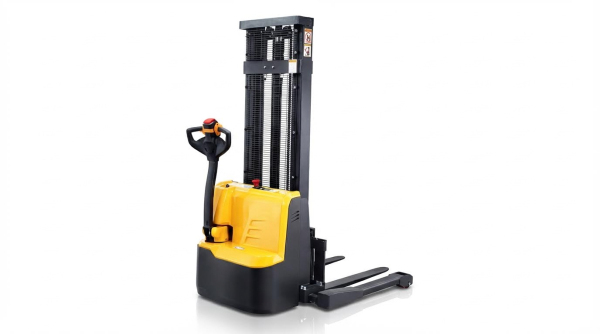
Specifying the right walkie stacker starts by working backwards from your rack heights, aisle widths, and load weights, then checking what mast and chassis can safely reach those levels without breaching stability limits.
Matching rack heights, aisles, and mast selection
To match walkie stackers to your facility, you must align rack beam levels and aisle widths with mast type, maximum lift height, and capacity derating at those heights.
When you ask how high can a walkie stacker lift, the practical answer is “as high as your rack design and stability margins allow,” not just the brochure maximum. Typical models cover roughly 3,000–5,400 mm, with some pedestrian reach and specialized units extending up to about 6,000–8,000 mm for high-bay work at the cost of tighter stability control and stricter capacity derating. Your job is to map those heights to your actual pallet positions and aisle geometry.
| Design Parameter | Typical Range / Option | What To Measure On Site | Operational Impact |
|---|---|---|---|
| Rack top beam height | 2,000–6,000 mm in most small/medium warehouses | Distance from floor to top storage level | Defines minimum required mast fork height with safety margin. |
| Required clear lift height | Rack height + 150–300 mm working clearance | Highest pallet placement plus handling clearance | Prevents impacts with beams when placing/removing pallets. |
| Mast type | Simplex, duplex, triplex | Door heights, mezzanine and sprinkler clearances | Balances lift height versus collapsed mast height. |
| Max lift height capability | 3,000–5,400 mm typical, up to 7,000–8,000 mm specialized with stability checks | Compare to clear lift height requirement | Determines whether all rack levels are realistically serviceable. |
| Rated capacity at ground | 900–2,000 kg typical for walkie stackers | Maximum pallet mass including packaging | Ensures truck can lift your heaviest pallets at low level. |
| Capacity derating at height | Often 50–70% of base rating near max height depending on mast and load center | Check nameplate and load chart at target height | Prevents under‑specifying when heavy loads must go to upper beams. |
| Aisle width | Typically 2,000–2,800 mm for walkie stackers | Clear distance between rack faces or obstructions | Limits chassis length and turning radius you can accept. |
| Gradeability | Around 10% for many models with load | Maximum slope on ramps or dock plates | Determines if the unit can safely move loads between levels. |
Choosing the mast is a geometry problem. Simplex masts give strong rigidity but low reach, ideal where rack heights stay below roughly 3,000–3,500 mm and headroom is generous. Duplex masts reach medium heights up to about 4,000–6,000 mm while keeping overall lowered height acceptable for low ceilings and doors thanks to limited free lift. Triplex masts unlock high-bay storage above 6,000 mm while still passing through standard door heights, but they add sections, chains, and rollers that demand tighter maintenance and more skilled operation.
- Simplex mast: One section, low lift – Best where you only feed docks or low racks and want maximum rigidity.
- Duplex mast: Two sections, moderate free lift – Good for mixed dock and standard racking up to about 4,000–6,000 mm.
- Triplex mast: Three sections, high free lift – Suited to high-bay storage where you must still clear 2,000–2,300 mm doors.
- High‑reach/specialized: Up to 7,000–8,000 mm – Only when your rack design, floors, and training support high‑elevation work.
How to survey your warehouse before specifying a mast
Walk every aisle and note: maximum rack beam height, lowest doorway or sprinkler main, tightest aisle width, steepest ramp, and typical pallet size and mass. Photograph problem spots like low beams or uneven floors. This data drives the mast and chassis choice more accurately than catalogue browsing.
💡 Field Engineer’s Note: For any rack levels above 4,000 mm, I always insist on seeing the manufacturer’s capacity chart at that exact height and your real pallet load, not just the nameplate rating. This is where many facilities discover that “on paper” capacity disappears once the mast is fully extended and the load center creeps beyond 600 mm.
Safety, standards, and operator training requirements
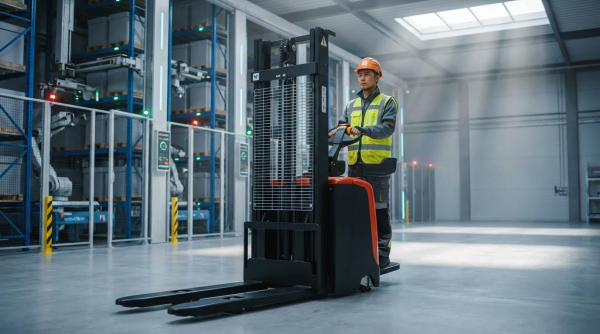
Safe use of high‑lifting walkie stackers depends on compliance with standards, clear site rules, and operators trained specifically on stability, derating, and high‑level load handling.
Modern walkie stackers must comply with safety requirements such as ISO 3691‑5, which covers verified stability with rated load at maximum lift height, guarding of moving parts, and reliable braking behavior on slopes and during power loss above 1,000 mm lift. But standards only set the baseline. Your site rules and training must reflect how high can a walkie stacker lift in your building, with your loads and floor conditions.
- Pre‑shift inspections: Daily documented checks for leaks, structural damage, tire condition, controls, and braking response – Catches defects before a high‑level incident occurs.
- Capacity and load center training: Teach operators to read the data plate and understand that capacity drops at height and with longer load centers – Prevents overloads on upper rack levels.
- Travel rules: Keep forks around 300–400 mm above floor during travel and slow at intersections – Reduces tip‑over and impact risk in shared aisles.
- Slope limits: Restrict loaded travel to approved ramps, typically below about 7°–10% grade depending on truck rating – Maintains the stability triangle within safe margins.
- Speed management: Set site‑specific speed limits by area and traffic mix – Aligns kinetic energy with available stopping distance and visibility.
- Load handling technique: Full fork insertion, even fork height, no tight turns with elevated loads – Reduces torsion on the mast and sudden shifts in center of gravity.
- Battery and charging safety: Match charger to battery, avoid deep discharge, and ventilate charging zones to control hydrogen buildup – Prevents fires and extends equipment life.
- Preventive maintenance: Tiered schedules from daily checks to six‑monthly strip‑downs – Keeps chains, rollers, and brakes within spec as lift heights increase.
Key topics for a high‑lift walkie stacker training module
Include: stability triangle and combined center of gravity; reading capacity plates and derating charts; differences between simplex/duplex/triplex masts; correct behavior on slopes; emergency lowering procedures; and what to do when the truck behaves abnormally (unusual noises, slow response, uneven lifting).
💡 Field Engineer’s Note: Any time a facility pushes walkie stackers above about 4,000–4,500 mm, I recommend treating them like “light reach trucks” from a training standpoint. That means formal practical assessments on high‑bay work, strict rules against turning with raised loads, and supervisor sign‑off before operators work the top beam levels.
Final Thoughts On Walkie Stacker Lift Heights
Walkie stacker lift height is never just a brochure number. Real limits come from mast geometry, capacity derating, and the stability triangle acting together. As height increases, the load’s lever arm grows, mast deflection rises, and the combined center of gravity walks toward the edge of the support base. That is why capacity at 5,000 mm can fall to half of the nameplate value at floor level.
Engineering teams must treat mast choice as a geometry and stability problem, not a catalog exercise. Match simplex, duplex, or triplex masts to rack heights, door heads, and clearances. Then confirm that capacity charts still cover your heaviest pallets at the top beam, at the real load center, with any attachments fitted. Battery mass, wheelbase, and outrigger width must support those heights without creating a nervous, over‑tall truck.
The safest practice is simple: design around the stability triangle, not the marketing maximum. Keep loads low while traveling, avoid slopes and tight turns with raised forks, and train operators on derating and data plates. When in doubt, ask Atomoving for capacity-at-height data for your exact layout. That approach delivers high storage density without trading away safety.
Frequently Asked Questions
How high can a walkie stacker lift?
A walkie stacker can typically lift loads to heights of up to 6,100 mm (approximately 6 meters). This makes it ideal for storing loads at elevated levels in warehouses. Crown Walkie Stacker Info.
What is the lifting capacity of a walkie stacker?
The lifting capacity of a walkie stacker generally ranges from 1,500 kg to 2,500 kg, depending on the model and manufacturer. These stackers are versatile for various warehouse tasks. United Equipment Specs.